Triangular Tourname*
pp. 154-155 · Read in the full issue
Sports Review
Big Time Regatta
On The Sepik
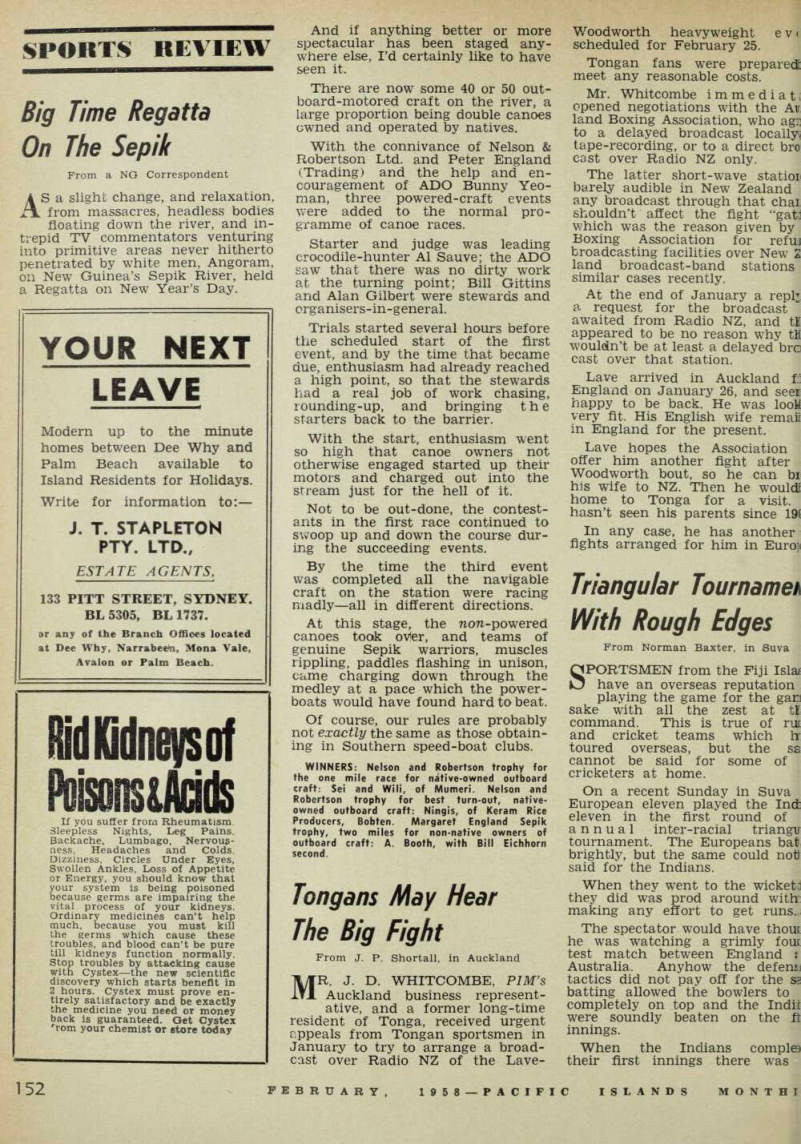
From a NG Correspondent A S a slight change, and relaxation, A from massacres, headless bodies floating down the river, and in trepid TV commentators venturing into primitive areas never hitherto penetrated by white men, Angoram, on New Guinea’s Sepik River, held a Regatta on New Year’s Day.
And if anything better or more spectacular has been staged any where else, I’d certainly like to have seen it.
There are now some 40 or 50 out board-motored craft on the river, a large proportion being double canoes owned and operated by natives.
With the connivance of Nelson & Robertson Ltd. and Peter England (Trading) and the help and en couragement of ADO Bunny Yeo man, three powered-craft events were added to the normal pro gramme of canoe races.
Starter and judge was leading crocodile-hunter A 1 Sauve; the ADO saw that there was no dirty work at the turning point; Bill Gittins and Alan Gilbert were stewards and crganisers-in-general.
Trials started several hours before the scheduled start of the first event, and by the time that became due, enthusiasm had already reached a high point, so that the stewards had a real job of work chasing, rounding-up, and bringing the starters back to the barrier.
With the start, enthusiasm went so high that canoe owners not otherwise engaged started up their motors and charged out into the stream just for the hell of it.
Not to be out-done, the contest ants in the first race continued to swoop up and down the course dur ing the succeeding events.
By the time the third event was completed all the navigable craft on the station were racing madly—all in different directions.
At this stage, the ncm-powered canoes took ovter, and teams of genuine Sepik warriors, muscles rippling, paddles flashing in unison, came charging down through the medley at a pace which the power boats would have found hard to beat.
Of course, our rules are probably not exactly the same as those obtain ing in Southern speed-boat clubs.
WINNERS; Nelson and Robertson trophy for the one mile race for native-owned outboard craft: Sei and Wili, of Mumeri. Nelson and Robertson trophy for best turn-out, native owned outboard craft; Ningis, of Keram Rice Producers, Bobten. Margaret England Sepik trophy, two miles for non-native owners of outboard craft: A. Booth, with Bill Eichhorn second.
Tongans May Hear
The Big Fight
From J. P. Shortall, in Auckland Mr. j. d. whitcombe, pim’s Auckland business represent ative, and a former long-time resident of Tonga, received urgent appeals from Tongan sportsmen in January to try to arrange a broad cast over Radio NZ of the Lave-
Woodworth heavyweight ev i scheduled for February 25.
Tongan fans were prepared!: meet any reasonable costs.
Mr. Whitcombe immediat; opened negotiations with the Av land Boxing Association, who agi; to a delayed broadcast tape-recording, or to a direct bro cast over Radio NZ only.
The latter short-wave station barely audible in New Zealand any broadcast through that chai shouldn’t affect the fight “gatj which was the reason given by Boxing Association for refuj broadcasting facilities over New 2 land broadcast-band stations similar cases recently.
At the end of January a replj a request for the broadcast awaited from Radio NZ, and tE appeared to be no reason why tH wouldn’t be at least a delayed bro cast over that station.
Lave arrived in Auckland f:; England on January 26, and seer happy to be back. He was looM very fit. His English wife remaii in England for the present.
Lave hopes the Association offer him another fight after Woodworth bout, so he can bi his wife to NZ. Then he wouldt home to Tonga for a visit, hasn’t seen his parents since 19( In any case, he has another fights arranged for him in Euroj<
Triangular Tourname*
With Rough Edges
From Norman Baxter, in Suva Sportsmen from the Fiji isia* have an overseas reputation playing the game for the gan sake with all the zest at tl command. This is true of rut and cricket teams which hr toured overseas, but the ss cannot be said for some of cricketers at home.
On a recent Sunday in Suva European eleven played the Ind: eleven in the first round of annual inter-racial triangv tournament. The Europeans bat brightly, but the same could noti said for the Indians.
When they went to the wicketd they did was prod around withr making any effort to get runs...
The spectator would have thorn he was watching a grimly fout test match between England f Australia. Anyhow the defend tactics did not pay off for the sa batting allowed the bowlers to completely on top and the Indii were soundly beaten on the ft innings.
When the Indians comply their first innings there was
bility of an outright win to r side. The Europeans batted leartedly and were dismissed ick time. The Indians’ batting e second innings was a little ter, and it should have been, le Europeans did not use any nised bowlers even the tkeeper wheeled up a couple Brs. rt is not always bright in the ind easy South Seas.
kalian Team for
' Caledonia?
By Peter Hall OTIATIONS are under way r an Australian soccer team play a series of matches in Caledonia in July-August, stary of the NSW Soccer ill Association, Mr. W. Orr, e this in Sydney in February.
Orr said that an invitation tended by the New Caledonian ition and if all goes well an lian eleven, comprising about players, will take up the ige.
Caledonia could expect tch soccer from the Aussies tour by Stanley Matthews e English Blackpool side (to i Sydney on May 3) will have id them with some excellent practise. would be the third Australian tour of New Caledonia.
r an Offer to Fiji
Tonga Rugby Union Football ociation has invited the ?by Unions of Fiji and to send teams to Tonga in or a three-way tournament, cepted, the contest would be al of the contests that used held regularly between the before the war.
u Has a Nibble,
Nothing Hooked
: DAWAI, Fijian rugby foot captain, had a nibble in desire to play the professional igby league, in Sydney this But he failed to land the hampion club in Sydney, St. which can field up to nine tionals, showed more than a interest, for it realised that acular Fijian would give a > gate money. tunately the club did not on a number of difficulties way, chief of which would >een opposition by high lorn in Fiji. Had it been suc in signing the Fijian up the uld have had to pay passages
to Sydney for Orisi and his wife, and would have had to find him accommodation and a position.
Orisi could have cleared up to £2,000 for three seasons' rugby league in Sydney, for the St. George Club has been paying handsome bonuses in the last two seasons—it won the first grade championship in 1956 and 1957.
There is still a possibility that some other Sydney Club will show an interest.
Meantime, it looks as though Orisi will be playing the amateur code in Suva this season. * * * SOCCER is drawing bigger and noisier crowds in Netherlands New Guinea.
The Papuans play in bare feet and the spectators rival any South American fans in their enthusiasm.
Villagers often go on 'a one or two days walk to attend a soccer match and pay a 1/- admission, a recent idea, designed to show the natives that they must pay money for what they want.