Pacific Shipping And Cruising Yachts
pp. 103-113 · Read in the full issue
The question of registration of United Nations Trust Territory-based merchant ships is shortly to be discussed by a UN committee. There are some complex legal aspects to the problem, which involve insurance and various international
shipping regulations.
The matter received some publicity Australia a year or so ago when e New Guinea Trust Territory irchasers of the former Melanesian ission ship Southern Cross (since named Kilinailau ) were unable to gister her as a trading vessel. She is formerly registered in London a yacht.
She eventually sailed from Sydney r New Guinea minus the protec m of any flag, and theoretically uld have been seized on the high as with no protection available, i doubt she is now registered under ne flag as she goes about her busi ss in the New Britain-Bougain le area. Her particular case was mplicated by several factors, but e question of registration in the ust Territory arose. It may be that, future, vessels based in Trust rritory waters will fly the pale le United Nations flag with laurel ives enclosing a globe map.
R That Secret Destination
Fhat “secret destination some iere in the Pacific”—Christmas and to you—was in the news ain in mid-January. “The atmos ere was tense” at Port Adelaide, wording to a news agency despatch >m that port, when the 4,255-ton ixivell Brander loaded heavy uipment, including two 30-ton )bile cranes under a guard of ;curity men” —next stop Suva. The ;ter item seems to have slipped rough the censorship.
Someone, doubtless wearing a false mstache, also managed to get one the crew to admit that the ssel’s cargo “certainly could be” nnected with nuclear explosions, istoms officials were busy prevent >• photographers from operating ;m a wharf opposite the ship’s rth. Suva will have viewed the rstery ship well before this appears print.
Anging Colours
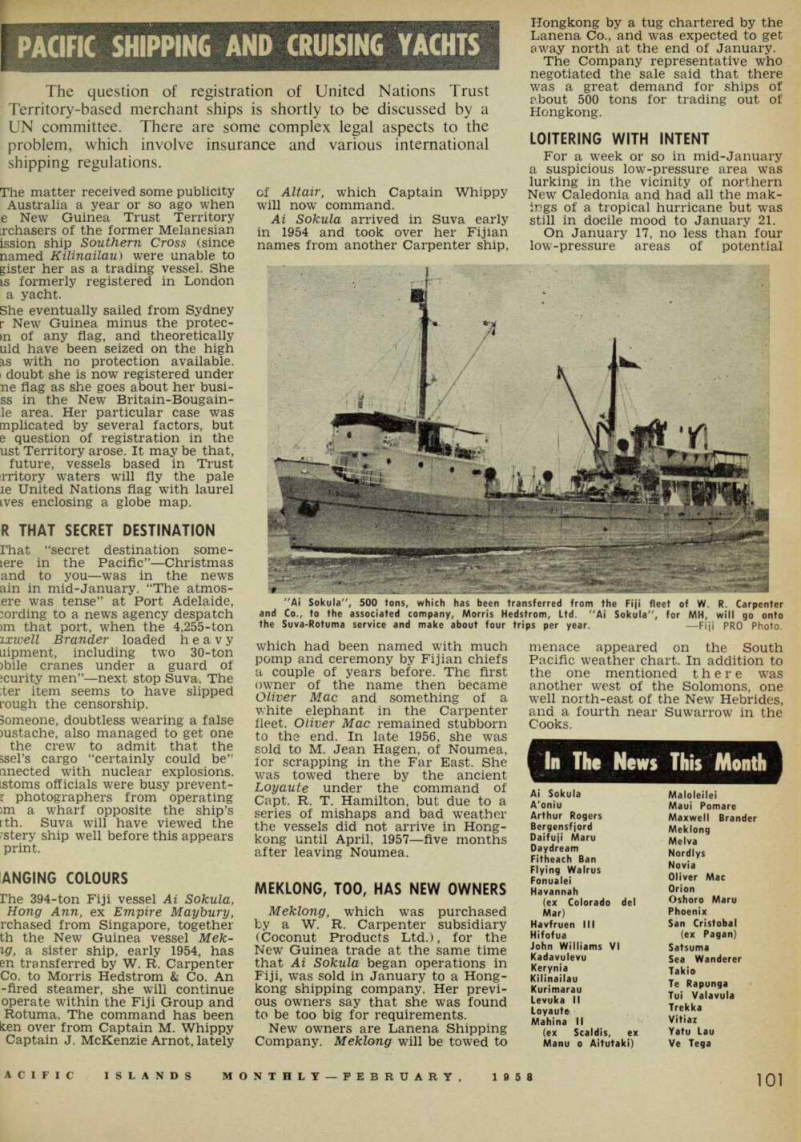
rhe 394-ton Fiji vessel Ai Sokula, Hong Ann, ex Empire Mayhury, rchased from Singapore, together th the New Guinea vessel Mek ig, a sister ship, early 1954, has en transferred by W. R. Carpenter Co. to Morris Hedstrom & Co. An -fired steamer, she will continue operate within the Fiji Group and Rotuma. The command has been ken over from Captain M. Whippy Captain J. McKenzie Arnot, lately
of Altair, which Captain Whippy will now command.
Ai Sokula arrived in Suva early in 1954 and took over her Fijian names from another Carpenter ship,
which had been named with much pomp and ceremony by Fijian chiefs a couple of years before. The first owner of the name then became Oliver Mac and something of a white elephant in the Carpenter fleet. Oliver Mac remained stubborn to the end. In late 1956, she was sold to M. Jean Hagen, of Noumea, for scrapping in the Far East. She was towed there by the ancient Loyaute under the command of Capt. R. T. Hamilton, but due to a series of mishaps and bad weather the vessels did not arrive in Hong kong until April, 1957 —five months after leaving Noumea.
Meklong, Too, Has New Owners
Meklong, which was purchased by a W. R. Carpenter subsidiary (Coconut Products Ltd.), for the New Guinea trade at the same time that Ai Sokula began operations in Fiji, was sold in January to a Hong kong shipping company. Her previ ous owners say that she was found to be too big for requirements.
New owners are Lanena Shipping Company. Meklong will be towed to
Hongkong by a tug chartered by the Lanena Co., and was expected to get away north at the end of January.
The Company representative who negotiated the sale said that there was a great demand for ships of about 500 tons for trading out of Hongkong.
Loitering With Intent
For a week or so in mid-January a suspicious low-pressure area was lurking in the vicinity of northern New Caledonia and had all the mak ings of a tropical hurricane but was still in docile mood to January 21.
On January 17, no less than four low-pressure areas of potential
menace appeared on the South Pacific weather chart. In addition to the one mentioned there was another west of the Solomons, one well north-east of the New Hebrides, and a fourth near Suwarrow in the Cooks.
"Ai Sokula", 500 tons, which has been transferred from the Fiji fleet of W. R. Carpenter and Co., to the associated company, Morris Hedstrom, Ltd. "Ai Sokula", for MH, will go onto the Suva-Rotuma service and make about four trips per year.—Fiji PRO Photo.
In Suva, Captain Matheson, of u,rimarau reported that his ship d received a heavy buffeting in e vicinity of Niuafo’ou Island in e December tropical storm which Dssed north of Fiji, missing that ■oup. Not much was heard of that >rm, which missed the major land isses as it whirled down between ji and Tonga.
Ike Your Pick
Last month we demonstrated how single letter dropped from the me of a Japanese ship can make the difference to her identifica n in a shipping register.
We also noted that while Rabaul s satisfied last July that the issian survey ship visiting that rt was Vityaz, which agreed with d spelling in British scientific irnals describing her work, Suva s convinced that her name was tiaz when she called there in De nber.
Arriving in Wellington in January ; papers there were prepared to tie at first for Vitiaz. Up to here had been unable to trace any :ails of this interesting vessel in >yds Register. Then a Wellington ming paper’s shipping column issomed forth with Witjaz —and ire, surely enough, under the r ’s” in Lloyds was a Witjaz, but it entry does not seem to fit, as i listed vessel is only 2,975 tons >ss.
U this stage it was time to check ;h the Soviet Legation at Well ;ton while the ship was in port, tne days later came a reply: The ter had been handed to Professor gorov—of the vessel Vitjaz —who uld no doubt reply from Vladivo ck (after clearing the matter with ►scow perhaps) so vich is which leave to you. All we can say is it she takes her name from a .v a 1 corvette commanded by miral Stephen Makaroff, which s said to have made the first ianographic survey of the North cific. {See p. 109 for final word).
Captain Igor Sergeev said at illington that on leaving Vladivo ck last November 5 the vessel had ided east to longitude 174 west, i had followed that meridian ith, except for the diversion to va. On leaving Wellington the isel was to return home along igitude 172 east, and so might be ected to pop in to Tarawa per ps, as she worked her way north m station to station on her entitle work.
Ming Ashore
Captain Francis Bottoms, MBE, ster mariner, and at the same ie holder of a commission as ght-Lieutenant in the RAF, who 3 been in command of the LMS '-ton John Williams VI, well own in Island waters, is reported have accepted a shore position
with a Suva shipping firm. Some details of his interesting career appeared in PIM of September, 1956. Ten of his 30 years as a master mariner were spent in the RAF’s air-sea rescue service in command of rescue vessels.
Still In Trouble
The motor fishing vessel Pagan, brought out from England via Tahiti a year ago, adrift at sea in the Kermadecs region for several weeks en route, sold, refurbished — and promptly damaged by fire —was again in trouble in January. Re named San Cristobal when sold, she sank at her berth at Onehunga wharf, near Auckland, on New
Year’s Day. Someone had left some thing open.
Plumbing The Depths
Included in the several Japanese oceanographic vessels now making an IGY survey of waters south to New Guinea is the recently launched 900-ton Takio, and the 1,000-ton Satuma, which took part in Opera tion Equapac last year. Government owned vessels, they, like warships, do not carry the “Maru” suffix.
The Catch Was Good
Whether or not the very dead whale sighted by Maui Pomare, as mentioned last month, was some thing the Japanese whalers had
?laid, it does not appear to have seted their record tally of sperms. ?he target of the six Japanese aling fleets which went south in member was 1,710 sperm whales — sperm season precedes the season baleen or toothless whales which ;ned early January. From Tokio s reported that the actual catch riled 2,190 sperm.
\Al For Norge!
liggest maritime event of the r for the open-roadstead port of irua, Rarotonga, was to be the ■too-brief visit of the big new •wegian cruise-1 in e r Bergen rrd on February 3 with a full ster of dollar tourists. Operation lenback, the removal of as many these dollars as possible, in most isant possible manner and in the ited time available, was the sub ; of active planning on the island January. he hula skirt, necklace, and curio sers were straining all efforts to ;t the hoped-for rush of business, put the customers in the right ne of mind a party of island Stainers was to board the ship i music and eis (Cook Islands sion of leis) when the pride of 3 Norwegian merchant fleet pped anchor at 7 a.m. To the :hing tunes of the South Seas clients were to be shepherded ore to the souvenir stands in Union Co. sheds, rom there the tourists would re out to cars and trucks—Raro ?a has only one taxi and some es none—and split into three ips for entertainment in outer iges. Sailing time, 6 p.m. All ild depend on the weather — ch could hardly be less predict ! than in the middle of the hurri e season, which now appears to 'ast developing into the favourite s for cruise-ships to head for the nds.
Icy Mission
'aui Pomare, southbound from
Rarotonga and Apia in January, wa s diverted to Raoul Island, Kermadecs early January to a sick Tongan member of the ten-man staff at this weather station — Sekona Vi. With him also came a member of the island’s catering staff, a Mr. Van Sales. A boat was launched from the “Pom Pom” to pick up the evacuees.
A similar call was made by the ship about a year ago. Due to a glut of bananas at Western Samoa, Maui Pomare was again to call at Apia on the home run from the Cooks in late January, when a call was also scheduled for Niue. She would then have her annual refit.
According to a well-tuned coconut radio signal, Maui Pomare No. 2 is still in the “planning” stage—and new, with a new Government and Minister of Island Territories, and a general tightening of the New Zealand belt, it will be surprising if the new vessel is actually ordered until well into 1958. The Minister is to visit the Cooks, probably in April.
Explosion Victim Progressing
Mr. Bob Grant, of Boston, USA, who survived fire, explosion and sinking of his trading vessel Ve Testa, in the New Hebrides in De cember, came to Auckland as a stretcher case in a TAI aircraft early January and is now making excellent progress there in Middle more hospital, where he is under going skin grafts. He will probably be in hospital until May.
During the flight, Mr. Grant was in care of Mrs. Diana Hepworth, of the yacht-cum-trader Arthur Rogers, who came south on a business and holiday visit. There was a possibility that husband, Tom might bring the Brixham trawler south again soon.
The Payoff
Still purring pleasantly over the satisfactory sale of his vessel Melva, Skipper Hugh Williams returned to his Rarotonga banana farm in Janu
After the
Hurricane
This is how the "Yatu Lau", hurricane battered, looked from a RNZAF flying-boat that was preparing to drop much - needed lubricating oil to the vessel, after the Fiji hurricane. See story on page 106. —Official RNZAF photo.
ary, swearing that he would touch no more ships, but might soon award himself a pleasure jaunt to Japan, or maybe England, while engineer Livingstone is left behind putting the bends in the bananas for a while.
Hurricane Horrors
Fijis inter-island shipping took a battering in the hurricane which swept past the eastern tips of Vanua Levu and Taveuni and on through the Lau Group on Janu ary 7.
Fortunately, the hurricane warn ing system in Fiji has reached a state of efficiency where the effects of a big “blow” are minimised, board afterdeck stove in.
The first indication that there might be a hurricane came late on January 5. The small ships in the ereas likely to be affected scuttled for the nearest safe anchorages, while those in Suva went to anchor ages at the nearby Bay of Islands.
For several days after the hurri cane a number of ships were re ported missing. Two of them, the Yatu Lau (84 tons) and the Kada vulevu, are operated by Hurley’s Shipping Agency. The Yatu Lau re ported by radio on January 7 that she was in the middle of the hurri cane and that both her anchors had carried away.
Then there was silence for about 24 hours, when a brief message was
picked up in Suva. At the time lost her anchors, Yatu Lau actually anchored at Vua q s Island. She then drifted out to RNZAF Sunderland flying-b« returning from Auckland on Janu 8 (they had taken off hurrit from Laucala Bay on January when the hurricane threaten searched for Yatu Lau without s cess. The master, Anare Vuibur said later that he had seen Sunderlands, and had made vis signals without attracting their tention.
On January 9, the RNZAF ] three Sunderlands looking for Yatu Lau, and the Orion, steam to Nukualofa from Suva, was g
asked to keep a look-out. The f!
Sunderland out found the Lau about 30 miles from Va Island, and stayed with it until eai afternoon, when another Sunderla took over.
The second Sunderland “home the Orion to the Yatu Lau, a stayed in the area until about p.m. It made contact with the Yc Lau after dropping a plastic cc tainer of instructions. At the it the Yatu Lau was completely c of control, so this container v dropped along the line of drift, obeying the signal instructions, t Yatu Lau was able to convey to t Sunderland that it was out lubricating oil, and that there w ample food and water on board.
The third Sunderland set out w: 23 gallons of oil to be dropped parachute. On the way out it spe five minutes flying round Matui Island looking for the Kadavulei When the third Sunderland arriv. it found the Orion standing by wi a rowing boat down.
The Sunderland dropped the in two containers by parachu; These were picked up by the rowii boat from the Orion and taken the Yatu Lau. The Orion also ga the Yatu Lau some oil. She w then able to limp back to Su; under her own power.
In addition to losing her ancha the Yatu Lau lost two rowing bog and a dinghy. Her main steerii was smashed and she had to ste with auxiliary equipment. F davits were smashed and the sta
"Meklong", formerly of the WRC New Gui fleet, which has been sold to the Far E (See story page 101).
rhe passengers on the Orion, lich was on a cruise from Sydney, d a grandstand view of the *ZAF in action on a mission of jrcy. rhe next day the Kadavulevu (23 is) was reported to be sheltering a bay on the east coast of Moala and. A J Dther small ships reported miss r were the Tui Valavala, owned ’Mr. George Houng Lee, of Suva; vuka 11, a Fijian fishing boat »m Levuka; and Maloleilei, a irns Philp cutter.
Fhe “blow” over, these busy little Lps returned to their trading ssions throughout the Fiji Group.
B On Coast
Savannah ex Colorado del Mar, lich was sold by the Savoie in vests to Societe Transports Mari le Caledonien a couple of years d, for inter-island work in New ledonia, has been sold again. She 11 go to work on the Queensland ist.
" Marks The Spot
rhe Japan Fishery Research In tute is shortly publishing an ,borate tuna-fishing chart of the cific and Indian Oceans for the idance of Japanese tuna fisher m. The result of 30 years of study d research by the Nankai Fishery search Institute into the best isonal tuna fishing areas, it mhses to be an interesting docu nt.
Transport Astronomers
party of Japanese astronomers, aded by the director of the Tokio ;ronomical observatory, is to be .nsported to Pukapuka or Nassau, rthern Cooks, to observe a total ipse of the sun next October—an Y effort. The vessel to be used by » Japanese team is the 620-ton aery research vessel Oshoro Maru, ned by the Fishery Department Hokkaido University. This is parently a new vessel as no de ls appear in Lloyds Register of •7. She is probably similar to the eamlined, well-equipped fishery ining vessel Daifuji Maru, 472 is, which called at Suva in Sep nber, 1954—first post-war Jap- Bse vessel to call at that port.
Ess Button Weather Station
Dne of the Chesterfield islets, ighly midway between Noumea d Townsville, may get an auto ,tic weather reporting station. A rty from a French naval Pacific ition vessel recently called at the inhabited French islet to investi te re-establishing a station there.
During the war, the US Navy in lled an automatic weather tion there on Long Island, and operated successfully for about o years, a flying-boat from
Noumea paying a visit about every four months to refill the petrol tank and oil the machinery.
That station was almost uncanny in its operation, and any new one, with further refinements, will be very similar no doubt.
Power was supplied by a petrol motor-generator which was started up at predetermined times by a battery-powered pendulum clock, which activated the motor selfstarter from a 12-volt accumulator battery supply.
The motor-generator charged the battery. Weather transmissions were made four times per day. The generator plant and radio transmitter, which operated on two frequencies, were housed in a 6-ft
cube building, together with an auto matic fire-extinguisher to deal with emergencies. On the roof was a standard type of screened “meat safe” housing the instruments — barometer, thermometer, hygrometer, rain gauge, and on top, the wind gauge, The transmitter was activated alternatively by these various in struments it being automatically switched from one to the other in sequence. Listeners in Noumea and elsewhere knew the sequence. All they did was count the succession of morse dashes sent in one minute by each instrument, with the aid of a stop-watch. Then by checking with a graph they were quickly able to interpret this information. The
inciple under which the weather [ormation was converted into lio signals was the same as that iployed in the little radio-sonde msmitters which are sent up reral times each day from a num r of Pacific Island meteorological ttions with the aid of balloons.
Ngan Vessels Later
rhe vessels building in Holland • the Tonga Government are run ig behind schedule, and the first isel, A’oniu, is not now expected
’each Tonga before June. Hifojua be completed about three months ;r. arlier it had been anticipated t both vessels might be ready by ut March and they were to im out in company. Now they i be brought out by European vs under contract separately, as n as each is ready, he new dual purpose towing nch-cum-cargo carrier Fonualei, It in London, shipped to Suva, I brought on under her own /er, reached Nukualofa on De iber 14 and on the same after m there was a welcoming 3mony which terminated in a rt official voyage and picnic at ,ta. .11 four new Tongan vessels are ig powered with Kelvin diesels. j two smaller craft have 88-hp ts. '•:A J omu will have a 500-bhp t would be interesting to know v much these Tongan vessels will illy cost and whether a less ex isive job might have been done Australian or New Zealand ship
builders. Australian shipping ex
perts, making rough calculations,
say that the delivery voyages will cost “thousands.”
Raising Japanese Ships
Japanese salvage workers in
Rabaul, New Guinea, have been raising, on an average, a ship a
month since they began operations
in February, 1957. This is about one third of the sunken Jap ships owned
by Pacific Distributing (New
Guinea), which is employing the
Japanese on the salvage project.
However, some of the ships are in water too deep for easy salvage.
Almost 100 Japanese, including 20 divers, are employed. Divers blast the wrecks into pieces of 80 to 100 tons. Floating cranes then pick up
each piece for taking ashore, where
it is cut by oxy torch into scrap suitable for sending to Japan.
News of Cruising Yachts
• FOR SAFETY'S SAKE: The New Zealand Marine Department is now issuing a form which is to be filled in by all yacht-masters departing overseas or on long coastwise passages from New Zealand ports. The aim of the questionnaire is to have a full record of the yacht, its colour, type, rig, safety equipment including radio equipment, fre quencies available where a transmitter is carried, route and destination, etc. This is for the use of the Search and Rescue organisa tion in the event of trouble, and also to avoid unnecessary search for a vessel be lieved overdue. It is a fact that many yachts men do not leave this information behind them when they sail for distant shores, and the questionnaire seems overdue. • MAHINA II is the latest name under which the steel Dutch-built craft which left Holland some years ago as SCALDIS, is now sailing. En route to the Pacific she was re named SEVEN SEAS by owner Bounmeester who sold her in Rarotonga. Converted to a trading craft she became MANU 0 AITUTAKI.
Now John Harrington has sold her to lan Lowes, until recently of Aitutaki but now stationed at Nadi, Fiji. In January three yachtsmen, Messrs. Beard, Lever, and Auchter lonie, went north from Auckland per MAUI POMARE to bring the yacht south. At the end of the hurricane season she will be delivered to Fiji. Plans were to use the diesel motor a good deal on the run to Auckland. • TE RAPUNGA, reported last month as stranded near Greymouth en route from Hobart to Auckland and the Islands, was refloated by owner George Dibbern on January 7, and is now undergoing repairs at Greymouth. • FITHEACH BAN, 83-ft. schooner yacht which Captain A. Watchlin brought from the Mediterranean to Auckland via Island ports several years ago with an Italian crew, and which he sold last year in Sydney, is now being altered at Picton, NZ, by owner Captain A. Tregida, for use as a crayfishing vessel.
The motor is being shifted forward to make room for galley and deepfreeze chamber aft. • NOVIA and the Greggs have lately been cruising in Coramandel waters near Auckland, together with the Norgroves who cruised Poly nesia a few years ago in WHITE SQUALL. • FLYING WALRUS and the Wells couple were reported still based at Whangarei, NZ, in mid-January. • TREKKA of Canada, still in northern NZ waters, might be fibre-glassed before owner John Guzzwell puts to sea again a little later in the year. • SEA WANDERER and Edward Allcard, heading for the Pacific, were reported at Antigua, West Indies, late December, so the
[?]e attached photo effectively ends the con [?]n regarding the English form of spelling the name of the Russian oceanographic [?]ey vessel which was "Vityaz" in Rabaul "Vitiaz" in Suva. Here, painted on vhe [?]el's bow below the Russian form of her [?]e, is the English form: "Witjaz". Photo [?] he ship was taken in Wellington, NZ.
Photo: J. P. Shortall.
Ft. ketch may appear in Polynesia this ling winter. » HAVFRUEN 111, with Group-Captain T. H. r and Mrs. Carr, reached Auckland January and will stay there for some time. > KERYNIA, 72-ft. x mahogany ketch, Southampton, England, may be brought to ;k Ia n d via Island ports this year or next Athol Rusden, remembered in Polynesia as rr.er owner of NEW GOLDEN HIND, LANTE 11, etc. Mr. Rusden, who earlier
med to leave for England in January, re ‘ed then that he was not going to take very just yet, due to pressure of business, i NORDLYS owned by Walter S. Johnson the US, cruising the Cook Islands in ember, cleared the group from Penrhyn Papeete, where the yacht is currently :d, on December 15. » PHOENIX is on schedule according to a ery note, dated January 14 at Balboa, al Zone, in from Dr. Earle Reynolds. He te to announce that the 50-ft. double er auxiliary ketch is back in the Pacific in. Dr. Reynolds, an American anthro (gist ex-Hiroshima University, with Mrs. nolds and son Ted and daughter Jessica Japanese crew members were in Sydney PHOENIX in March, 1956, being about 20
months out on a circumnavigation planned to last four or five years. They had already come down through the Pacific Islands, and at end of June, 1956, were at Thursday Island.
Their route back to Hiroshima was via East Indies, South Africa, Panama and Honolulu.
They promised to be back in the Pacific early 1958—a promise they have kept. Planned route to Hiroshima now is via Galapagos, Marquesas, Hawaii Group and points west.
• Auckland-Suva Yacht Race: The Royal
Akarana Yacht Club of Auckland, sponsors of the Auckland-Suva Yacht Race—intended to be a biennial event—announced late January that the 1958 race might have to be cancelled by default. The race is scheduled to start from Auckland on May 3, but when entries officially s'?.TX E 4 , M M 6 wh ; c . h en,“^ as i.: i.sa i:r^ s p s !i^rSes b "LrLffi starters. Two other yachts were rejected on the score of being less than the acceptable
minimum of 24-ft. waterline length. Other 1956 starters are willing, but the cost of equipping, and time lost from work, are the factors entering their considerations of the event.
The Club is likely to accept entries a good deal later than the official closing date, if the boats concerned seem certain entries. • WAYWARD, 20-year-old yacht of Whan garei, NZ, will sail this autumn for Noumea, Suva, Apia, Rarotonga, Papeete, and South America. With owner Geoffrey Rawson on the first stage of the voyage will be Frank Perry.
Rawson purchased the yacht for £5OO and is fitting her out for the voyage. Dimensions unknown. • LANDFALL II in which Dr. and Mrs. Hol comb of the US cruised the Pacific in 1954, completing its world circumnavigation, passed through Panama Canal several months ago and is again in Pacific waters. • TAKI-O-AUTAHI and MAHINA II (see else where) were both expected to clear Rarotonga for Auckland about January 24.