Real Cannibal
pp. 90-101 · Read in the full issue


The Month's New Reading
With Judy Tudor
One of the most interesting small books to come this way in a long time is Sources of Australian History, collected and edited by Professor M. Clark of the department of history at the Canberra University College.
rHE period covered is from the earliest discovery up until about vie First World War; but what nakes this book different is that 3 rofessor Clark has not written a nstory of the period, but has col ected together reports, documents, lewspaper articles and even current 'erses and songs of the appropriate jeriods, and let these accounts carry he story.
The collecting and editing has >een so skilfully done that it makes , smooth chronological narrative, without that curse of most modern histories”—the conscious or un onscious “slanting” by the person /ho is doing the writing.
We therefore proceed through ex racts of Tasman’s, Dampier’s and book’s journals, to eye-witness ccounts of the landing at Port ackson and the establishment of he convict settlement; to relevant louse of Commons papers on the onvict system, free settlement and ther matters.
There is the indictment of Mac uarie and his idea of democracy by lac Arthur; and Macquarie’s de snee of his administration to Earl lathurst, the then Secretary of itate for the Colonies.
Extracts from newspapers of the ay, and other, official, reports cover tie establishment of other States, ae gold-rush period, including the ureka Stockade; the years preced ig Federation and the years after, ;ading up to the First War.
These latter were the years of wilder social consciousness. In June, jO7, the Sydney Morning Herald r as editorialising at great length bout the “Drift to the Cities”, he Melbourne Argus, in January, ? 11, editorially approved “moving ictures” in spite of the “banality nd frequently the vulgarity of )mic films”; and in the same year ithused over the amazing progress ie Motor-Car had made since the idustry began 10 or 12 years previ ■isly.
But in May, 1914, the Argus re nted at length a condemnation ade by the State Presbyterian ssembly committee on public orals. It was headed, “Dance and ress Fashions—Tendency to Run iot and a Sign of Moral Laxity”, The report left no doubt that, in resbytenan eyes, our grandmothers id grandfathers were standing on
the brink of hell with their “new and eccentric forms of dancing” and their “extremes of indecorous and uncomely fashions”.
Professor Clark’s book is a must for every student of early Australia, and will be of considerable interest to the general reader as well.
The volume is in the World Classics Series, has over 600 pages and is, of course, well indexed. (Published by Oxford University Press. Aus tralian price, 12/9.)
Real Cannibal
Stuff
ROSS SALMON is an old Harrow boy with a fine war record, who went off to South America a few years ago to look for a bit of extra adventure. To learn whether he got it, the reading public need look no further than the first para graph of his book, Forbidden Jungle, v/hich begins: “Two arrows forming a cross were stuck in the trail ahead of me. This was a declaration of war. A declara tion by the hostile Motilon Indians,
a primitive, almost unknown tribes living in the mountainous jungle land on the borders of ColombiaE and Venezeula. A land of mystery* and legend which still awaits to bs explored by modern man. Now I was in that land; face to face with theses cannibal Indians after sixty days ofi frustration and hardship shared by* Eric Keen my sole companion.”
Well, we can report that the old Harrow boy, despite the impen etrable jungle, raging fevers, crouch ing jaguars and those canniball Indians, finally got out of it all right! —although it is still beyond us why* he ever got into it, unless it was toe write this book.
According to the dust jacket, hee is now back in England running thee “Lazy S”, the country’s first ranch..
No doubt the South American! authorities are hoping he stays there.. (Published by Hodder and Stoughton. Aus tralian price 26/-,)
More Customers for
the Nut-House
WE don’t know what Carl Jonas; tries to set out to prove in his; latest novel, Our Revels Now e Are Ended, but we suspect that it: is that all Americans are poor mixed— up kids. The two leading characters; in this opus have psychiatric treat ment—and a lot more of the char acters appear to be in need of it.
According to the New York Times,, Mr. Jonas must be placed near the; front rank of contemporary Ameri- • can novelists, so we can assume that; Mr. Jones is presenting the Ameri- ■ can scene as he finds it.
It is a sobering thought, however,,
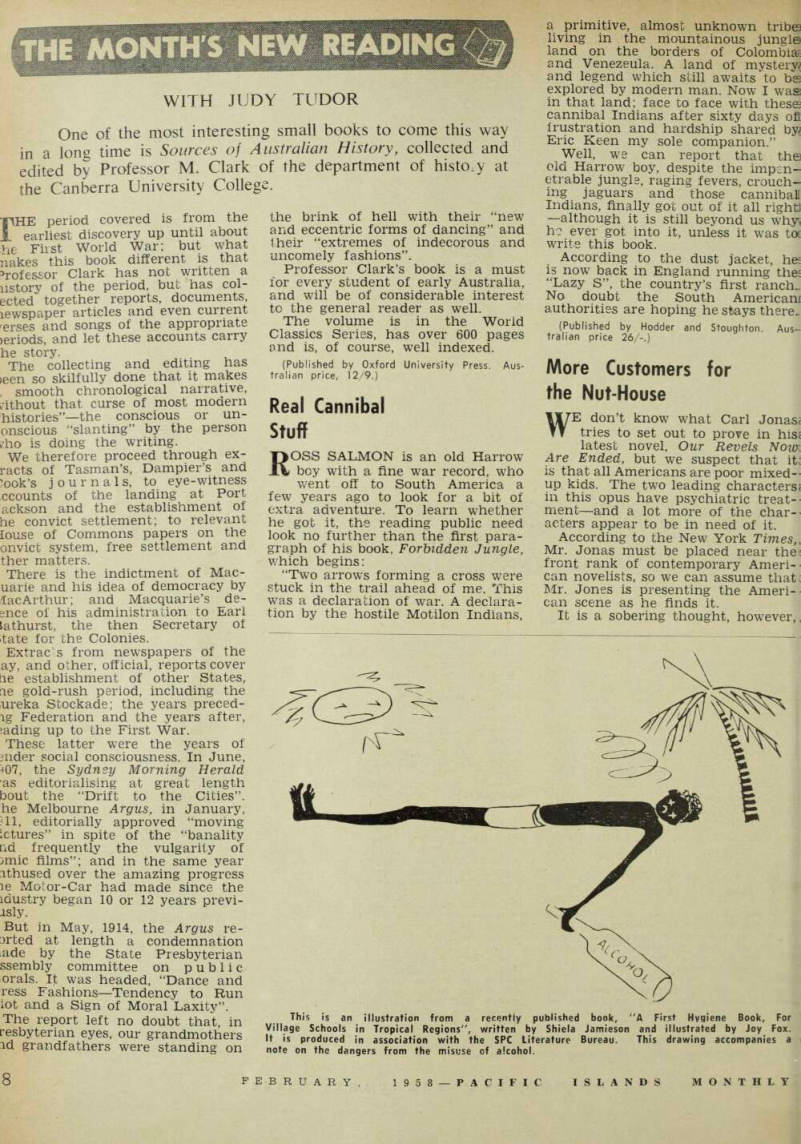
This is an illustration from a recently published book, "A First Hygiene Book, For Village Schools in Tropical Regions", written by Shiela Jamieson and illustrated by Joy Fox.
It is produced in association with the SRC Literature Bureau. This drawing accompanies a note on the dangers from the misuse of alcohol.
J:at what a couple of generations igo would have been treated with i couple of good swift kicks in the 'metaphorial) pants now needs nonths of expensive treatment by i mind-doctor. The trouble with his sort of book is that if you read inough of them you begin to fancy 'ourself as a candidate for the jhychiatrist’s couch yourself. It las yet to be proved that the world las got to be any better since people ave up solving their own emotional iroblems and persuaded society that hey are really just sick and need , doctor.
This story concerns Mildred, an cute case of arrested emotional levelopment; and Wesley, a suc essful young businessman whom be married. Things go Wrong at the ut s e t—or as Wesley puts it, Mildred won’t sleep with me, Ben”.
The rest of the story is taken up allowing Mildred through the [inic she attended to get herself traightened out. We aren’t too sure bout this —but the root of the 'ouble seems to have been that a lort while before their wedding, [ildred propositioned Wesley and Lesley said, “Oh dear no, Mildred, luch as I want you everything has ) be right in our marriage”.
Mildred felt somewhat set down /er this.
This is the sort of book you like » cast off half read, but which you rniehow continue to read with lorbid fascination to the bitter end. ne thing is for sure, if this is a ;al picture of American contem jrary life, Russia has no need of tercontinental missiles. All it needs patience. Given time all Ameri ms will become so involved in their vn frightful emotional problems lat they will all take an overdose : sleeping pills.
Mildred is the sort of character lat makes you long to be a Russian ;mmissar. Cracking rocks on a ans-Siberian express-way would ; just the shot for this dear girl. (Published by Peter Davies. Australian price,
lonsters—And How
o Catch Them
T’S natural for man to go out and kill things. When it is other humans it’s called murder; when is animals or fish, that’s sport.
Some humans have got too civil ed, apparently, and killing things erely bores them, and amongst lese you can count Yours Truly. have no desire to shoot an ephant; or have a stuffed lion’s Bad —trophy of my hunting—on ie living room wall. And when I e a tiger shark cruising in the ;ean, my reaction is to get out of ie ocean and let the shark have it. ve no desire to go out in a little )at, hook it on the end of a line id play it for six hours.
This is by way of explaining that when someone called Athel D’ombrain wrote a book called Game Fishing Off the Australian Coast, pnd his publishers sent it here for review, it was a dead loss. But if you are one of these people who like to go out to sea to wrestle with 600lb fish on the end of a line no thicker than sewing cotton, you can take it that this is a very fine book. t* ♦ -a • , , , , ls ™ of advi f e oa what to do and what to do it with; and stiff with pictures of people standing alongside 10 feet high fish they have caught. There are even pictures of a character called Bob Dyer and his wife, Dolly, and the assorted th6y haVe PU ' led fr ° m the ocean -
It seems pretty clear, however, that game fishing (off the Australian coast) is not likley to be one of the overcrowded sports, because one of the first things that is necessary is a boat; and as one engine is always likel y to g ive U P at a critical moment, il better to have a boat that is fS U I ppe .?> P 1? two^and diesels at engines, says the au T th or, could explode in one’s face).
In Australia, boats equipped with twin-engined diesels come pretty high—so that removes the sport forever from the reach of the poor guy who is struggling along on £2O a week with a wife and two kids to support and a washing-machine and a TV set to pay off.
Ang US and Robertson. Aus tralian price, £2/10/-.) (Over)
Learning About
the S. Pacific
I EVIDENTLY The Great South Sea, j by Roger Pilkington, is mean*to be a text book for youngsters —an introduction to the South Pacific.
Pilkington (according to the jacket flap) was a research scientist at Cambridge but now is more con cerned with writing children’s fiction.
Why he should be called on to KTite a book about the Pacific is tiot quite clear but the result is juite unremarkable, one way or mother; The sort of quasi-text book [or children that anyone could write Torn the distance of London.
Pacific experts on or nearer the ipot might have a couple of bones o pick with Mr. Pilkington, none heless. For example, he favours the ion Tiki theory of Polynesian nigration—that is, that they came fom South America —rather than he older theory that these islands pere populated from SE Asia.
And it is news to learn that iamoa “produces fine hardwood imber for export”. Or that the “gay nd scented” frangipani and hibiscus ,re indigenous to the South Pacific slands. New Guinea has a native übiscus, from which native twine > made, but the cultivated, flowering hrub does not grow wild.
But Mr. Pilkington is half-right: übiscus are gay; and frangipani 3 scented. (Published by Macmillan and Co., Ltd. Aus alian price, 11/-.)
nternal Combustion
SECAUSE his fiancee was killed in a motor accident on their wedding day, Arthur Warman had phobia about motor cars. He was razy in only this one way but con idered that it was his mission in fe to warn people of the peril ngendered by the internal com ustion engine.
John Hereford makes Warman be central figure in his newest cvel, The Man Who Was Angry.
Feeling, as he does, it seems un irtunate that Arthur continues to ve in a town where the youth are edicated to racing cars. While the uthor works out his theme against /arman’s obsession, the reader has ) put up with the half-baked irgon of lower middle-class Eng shmen in pursuit of their pleasures.
Hereford specialises in “quiet luntry people”, and his character ation is, in the main, competent, he trouble is that the class of Eng sh youth he writes about is so in- Tnally unattractive —fags, and beer t the local and a lot of wishful linking about racing cars and orses.
The story, after dragging its feet
a the early stages, quickens towards lie end when the inevitable happens nd a child is killed by a hit-run acing driver.
This is a novel which would have eld together quite well without barman, who is nonetheless, de igned as the pivot around which ie plot revolves. Although the linor players are well cast, Warman ; a badly overdrawn character who ever quite rings true. (Published by Hodder and Stoughton, Ltd, jstralian price 15/6.)
error for Terrorists
JfOST readers will identify James U. Dillon White’s latest novel, Night On the Bare Mountain, ith Cyprus and the Troubles, though the author is more than mally insistent that the characters •e imaginery.
It is a grim story of adventure, ade up of a whole lot of unlikely ctors that become plausable lough at the hands of this com ment writer.
Primarily, it is a story of revenge the revenge of Anderson against ,e Island’s terrorists who had lied his son, an officer in the 'itish Army. Anderson is a New alander, for no particular reason her than it is becoming the habit novelists to cast New Zealanders these roles of derring-do. (For ample, the hero of Maclean’s ins of Navarone).
Anderon had flown the 10,000-odd iles from his sheep farm in NZ the island, ostensibly to see the >t resting place of his son. But len he should have departed he iged a fake drowning and stayed to start a campaign of terror longst the terrorists.
Anderson’s love for his son had ose elements of fanaticism that •uld sooner or later have meant >aster, and the implication is that 3 vendetta was more than usually splaced because Anderson, Jnr., fore his death, was up to no good, rhe story is based largely on inter iy between the feelings of Ander -2 and the girl Ilena, daughter of terrorist, who had loved Anderson, r., and then transfers her affec ms to the father; and Major siding, who is in charge of the :al military unit, whose job it is catch the man who is successfully gaged in counter-terrorism, rhe story is as much Fielding’s Anderson’s. Fielding does not ink much of himself as a soldier: i is much more liable to see things terms of human problems than military exercises. ft is not a story that could have happy ending; but most readers 11 agree that it is a satisfactory e.
Published by Wm. Heinemann. Australian :e, 18/9.)
Fascinating Facts—
By Frank
TiHAT word-m achi n e, Frank Clune, has given birth again.
And when Frank writes he be lieves that everything and everyone should get a mention. Some people have had a suspicion that he is paid lor it; but we think it is just part of his big-heartedness.
The brand of the canned soup he eats; the name of the manufacturer of the vehicle he drives; the airline he flies by, the petrol he uses —all form part of the fascinating story. As well, you get the vital statistics of every hamlet encountered shot at you from his fact-filled cranium.
The result may not guarantee him an ultimate place in Poet’s Corner, but he does produce a literary phenomenon that combines the virtues of a radio commercial, a gazetteer of Australia and a social climber’s Who’s Who.
What set Frank off on his latest rampage is uranium (The Fortune Hunters). He acquires a geiger counter and with this as bait col lects around him in a well-known Sydney restaurant (named) a syndicate (also named) composed of “business tycoons” and “legal eagles”, politicians and other scions of Aus tralian society.
They each put in £250 and this allows Frank and a geologist to set cut with the geiger-counter over a
trail that led from Sydney tJ Darwin via Broken Hill, Ron Augusta and Alice Springs.
They didn’t get any uranium bu it gives Frank a heck of an oppor tunity for practising his own variet: of publicity; and innumerabll occasions for loosing on his reader such shafts of wisdom as this: “. . . Wellington, a prettily situi ated town at the junction of thi
Bell and Macquarie Rivers, 22} route-miles west of Sydney. It wa> named by Major Mitchell after th» Iron Dook, who stonkered Bonej (with the aid of the Prussians, tht Russians, the Dutch and the Aus trians) in 1815.”
Thanks, Frank. (Published by Angus and Robertson, Ltc Australian price, 25/-.)
They Made the World
Safe for Ships
WHEN sailors write their stories they almost invariably sound like entries in a ship’s log book, and Captain G. S. Richie’s Challenger is no exception.
But like most seafaring books, mce you have adjusted yourself to the economical style, devoid of literacy gimmicks and contortions jf all kinds, it begins to exercise its jwn insidious fascination. As a change from the usual ingredients found in a novel these days, a plain 500 k about a ship and the men who Jo a job in her is like a week in nonastic Retreat after a steady diet >f cafe society.
Richie tells the story of HM’s imvey ship Challenger from the ime of her launching in 1931 until he was handed over to the British ion and Steel Corporation for scrap n December, 1953.
In those years, in peace and in /ar, Challenger surveyed the oceans, he harbours, rivers, entrances, and oastlines in virtually every corner »f the globe. Iceland to the West ndies; West Africa to the Torres Straits; Funafuti to the Persian Julf. She also plumbed some of the leepest Depths, around the Ker aadecs and Marianas in her last 21 ears “sounding” cruise. Residents if the Pacific will probably re xember Challenger going about her /ork in the Pacific in 1951.
As well as a story of a ship and he work she did, this is also a tory of places. As travellers’ tales hey are not spectacular, but seen lildly through a sailor’s eyes, in sresting enough.
In to-day’s over-booked world, is he story of such a ship worth while? The answer is yes. Perhaps ne author best sums it up when, awards the end of the book, and aving warmed to the subject, he rites: “An oceanographic voyage remains
to-day one of the last retreats where man may observe and study unmolested. It is well known that a captain’s troubles commence when land is sighted, and reach their peak ao the ship is finally berthed to permit agents, authorities, customs, press and tradesmen to surge over her like an invading army, and all privacy is gone.
“The peace that comes upon the commander of a deep-sea expedition as the land slowly sinks below the horizon astern and he heads for the limitless ocean is profound. The ship is clear of all but those there for a purpose, no telephone is connected, no unwanted mid-day caller will arrive; all that matters is the one
job in hand, that of surveying and studying the ocean”. (Published by Hollis and Carter, London.
Price in Sterling, 30/-.) Reviewed Briefly . . .
Sandy’S Selection (And Back
At Our Selection), by Steele Rudd, are reprints of the 1904 and 1906 Australian classics —complete with the original drawings—in one com bined volume. Although Dad and Dave have degenerated into a col lective term for a caricature of the Australian “cocky” farmer, most present-day Australians meeting the original Rudd stories for the first time will be as intrigued as their
Teady to time or else —so I said grandfathers were at the beginning of the century. Rudd was a real literary craftsman, and although the day of the selector has pretty well passed, there is a freshness about the tales that 50 years have failed to dim. The present volume is a companion to On Our Selection, which the same publishers reprinted in 1953. (Published by Angus and Robertson. Aus tralian price, 17/6.)