a Millionaire
pp. 88-101 · Read in the full issue
The Tragic Story of "Kar Kar" Smith
He Should Slave Been a Millionaire
By George Hanson
Paul Ignatius Schmidt was born on February 1, 1885, at Deutschkrone, West Prussia, of sound, middle-class stock.
IE received a liberal education, was groomed for the Catholic Church, acquired a good know dge of Latin—but elected to join ie German Imperial Navy and ecialised in navigation. This know dge stood him in good stead when ter, as a schooner-master, he sailed the wide Pacific, searching for nely, low-lying atolls.
Commencing work in German ew Guinea in 1907 for a German mpany, Paul Schmidt quickly tablished for himself a name as a antation manager, and an efficient n d humane superintendent of itive labour.
He was friend and neighbour of Lieen Emma, and he had a fund of ories concerning that dynamic f leisure-loving lady.
After he had successfully opened > new out-stations for his firm— id had been wounded often by itives in the process—he was re ived in Buka by a friend, Gordon aomas, in 1911.
Explored Edie Creek
With a German partner, Flugball, hmidt commenced a series of ex orations, coupled with bird-of radise shooting on the mainland New Guinea, in 1912. He explored e then unknown Wau, Bulolo, and lie Creek regions twelve years be re the Edie Creek-Koranga-Bulolo Id rush began.
Then Dr. Hahl, a far-seeing Ger an Administrator decided that ar Kar Island should be tamed id developed. It had been for any years a thorn in the side of e Madang District Officer—patrol ter patrol had been chased off the and by the war-like natives.
Dr. Hahl finally asked young Paul hmidt if he would try to settle on e island and bring the natives
under control. Schmidt agreed; and so “Kar Kar Smith” was born.
“Kar Kar” soon found he had on hand a terrific task. All his ad vances were repulsed by the in habitants, often with loss of life among the loyal natives he had taken to the island with him from New Britain and Buka.
Treacherous Attack
In one treacherous attack on his small homestead (which he literally had hewn out of the jungle), his New Britain boss-boy, a lad who had looked after “Kar Kar” since his arrival in New Guinea, was murdered.
“Kar Kar” then abandoned diplomacy, and a short, sharp war ensued.
With his right leg smashed by a war club, speared through the side of his chest and both arms, one eye completely covered by a mass of flesh shot adrift from his forehead by an arrow, “Kar Kar” emerged victorious; and planted upon the island one of the finest plantations in New Guinea.
The natives of Kar Kar Island gave no trouble after that. Once again, Dr. Hahl had proved his ability to pick the right man.
World War I broke in 1914. “Kar Kar” continued his pioneering work, and he found firm friends among the Australian Military District Officers.
When he heard, in 1917, of the possibility of expropriation, “Kar Kar” saw the then Australian Mil itary Governor, who stated that, although there was a chance of his present property (which had been commenced during the German regime) being taken over, any pro perty which he (“Kar Kar”) applied for and planted up during the Aus tralian Military Occupation should remain his.
Thereupon, “Kar Kar” cleared and planted another very fine planta tion a few miles from his earlier venture. But both were taken from him at the close of World War I, when “Expropriation” came into effect.
He Started Again
Leaving Kar Kar Island, and all he had loved, worked so hard for and fought for, in 1922; “Kar Kar Smith” (as he now was generally known) captained Island schooners and helped young British planters.
Some thirty years ago, he gave this writer more valuable practical advice on choice of soil and planting than our own Agricultural Depart ment, in Rabaul, could furnish. In my opinion, one of the greatest dis abilities we and New Guinea suf fered was the almost wholesale ex pulsion by Australian bureaucrats of German brains and experience, under the Expropriation Act. A few German pioneers were allowed to remain, and these experienced men, mostly brave and adventurous spirits of a past generation, gave of their best to the newcomers who
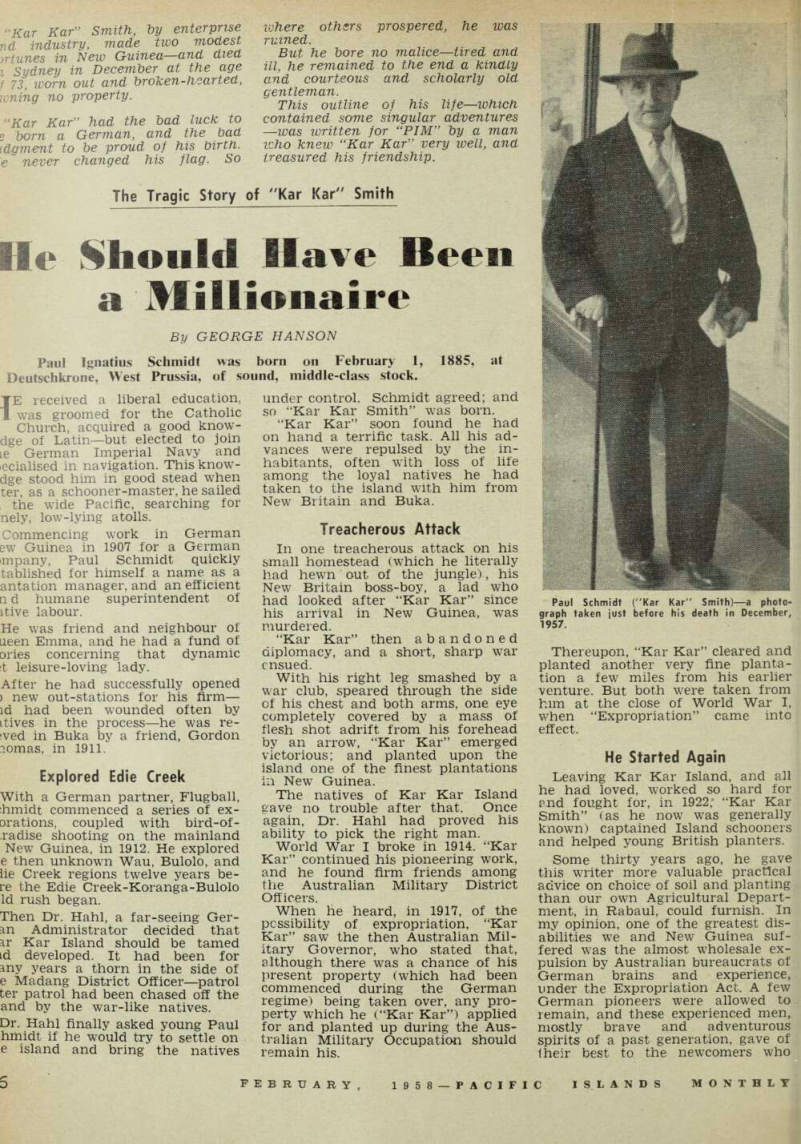
Paul Schmidt ("Kar Kar" Smith) —a photo graph taken just before his death in December, 1957.
‘ wished to carry on the pioneering work.
In 1926, “Kar Kar” was back on the mainland, in the big, gold rush.
After various adventures, he dis l/i the Gold Rush covered a profitable gold mine of his own, and recouped his fortunes sufficiently to buy Pal Mai Mai Plantation, on the South Coast of New Britain.
It was while on the goldfield that “Kar Kar” witnessed the brutal murder of a native carrier by police boys.
Working on his lonely gold claim, “Kar Kar” was shocked, weeks later, to learn of the arrest of a wealthy Australian miner, who had been charged with the murder of the carrier and escorted to Rabaul to stand trial.
“Kar Kar,” although then in straitened circumstances, working hard to win gold to establish him self again, immediately made a sea and-air dash to the capital. His evidence gained acquittal for the Australian, and the police boys who were guilty were charged and sentenced. In court, the Judge praised “Kar Kar” for what he had done in the cause of justice, and
complimented him on the manner in which he gave evidence. But he lost two months of gold-winning, and his fares and accommodation cost him hundreds of pounds. The wealthy Australian did, I think, thank him.
In 1928, with his hard-won gold, “Kar Kar” bought Pal Mai Mai
Plantation. The place was badly run down, but “Kar Kar” cleared the palms, erected new labour houses, copra driers, etc. Then, co-operating with Australian Charles Boles, he built and equipped a splendid saw mill, supplied timber to Rabaul, and built himself one of the finest houses in the Islands.
He returned to his old love, coconut planting, felled the adjoin ing bush and increased his holding by another 600 acres. He married a New Zealand girl and settled down to the planter’s way of life.
Midwife Smith “Kar Kar” owned a 24-ft craft, with auxiliary engine, in which he made business trips to Rabaul.
On one occasion, in Rabaul, he met a very large white woman, who wished to return to her home on the South Coast. She had travelled to Rabaul in order that her expected baby could be born where it would have a better chance of survival.
But the doctors assured her she was not pregnant; and, in view of the lady’s bulk, such a diagnosis could be excused.
She, “Kar Kar”, and a native crew of four sailed from Rabaul. At a point near Tokua Plantation a fierce sea whipped up, and they were forced to anchor.
During the night, with the small craft bucketing about madly, the lady was seized with labour pains.
“Kar Kar”, a stickler for white prestige, immediately sent the boys swimming ashore; and, in the small hot cabin, with a hurricane lamp swinging wildly, as sole illuminant, and a piece of teased-out rope and an old pen-knife, he delivered a bonny babe. He then up-anchored, beat back to Rabaul and presented the sorely harassed doctors at Namanula with mother and child.
Companion Killed
In 1939, World War II hit us again, and in 1940, “Kar Kar” and other German nationals were brought to Australia and interned in Tatura Camp until 1946.
With all that he had built up lost again, the ageing “Kar Kar” returned to New Guinea and man aged a plantation for a friend on New Ireland. Although now far past his prime, he did a magnificent job in reclaiming the property from the
(Continued on page 99)
Kar Kar's Famous Colton
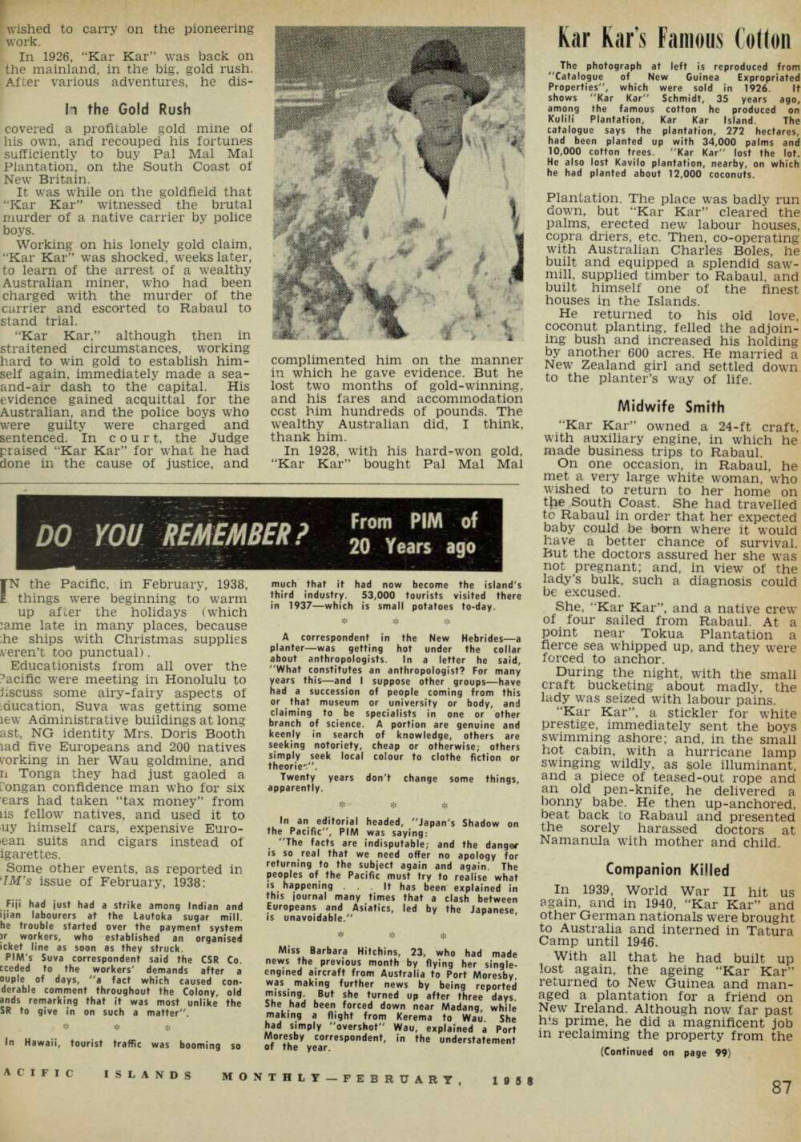
The photograph at left is reproduced from "Catalogue of New Guinea Expropriated Properties", which were sold in 1926. It shows "Kar Kar" Schmidt, 35 years ago, among the famous cotton he produced on Kulili Plantation, Kar Kar Island. The catalogue says the plantation, 272 hectares, had been planted up with 34,000 palms and 10,000 cotton trees. "Kar Kar" lost the lot.
He also lost Kavilo plantation, nearby, on which he had planted about 12,000 coconuts.
jungle chaos which developed during the Japanese occupation.
One day in that area of bad roads —or no roads —and blown-up bridges, a motor vehicle “Kar Kar” was driving turned over on him, killing Dutright his white companion and areaking “Kar Kar’s” remaining sound leg.
His natives carried him to his Dungalow and, despite the tele graphed appeals of his friend and ‘mplwyer, he refused to go to hos pital, stating that if he left the plantation no work would be done.
The leg knitted naturally—as all lis other wounds had had to an— and he carried on efficiently until he property was sold. He returned o Australia in 1949 and lived lappily near his friends, with iccasional breaks in Sydney, until he end.
With three fine plantations which le established, and the high prices if copra, cocoa, cotton and timber uling since 1945 “Kar Kar” Smith -but for the misfortunes of war— ould have been in receipt of 65,000 to £70,000 a year, free of in ome tax. This would have placed urn in the millionaire class, in any urrency.
He lost every palm and every ienny.
He refused to repine, tended his arden and raised fine crops at his tome near Gosford. Occasionally ashing for a change, he would go and his small Sydney flat.
The day he died he had entered ito a contract to write the early istory of New Guiena. * * * “Kar Kar’’ was more than an ex lorer, pioneer, planter and miner, 'n his first property he grew the nest cotton ever produced in the outh Sea Islands. He crossed the est varieties and produced out of ’ar Kar Island soil a staple that ad the Liverpool cotton-masters Ousting for all he could send them, 'he writer has seen old letters offer ig “Kar Kar” a price far beyond 'le ruling rates for all he could pro uce. His knowledge of cocoa culture -as prodigious, and his crops rought the highest price.
A gallant gentleman, a fine .'holar and loyal friend. The world all too short of “Kar Kar Smiths”.