And Some Respectability
pp. 57-61 · Read in the full issue
Mew Approach To Pidgin
It’s Got a New Look, a New Nome And Some Respectability
• Pidgin English used to be regarded as necessary, hut funny.
Now that it is being attacked scientifically, it is not so funny but is more useful. Here JUDY TUDOfI discusses the REV. FR. FRANCIS MIHALiC’s new Dictionary-Grammar of Neo Melanesian
IT used to be said in New Guinea —and maybe still is—that the people who spoke Pidgin English best were foreigners.
Although in this neck of the woods we do not regard Americans as foreign, it is probably no accident that the most notable work on Pidgin English has come from
Americans. They have the out siders’ approach to the subject while Australians, even those who defend it lustily, still think it something that can be made up as you go along.
The first American to take Pidgin seriously was Dr. Robert A. Hall, Professor of Linguistics at Cornell University. He did his basic re search in the United States, theory only; and arrived out here a couple of years ago to do a year’s field work on Pidgin from Australian headquarters.
To the amazement of those socially-conscious Australians who wanted Pidgin banned (as a slave language), he proceeded to defend it and his efforts have done a lot to cast a cloak of respectability over the much-maligned lingua franca of the SW Pacific.
While he was here he wrote a small book called Hands Off Pidgin English! which was published by Pacific Publications Pty. Ltd. He also rechristened the language Neo- Melanesian; it is too soon yet to know whether it is a name likely to stick.
(Continued on page 57)
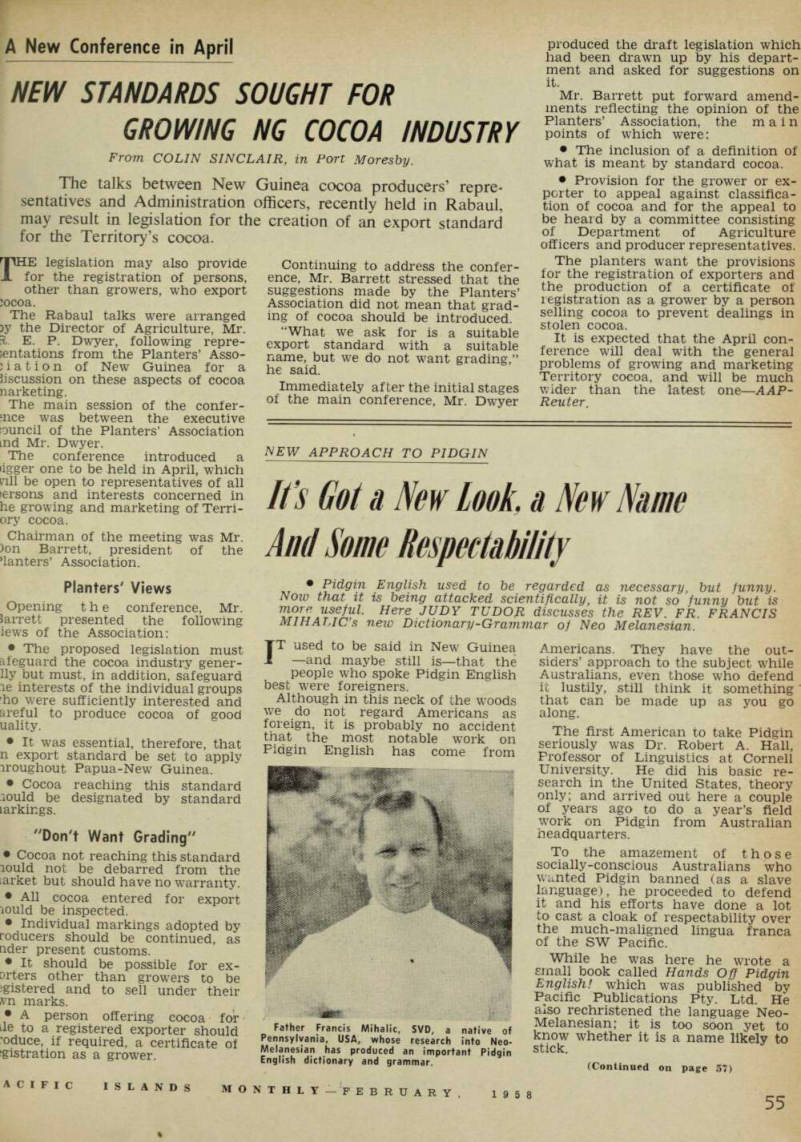
Father Francis Mihalic, SVD, a native of Pennsylvania, USA, whose research into Neo- Melanesian has produced an important Pidgin English dictionary and grammar.
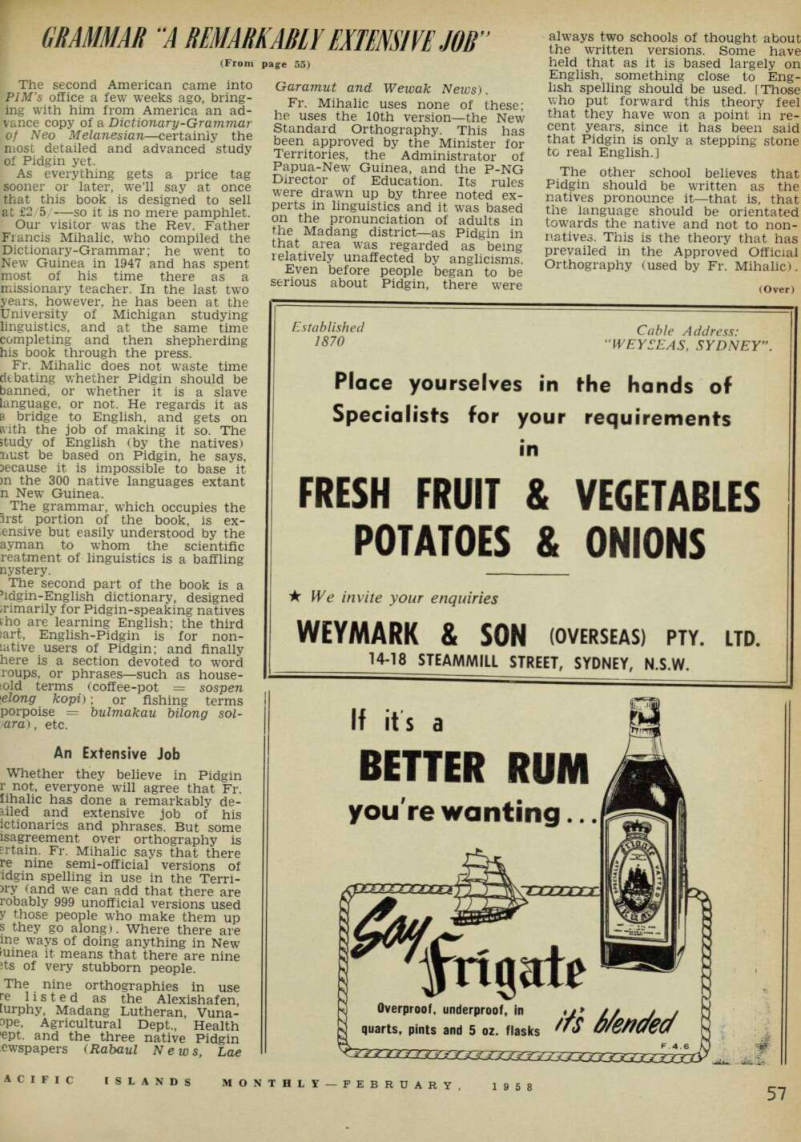
The second American came into PlM’s office a few weeks ago, bring ing with him from America an ad vance copy of a Dictionary-Grammar of Neo Melanesian —certainly the most detailed and advanced study of Pidgin yet.
As everything gets a price tag sooner or later, we’ll say at once that this book is designed to sell at £2/5/ —so it is no mere pamphlet.
Our visitor was the Rev. Father Francis Mihalic, who compiled the Dictionary-Grammar; he went to New Guinea in 1947 and has spent most of his time there as a missionary teacher. In the last two years, however, he has been at the University of Michigan studying linguistics, and at the same time completing and then shepherding his book through the press.
Fr. Mihalic does not waste time debating whether Pidgin should be banned, or whether it is a slave language, or not. He regards it as a. bridge to English, and gets on tvith the job of making it so. The study of English (by the natives) nust be based on Pidgin, he says, lecause it is impossible to base it m the 300 native languages extant n New Guinea. The grammar, which occupies the irst portion of the book, is ex pensive but easily understood by the ayman to whom the scientific reatment of linguistics is a baffling nystery.
The second part of the book is a hdgin-English dictionary, designed irimarily for Pidgin-speaking natives iho are learning English; the third •art, English-Pidgin is for non lative users of Pidgin; and finally here is a section devoted to word roups, or phrases—such as house hold terms (coffee-pot = sospen \elong kopi ); or fishing terms porpoise = hulmakau hilong sol >ara), etc.
An Extensive Job Whether they believe in Pidgin r not, everyone will agree that Fr. lihalic has done a remarkably de nied and extensive job of his ictionaries and phrases. But some isagreement over orthography is frtain. Fr. Mihalic says that there re nine semi-official versions of idgin spelling in use in the Terri fy (and we can add that there are robably 999 unofficial versions used V those people who make them up s they go along). Where there are me ways of doing anything in New rumea it means that there are nine its of very stubborn people.
The nine orthographies in use re listed as the Alexishafen, lurphy, Madang Lutheran, Vuna ape, Agricultural Dept., Health ept. and the three native Pidgin ewspapers ( Rabaul News, Lae
Garamut and Wewak News).
Fr. Mihalic uses none of these; he uses the 10th version—the New Standard Orthography. This has been approved by the Minister for Territories, the Administrator of Papua-New Guinea, and the P-NG Director of Education. Its rules were drawn up by three noted ex perts in linguistics and it was based on the pronunciation of adults in the Madang district—as Pidgin in that area was regarded as being relatively unaffected by anglicisms.
Even before people began to be serious about Pidgin, there were
always two schools of thought about the written versions. Some have held that as it is based largely on English, something close to Eng lish spelling should be used. [Those who put forward this theory feel that they have won a point in re cent years, since it has been said that Pidgin is only a stepping stone to real English.] The other school believes that Pidgin should be written as the natives pronounce it—that is, that the language should be orientated towards the native and not to non natives. This is the theory that has prevailed in the Approved Official Orthography (used by Fr. Mihalic). (Over)
But even amongst adherents of the second theory, there are basic differences in practical application.
The layman, of course, thinks that all phonetic rendering of Pidgin is just a device dreamed up by the experts to make it seem more dif ficult. They will remain uncon vinced that Olsem wanem haus i-paia? (Approved Version), would not be better rendered as “All the same what name house ’e fire?” (How could the house have caught fire?). But as present-day Terri torians seldom take the trouble to learn correct Pidgin, their prefer ences for once can be discounted.
Adopt One Version The vital thing, for the sake of the natives, whose lives must be in fluenced by it, is to adopt one version and stick to it. As matters stand at present, the New Guinea natives are in the position an Eng lishman would be if he wished to learn Spanish but found that the Spaniards had 10 different versions of writing their language.
Father Mihalic has given New Guinea an extraordinary good basis for a new approach to Pidgin. Some fears ago, Pidgin was given Admin istration blessing as an accepted anguage. They cannot do very much ?bout the versions used by the Vlissions (or the 999 unofficial versions used by lay Territorians) lut they should be able to straighten )ut much of the conflicting ideas hat evidently beset the official inguists of the Health and Agri :ultural Departments, and the three hdgin news-sheets.
The printers of Fr. Mahilic’s lictionary have taken special care o make it tropic-proof—with a pecial cover and nylon stitching. It hould be available in New Guinea hthin the next few months, irobably through local stores, but ertainly from the Catholic Mission, \fewak, New Guinea.