On Japanese
pp. 40-43 · Read in the full issue


It’S Really Tough
A New Slant
Tuna Fishing
From J. P. Shortall
One of the more interestiii
(and for some, frustrating ar
infuriating) developments of pos
war years in the South Pacific hi
been the great expansion »
Japanese tuna fishing activitii
south of the equator.
IN the years between the waj there were always a few sampai working these waters, but nev< the scale of mother-ship operation as now exist, with operations sout to New Zealand, east of Sout America, and west into the India Ocean, the Persian Gulf, and eve into the Atlantic.
But despite all this activity, moi people, outside Japan, know ve: little of the day-to-day life aboai one of these modern tuna fishiri vessels.
An outline of this life in all ii aspects, the method of deciding c a fishing ground, the make-up . the equipment used in fishing tl productive 50 to 75 fathom level, an many other interesting facets of th industry in which the Japanese ha’ been engaged for 300 years, is coi tained in an article which recent appeared in a US Fish & Wildlii Service publication.
It is from a bulletin written 1 Mitsuo Nagai, director of t h fisheries experiment station of tl Kanagawa Prefecture of Japani one of the leading Japanese fishe:; research institutes.
For a glimpse of life on the ocea wave—tuna fishing style—we qua a small portion of this interests article: When the boat is hove-to on whi is estimated to be a good groun: the setting of the lines is begu around 3 o’clock in the mornir: This is because the feeding reacti© of fishes is most pronounced at sut times as sunrise and sunset, at tl, change of the tidal current, or wht sea or weather conditions change Once the line is set, it is left
oak for 2 or 3 hours, and then the Ine hauling is begun. With expert Lands this operation is carried on t the rate of about 4 minutes per asket (a “basket” being a 300letre length of main line with 6 ?enly spaced drop lines).
At this time great skill in handling le boat is required; when the eather is bad it is especially dif cult, and great demands are made a the engine. Furthermore, the ex ertness, or lack of it, in this Deration has bearing on the work ig life of the long lines, and on le occurrence of main-line breaks id the loss of hooked fish.
About 19 men are required in itting the gear. The boat steams ; 8 to 9 knots while the line is set om the stern, setting being finished l about 4 to 5 hours. The speed of tting is related to the depth of shing.
Line hauling calls for all hands id requires 12 to 14 hours, and aen there are line breaks or the tch is heavy, the work frequently ntinues through the night. Once le hauling is completed, setting arts again after 1 or 2 hours.
When fishing is poor, boats some nes keep on operating for as long 40 days.
The working hours of the crew e 6 hours for line setting, and 13 »urs for hauling, a total of 19 urs, and if one hour is added for jals and so forth, about three or ar hours are left for sleep. As ch labour is done continuously, b fishermen are terribly fatigued the end of a trip, and frequently eir health is damaged. Con luently, men can engage in this >rk up to about the age of 40. rhe compensation for this labour erages 29,000 yen (£Stg.29 a mth) and when taxes and cost of rking clothes are subtracted, this ives a monthly income of £Stg.2s. ie captain receives three times as ich as an ordinary fisherman, and “ chief engineer about 2i times as ich.
In 1956, the average monthly in come of regularly employed work ers in Japan was 20,669 yen < £Stg.2o/13/-), and for miners the figure was 20,465 yen. By compari son, the pay of tuna long-line fisher men is very low, in view of their working conditions.
In foreign countries the income of maritime workers is generally considered to be about twice that of workers ashore, but the Japanese fisheries are peculiar in this respect, and this is one of the problems to be faced in the future (the article concludes).
As Mr. Mitsuo Nagai shows else where in his article, it is not a question of exploitation of labour
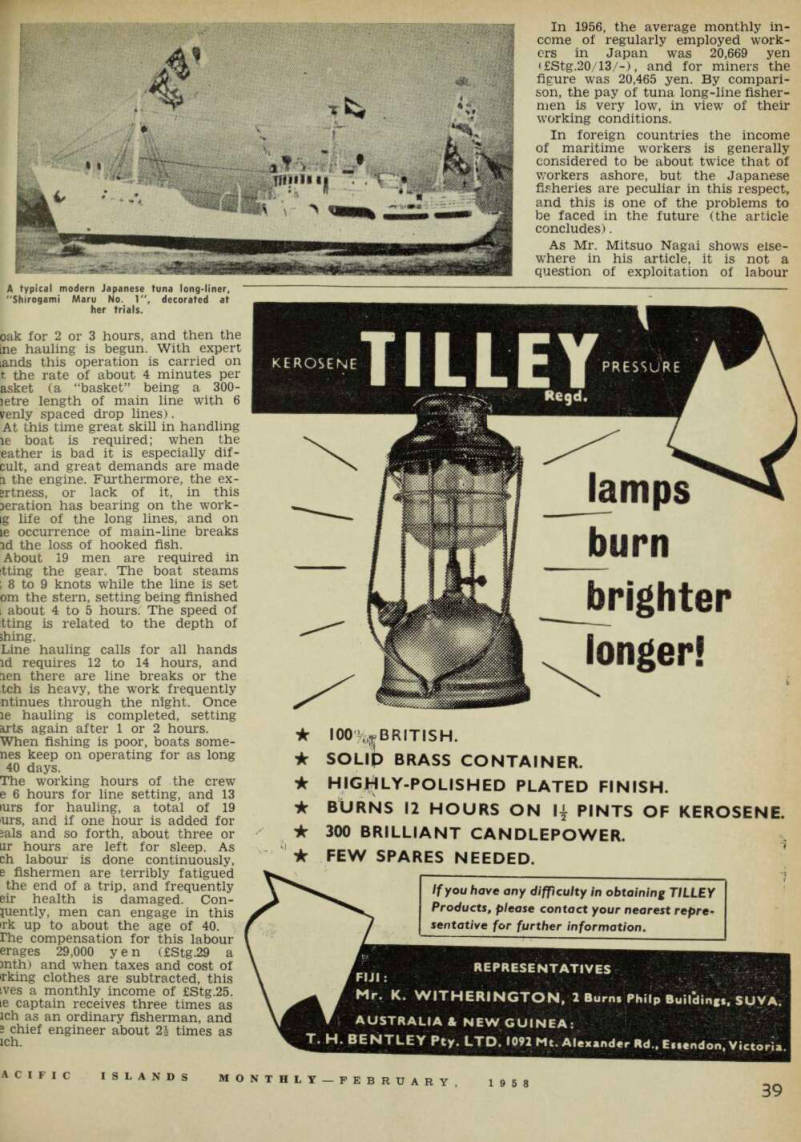
A typical modern Japanese tuna long-liner, "Shirogami Maru No. 1", decorated at her trials.
)y the ship-owners. A typical modern J5O-ton vessel, costing £Stg.B2,ooo in L 953, lost £Stg.ll,ooo on operations >ver four voyages in 1956, despite ;ood average catches.
Some 67 per cent, of operating :osts is taken up by diesel fuel — md the further the boats have to ;o for a load, the higher these osts are.
All-in-all it is a gloomy picture, nd from the above portion of the rticle alone it is possible to begin > understand how many strandings ccur, probably through sheer ex austion of the navigating staff, and hy a Japanese tuna boat, once i a while, pulls into the lee of some ninhabited or sparsely inhabited land and lands her men for a ash, a fresh coconut, and a brief eep under a shady palm, no atter how illegal it all may be.
After 20 hours’ work per day in reeling workshop the fine points 1 international law are liable to se some of their sting.