omparison of Copra Prices
pp. 19-153 · Read in the full issue
fferent Territories and Different Procedures
omparison of Copra Prices [?]New Guinea and Fiji
The way in which the Australian authorities in the Dual Territory of Papua and New Guinea now are handling the Territory’s copra output is of significance to all the South Pacific Territories.
VERY one of the 16 South Pacific Territories produces copra; and in all except Fiji ?ar), Samoa (cocoa) and New edonia (metals) it is the domin crop. 3Uth Pacific production scarcely cts the world market, however, lippines is the largest producer, )wed by Indonesia, Southeast i and Ceylon. The world produc ts about 3 million tons; and th Pacific does not export much e than 200,000 tons, le annual production of P-NG low close to 100,000 tons. No t South Pacific Territory pro 's more than a quarter of this.
P-NG Marketing Board ie disposal of the whole of the a output of P-NG is in the is of the Papua and New Guinea ra Marketing Board, which was ip under a special Ordinance in , and which is responsible to Australian Territories Minister, is not part of the P-NG Ad stration structure. It comprises chairman (who actually is the I executive officer), three mem representing the P-NG copra ucers, the Director of Agricul and one other. le Board has power to control sale of all copra that goes out of P-NG; but it has no control buying and selling within j. For example, P-NG traders larly buy quantities of copra both European and native ucers, and sell to the Board.
Planters’ Association recently i the Minister to amend the nance, to ensure that all copra ken by the Board, e biggest buyer of copra within > is the Carpenter crushing at Rabaul (Coconut Products —it could probably crush the e P-NG output of 100,000 tons;
MG Growers Get £47: Fiji owers £s7—See page 149.
there is no legal reason why mill should not purchase its s directly from the growers, t—apparently for the sake of 1 economy and orderly market )f P-NG’s main product—some igement has been made under i the mill buys the whole of its rements from the Board, at a agreed upon.
The price to the mill is kept in line with the dominating factor— the sale of about 20,000 tons per annum to Unilever (Raw Materials) Ltd., London, at a price regulated by the prevailing quotation in the Philippines market —and the delivery to the mill in 1958, apparently by agreement, is to be 40,000 tons.
The effect of all this is as follows: • All the copra produced in Papua and New Guinea is delivered to the Marketing Board, either directly, by the growers, or in directly, through traders. • Until otherwise notified, per sons delivering copra to the Board at the main ports receive, provision ally, a price ranging from £A47 to £A4S/7/6 per ton, according to grade; and if the Board finds, on periodical adjustment of accounts, that it has made, net, more than this from the sale of the copra, the persons delivering the copra will re ceive a “dividend” in addition to those rates. • On the assumption that the P-NG production will be 95,000 tons, the Board proposes in 1958 to supply 10,000 tons to the Rabaul mill; 20,000-22,000 tons to Unilever; be-
tween 26,000 and 30,000 tons to mills In Australia, for Australian con sumption; and the balance to the open market.
It is not anticipated that the pre sent “tentative” price of £A47 for
first-class copra will be altered, un less there is a marked change in the governing factor—namely, the Philippines quotation.
The £47 price, fixed in January, as compared with the then prevailing Philippines quotation, seemed to leave th-r Board with a safe margin for contingencies. This suggests that there should be a “dividend” for growers, in later adjustments. l i ? (Over)
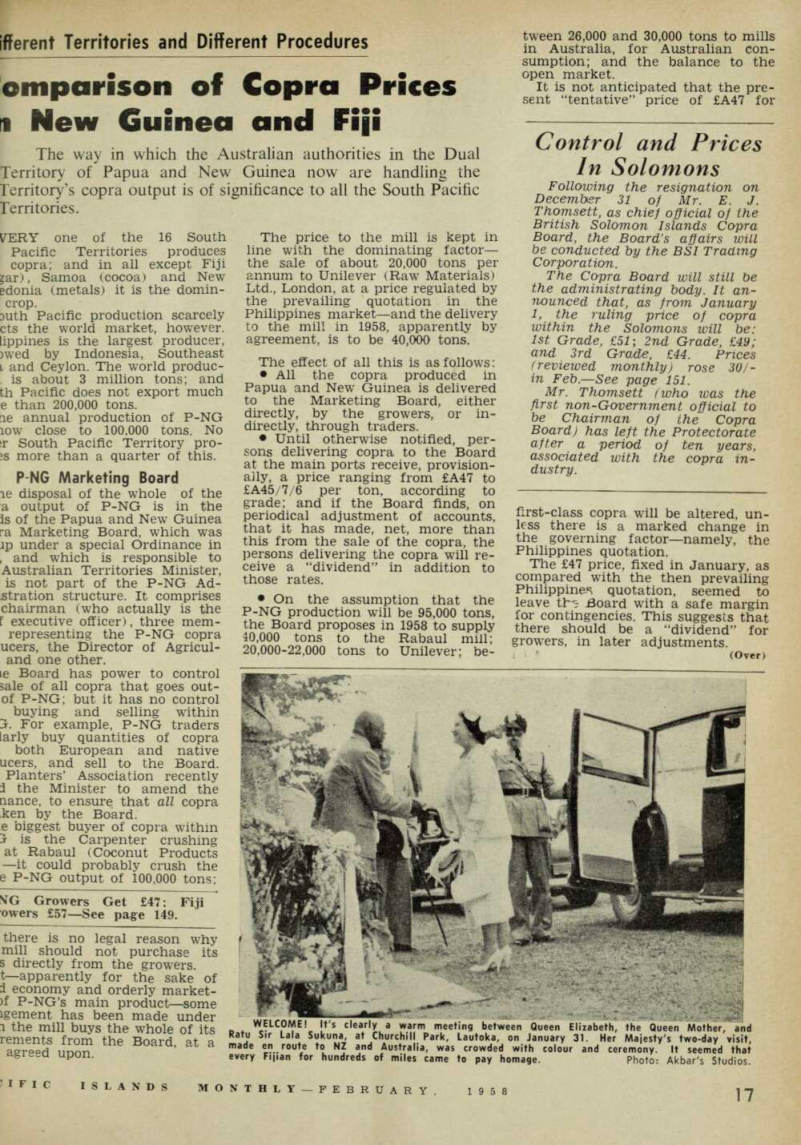
W elcome I t's clearly a warm meeting between Queen Elizabeth, the Queen Motherland Ratu Sir Lala Sukuna, at Churchill Park, Lautoka, on January 31. Her Majesty's two-day visit, made en route to NZ and Australia, was crowded with colour and ceremony. It seemed that every Fijian for hundreds of miles came to pay homage. Photo: Akbar's Studios.
A marked movement upwards in the Manila quote might mean an increase in the £47 “tentative” price.
A marked fall in Manila certainly would mean a reduction in the £47 rate.
Months may elapse before P-NG producers will know how the new system is working. In some ways, the Board will be feeling its way. How ever, the presence of three pro ducers’ representatives on the six member Board gives the growers an assurance that their interests will
be closely studied at the regular Board meetings.
If P-NG growers ultimately get £5O, per ton, they will be down £7 per ton on the rates they got in 195[7 (£57 per ton.) , It is now quite clear, of course, that a “pool” system is being operated.
All the P-NG copra goes into a common pool, and is graded. The “tentative” price per ton is paid at once, according to the grading. The Board markets the copra, and credits the pool.
The Board pays all the costs (storage, handling, grading, ship ping, insuring, accounting, shrink age, etc.), and charges same against the pool. If the net result at the end of the accounting periods (prob ably every 12 months) is better than those “tentative” prices, then there is a dividend for the growers,
(Continued page 149)
Pacific Copra Prices
(From page 18) mged according to quantities and ding of copra delivered. If the result is definitely lower than “tentative” price already paid , there will be a reduction in tentative price to take care of rices Elsewhere: Fiji's £57 does not seem that there has ‘ n any consultation between ritories regarding the prices to >aid in each for copra after De ber 31, 1957; and, already, some ous disparities are seen. >r example, take the following bs, to be paid for copra delivered ominated places, announced late miber or early January, and all ■ced to Australian currency:
it, for purposes of this com son, it should be noted that Solomons and Fiji prices are i; while the P-NG price is tative”, or provisional, e P-NG Copra Marketing Board, Tiving at its tentative price, did
not take the Philippines December quotation as a basis, but instead, for safety’s sake, took the average of the Philippines price for the six months, July to December, 1957. This appears to have produced a GIF European-port price, delivered weight, of about £6O/15/- (Sterling) per ton.
Working back from that, and tak ing into account many factors (Unilever Contract discount, freight, marine insurance, agency com mission, stevedoring, shrinkage of 3 per cent., exchange premium of about 25 per cent., handling in Board stores, in-store shrinkage of 2 per cent., export duty of about £5 per ton, grade premiums, etc.), the Board’s experts arrived at the “tentative” rates announced early in January.
We have seen many calculations, some agreeing generally with the Board, some differing.
But it does appear that, if the Board’s calculations are reasonably correct, if the market does not fluctuate too much, and if the grade premiums proposed are paid (which means that the copra must really be up to standard) the P-NG grow ers eventually will get from £2 to £4 and even £5 per ton over the “tentative” price.
But it may be twelve months be fore they know. The final dividend may bring them generally into line with the Solomons price; but they still are quite a way below the Fiji price.
The position in Fiji, of course, is dominated by the amount which the Suva mill is prepared to pay, from week to week, forthwith and finally, for copra delivered to it on the wharf, Suva.
The Fiji price is paid by private enterprise, which watches the world makels every day, and adjusts its buying rates accordingly. The P-NG and Solomons prices are made by Government and semi-Government instrumentalities, which work under very different conditions. But there may not be much difference in the end result.
The P-NG Board took as the start of its calculation the average Philip pines price for the last six months of 1957, and thus got about £6O/15/- Sterling. The Carpenter mill in Suva naturally took the Philippines price (converted to GIF European port) in early January, and got £66/17/6 Sterling.
Thus, a difference of £6 Stg. per ton immediately shows up between the prompt final price of private enterprise in Suva, and the
P-Ng
Solomons Fiji £Aust. £Aust. £Aust. per ton per ton per ton ir . 47 0 0 51 0 0 57 12 11 46 0 0 49 0 0 56 2 4 id . 45 7 6 44 0 0 54 11 10
“ntative” price fixed by the semi jvernmental control in New linea.
Huge Sum in Stabilisation
Fund
rhe P-NG Copra Marketing ard has no control whatever over ‘ Copra Stabilisation Fund—it rely takes from the receipts about per ton as copra export duty, to one seems to know exactly at happens to that £5 per ton. It definite that £2 of the £5 goes the Stabilisation Fund. What Dpens to the £3? low much is the Copra Stabilisa i Fund, and what is being done h it? i Jack in 1946, the then nt established a “Copra Reserve id”, and, in order to build it up, luctions were made from copra ?s, from December 1, 1946, to »ut 1949. Deductions ranged from to £8 per ton, according to Min rial whim. Up to the end of 1949,
collections totalled £780,000. In next 18 months another £672,000 accumulated —so that the total ira Reserve Fund held by the nmonwealth as on October 31, was £1,452,000. ben they started collecting funds, . similar way, under the Customs port) Tariff Ordinance, 1951; that has gone on ever since. A rd to control the Fund thus ted was established under the pua and N. Guinea Copra In ;ry Stabilisation Ordinance”, and ay the Board consists of Messrs.
E. Fairfax-Ross, Port Moresby; ik R. Wilson, of Rabaul; C. B. ey, of Rabaul; R. E. P. Dwyer, ctor of Agriculture, and H. H. ve, Treasurer, of Port Moresby, le total of the Fund on Sep aer 30, 1957, was no less than !0,399. As far as this writer vs, it does not include that
>2,000, accumulated under other up to October 31, 1951. ie two funds, taken together, d provide about million for filisation” of the copra industry; therwise could be most usefully loyed. The Papua and New lea planters, who themselves ;ed that wealth, should ask some tions about it.