Deeds Thai Did Not Save The Empire
pp. 86-97 · Read in the full issue

This Month's New Reading—
Conducted hy J.T.
BY this time no book-reviewer is likely to come out in goose pimples of excitement when a new war-book is deposited on tne editorial table. Almost one per week is still hitting this office —and it might be easier all round if you could write off war stories as an over-produced commodity and let it go at that.
Unfortunately, for anyone with any sense of history, or of human effort or adventure, to dip, even into a jacket flap, is to be sunk.
Ail of these books have something worth saying, even if it is just be cause no two servicemen ever seem to have fought quite the same war.
Soldier Surgeon In Malaya, by Lieut.-Colonel Thomas Hamilton, makes a conspicuous contribution, even though it has come late in a spate of books about the campaign in Malaya. It differs from most of the others in that it does not deal with prison camps, the Thailand railway or attempted escape from the Japs. Instead, it tells of the campaign from just before Christmas, 1941, until the surrender on Singa pore island on February 15.
Hamilton was CO 2/4th Australian Casualty Clearing Station, 2nd AIF, and although preoccupied with the medical side of the war, he never theless gives an excellent account of this most muddled and expensive campaign of War 11.
Except for an epilogue, he does not attempt to describe the horrors that occurred between February, 1942 and August, 1945; most of the book is taken from diaries written up in prison camps, the diaries themselves having at one stage been committed to the grave of a soldier in Burma, and the mildewed pages dug up and returned to the author after the war.
Passibly in no campaign did the old stiff-necked approach of the professional British soldier get so at odds with what was expedient and possible for the times. Perhaps this is best shown by the order of the day issued by General Wavell, just five days before Pet’cival had to surrender unconditionally to the Japanese. It is worth reprinting here: It is certain that our troops on Singapore Island heavily outnumber any Japanese who have crossed the Straits. We must destroy them.
Our whole fighting reputation is at stake and the honour of the British Empire. The Americans have held out in the Bataan Peninsula against far heavier odds; the Russians are turning back the picked strength of the Germans. The Chinese, with an almost complete lack of modern equipment have held
the Japanese for 4£ years. It will be dis graceful if we yield our boasted fortress of Singapore to inferior enemy forces.
There must be no thought of sparing the troops or civil population and no mercy must be shown to weakness in any shape or form.
Commanders and senior officers must lead thei troops and if necessary die with them. Ther must be no question or thought of surrende ... I look to you and your men to figh till the end to prove that the fighting spiri that won our Empire still exists to enable u to defend it.
It was believed subsequently tha the order was a direct inslructioi from Churchill—who had broadcas that Singapore “would not fall” and it so infuriated most AH commanders that they would no pass it on to their troops. It ha< been sent via GOC Malaya, whi added a note of his own to the effec
that some unit had not showi the fighting spiri expected, and i would be a lasting disgrace if “we an defeated by ai army of cleve: gangsters man’ times our inferio: in numbers”.
That Singapon was a state 0) mind with thosi who were running the campaign from London, is shown again in this book The disillusion ment that cami with the fall o< the impregnablt fortress was so great it seem; likely now tha; Wavell was mon prophetic in hi: order of the da3 than he realised.
Few people sines have had th ♦ temerity to speaH about s u c U delicate subjects; as the “honour o:< the British Em pire”; or tho “fighting spirit” oi same. Empirt has become to bo regarded as one oj those disgraco words 1 i k o “native”—and tin. fall of Singapon may yet be re-: gar d e d as tho actual turning point that markeo the end of Britisll predominance.
But Lieut..
Colonel Hamilton is refreshingly un j concerned wit II pro and anti Colonialism in hi;i narrative. Hr: writes a plain story about thing;' as he found them under abnormar and frustrating circumstances. I
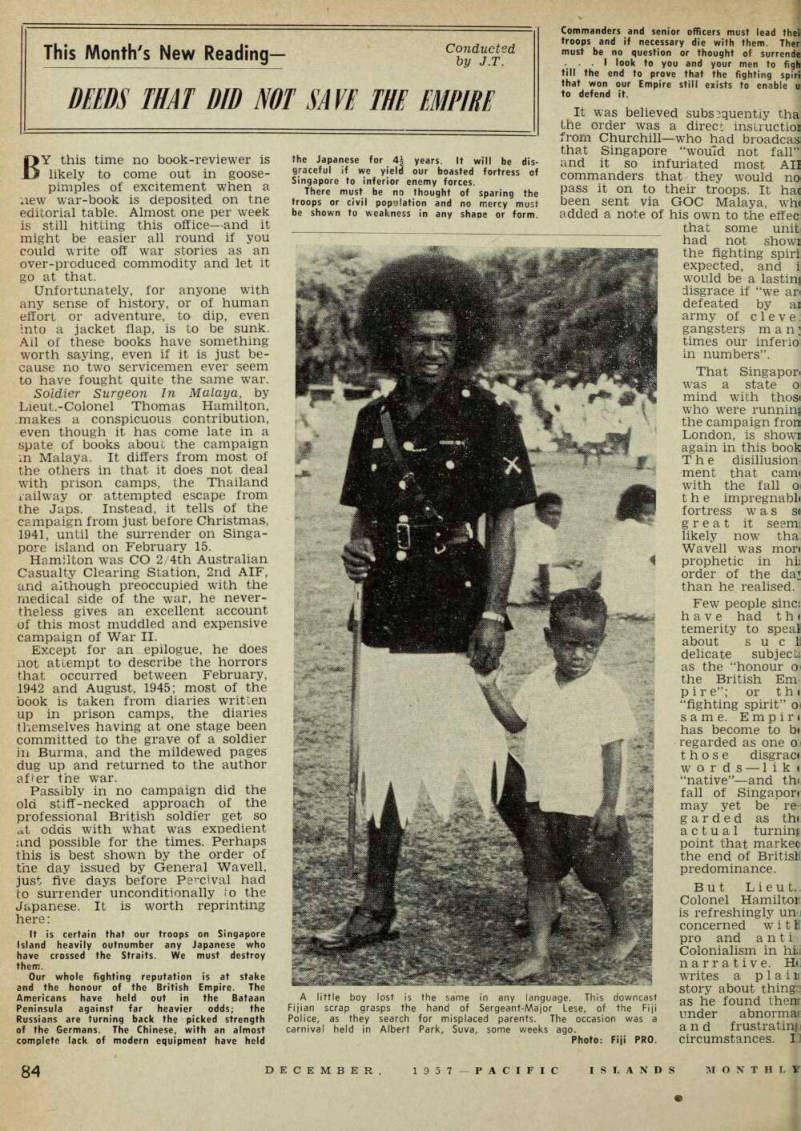
A little boy lost is the same in any language. This downcast Fijian scrap grasps the hand of Sergeant-Major Lese, of the Fiji Police, as they search for misplaced parents. The occasion was a carnival held in Albert Park, Suva, some weeks ago.
Photo; Fiji PRO.
he has views on the place British stuff ed-shirtism had in losing the Empire, he sensibly does not say so but allows the reader to judge for himself from the context. (Published by Angus and Robertson. Aus tralian price, 18/6.)
A to Z in
Uplift
ONLY slightly fewer in numbei than the works of war are the works of uplift. We have had them in every denomination, and now currently one based on the Jewish faith. This—A Book O] Contemplation— is by Dagobert D Runes, who is a Doctor of Philosophy with a vast list of works on sub jects like Ethics and Philosophy Religion, Art, etc. Distinctly in the upper intellectual bracket.
The present book is published by Philosophical Library, New York, and the cost is $3.
It consists of snippets of wisdom, which we presume Dr. Runes has invented, and which for some reason which is not clear are arranged in alphabetical order.
For example, under “A” you find “ABNORMAL” and the text: “All great ideas and all great acts on the stage of history were abnormal.
Was Beethoven normal? Or Michael angelo?”
Over in the back, in the “S’s” you find “SELFISH: All men are selfish but how their selves differ!”
Oddly enough, under “E” (for Education), we find “The heart can learn only from another heart. The printed word does not teach it”.
Evidently the good Dr. is a guy who doesn’t believe his own philisophy, although after the first few pages the habit becomes catch ing and even the soured book reviewer is likely to try a hand at. the business.
Such as: “Confucius say Philosophy like pants—no damned comfort unless made to measure.”
For those who still prefer Dr.
Runes’ three-bucks’ worth off-the hook, applications should be made direct to the publishers. So far as we know, the book is not yet on sale in Australasia.
More Howard Spring
Cavalcade
WHATEVER else can be said about Howard Spring he has: not yet succumbed to the gim mick: His novels still consist of large chunks of life as he sees it, a close-printed 400 or 500 pages of it, meandering through two or three generations without any attempt to “arouse quick reader interest”.
Time and the Hour, his latest; effort on behalf of his middle-brow admirers, amongst whom you can count this reviewer, has all the in gredients, including sex. But it is the pre-1920, golng-to-bed sex, that
,s no relation to the undressed ■l, magazine-cover sex that batters these days at every turn.
According to Spring’s rendering the theme, the word is never mtioned; but the pure noble lotion of love was sometimes dis used by pure noble women to the m of their choice, even in those ys, without benefit of matrimony.
As he starts his characters off as ildren about 1912 and leaves them the mid-30’s approaching Hitler’s id Mussolini’s war, they can be id to have finally arrived within eaking distance of the present, it in spite of their forwardness some directions, Mr. Spring’s nales insist in retaining an aura such gentility about them that it hard to believe that he did not ansplant them complete from me deep-freeze storage of Late ctorianism. He has better luck th his men and probably the best rt of the book is the delightful rly section where young Anthony omwich goes to the eccentric nius Septimus Pordage for his ucation.
Like all Spring novels, this is mpletely without plot. The addict erefore must be prepared to follow e writer into a story where the .aracters—usually reckoned by the ■zens, and vaguely related to other aracters who have appeared in her Spring books—are permitted take charge of the situation, and ape their own lives. The result is
probably as surprising to Mr. Spring as to the reader.
Howard Spring was born in poor circumstances in Wales in 1889 and began work as a butcher’s errand boy at 12. He later became a messenger boy on a newspaper and later a reporter on the same paper.
Hard work and ability took him to the Yorkshire Observer and Man chester Guardian and ultimately to the top of his profession.
His early life and newspaper ex perience is reflected in most of his novels —particularly in the stories that have concerned the newspaper
world, Dunkerleys’, Hard Facts, etc.
Joe Morrison, the young reporter who became a Dunkerley foreign correspondent in Mussolini’s Italy and Hitler’s Germany, is the means by which Spring carries into Time and the Hour the saga he began in his earlier novels.
A story of this sort makes small sense of brief reviewing—but you can take it that as another caval cade of life, Mr. Spring has suc ceeded again. (Published by Wm. Collins. Australian price, 20/-.)
(Continued on page 90)
FRANK YERBY, American latter day best seller capitalises on his countrymen’s wide streak of sentimentality— strong men, torn by all the earthy lusts who nonetheless inevitably produce principles at the right moment and see the Light be fore all is lost.
His females, alas, can sometimes be weaker vessels.
It is, however, a convenient frame work oyer which to stretch the fabric of his romantic period novels —and the latest of them, Captain Rebel, will be welcomed by the fans as have his 12 other best-sellers.
In Captain Rebel, readers will in eyitably be reminded of Gone With •ne Wind and read into Meredith a shadowy version of the rumbustious Rhett Butler. The latter has become part of American 1 oik-loro; the same immortality is unlikely to be the lot of Meredith, although he manages to become a Do-Gooder in the end.
Meredith—Captain Rebel—was not was only a Rebel, he was a rebel against the Rebels. Although he was Southern Gentleman born, had been educated in the North, was a S n^ 1C c to ., boot ’ and did not believe that Southern culture would win out in the end against the superior arms
and numbers of the Northerners In tms he differed absolutely from his friends who fought and died for the Cause.
He became a blockade-runner for the Confederacy but arranged matters in such a way that should the wrong side win—and he thought this entirely probable—he would appear to have been doing a fine
piece of fence-sitting.
Perhaps the success of his wa can be judged by the fact that h emerged from it with a considerabL fortune.
But if Meredith is a faint echi of Butler, Sue, the love of his life is no Scarlett O’Hara. The only re semblance between the two ladie is that, in the exigencies of war
ch made a gown out of the draw g-room curtains.
But while Scarlett wore the re ilts with insouciance and with a irpose (to charm something out Butler) with Sue it was just a ece of war-time austerity along lG lines of Mend and Make Do. [Published by Heinemann. Australian price, /-•)
>r Four to Eight
ears Old
LTHOUGH for the first Christmas L for many years we have not had a new book from Colin mpson, the Simpson family is still presented in the season’s new re uses. Wife Claire Simpson, who is done a number of the drawings the Simpson books, has brought it a children’s book, both written id illustrated by herself.
The Walking House is a colourful, nciful story for four-to-eight-year ds. Production is to the very gh standard required for colour ■inting of children’s books these iys. (Printed in the UK for Angus and Robertson, dney. Australian price, 10/6.)
nother for
mateur Sailors
TUMBER 36 in the Mariners’
S Library (.The Voyage of the Tai-Mo-Shan, by Martyn Sher ood) is an old friend from what arid likely be called more “spaci is days”—or at any rate, more juthful days, when sailing boats i long ocean voyages seemed more unantic than they do to yours truly i-day.
But probably even then —the book as first published in 1935 —some ; the charm of the story lay in le fact that the guy who writes
it always spent the first two or three days after leaving port being violently seasick. It seemed that in this we probably had a lot in common.
Much history has been written since 1932, when five young Naval officers of the British China Squadron decided to sail their own boat back to England. They had her built in a Hongkong ship yard, and named her for the highest local mountain, which being translated means High Hat Hill.
in May, 1933, they sailed out of Hongkong northeast to Japan and the Aleutians, east across the Ber mg Sea to Canada, south down the west coast of North America, through the Panama and the West Indies and across the Atlantic home, The 16,000 miles journey took one year, much longer than was intended, due to the usual unforseen events attendant upon voyages of this sort.
As remarked earlier, a great deal of history has been written since
3 —but the 'essentials of small p adventure remain the same, is unfortunate that the publishers this reprint edition do not now fit to cater to human curiosity, i tell us what has subsequently ppened to the five handsome mg Navy officers, jut perhaps better not. Those who ■vived the war no doubt are now
;y-bearded grandfathers.
>ublished by Rupert Hart-Davies. Australian e, 15/6.)
ephen Lister Sees
rica Darkly
LTHOUGH we have learned con , siderable about the south of France—and French cooking— ir the years from Stephen Lister, • recent expedition into darkest rica can be regarded only as the aide for his latest story which s the unlikely title of Everything lelt Of Kippers.
Someone should have told the or fellow that they haven’t got evision in Johannesburg, certainly t in 1955 and not even to-day. you are the sort of reader who stens on these small faux pas you s likely to end off with the notion at the bloke hadn’t really been ere at all.
But we feel that he went there ight—or at least somewhere to e furthest most ends of the ipical Commonwealth —for in no aer way could he have encountered e many discomforts and perils lich he describes in the latest venture.
For sure, it could equally as well ve been outback Australia, or the V Pacific islands—we could de ribe a dozen places where the dis mforts are similar—but wherever was, he indubitably suffered.
To visit Beaky, an old school iend, and ex-Empire Builder, ster journeys to a small island : the East Coast of Africa, where has set up a colony to save e world from its evil ways.
To sustain his colonists, he pro des canned kippers and a local riety of lolly-water, and Lister is en more put out and concerned ith the variety and quality of this od, than he is with the ill-assorted t of characters who go with the ace.
There is Zara, Beaky’s Central iropean mistress whose pregnancy dly becomes more pronounced; the (loured lawyer from Sierra Leone; te English missionaries; and a indu or two.
Lister’s efforts to clear the place ‘ both its kippers and its colonists id to turn it into a big-game shing resort border, at times, on ap-stick—to a greater degree than lything that came out of Sainte [onique. But there is sufficient of le writer’s sour wit to allow the ling to be swallowed without un le effort.
Like all Lister’s books, it is better read on an empty stomach as at the drop of a hat he will go off into long dissentations about food— and the correct wines to go with it.
Books like this would be a hell of a thing to read 500 miles up the Fly River, when there are only two withered yams and a tin of luncheon beef in the tucker bag. The only defence you would have would be to find (as dear Steve most assuredly would) that the fourth wife of the local headman had a witching way of turning swamp worms and taro roots into a fricassee that was simply delicious. (Published by Peter Davies. Australian price, 17/-.)
Xmas is Coming
AMONG the first of the Christmas gift books (they usually arrive too late in this country) is A String of Blue Beads —described as a modern parable— by the late Fulton Oursler.
Oursler was one of the editors of Readers’ Digest before his death in 1952 and has written many popular books of a religious nature.
This sort of writing is more popular in America than in Australasia: but the small book under review would make a suitable gift in keeping with the sentiments of the Christmas season. (Published by World's Work. Australian price, 6/3.) (Over)
They looked for the
Fly River in 1875
EIGHTY-TWO years ago (ii J 875) a notable Australian, Si William Macleay—who was ; rich sheepfarmer by occupatior and a distinguished scientist n inclination—led Australia’s firs scientific expedition to Nei Guinea.
By most standards, it was not i very successful enterprise. Th 300-tons barque Chevert, whicl carried Macleay and a large com pany, had a troublesome tim among the uncharted reefs an< unpredictable currents of the Torre Strait islands.
The expedition actually reachei the New Guinea coast at only tw< places—the mouth of the Katai River, westwards of the Fly River m Southwest Papua; and at Hal Sound, that sheltered anchoragi between Yule Island and the Papuf coast, which powerful aluminum interests now are about to conven into a deepwater port, Macleay and his team collected especially among the Torres Islands, a great many specimens ol hitherto unknown botanical, insecl and mammal life—and in thal respect justified their effort. Bui they also received, from the incredible mosquitoes of the Papuan Gulf swamps, an amount ol malarial infection that crippled their bodies and broke their resolution.
When they found that they had so badly miscalculated the South New Guinea monsoonal season that they could not venture deep into the Gulf of Papua, to confirm or otherwise dispose of a report that a great river emptied into the sea thereabouts (they were looking for the mouth of the Fly) they folded their topsails and hastened back to the Australian mainland. The expedition lasted only 4 months.
There were a good many missionaries in and around the Torres Islands in 1875, and some of these gentlemen circulated reports about the blundering ineffectiveness of the Macleay expedition.
From his isolated station on Yule Island, the famous Italian explorer, L. M. d’Albertis, watched the Chevert party’s activities in Hall Sound; and in 1881 he wrote “Notwithstanding the great preparations made for his expedi tion, and the large number of men he has on board, Mr. Macleay has done very little”.
In A Squatter Went to Sea, a University of Sydney archivist, David Macmillan, has undertaken the task of defending Macleay against what he calls “the campaign of belittlement and denigration”; and he has done his best in a well-written book of considerable literary quality. But, after reading the lively story, one somehow is
; with the impression that, dng met the treacherous currents Forres Strait and the exceedingly hy fevers of “the Dark Island”, cleay and his earnest band of mtists had very little stomach ; for further New Guinea
ventures. ,
lowever, the book is a valuable itribution to Islands literature, provides an authentic chapter the all-too-insufficient history of mts in and around New Guinea or, to the colonising efforts of rmany, Britain and the Aus lian States, in the ’Eighties. iblished by Carrowong Press. Our copy i Angus and Robertson, Sydney. Australian e, 27/6.)
Readable Book on
e Pacific Problem
VER since it was first found there were people living in the Pacific, there have been debates going as to how they got there. The jument is by no means settled ;, but anyone who wants to dive ht into it and come up well in ■med, could not do better than ; hold of Andrew Sharp’s Ancient yagers In the Pacific —the new lican edition of the book, which s first published in 1956 by the
lynesian Society.
;t would hardly be doing Mr. arp justice to say that the most luable part of his book is the nderful index and bibliography, t undoubtedly for many readers sse sections will be well worth the 5 asked for the book. They will thumbed over long after Mr. arp’s own theories have been read ith interest) and digested. The jliography gives the student of cific matters a fine springboard :o further studies.
The old argument that the rther islands were peopled by de aerate colonising voyages by the tive people does not impress him. ; points out, among other things, at this argument depends on the rly colonisers having a knowledge navigation and geography that ey certainly didn’t have when the iropeans first contacted them.
And if they had had it, how did ey lose it?
Mr. Sharp offers a wealth of in rmaticn in support of the theory at any colonising was done by cidental voyagers over centuries— en blown away, or attempting to t somewhere and ending some ace else.
He supplies plenty of information bich seems to indicate that the rly navigators were not quite a§ ever as they have been credited r later generations. Much of this formation comes from people like aptain Cook, who had firsthand :perience with the Pacific people sfore European contact confused any of the facts with theories. (Published by Penguin Books. Australian ice, 5/6.)
Seduction,
French Style
IF you have never heard of French writer Colette, except in vaguest terms, you are in good company.
That goes for your reviewer, too.
However, you can remedy the fault with an English translation of a confection called Mitsou, and, for somewhat under £1 find out about the particular French art form pursued by this writer.
The theme is a piece of co-oper ative seduction between a music hall actress and an Army officer on leave in Paris during the First World
War. The first portion of the story is written in dialogue; towards the end it is carried along by an ex change of letters. And here and there it is interspersed by straight narrative.
The seduction scene—or more accurately the co-operation scene— might be regarded as a triumph of art over pornography. (Published by Seeker and Warburg. Aus tralian price, 13/3.) t USS Wahoo arrived Papeete, from Honolulu, November 22. This vessel is one of the newer type of sub marine and is engaged on a training cruise to testing new equipment.