tropicalites
pp. 79-80 · Read in the full issue
Magazine Section
Those Sky Things
AN engineer employed by the Nickel Company at Noumea reported to the Civil Aviation Dept., of New Caledonia, that on October 6, he had sighted a moving object in the sky moving from West to East.
With a marine telescope he kept the object in view for nearly a minute. He was unable to identify it as being oval or spherical but said it had a misty halo around it.
He said he was quite familiar with the vapour trails left by jet aircraft but he was sure it was not an aircraft. He was of the opinion that it was the Soviet satellite.
However, as the satellite is on a course nearly ninety degrees different from the object he observed, that possibility must be ruled out.
Quite responsible people believe in “flying-saucers”, and in these days of space-dogs, etc., it is as well not to write everything off to imagination.
Most manifestations, however, have a natural explanation.
On November 6, residents of Bathurst, NSW, discovered a ‘flying-saucer” in the bright afternoon sky.
Two Sabre Jets were sent from Williamstown base to examine it; a Qantas Super Constellation bound Sydney from Hongkong also circled the town.
Some of the townspeople saw rapour trails coming from the abject; some said it was cigar shaped; a chemist looked at it through a telescope and said it was red on top and lighted underneath, A taxi driver saw swept-back wings
on the object that was “hovering”.
The Sabre Jets circled the town Sj’ efin h< ? Jr and SaW The Constellation crew identified the °k , l ec J' as Planet Venus. , , was -. As afternoon deepened into night, even the burghers of Bathurst were con yi n^ ed ; ® y ?. ney Observatory said that at this time of the year Venus J® at a fl P omt , M' B or h l . t nearest and it is visible in tne sky during daylight. paptta’q irAirUA o wuoDi riIHERE are plenty of characters A in the islands—we all know that —but that bright bundle of energy, “Woody“ Troeth, more correctly Mrs. Dorothea Troeth, rates a par for her Rouna Hotel, in the ranges not far from the Kokoda Trail. It’s no thing of beauty, that hotel, with all the bits and pieces that are appended to it, but it’s a pioneer business in its own way.
Before the war, part of the building, not a hotel then, was used to store rubber brought down from the top of the ranges by mule pack, During the war it was a provost post to help control men and mach ines headed for the Trail, and afterwards it became a guest house, “Woody” has had it about seven years, supplies her tables with milk from a vast herd of goats and is always promising to build a swim ming pool. Moresby’s increasing mobs of tourists always head for Rouna, the locals drive up on weekends, and once, “Woody” boasts, seven generals turned up.
There have occasionally been
complaints that a liquor license shouldn’t be given to any hotel in Rouna’s situation —half way up a narrow, winding road in a range.
But it’s possible to go too far in protecting the public from them selves.
Agin The Government
HERE is a newspaper paragraph, attacking Canberra, which I read in Moresby: “The attitude of this haughty Government towards the press which has had cause to chide it is ludicrous in the extreme.
They loathe publicity and the lime light, as they are well aware that as soon as the Australian nation becomes acquainted with the real facts concerning the administration of this territory—so soon will re forms be insisted upon, and the present deplorable state of affairs cease. The impertinence of the press daring to criticise the autocrat in charge, is too great for words”.
No, it wasn’t the South Pacific Post having a go—but it was the Papuan Times of February 11, 1914.— Ess.
Freedom Is A Two-Edged
Sword
WITH a controversy raging as to whether there should be “open slather” for all races in the consumption of liquor in Fiji I was involved in a small incident re cently in a Suva hotel which forcibly brought home both sides of the question.
Two of us were having a quiet drink before dinner in the private bar when four Fijians walked in, one of them very young, and very much under the influence. He asked me where the barman was and I pointed him out. The barman came across and refused the Fijian’s order for a glass of beer.
The young Fijian tried to thrust a note into my hand to get him a bottle of beer, saying: “I’m Fijian, I can’t get a drink.” It transpired he did not have a permit so I had to refuse to do so. (Over)
The young man started to become obnoxious, as most Fijians do when tight, so his pals came to the scene and hustled him away. If meek and mild Fijians become that way when under the influence, then should they be allowed to have liquor?
On the other hand, I had only recently arrived in the Colony, and as I am a European I can drink to my heart’s content if I wish in the Fijian’s country.
There must be a moral in this somewhere —N.B.
Name It And Have It
BISHOPS, so people say, are very solemn folk. One exception is the jovial head of the Marist Fathers in the Northern Solomon Islands, Bougainville, Most Rev.
Thomas J. Wade.
An American, from the tiny Eastern State of Rhode Island, he recently told a good joke against himself, when he was in the States.
Telling an audience of the way the Buka boys coin graphic, pertinent phrases, he explained that he once set up a loudspeaker in a tree in order to speak to a large gathering. Demonstrating the new gadget at its maximum volume, he realised that there was no native word for “loudspeaker”, so asked them to give it one in Pidgin Eng lish. One bright lad came up with: “Call ’im big mouth b’long Bishop!” —Dee.
Seth Parker’S Scoop
Robert tomar c h i n, the Henderson Island “Crusoe”, is not the first American enter tainer to use the South Seas as a stepping-stone to fame.
Some can recall the affair in early 1935 when the radio compere, “Seth Parker” (real name Phillip Lord), involved himself in the Duke of Gloucester’s Royal Visit to the p<> At that time, while cruising among the South Sea islands on his way around the world in his own four masted schooner, Seth Parker, Lord maintained a radio-hook-up schedule every night over major American broadcasting stations. After the Duke of Gloucester had been in Fiji and Samoa, he sailed in HMAS Aus tralia for Panama. Scenting a “scoop”, Lord flashed a radio message that caused Australia to alter course and dash to the schooner’s assistance, north of the Cook group.
The air turned blue with naval oaths when Australia reached Seth Parker and found her safely cruis ing along—with the radio compere gleefully describing to his Stateside listening audience how the Aus tralian warship carrying the Royal Family’s third son, His Royal High ness the Duke of Gloucester, Prince Henry William Frederick Albert, had met up with his own Seth Parker right smack in the middle of the lil’ ole Pacific.
It seemed the call for help was just a publicity gag.
But justice was done the next day when Seth Parker ran full tilt into a hurricane that wrecked havoc in the Cooks. Lord’s hysterical call for help this time was no stunt, but Australia’s commander, 300 miles away, kept his course and radio’d that Seth Parker would have to send out proper international dis tress signals.
The SOS that came frantically tumbling through the airwaves was no phoney, and so Australia dashed back through the hurricane-lashed seas. This time, finding Seth Parker in real danger, she provided assist ance and took some of the schooner’s crew aboard for treatment.
Phillip Lord, like the majority of other US entertainers of that era, fell out of fashion and disappeared from the entertainment scene. — “W.D.”
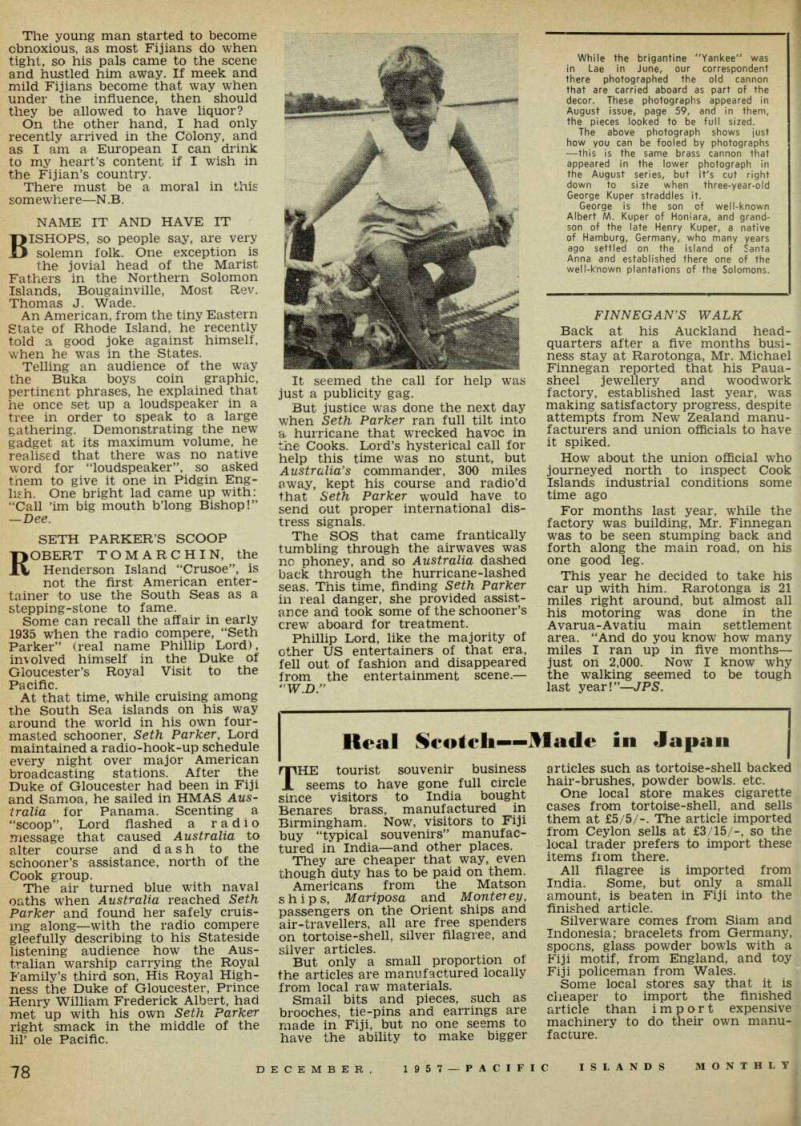
While the brigantine "Yankee” was in Lae in June, our correspondent there photographed the old cannon that are carried aboard as part of the decor. These photographs appeared in August issue, page 59, and in them, the pieces looked to be full sized.
The above photograph shows just how you can be fooled by photographs —this is the same brass cannon that appeared in the lower photograph in the August series, but it's cut right down to size when three-year-old George Kuper straddles it.
George is the son of well-known Albert M. Kuper of Honiara, and grand son of the late Henry Kuper, a native of Hamburg, Germany, who many years ago settled on the island of Santa Anna and established there one of the well-known plantations of the Solomons.