[?]Acific Shipping And Cruising Yachts
pp. 43-124 · Read in the full issue
[?]s Month's News of—
Uckland Building
ANDS SHIPS: There has been jvelopment of interest to Islands i owners at Auckland, NZ, which 3 supplied much of the Pacific r-Island wooden tonnage but suffered a ship-building decline ecent years. idications are that Islands craft, time in steel and alloys, will i again be going down the ways, rcumstances are changing in ur of construction in New Zea l and one firm, Mason Brothers , now entering the field and i for Islands custom, is satisfied ■ it can quote at competitive as. Steel vessels of over 50 ft, ?ned to individual requirements, be turned out cheaper than fen craft of equal size, le firm plans to standardise on ral designs likely to be of in ;t in the Islands; delivery is ded by the use of prefabrication welding. hand at present is a 56 ft x 16* 9 ft mid. depth x 8 ft draught trawler with a loaded displace t of about 70 tons, with linium alloy wheel-house and structures and sprayed zinc
rustless finish to ironwork. She will be in the water and completed in 44 months.
The sections are now taking shape in the workshop, where there is no loss of time through weather, access to tools, etc.
She is ruggedly designed, with 5/16-in. plating; fuel is carried in double-bottom tanks; and the hull is double-chine, conically developed type. She will be sheathed inside
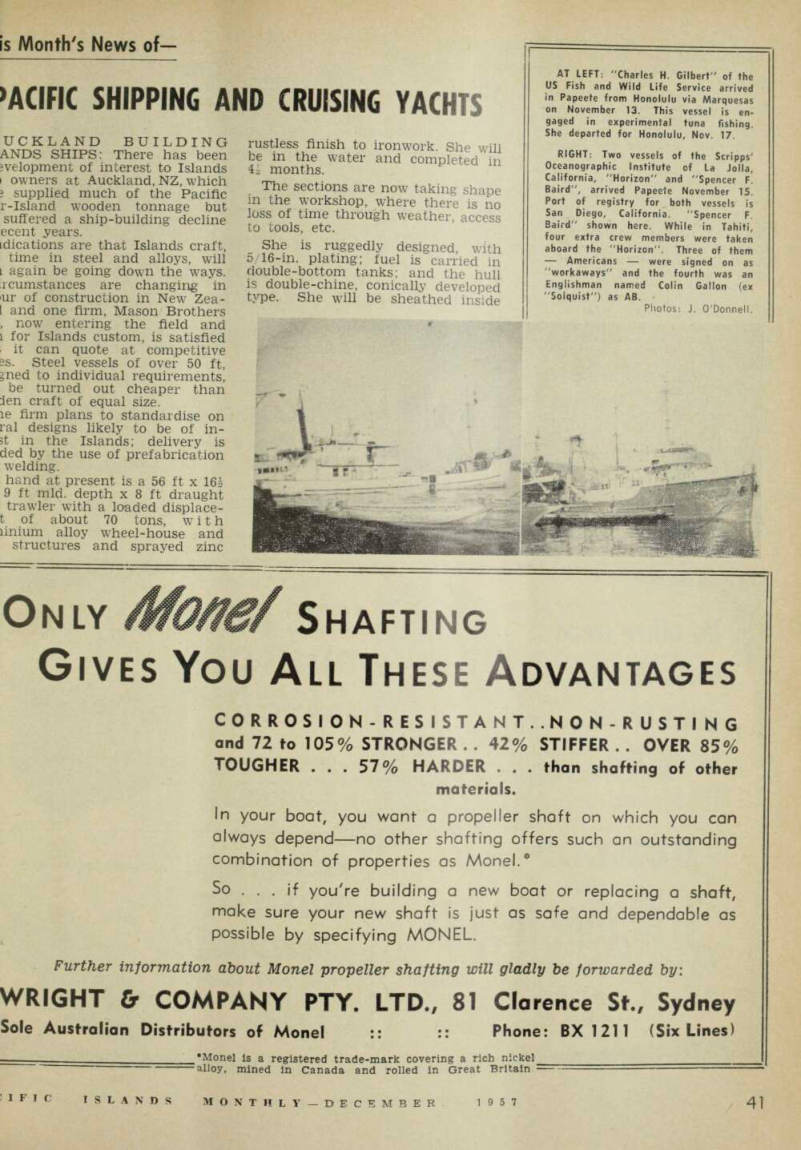
AT LEFT: "Charles H. Gilbert" of the US Fish and Wild Life Service arrived in Papeete from Honolulu via Marquesas on November 13. This vessel is en gaged in experimental tuna fishing.
She departed for Honolulu, Nov. 17.
RIGHT: Two vessels of the Scripps' Oceanographic Institute of La Jolla, California, "Horizon" and "Spencer F.
Baird", arrived Papeete November 15.
Port of registry for both vessels is San Diego, California. "Spencer F.
Baird" shown here. While in Tahiti, four extra crew members were taken aboard the "Horizon". Three of them Americans were signed on as "workaways" and the fourth was an Englishman named Colin Gallon (ex "Solquist") as AB.
Photos: J. O'Donnell.
with aluminium alloy separated from the outer steel plating by Jabe lite foam insulation and sheet asbestos.
The fish-hold, which has a capacity of 20 tons, will have a pearlite cement floor. She will be powered with a 152-hp, BL3 Gardner diesel with three-to-one reduction to the shaft, Tihs firm is one of the largest engineering organisations in New Zealand. It turned out seven steel trawlers, but not by prefabrication, for UNNRA (they went to China), and local buyers in 1947-48, after which this type of construction in New Zealand met difficulties in steel supplies and economic factors.
Disaster In New Hebrides:
Ve Tega, brand new Honolulu-built 50-ft workboat, brought to the New Hebrides as a business speculation in September, was destroyed by ex plosion and fire on the night of November 7, and with one of the owner-partners killed, and the other seriously burned.
When they were unable to sell the vessel at Luganville, Messrs.
Bob Grant and Neal (some reports called latter Neil Rinker), went on a trading voyage to the Banks Islands, calling en route at Hog Harbour, Espiritu Santo, where Grant had once been employed on the planta tion of Mr. Gaziani. During the night, while anchored there, there was a heavy explosion which brought
the Rev. H. F. Prenter, local Presby terian missionary, out to see what had happened.
He found Ve Tega ablaze—the re mains sank in 15 ft of water —and Grant on the beach terribly burned.
Neal’s body was found under the wreckage subsequently.
The men were asleep aboard the time of the explosion, which thought to have been caused t the flame-type refrigerator ignitir highly explosive rock-gas which m£ have been leaking from the cylinde: which supplied the cooking facilitie Grant was taken south to Lugai
e hospital by Mr. Prenter and admitted unconscious. A Gov nent officer and divers left im liately for the scene and efforts e being made to trace the miss man’s next-of-kin or relatives. e Tega was reported to be in id for £lO,OOO. :arus—ashore and jOAT: The Maru-boats were ywhere in October-November, more than one was flouting the le-mile limit. i to Suva came the Eiko Maru, 0 tons, to load fuel oil and sr for a tuna fleet working in Tonga area. Captain Suzuki then to uplift fish from the : and proceed home, sfore clearing Suva, Captain iki stated that a Japanese busi : man, long resident in Tonga, regularly visiting the Japanese mg boats off-shore. Interesting, ot illegal. it more curious still was how zo Maru No. 16 came to be so 3 in to Pukapuka to land her firmly and finally on that them Cook island on October 5. Distress signals brought two r vessels of the same fleet to scene, but their efforts, aided by e of the Pukapuka people, were /ailing up to last news on Oc r 17. 1 the same day another vessel :d at nearby Nassau Island and 3 of the crew landed, no doubt ng that the island was un bited. It was not. Salutations exchanged with the residents, the vessel departed, obably it was the same fleet was busily engaged in the tuna b on the Rarotonga-Auckland 3 early November. The Can n salmon-fisher White Hart, dng at Auckland with eight : Island passage-workers aboard, rted sighting one vessel. hite Hart’s men had also had ‘ handsome and highly accept hauls of tuna themselves to
bolster their rations on the slow 25-day passage south.
At about the same time and on the same route, Captain Hugh Williams found his 243-ton Melva in amongst a whole network of
longlines, buoys, flags and Japanese tuna-craft one evening a couple of days prior to reaching Auckland, He stopped his motors and coasted through the mess, fortunately not fouling his twin screws. (Over)
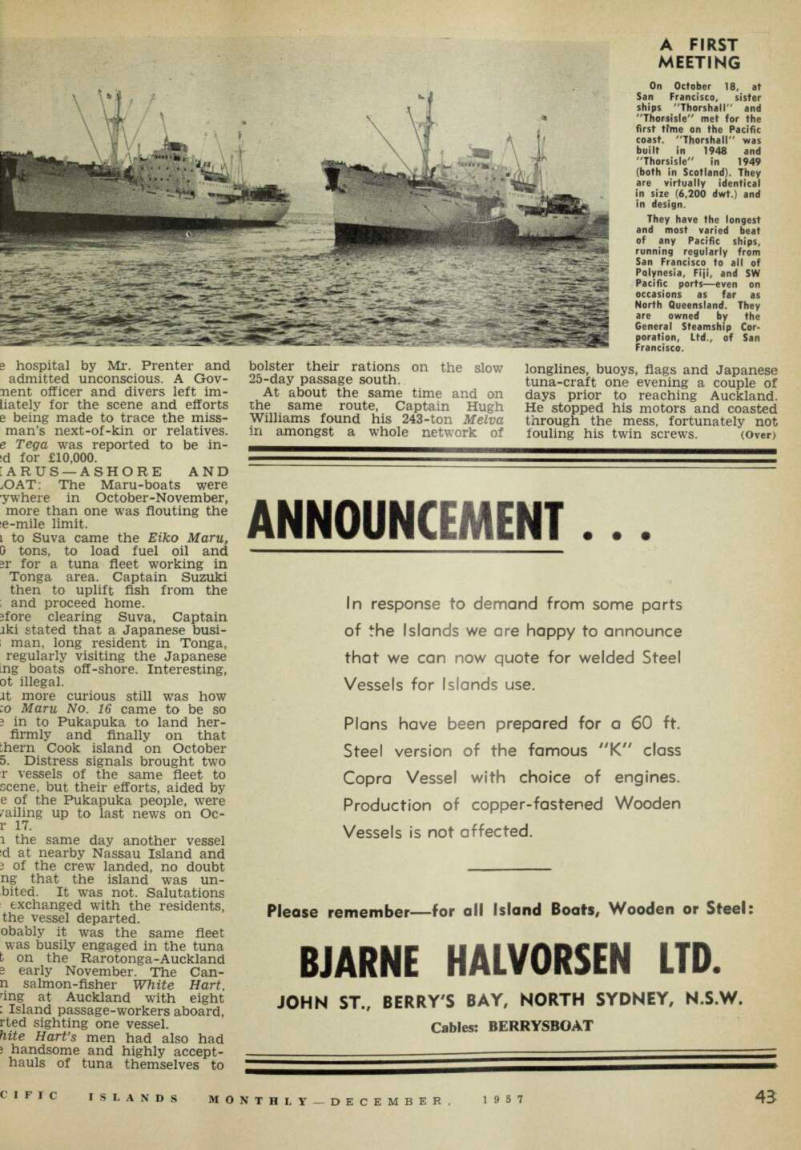
A First
Meeting
On October 18, at San Francisco, sister ships "Thorshall" and "Thorsisle" met for the first time on the Pacific coast. "Thorshall" was built in 1948 and "Thorsisle" in 1949 (both in Scotland). They are virtually identical in size (6,200 dwt.) and
in design.
They have the longest and most varied beat of any Pacific ships, running regularly from San Francisco to all of Polynesia, Fiji, and SW Pacific ports—even on occasions as far as North Queensland. They are owned by the General Steamship Cor poration, Ltd., of San Francisco.
orthbound from Auckland for Dtonga in early November, NZGS a Pomare met up with the same ;, five vessels being sighted in late afternoon. The “Pom Pom” ;ed close enough to one to read name and port of registry: yie Maru, Tokyo. bis was about 130 miles from ier Island lighthouse at the roaches to Auckland. Radio
Officer Windsor said that for some days the air was alive with Japanese Katakana code (equivalent to the Morse code but with a much larger alphabet) on 2 mc/s. as the vessels of the fleet exchanged signals.
For reasons unknown, these Jap anse fishing vessels seem to prefer code to radio-telephony. The latter is used by most fishing vessels of the world to save having to carry
a trained radio operator. Telephony is generally handier for short-range work but would be unreliable for maintaining long-range contact with Japan, so this may be the explana tion.
Chief Officer Tony Thomson, on the bridge when one vessel was passed, said that there was no doubt about them being “onto the fish”, which were being landed on deck at the time.
From Tokyo Radio came a report on November 13 that the last of six Japanese whaling fleets had that day sailed for the southern whal ing grounds. Prior to the opening cf the baleen (non-toothed) whal ing season on January 7, the Jap anese fleets would in some cases, as usual, hunt for sperm whales in tropical waters and might be seen in the Western Pacific.
Further west, on Wreck Reef in the Coral Sea, Japanese and Aus tralian salvage workers made pro gress in saving a fortune in baled
he new bulk - fuel at Point Fareute, eete. Standard Oil California in August menced the con ction, the estimated of which is 0,000. he site has been pared to Standard specifications by a I contractor and erection of the s (eight) and ware se is being done er contract by the [?]inal Steel Co., Ltd., Honolulu, who have specialists (welders structural iron [?]ers) engaged on
work under the supervision of Dave H. ders, field superintendent, andard Oil's policy is to utilise local labour much as is practicable on the project and, this in mind, local labour under the rvision of George Kent, Standard Oil ent engineer, will lay the pipe lines. local labour, under the supervision of rt Busey, Standard Oil representative, will [?]te the base on completion of same.
The base will have a storage capacity of 2,640,000 gallons and store such petroleum products as aviation gasoline, automotive gaso line, diesel oil, light fuel oil and kerosene.
Motorists are looking forward to a welcome reduction in the price of gasoline.
The base should be in operation by April 15, 1958. However, if the present rate of progress is maintained this tentative opening date may be considerably advanced
wool and other cargo aboard the 5,490-ton, 4-year-old Eifuku Maru, which went up there in October, bound Australia-Japan.
Papeete Bulk Oil Term
INAL: Reports from Tahiti indicate that rapid progress is being made on the construction of bulk oil tanks at Fareute Point, on the east side of Papeete Harbour, close to the ship repair yards and the naval depot. It is understood that plans call for a new fuelling berth east of the present wharves. (See photo, previous page).
Treasure From The Sea:
Despite the loss of two salvage vessels in attempts to reach New Zealand from England, Mr. Bill Havens, 39-year-old Sydney mining engineer, is still determined to claim his share of the gold that was lost in General Grant when that vessel was wrecked on the Auckland Islands in 1866.
Under a November Singapore date-line, Mr. Havens indicated that his plan was not abandoned, though people who had visited the scene are certain that the wreck has long since been pulverised At Rarotonga, Mr. Malcolm Sword, formerly of Fiji and now wharfinger for the Union Co., dealt with more substantial treasure when he brought up the third blade of a 17-ft diameter bronze propeller from the 40-year-old wreck of the Union Co.’s Maitai off Avarua.
Two other blades, each weighing about 4,750 lbs and of 92 per cent, pure copper, showed a handsome profit to a group of amateur skin divers who brought them up last year. Since then, the price of metals has fallen and the third blade still lies at Rarotonga. The fourth blade, deeply embedded in the coral, is a tougher salvage proposition.
Them’S Fightin’ Words!:
Mr. Lewis Graham, of South Pacific Shipping Co., Suva, former owners of the ill-fated and mis-spelt Nukalau, ex San Michele, and pre sent owners of the 655-ton Suva registered Bahinda, seemed to be trailing his coat somewhat in No vember when he made a press state ment in WTiangarei, NZ, calculated
cause some NZ unionists to “see i” [n the well-featured statement, r. Graham was reported as saying at “he would not have NZ seamen his ship”.
Mr. Graham was reported as say -I‘. “With a NZ crew you do not ow where you are. They were vays fighting amongst themselves d one never knew when a couple iuld decide to walk off the ship. iey would not care that they might Id the ship up for a couple of ys”.
Mr. Graham was further quoted:
Fijians aie different. They were
fiSreoSfSßka? »
..nQ ixiost rename. me only pitfalls bi TV, Jit hteViiL™^th r °SI S ,°* rt ”- To get his Fijians the NZ Man- V £ l °k% 1 rQt S i' ed pay rnnritb«T t «mrrip t KuT a m d a l 18 ™ lf hls me * as w?rp 6 nniv W J°l t ? em ‘ They were only permitted to draw m cash what they would normally earn in *iji.
One reason why the company was abie to get its Fijian crew at all was that the accommodation in the vessel is well below present-day standards prevailing on the NZ or Australian coasts, and local unionists were not keen to serve in
Bdbinda, though the standards are as . I good or bet ter than those pre vailins in vessels in the Fiji ilter-isTand trade 8 ‘
Mercy Mission To For
Bidden Waters: When Com
mander Bernard J. Lauff, command lng the Us Navy icebreaker Glacier cached New Zealand in November h e reported that he had been forced to enter the British H-bomb test area near Christmas Island to obtain medical assistance for one of his crew, The 8,625-ton Glacier, a unit of Operation Deepfreeze, was bound from Panama to Lyttelton when a 19-year-old fireman was diagnosed as having a brain tumour. The ship
(Continued on page 113)
TOP: "Utopia", which was at Papeete in vember, westbound.
Photo: F. J. Peterson.
LOWER; The London yacht "Nona", now Polynesian waters.
Photo: Max R. Hart.
headed for Christmas Island, a contact was made, and an RAF ckleton patrol bomber flew to
the ship and dropped medical sup plies. Later, when nearer the island
Glacier’s own Sikorsky helicopter
hew the man off to the island’s airfield. From there an RAF jet bomber flew him to hospital at Pearl Harbour.
Cannibal-Sub Visits Pago
PAGO; On a round-about route to Japan from Pearl Harbour the US Navy’s submarine-hunting sub marine USS Bream paid a visit to Pago Pago early November before continuing on to Auckland, where certain engine spare parts were air freighted from Hawaii. The 312-ft craft, fitted with the latest electronic devices for hunting enemy sub marines under water, was com manded by Lieutenant-Commander Roy B. Cowdrey.
To encourage recruitment to the US Navy it is policy for vessels to divert to places even well off the route, as selected by popular vote of the crews, for recreational calls.
Auckland appears to be well up on the list of “most-favoured” ports, and some of the (allegedly) more romantic islands are only “way ports” as the Americans say.
Home Is The Sailor: A Man
known, though perhaps not always by name, to a great many people along the Union Steam Ship Co.’s Polynesian circuit, had his mortal remains—a container of ashes— scattered from Tofua somewhere along that route in November.
He was Stephen Courtney, late
chief steward of that vessel. He had retired after 50 years at sea six weeks prior to his death in Auck land.
These Vessels Were
LINKED: Two vessels in the news in Fiji recently had, at different times, been owned by the same man—Cap tain Hugh Frewen, now living in Queensland. One was the 55-ft
-O-Aotahi" in Papeete—see story page 122.
Photo: J. O'Donnell.
clipper-bowed, ketch-rigged, twin screw, motor-sailer Viking Ahoy, brought to Fiji some years ago by Captain Frewen under an arrange ment with Rank Films to assist in the filming of Blue Lagoon, in the Yasawas.
A comfortable and attractive craft as a passenger cruiser, she was later exchanged, with a probable cash ad justment, for the 54-ft single screw clipper-bowed cargo-and-passenger vessel Melanesia, owned by the Seventh Day Adventist Mission.
Later still. Captain Frewen sold Melanesia to Mr. F. Cliffe, and he in turn recently sold her to Hurley’s Shipping Agency of Suva. Lately, Viking Ahoy was advertised in Fiji at £7,000 by the mission, and at about the same time Melanesia, under her new ownership, was in trouble, having gone ashore on a Fiji reef with a specially chartered party of holiday-makers aboard. She was later got off and returned to Suva, apparently little the worse.
Viking Ahoy was built in Queens land for Mr. G. H. Griffiths, of Toowoomba Foundry, manufacturers of the Southern Cross diesels. Dis posing of her, he built a larger version, the 74-ft Coongoola, in ■which he then sailed round the world before selling to Mr. N. W.
Thomas, of Wellington, NZ. Mel anesia was built by W. M. Ford, of Berry’s Bay, Sydney, in 1917.
Skipper Wanted For Ng:
The Australian Lutheran Mission at Umboi Island, off the coast of New Britain, wants a skipper for its vessel Umhoi 11.
The vessel plies between Umboi, Finschhafen and Lae, where it un loads copra and picks up supplies, making the trip every few weeks.
It is a good regular sort of job
for the right person, but not muc excitement: that is perhaps why tt men who have been brought froi South for the job do their teri and return to Australia.
WORTH READING: A year or j ago Andrew Sharp’s book Anciei Voyagers In the Pacific was mer tioned in this column. For those r<
nt then to spend £1 there is good news. The book, un [ged, has appeared as a Pen issue at 3/6 Stg. For anyone ested in the ancient Polynesian ?ers and who has swallowed the )ted theories, hook, line and r, there is a wealth of well nented evidence in this studi work to support some new ies which place the Polynesian i navigator in rather less ourous light than here-to-fore. my student of navigation this fascinating book. (See book ivs, p. 84, this issue).
Aiming Scheme But
[NEES LAG; In August, the rovernment announced a useful ne for the elementary training avigators and engineers for d vessels, the trainees to be ders, part-islanders, or per even Europeans domiciled in slands. Candidates who have r or more of secondary educa two or more years of sea ex ice, and are sound physically •eceive preference. i scheme is to operate from February, and the cost per is estimated at £265 for the -months course, all inclusive, f of this is to be paid by the oring ship-owner or found by ainee, who must sign an agree to return to work in Islands s for at least two years after ourse. He will receive a certi showing, in the case of a.
navigator, that he has attained a standard equal to that set for foreign-going Second Mate’s ticket; and in the case of an engineer showing qualifications equal to the certificate of Engineer of a Local Motor Ship. The navigators will train at the Marine Department’s Wellington school, and the engineers will train at McKenzie’s Engineer ing Academy, Wellington.
Our information is that, to date there has been little enthusiasm for the scheme on the part of Cook Islands ship-owners: but whether or not they are enthusiastic, it might be an excellent way of ensuring shipping safety if the Government insists that at least skipper, mate and two engineers in every craft licensed to carry passengers be re
quired to take the course or show equivalent qualifications. Otherwise some owners will be happy enough to peg along on the “pot luck” system.
Continuous Watch On
Local Frequency: Suva Post
Office, which formerly maintained watch for R/T calls from local ship ping only during regular business hours, now maintains continuous watch on 4073.9 kc/s. After hours, the watch is by loud-speaker in stalled at the telephone exchange.
Replies are made, as usual, on 4445 kc/s. At night there is considerable interference from overseas stations, not present in daytime. Radio con ditions at night are also frequently such that signals from ship and Post Office may be much weaker
Brothers Matheson: Captain R. D.
son (top) of "Kurimarau" handed over s brother, Captain D.K. Matheson (be at Suva in November and went south few months vacation.
Photos: J. P. Shortall.
i in daylight, due to “skip” ’ts. These factors could well amt for failure of the telephone mnge operator to intercept calls assistance sent out from 6.30 to 10.30 p.m., October 12. by anesia \frhen she went ashore Vatulele, only about 50 miles y. enerally speaking, lower fre 'icies—such as the 2182 kc/s in ational distress channel, provide e reliable night contact and ters should not be too ready to iemn the shore watch at night n using 4 mc/s or higher. Where ral frequencies are guarded, use lower for medium and short mce work at night.
Drmal Adi Maopa Inquiry:
Fiji Marine Board has tossed
a curly one up to the formal court which will investigate the circum stances on the stranding of the Gov ernment vessel Adi Maopa, on a reef off Viwa Island on August 30.
The board, at a preliminary in vestigation, found that the master should have exercised more care,
but in its finding, it did not specify who the master was.
Edward Kemp Anderson, who holds the appropriate marine certi ficate, said that he was in charge of the vessel while she was on the trip, which was from Rotuma to Suva, but he had not signed on as master. He was not on any book cr register, and put his name to.no papers whatsoever.
Anderson told the board of strange actions of the chronometer during the trip. The evening before the ship left Rotuma the chronometer was 44 seconds fast. The evening ic left it was 26 seconds slow.
The board was mystified and so was Anderson. He had never known anything like it before. The next time he checked the chronometer it was 28 seconds slow. As this was only a two-seconds variation from the previous check, he thought it was back to normal.
He told the Board plainly: “The grounding of that ship had noth ing to do with anybody except myself, my navigation and that chronometer”. (Over)
has been a long haul, but Ben Carlin— n here giving the victory signal—has [?]y done it. Photo was taken in San cisco after he arrived from Anchorage, [?]a, on last stage of the round the world [?]ibious trip that Carlin commenced with wife, Eleanor, in 1948. rlin began planning the trip in the am ous jeep "Half Safe" soon after the war the difficulties and troubles encountered [?]arrying out the programme have been endous. Wife Eleanor accompanied him on irst oart of the journey and was with him [?]stralia a couple of years ago when "Half was on view at a Sydney department But there has been no mention of [?]or in the latter half of the adventure.
Carlin is an Australian.
When the Adi Maopa hit the reef he did not have the “faintest idea where we were”. “I thought we had: found a new reef”, he said.
The formal inquiry will, no doubt* bring several matters to light.
Captain’S Certificate
SUSPENDED: The Fiji Marine*!
Board suspended for six months the certificate of Captain Jos e v a Vulaono, who was master of the Tui Levuka when she stranded on a reef near Koro Island, on June 13. The Board considered that the master had controlled the vessel in an unseamanlike manner by manoeuvring her in restricted waters with a lee shore.
It also considered his judgment was likely to be impaired because he had consumed three rums just previously.
The undercurrent in the inquiry was whether the master was sober or not.
Ram Charan, the mate, swore that Captain Vulaono was drunk, but when pressed he could not de fine drunkenness.
The evidence showed that he had been drinking and in the circum stances the penalty could not be considered severe.
Whippy’S For Sale: The Well
known ship-building and repair business of Charles Whippy and Co.„ Suva, is for sale as a going con cern. Offers for purchase closed on December 7.
No reason was advanced, but an announcement may be made in the near future.
SOLD OUT: Skipper Hugh Williams, otf' Rarotonga, and formerly of Sydney, confirmed in Auckland, late November, that negotiations were in hand and would probably soon be finalised for the sale of his Auckland-built, eleven-year-old, ccmposite-type, 243-ton, twin screw vessel Melva, which was then under Bureau Veritas survey on behalf of a client of Captain Kennedy, Syd ney shipbroker.
Skipper Williams, engineer Les Livingstone, and the crew of Cook] Islanders were expected to deliver* to Sydney for hand-over. The price mentioned was substantially above] the very reasonable figure paid by Captain Williams in June, 1956, but a lot of money had since been spent in improving the vessel for tropical service. She is in very good condi tion .
Captain Williams said the sale! was influenced by poor trade conH ditions in the Cooks, lack of safe; harbours there —and no real sign] of the Administration making seri-j ous improvements to Avarua for small ships in the forseeable future.; A PEARL FOR £9,000: Rose Pearl , which has been making headlines in Darwin for the past three months (PIM, Nov., p. 117) and which was auctioned there on November 23, was knocked down for a £A9,000 bid from a Captain Bell, acting on be
alf of Henderson, Trippe Ship ng (Aust.) Pty. Ltd., of Sydney.
The auction was the outcome of a urt action by Dalgety & Co. ainst the former owners in respect an amount of £15,000 which was ring.
The £9,000 has now been paid into urt, but there are several claims ion the money—including one by e ship’s company for wages due r the past three months. The crew mostly Chinese and Filipinos— re stranded in Darwin and were 1 from charitable funds.
A. Sydney spokesman for Hender a, Trippe said that Rose Pearl s been bought on behalf of Hong ng interests'" and that the vessel uld be on Panamanian register. did not know when she would ; away from Darwin—but as soon possible. The existing crew would bably be used. le was not .anxious to talk about - ship or her future movements, I with good reason. It is the ire of owners in deals of this t, to remove the vessel from Aus lian ports as quickly and as onspicuously as possible. It is ays possible that Australian ritime unions will take a dislike the colour of the funnel and lare the whole ship black; or find ms of horning in on the deal
and getting a rake-off for them selves.
Henderson, Trippe will not be using the ship themselves. With Philippines Trader and Philippines Merchant, they began operating in the cattle trade between Australia and Philippines after the war.
Bellbird Tragedy In New
GUINEA: New Guinea’s worst local shipping tragedy since the Hermes went missing without a trace exactly 22 years ago, occurred in New Britain waters on November 15, when six people were lost follow ing an outbreak of fire on the coaster Bellbird. The tragedy is re ported elsewhere in the news section this issue.
Bellbird is owned by Colyer Wat son (NG) Ltd. and has been operated in New Britain waters for -he last 10 years—ever since pur ;hased in Sydney by the company.
Although now getting into the aged ilass—she was over 50 years old— 'he was considered sound and sea-
"Malolelei" undergoing trials off Levuka, Fiji, recently after installation of an engine.
She was built by a Japanese boatbuilder in Suva about 40 years ago and was sailing under the Burns Philp flag in Tonga waters for many years. In 1941 she was transferred to Levuka and has been trading from there to the Lau Group. Some months ago she was laid up and almost completely rebuilt. She had an engine
installed and is now considered one of the fastest vessels for her class in Fiji.
Photo: B. Obed.
rthy, and recent surveys have )wn her in excellent condition, s was about 85 ft long and was
sel powered.
>he was carrying only about 750
js of copra at the time of the aster, no deck cargo and was 11 within the limit imposed on the Tiber of passengers carried.
News of Cruising Yachts
i NONA, 41 ft. x 116 ft. cutter of London, reported as clearing the Channel Is. on )ber 19 last year, cleared Balboa for the nds on September 10 and will now be in rnesia. At the Canal Zone, Joe and Elsa nning-Pearce and Bill Hodgson tarried for months to do an interesting and perhaps '■table job—rebuild a local 40-ft. sloop and ver it to Miami. When the 57-year-old IA cleared Balboa there was no mention Charles Candler, an original crew member, is Auckland. > SALMO of Rhu on the Clyde, only 7-ft. by 6 ft. draught, cleared Balboa Member 1 for the Islands and round-the- Id ports with Mr. and Mrs. Peter Hamilton
aboard. This voyage commenced August, 1956.
Island ports scheduled are Galapagos, Pitcairn.
Rapa, Papeete—and the next mentioned place is Cairns, Queensland. Skipper Hamilton made the trans-Atlantic passage alone to Montreal, where his wife joined him. They came south via New York and Jamaica. SALMO has no auxiliary motor. • CELESTE, 40-ft. steel cutter of Canal Zone, mentioned in September PIM, put back to Balboa three weeks after sailing, minus most of her sails. She returned via Ecuador and has more recently again cleared, for the US West Coast this time. • DANA RESCUER, the 19-ft. all-metal Danish demonstration ship's lifeboat, making a busi ness cruise round the world under command of Captain Walter Vestborg, was still at Canal Zone early November, having arrived there some months ago (PIM, July). The skipper was seek ing a job for a while, before clearing for the US West Coast. Our correspondent mentions that Tahiti is now included in the agenda, though earlier reports had suggested his route would be via North Pacific and Orient. • FLYING WALRUS, bearing no aroma of a chimpanzee, made Russell, NZ, 30 days out of Rarotonga which she cleared on October 10. • NOVIA and LITTLE BEAR cleared Raro tonga on October 12, the former for Auckland and the latter for Honolulu. • WHITE HART, with skipper Reeves and eight Cook Islands passage workers, made Auck land in 25 days, having cleared Rarotonga October 17. This sturdy Canadian salmon fishing ketch, with all gear and electronic aids, is to be offered for sale in Auckland. Anyone interested in this 48-footer could contact Tony Reeves via PlM's Auckland office. • CHRISTINA, 26-ft. Wellington sloop, with owner-skipper Bill McQueen and two com panions, reached Auckland November 10 from Norfolk Island via Whangaroa, NZ. This yacht cleared Wellington last December 8 for
Sydney, Brisbane, and Townsville and is now homeward bound. Mr. McQueen hopes to sell the self-built craft and purchase a larger yacht for an Islands cruise. • UTOPIA, handsome 65-ft. staysail schooner of Sturgeon Bay, Wisconsin, which cleared Bal boa June 30 was at Papeete in November. En route, owner Fred Peterson picked up Aus trian Joe Pachernegg, whom it will be re called, was wrecked in the Galapagos in his 33-ft. SUNRISE a year ago. SUNRISE, better remembered as VIKING, was sailed round the world in 1953-54 by that popular young Swedish couple, Sten and Brita Holmdahl. Some of UTOPIA'S crew returned to the US from Tahiti.
Mr. Peterson, who is the millionaire-owner of Peterson Builders Inc., a shipbuilding yard on the Great Lakes, engaged in building non magnetic minesweepers for the US Government, intends staying in Tahiti until late January when he will be joined by his wife for a short cruise of the Society Islands.
He and his wife will then return to the US via Australia and New Zealand by Matson Lines. After a short stay in the States, Mr.
Peterson intends flying back to Tahiti to con tinue the world cruise aboard "Utopia". The vessel, designed by the owner, is equipped with the latest in electronic navigational aids such a radar, directional finder and fatho meter. a MAREVA (ex SEARCH), 55-ft. x 14 ft., 18-year-old motor-sailer owned by American James McConnaughey, resident of Tahiti, paid a visit to Rarotonga and Mangaia in mid- November under command of one of the Brun brothers of TAHITI NUI raft fame. The yacht was apparently under charter to anthropologist Don Marshall and his wife, well known in the Islands, who were landed at Mangaia November 14, MAREVA continuing back to Papeete.
MAREVA arrived at Papeete from the East Coast of the US on June 18, 1954.
• HAVFRUEN 111, owned by Mr. and Mrs.
T. H. Carr of Southampton, England, last re ported as clearing Balboa July 23, called at Rarotonga November 7. The 60-ft. Colin Archer type ketch was then bound for Papeete to Auckland via Nukualofa. Owing to bad weather only a brief call was made at Rarotonga.
Also aboard were two other persons. • SYDNEY-NOUMEA RACE: Our Noumea cor respondent reports that a Sydney-Noumea yacht race is scheduled for June, 1958, and that already the following yachts have been entered —-Lolo, Malohi, Anita, Niwami, Kurrewa IV, Siandre and Cyclone. The last yacht race] which was so successful, took place in New Caledonia's Centenary year, September, 1953. o TAKI -0 - AUTAHi (Maori translation Southern Cross) 21 ft. double-ended cutter of Poole, England, arrived Papeete November 13 with owner Bill Mangan (NZ) and companion Rick Mohun (US) aboard. This craft is the smallest, or one of the smallest, to cross the Pacific. Mangan reports an uneventful passage of 67 days from Balboa, CZ, to Taihae Bay Marquesas, from where they sailed to Nuhahiva and then to Raroia, Tuamotus, where they stopped for two weeks. Rarioa will be re membered as the landfall for KON TIKI.
Mr. Mangan's present intention is to stay in Papeete until March then proceed through the Islands en route to NZ. ® SKAAL, 25 ft. double-ended cutter, owned by John Yves Froment of Papeete, arrived from Raiatea via Moorea November 6. This vessel was originally built in France and shipped to Tahiti aboard one of the Messagerie Maritime liners. Until her recent purchase by Mr.
Froment. SKAAL had lain at Raiatea for the past few years. Approaching Moorea Mr.
Froment and his crew were caught unawares and vessel jibed and was demasted. How ever, they sailed into Moorea under jury rig where they made temporary repairs to the mast with some wire and a G-clamp and then sailed on to Papeete without further mishap. 1 Papeete’s argument for a bigger dock was advanced early in No vember when three ships were in port at once. The two liners, Monterey (arrived Nov. 1, departed Nov. 3), and Southern Cross (arrived Nov. 2, departed Nov. 3), were alongside the dock, and the freighter Thorshall was at anchor in the harbour. Great credit should be given to the Papeete harbour authorities for the skill and care displayed in bringing both these vessels alongside such a small dock without incident. Shortly it is hoped to extend the present dock as far as the marine base at Fareute. This will enable two or three vessels to be berthed at once. t MV Viti was chartered by NZ Island Territories Department in November to uplift the season’s first cargo of pineapples from the Cook Islands. The vessel cleared Auckland for Rarotonga on November 12. ♦ The Union Steam Ship Company’s Nukualofa office, preparing for the visit of the Orient Line’s cruise ship Orion, on January 9, was adver-| tising in Tonga for 50 motor vehicles! and drivers prepared to handle the! tourists on the big day. Motor trucks j would become passenger buses for* the event.