Pc Streamlines
pp. 39-41 · Read in the full issue

[?]t Conference Rabaul
Ts Programme
E next South Pacific Conference —the fourth —will be held in the Technical Training School tre, Rabaul, New Guinea, prob- April or May of 1959. le first and third Conferences South Pacific Native peoples ,ng together under the auspices he South Pacific Commission) ; held in Fiji. The second was in Noumea, le Fourth Conference will dis half-a-dozen assorted subjects, iding tourism and training local srs. But they will be of “broad ic interest” rather than subjects hich delegates are likely to be j involved with technical ;ers. (During the last Confer , one section found itself listen to a group of enthusiasts de tg the diet of lactating mothers). eliminaries of the 1959 Confer were discussed at the 17th .on of the South Pacific Com on, which concluded in Noumea arly November. ie SPC’s 1958 budget will be 790, to which the six member irnments, Australia. Holland,
France, New Zealand, United King dom and United States—contribute but some more than others (Aus tralia pays 60 per cent.).
This total amount is a drop in the bucket compared with the large sums that each of these countries lavishes upon its Pacific territories (Australia’s grant to Papua-New Guinea this year is over £ll million).
What the Commission contributes is therefore limited, but it is still necessary (say those people who be lieve in it): It provides some research, training and technical ad vice, promotes understanding and goodwill and widens horizons of Islands people.
Immediate Jobs for the SPC Some pretty savage criticism has been levelled at the Commission in recent years and the call to “cut out the deadwood” led to the Review Conference of member Govern ments in May this year. Some people thought that Conference would be by way of a requiem. It was not. The Conference decided to carry on the SPC on the same prin ciples, on the same budget, but trimming its activities to suit what the individual territories really wanted.
The commission is now implement ing those decisions. For itself it has decided: (1) Its planning officers are to maintain contact with the Terri tories by travel;
(2) Territorial officers will be brought together in at least seven technical meetings on specific problems within the coming 2 to 3 years; (3) Publications and circulars are to be reduced in scale closer to the demand for them; (4) The Quarterly Bulletin will
maintain about half its articles as contributions on technical sub jects from the Territories, telling
what they are doing.
No. 3 will be welcomed by those who have been at the receiving end of the avalanche of material turned out by the SPC. Excellent material most of it, but its volume has been
extraordinary; even bewildering.
On the advice of its Research Council, the SPC will concentrate on the following projects in the im mediate future: FISHERIES; This got a boost from the 13weeks training course for 25 Islanders held at Noumea about 12 months ago. Popular fisheries officer Van Pel is expected to return from leave in January and go straight back to visiting territories in turn.
RHINOCEROS BEETLE; Dr. "Chuck" Hoyt, the Commission's entomologist, was collecting predators in Madagascar from March to Sep tember, 1957. Large numbers of a carabid beetle were sent to and liberated in Fiji, and in Wallis Island. Another investigator, Dr.
Surany, has found several virus diseases to make life difficult for the beetle.
The entmologists of the territorial services are being brought together as early as possible in the New Year, to put their heads together as to future work. Approved by the Com mission are; Employment of an expanded team of investigators, and collectors, for shipment of predators and parasites from Madagascar and West Africa; a contribution to the Scientific Research Institute of Madagascar, to enable it to employ two entomologists in searching for likely enemies of the rhinoceros beetle in the Pacific.
All this could cost around £15,000 in 1958.
The SPC will carry part. Rockefeller Foundation is still meeting Dr. Surany's costs. Fiji expects to be able to contribute £l,OOO.
HEALTH-EDUCATION; An eight-weeks training
course for 39 Islanders was held at Noumea in July-August of this year, with much help from WHO. To follow it up, WHO have loaned Dr. Scherzer to go round individual territories as they require.
NUTRITION AND DIET; The Commission will engage a person qualified to advise territories on nutritional problems, but subject to some of them making requests for his services.
FILARIASIS: The Commission's Dr. lyengai has provided mosquito control programmes foe Western Samoa, the Cook Islands, and Niuei First call on his time is that of any territory that wants him.
PLANT INTRODUCTION: Dr. Jacques Barrat is back with the Commission, now as Plan' Introduction Officer. He will spend about 11 months of 1958 in visiting individual terri
, as a travelling link between the several Introduction Stations now in the Pacific ories.
ERATURE PROMOTION: Bruce Roberts, iture Organiser based in Sydney, has re r visited BSIP, Guam, the US Trust Terri- Port Moresby, and Tarawa. A library i bookshop were started in Apia last year. territories that have now asked for and will will get it, are BSIP and New onia.
JCATION: Top educationists of the terri and others will meet probably in 1959 scuss how SPC can help in general field, while, practical value has been found at jrial level by helping education officers one territory to visit and study conditions other. The Commission has assisted such from New Caledonia to Western Samoa, American Samoa to Fiji. •ED SELF-HELP; As used by the Com a's Research Council this term means ised forms of activity such as co fives, women's and youth organisations, any other sort of community work that help. sre is to be a special meeting of part e Research Council in May next to con this, with Professor H. Belshaw, of Vic- University College, Wellington, and Miss Gwilham of the UK Colonial Office invited end. anwhile, Mr. Joe Joannides, the Com m's Co-operatives officer, has spent most e past year in Gilbert and Ellice, BSIP, -New Guinea, Netherlands New Guinea, and the US Trust Territory, with two s in the Cook Islands. In July or August, there will be a Technical Meeting at Moresby, not of co-operative officers only, mingling of Administrative Officers with
landslide last month killed three
prisoners working on a road
Wewak, NG.
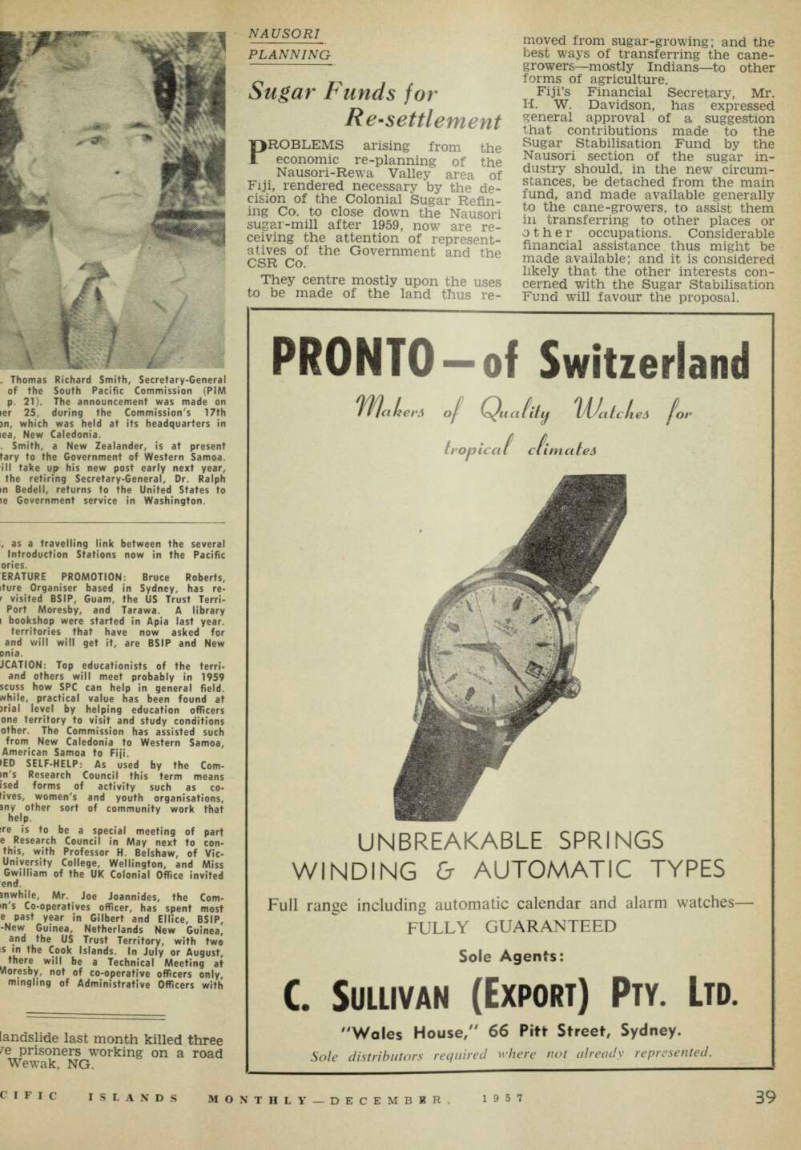
Thomas Richard Smith, Secretary-General of the South Pacific Commission (PIM p. 21). The announcement was made on ter 25, during the Commission's 17th on, which was held at its headquarters in lea, New Caledonia.
Smith, a New Zealander, is at present tary to the Government of Western Samoa, ill take up his new post early next year, the retiring Secretary-General, Dr. Ralph in Bedell, returns to the United States to [?]e Government service in Washington.