New Guinea’S Worst Shipping
p. 26 · Read in the full issue
Six Perish
Disaster In 22 Years
Six people lost their lives on November 15 when the coastal ship Bellbird caught fire off the New Guinea coast. It was the Territory’s worst shipping disaster since the Administration vessel Hermes was lost in November, 1935.
FIVE of the people who perished were drowned when trying to reach shore in rough seas. The sixth, a native crew member, was burnt to death on the ship. - The ship was on a routine voyage down the South Coast of New Britain. It was about 10 hours out of Rabaul when fire suddenly broke out at the stern of the vessel.
The lifeboat was burnt almost im mediately.
The Master, Captain C. Bolton, manoeuvred the vessel for about an hour to get it into the wind and to bring it close enough to shore for those on board to make an attempt to get ashore.
He also tried to send a distress message but the radio signals were not received in Rabaul. At this time he was standing on top of the burn ing superstructure and finally had to leap off into the sea and swim to the bows of the ship.
An inquiry into the disaster began in Rabaul on November 28, before Coroner G, Hall, SM, the Receiver of Wrecks E. Brennan, and Rabaul Harbour Master G. W. P.
O’Donoghue.
Witnesses said that as soon as the fire was discovered the entire native crew, with the exception of one man, had jumped overboard and swum for the shore.
The exception was a native called Towanna, who had stayed with the others and at one stage was in strumental in saving the life of Mr.
Maurice Farrant, the ship’s engineer.
The passengers had gone to the bows of the ship when flames cut them off from the burning stern.
Because they could not get at the life-jackets, the Captain had thrown Into the sea everything he could get his hands on that would float.
The survivors had got ashore on these. Mr. Cyril Parer, who could not swim, got ashore on two oars.
Herbert and Gladys Walsh had attempted to reach shore together, but had become separated and Mrs.
Walsh drowned.
When the fire alarm had first been given, everyone believed that it was a small one that could be dealt with quickly. But the stern was found to be a mass of flames which quickly spread to the superstructure.
After the survivors had got ashore, Captain Bolton and Mr. Tony Whitton, a plantation officer, walked 25 miles to Sum SUm plantation for help. The news was
Died:
Mrs. Gladys Walsh, wife of Adminis tration Medical Assistant Herbert Walsh. Drowned getting ashore.
James Thayne, engineer, drowned while getting ashore.
Eric Aquiningo, sawmill employee, drowned.
One native, crew member, name un known, burnt to death on ship.
Two native passengers, drowned when swept away at sea.
Survived:
Captain C. Bolton, master of the "Bell bird".
Mr. Maurice Farrant, "Bellbird's" engineer.
Thirteen native crew members.
Mr. Cyril Parer, planter of Karlai.
Mr. Herbert Walsh, medical assistant of Pomio.
Mr. Tony Whitton, plantation officer.
Three native passengers.
flashed to Rabaul and the vessels Mangana and Arawe picked up sur vivors.
FOOTNOTE: The Hermes, re ferred to above, left Madang for Rabaul on November 10, 1935, and was not seen again. (Fragmentary wreckage was found later). On board were 17 natives; J. A. Andrews, en gineer; N. E. Weldon, a surveyor, and F. Barclay, an AWA official.
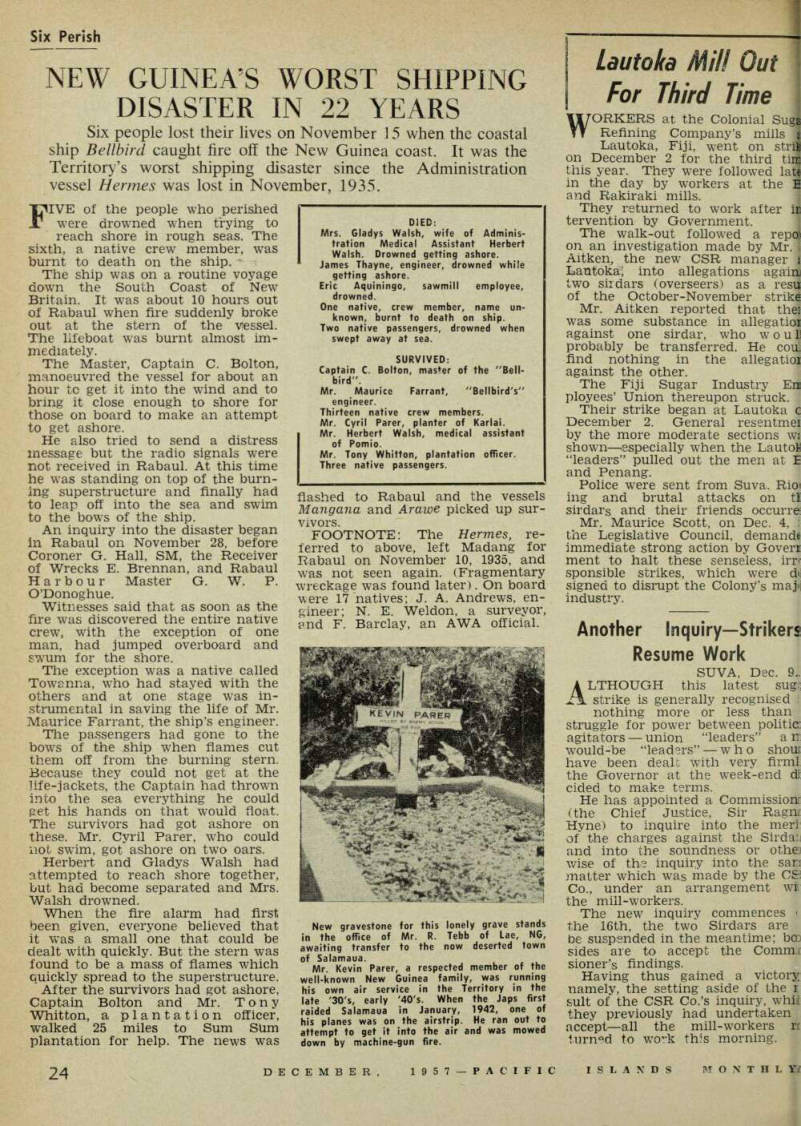
New gravestone for this lonely grave stands in the office of Mr. R. Tebb of Lae, NG, awaiting transfer to the now deserted town of Salamaua.
Mr. Kevin Parer, a respected member of the well-known New Guinea family, was running his own air service in the Territory in the late 30's, early '4o's. When the Japs first raided Salamaua in January, 1942, one of his planes was on the airstrip. He ran out to attempt to get it into the air and was mowed down by machine-gun fire.