Fiji Still Is
p. 24 · Read in the full issue
Copra in 1958
Undecided
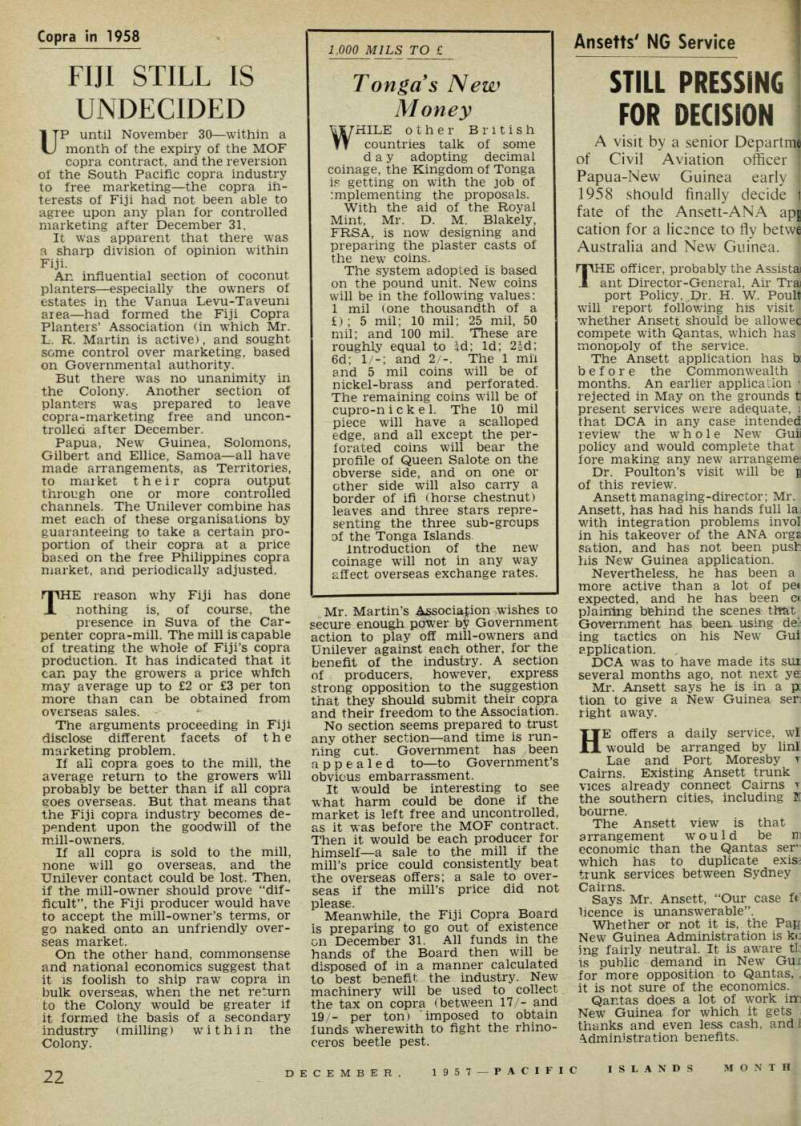
UP until November 30 —within a month of the expiry of the MOF copra contract, and the reversion of the South Pacific copra industry to free marketing—the copra in terests of Fiji had not been able to agree upon any plan for controlled marketing after December 31.
It was apparent that there was a sharp division of opinion within Fiji.
An influential section of coconut planters—especially the owners of estates in the Vanua Levu-Taveuni area—had formed the Fiji Copra Planters’ Association (in which Mr.
L. R. Martin is active), and sought some control over marketing, based on Governmental authority.
But there was no unanimity in the Colony. Another section of planters was prepared to leave copra-marketing free and uncon trolled after December.
Papua, New Guinea, Solomons, Gilbert and Ellice, Samoa—all have made arrangements, as Territories, to market their copra output through one or more controlled channels. The Unilever combine has met each of these organisations by guaranteeing to take a certain pro portion of their copra at a price based on the free Philippines copra market, and periodically adjusted.
THE reason why Fiji has done nothing is, of course, the presence in Suva of the Car penter copra-mill. The mill is capable of treating the whole of Fiji’s copra production. It has indicated that it can pay the growers a price which may average up to £2 or £3 per ton more than can be obtained from overseas sales.
The arguments proceeding in Fiji disclose different facets of the marketing problem.
If all copra goes to the mill, the average return to the growers will probably be better than if all copra goes overseas. But that means that the Fiji copra industry becomes de pendent upon the goodwill of the mill-owners.
If all copra is sold to the mill, none will go overseas, and the Unilever contact could be lost. Then, if the mill-owner should prove “dif ficult”, the Fiji producer would have to accept the mill-owner’s terms, or go naked onto an unfriendly over seas market.
On the other hand, commonsense and national economics suggest that it is foolish to ship raw copra in bulk overseas, when the net return to the Colony would be greater if it formed the basis of a secondary industry (milling) within the Colony.
Mr. Martin’s Association wishes to secure enough power by Government action to play off mill-owners and Unilever against each other, for the benefit of the industry. A section of producers, however, express strong opposition to the suggestion that they should submit their copra and their freedom to the Association.
No section seems prepared to trust any other section —and time is run ning cut. Government has been appealed to—to Government’s obvious embarrassment.
It would be interesting to see what harm could be done if the market is left free and uncontrolled, as it was before the MOF contract.
Then it would be each producer for himself—a sale to the mill if the mill’s price could consistently beat the overseas offers; a sale to over seas if the mill’s price did not please.
Meanwhile, the Fiji Copra Board is preparing to go out of existence on December 31. All funds in the hands of the Board then will be disposed of in a manner calculated to best benefit the industry. New machinery will be used to collect the tax on copra (between 17/- and 19/- per ton) imposed to obtain funds wherewith to fight the rhino ceros beetle pest.