Nger In Indonesian-Dutlh Dispute
p. 21 · Read in the full issue
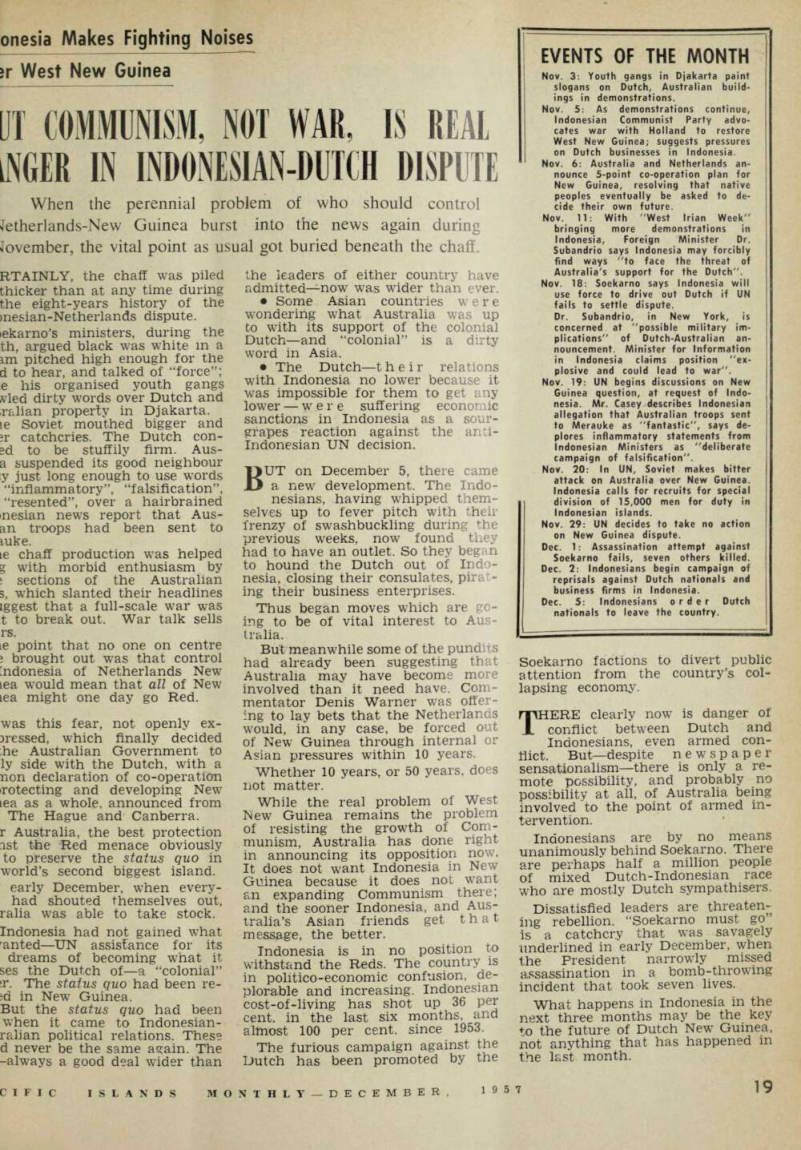
Indonesia Makes Fighting Noises [?]er West New Guinea
[?]Ut Communism, Not War, Is Real
When the perennial problem of who should control tetherlands-New Guinea burst into the news again during tovember, the vital point as usual got buried beneath the chaff.
RTAINLY, the chaff was piled thicker than at any time during the eight-years history of the mesian-Netherlands dispute, tekarno’s ministers, during the th, argued black was white in a im pitched high enough for the d to hear, and talked of “force”; e his organised youth gangs vied dirty words over Dutch and ralian property in Djakarta, le Soviet mouthed bigger and ir catchcries. The Dutch con =d to be stuffily firm. Aus a suspended its good neighbour y just long enough to use words “inflammatory”, “falsification”, “resented”, over a hairbrained nesian news report that Aus an troops had been sent to mke. le chaff production was helped g with morbid enthusiasm by ! sections of the Australian s, which slanted their headlines iggest that a full-scale war was t to break out. War talk sells rs. ie point that no one on centre ; brought out was that control Indonesia of Netherlands New tea would mean that all of New lea might one day go Red. was this fear, not openly ex pressed, which finally decided ;he Australian Government to ly side with the Dutch, with a non declaration of co-operation irotecting and developing New lea as a whole, announced from The Hague and Canberra, r Australia, the best protection ist the Red menace obviously to preserve the status quo in world’s second biggest island, early December, when every had shouted themselves out, ralia was able to take stock.
Indonesia had not gained what 'anted —UN assistance for its dreams of becoming what it ses the Dutch of—a “colonial” ;r. The status quo had been re id in New Guinea.
But the status quo had been when it came to Indonesian ralian political relations. These d never be the same again. The -always a good deal wider than
the leaders of either country have admitted—now was wider than ever. • Some Asian countries were wondering what Australia was up to with its support of the colonial Dutch —and “colonial" is a dirty word in Asia. • The Dutch —t heir relations with Indonesia no lower because it was impossible for them to get any lower were suffering economic sanctions in Indonesia as a sour grapes reaction against the anti- Indonesian UN decision.
BUT on December 5, there came a new development. The Indo nesians, having whipped them selves up to fever pitch with their frenzy of swashbuckling during the previous weeks, now found they had to have an outlet. So they begr n to hound the Dutch out of Indo nesia, closing their consulates, pirat ing their business enterprises.
Thus began moves which are go ing to be of vital interest to Aus tralia.
But meanwhile some of the pundits had already been suggesting that Australia may have become more involved than it need have. Com mentator Denis Warner was offer ing to lay bets that the Netherlands would, in any case, be forced out of New Guinea through internal or Asian pressures within 10 years.
Whether 10 years, or 50 years, does not matter.
While the real problem of West New Guinea remains the problem of resisting the growth of Com munism, Australia has done right in announcing its opposition now.
It does not want Indonesia in New Guinea because it does not want an expanding Communism there; and the sooner Indonesia, and Aus tralia’s Asian friends get that message, the better.
Indonesia is in no position to withstand the Reds. The country is in politico-economic confusion, de plorable and increasing. Indonesian cost-of-living has shot up 36 per cent, in the last six months, and almost 100 per cent, since 1953.
The furious campaign against the Dutch has been promoted by the
Soekarno factions to divert public attention from the country’s col lapsing economy.
THERE clearly now is danger of conflict between Dutch and Indonesians, even armed con flict. But—despite newspaper sensationalism —there is only a re mote possibility, and probably no possibility at all, of Australia being involved to the point of armed in tervention.
Indonesians are by no means unanimously behind Soekarno. There are perhaps half a million people of mixed Dutch-Indonesian race who are mostly Dutch sympathisers.
Dissatisfied leaders are threaten ing rebellion. “Soekarno must go is a catchcry that was savagely underlined in early December, when the President narrowly missed assassination in a bomb-throwing incident that took seven lives.
What happens in Indonesia in the next three months may be the key to the future of Dutch New Guinea, not anything that has happened in the last month.