New Guinea's Most Unusual
pp. 82-95 · Read in the full issue
Harry D.—
Public Servant
Terntonans when in Sydney and in doubt don't ask a policeman—they ask Harry Downing, whose official designation is Welfare and Information Officer, Department of Territories.
Officially he has been friend, philosopher and purveyor of in formation to thousands, and did it with such unofficial spon taneity that all his satisfied customers regard him as the guy who put the original meaning back into the abused term, pubhc servanc.
YOU want some information from a P-NG ordinance? Harry Downing will look it up if he cannot remember it off-hand. Hav ing husband-trouble? Mr. Downing will likely be able to suggest a solicitor who can steer you through the intricacies of Divorce and Matrimonial Causes Acts as they apply in Australia’s territories.
You want to know where most of New Guinea’s coffee is grown?
Ask Mr. Downing. You are a shy Nauruan schoolboy, being groomed for a government job. Mr. Downing will arrange your Australian school, meet you on arrival and see you get to the right place.
You are a New Guinea war widow, not sure of your pension rights, and faced with the job of bringing up a young family unaided.
The knowledge and the sympathy of Harry Downing are yours for the asking.
Someone needs accommodation in a mental hospital; or native New Guinea bandsmen need overnight barrack accommodation in Sydney?
Another couple of jobs for Harry D.
Odd jobs for a public-servant, you say. True—and like Topsy, Harry Downing’s dual job just grew.
In December, 1941, he went to the Department of Territories in Sydney for three days to assist the
women who had been hurriedly evacuated from New Guinea when Japanese invasion threatened. H e stayed 16 years.
He would probably have said at the time that he had not had much back ground for this sort of thing. He had been an Assistant District Officer and a Patrol Officer in Morobe, New Guinea, in Morobe’s roughest and toughest days.
Before that a Medical Assistant in the same ser vic e; a pro fessional photo grapher: an X ray technician; and a soldier of World War I.
They were, in fact, good train ing for the last 16 years, but the best qualification of all was that he has a sympathetic heart.
His early life was shaped by itchy
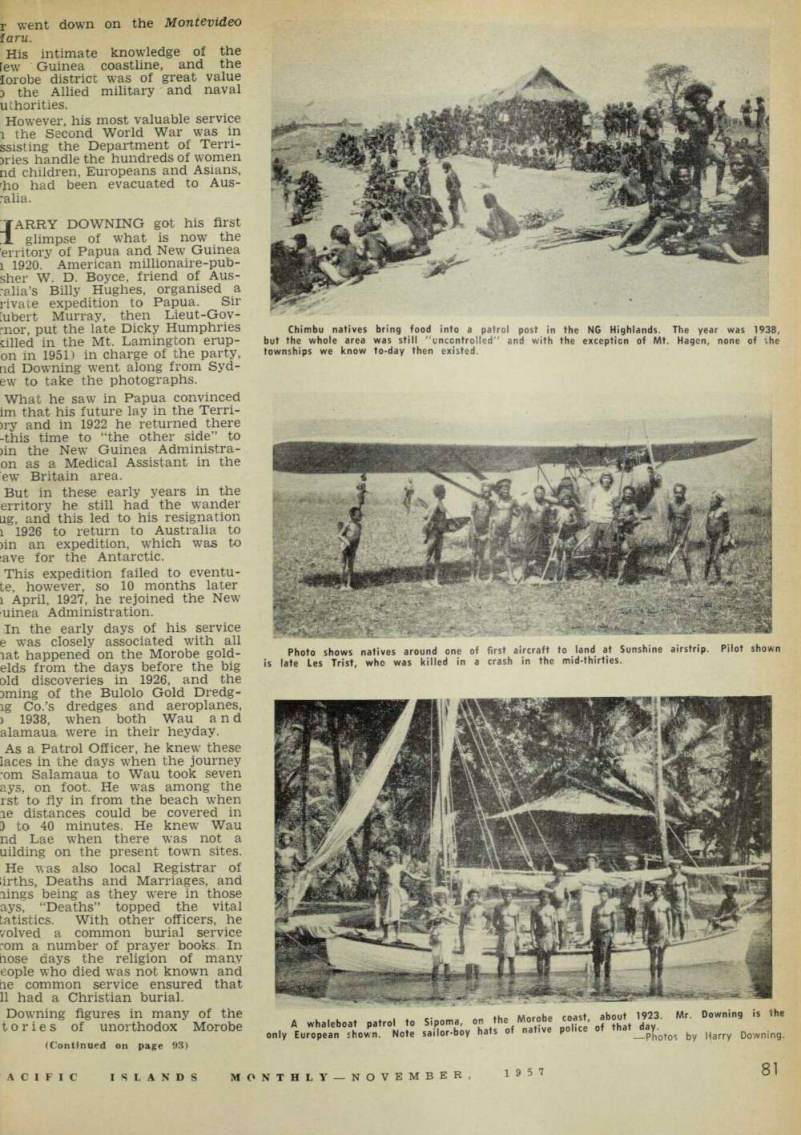
Queensland - horn Henry Ludlow Downing retires from the Australian Department of Territories on December 23,
after 35 years service—l 6 of
them in Sydney, and 19 as a field-officer in New Guinea.
He says he has only one regret —his duties have not taken him hack to the Territory in recent years.
His place at Circular Quay West will he taken hy another officer of the Department, Mr.
A. W. Wynne, who is already well-known to many who seek advice and information at the Sydney office of the Depart ment. Mr. Wynne has special ised in legal matters hut will also direct the “Welfare” part of the dual job he will take over from Mr. Downing.
feet; and his neck was probably saved in both World Wars by sick ness at crucial moments.
In World War I he went to Egypt with an infantry battalion.
In the desert the Gyppos pinched the Aussies’ blankets, Downing got pneumonia and went to hospital.
While convalescing, a call came for men who knew something about photography. He had been a demon strator with Kodaks before he en listed and he was chosen to take charge of the first mobile X-ray field unit.
For a while he was stationed in the south of France, then moved on with the fighting, sometimes at tached to the Canadians, or the French or sometimes with his own Australians.
His own battalion was in the thick of the stouch and few of the originals returned to Australia.
In 1941, he was Acting DO Kieta,, Bougainville, six months overdue i for leave and with a kidney con dition. He was ordered south for medical treatment and was in hos pital in Sydney when the Japs i struck at Pearl Harbour.
Hundreds of his NG contem poraries were murdered by the Japs
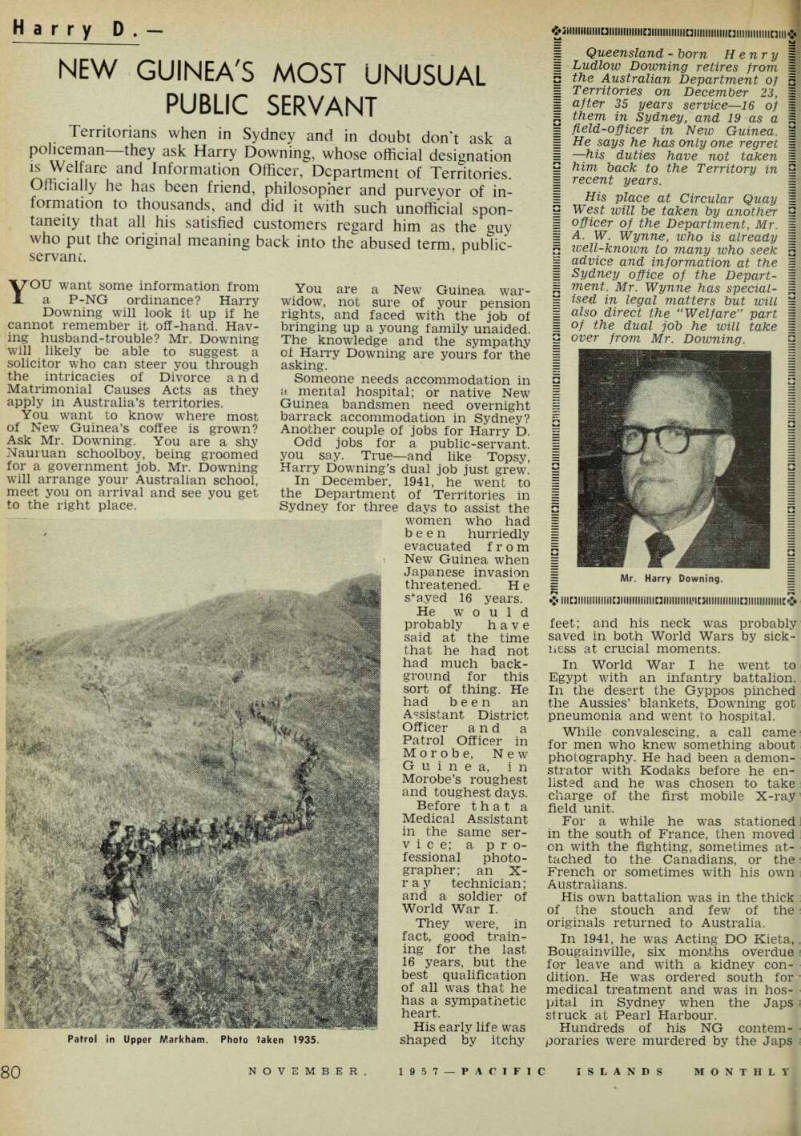
Patrol in Upper Markham. Photo taken 1935.
Mr. Harry Downing.
r went down on the Montevideo laru.
His intimate knowledge of the few Guinea coastline, and the lorobe district was of great value d the Allied military and naval uthorities.
However, his most valuable service i the Second World War was in ssisting the Department of Terri fies handle the hundreds of women nd children, Europeans and Asians, r ho had been evacuated to Aus :alia.
TARRY DOWNING got his first J. glimpse of what is now the 'erritory of Papua and New Guinea i 1920. American millionaire-pub sher W. D. Boyce, friend of Aus :alia’s Billy Hughes, organised a rivafce expedition to Papua. Sir Albert Murray, then Lieut-Gov :nor, put the late Dicky Humphries tilled in the Mt. Lamington erup on in 1951) in charge of the party, nd Downing went along from Syd ew to take the photographs.
What he saw in Papua convinced im that his future lay in the Terri fy and in 1922 he returned there -this time to “the other side” to )in the New Guinea Administra on as a Medical Assistant in the ew Britain area.
But in these early years in the erritory he still had the wander ng, and this led to his resignation i 1926 to return to Australia to >in an expedition, which was to lave for the Antarctic.
This expedition failed to eventu te, however, so 10 months later i April, 1927, he rejoined the New ■uinea Administration.
In the early days of his service e was closely associated with all lat happened on the Morobe gold elds from the days before the big old discoveries in 1926, and the Dining of the Bulolo Gold Dredg ig Co.’s dredges and aeroplanes, > 1938, when both Wau and alamaua were in their heyday.
As a Patrol Officer, he knew these laces in the days when the journey •om Salamaua to Wau took seven ays, on foot. He was among the rst to fly in from the beach when le distances could be covered in 3 to 40 minutes. He knew Wau nd Lae when there was not a uilding on the present town sites.
He was also local Registrar of lirths, Deaths and Marriages, and lings being as they were in those ays, “Deaths” topped the vital tatistics. With other officers, he solved a common burial service :om a number of prayer books In dose days the religion of many eople who died was not known and tie common service ensured that 11 had a Christian burial.
Downing figures in many of the tor i e s of unorthodox Morobe
(Continued on page 93)
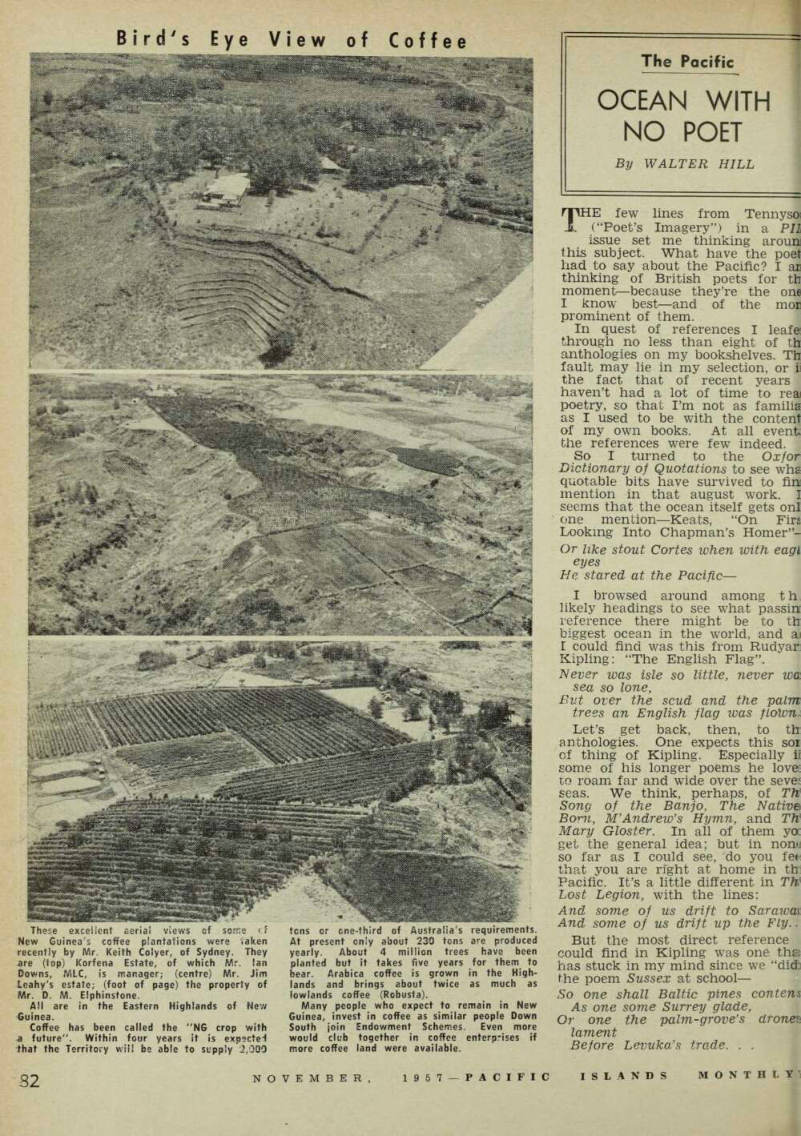
Chimbu natives bring food into a patrol post in the NG Highlands. The year was 1938, but the whole area was still "uncontrolled" and with the exception of Mt. Hagen, none of ‘.he townships we know to-day then existed.
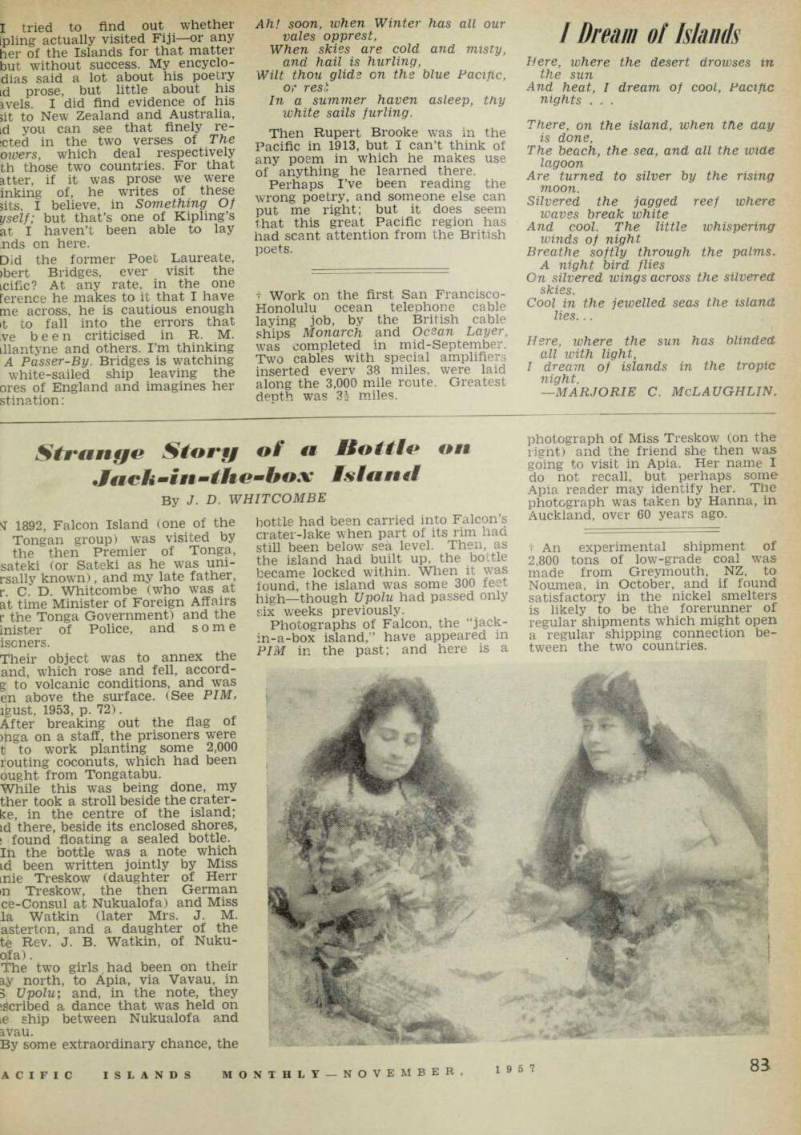
Photo shows natives around one of first aircraft to tend at Sunshine airstrip. Pilot shown is late Les Trist, who was killed in a crash in the mid-thirties.
A whaleboat patrol to Sipotna, on the Morobe coast, about 1923. Mr. Dowing is the only European shown. Note sailor-boy hats of native police of that day. -Photos by Harry Downing.
nerals of those days—apocryphal
Dst of those yarns, but some he :alls himself with a chuckle.
He tells of an Irishman and a ot who were partners at the ack Cat. They had many things common, including love of the trie, and were involved in many msing incidents.
However, the Scot died suddenly, s body was taken to Wau and is placed in a coffin made by the jvernment carpenter. The Irish m went into Wau for the funeral, d put up at the pub.
On the day of the funeral he d a few bracers before setting t—in fact he had so many that e of the girls at the hotel and e proprietress had to make him esentable.
When he saw the Irishman, Down -1 was amazed that he had been le to arrive at the assembly-point aided. From there to the cemetery is about half a mile, so Down l and another officer took it on emseives to act as props for the ishman.
The “hearse” was nothing more an a Guinea Airways trolley, and e coffin kept slipping off. Each ne this happened the Irishman freshed himself with a swig from bottle, with which he had oughtfully provided himself be re leaving the hotel.
The last time the coffin dropped om the “hearse” the Irishman rned to Downing and said: By . . . Harry, I wonder what the 1 Blank would think if he saw , me so drunk I can hardly stand ). It’s probably just what he’d :e to see, though, and he’d under and!” [THEN Harry D looks back over V these 25 years he classes as the highlights of his career his ase association with Levien, Park, sttleton and company, pioneer •ospectors of the 1923-24 period; s official representation of the G Administration at the inaugura an of the first BGD dredge at alolo,; and the active work in inging under control the difficult itives of the Morobe and Madang stricts.
The last 16 years have been in resting—at one time he went to orfolk Island to combine for three onths the threes roles of Acting dministrator, Acting Registrar and cting Official Secretary—but his ?art has remained in New Guinea.
He will be missed from the Sydney lice by many who knew him only ; a cheerful voice at the end of telephone line, and by thousands i whom the contact was more Brsonal.
As a public-servant, “Harry D” as different and that perhaps ex iains why he has got caught up
in the cross-fire between new and old New Guinea pension schemes and will leave the service poorer than when he entered it in 1922.
“Not much luck with money”, he says, “but plenty of good fortune elsewhere.”
With his 14-year-old daughter, he lives quietly in the Sydney suburb of Bexley, where he still engages in his favourite hobby of photo graphy.
Harry Downing has an amazing collection of photographs—some of which are published here. But many of his most valuable negatives were lost when the Japanese invaded the Territory in 1942.
Another patrol picture of early Morobe days—the police-boys still wearing their old-style uniforms.