E12/10/- Per Calendar Month-And
pp. 81-97 · Read in the full issue
When Fiji Police Officers Got—
A Boot Allowance
Written for PIM by CHARLES WAGER, formerly of the Fiji Public Service, and now nearly 80 years old, and living in retirement at Hillcreast Avenue, Tugun, Queensland.
I SMILED when I read in July PIM about the “insufficient” four-figure salaries of the officers of the Fiji Constabulary.
I think I am correct in saying that within a year of the gazetting of the Act which brought the Fiji Constabulary into being and sounded the death-knell of the old Armed Native Constabulary—l was appointed a Sub-Inspector in the new force. I claim I might be re garded as a foundation member of the Constabulary without pension!
For a while I was a sort of Supernumerary Pay and Quarter master and general rouseabout. Clos ing the pubs at 11 pm seems to stick in my memory as my chief duty. It never seemed to occur to anybody—as I was destined to take charge of a country district —to see that I got some experience in the Suva Police Court.
The nearest I got to that was when a very irascible Chief In spector, who just couldn’t stand us for very long, bounced up to me one Monday morning and said; “Did Sub-Inspector Ratu Inoke hand you two pineapples yesterday morning?”
T i coin I replied, Yes . And he sad, Where ar f „ T Ive eaten them , I. rephe(L were the exhibits in a Sunday traam £ case.
CJO came the day when the way O was clear and I was sent off to take charge of the Rewa District. That is why I smile ac the present-day low four-figure pay, because my pay, when I was trans ferred to the Rewa District, was £l2/10/- per calendar month.
Seeing that £3 of it was mortgaged f or a case 0 f Freddie Thomas’
Dewar’s Extra Special, it was as well> for decency’s sake, that we we re also provided with a uniform.
T . olc „ OQT , wp bad free must cilso SB,y i nc: allowance 0 year ’
M Y training lor me joo.
Well, a good few years before go ing to the Rewa, I appeared in the Bridewell Police Court, in my native town of Bristol. It was quite possibly the same Court in which Bloody Judge Jeffries dealt with the
supporters of the Duke of Mon mouth, I was more lucky than they were.
A bored old gentleman fined me 10/- and costs for letting fly with a catapult in a Bristol suburban street. “You are about the only one fool enough to get caught”, said my irate sire.
And that was about all the train ing I had had when the Rewa Dis trict first saw me. Perhaps £l2/10/per month was all I was worth.
But I will say this: if any of the £1,500 a year Superintendents are having a better time than I had on my £l5O, all good luck to them.
The office consisted of an old native-built bure; one chair and a few benzine-cases for callers; not a single book of reference of any sort —not even a copy of the Ord inances of the Colony. When I had to lay an information I had to go to the Court and borrow the magistrate’s book of words.
The so-called office was full of rubbish —exhibits A and B, and what-have-you, accumulated over the years. My first job was to clean it up. What wouldn’t bum went into the river.
A caller from the CSR, at Nauson, remarked on the clean-up.
I said; “Yes-—that nearly went into the river, too, but it looks to me like copper.”
“That” was a twisted bit of pip ing, about six inches in diameter.
“Just as well you hung on to it”, he said. “That’s the vital part of our mm-distilling plant, placed m the Government’s hands for safe
(Continued on page 94)
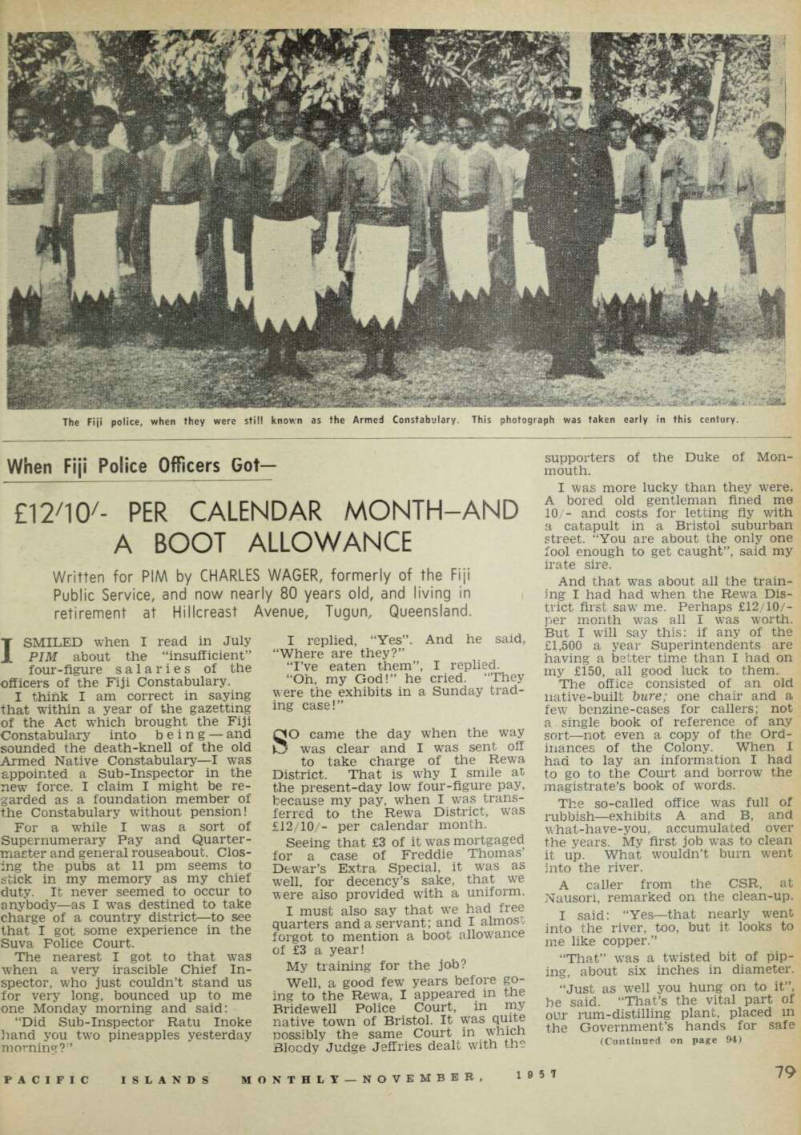
The Fiji police, when they were still known as the Armed Constabulary. This photograph was taken early in this century.
keeping.”
SO, the hard way, all we founda tion members of the Force learned our jobs.
I am sure my old friend Norman Casey, now retired from the Fiji Prisons Department, still remembers some of the hard cases we sent up to him —in my case, Sukhpal and Ramcharan especially.
When Mr. McOwan took charge of the Department it didn’t take him long to get all stations issued with a set of helpful books, as well as our own copies of the Ordinances.
Quite early in the piece, I had to deal with my first corpse, a very over-ripe specimen that was anchored to the bank of the river.
All my boys were out after an escaped prisoner so, for once, I was unable to pass the buck. However, I took the precaution of filling half a bottle of Dewars with water, just in case.
I had to help Dr. Montague, of blessed memory, haul the thing up on to the bank for him to do his grisly job. I doubt I would have
got through without my bottle. I remember riding home singing, “Down Among the Dead Men.”
I remember that Dr. Montague had a small son who was supposed
to have said to his mother, "Whei I grow up, will I be ugly lit Daddy?” If he grew up to be hal as fine a man as his father I should like to meet him.
used to be said, along the river, that my horse was the best groomed in the district. Thereby gs a tale. little Indian named Abdul, who an incorrigible deserter from plantation, was responsible. In , he happened to get the care ny horse, and he made such a of it that he never did any mguage, of course was one of troubles. When I started, I had light knowledge of Fijian, but imdustani. My Nepali sergeant, ted Ghori, had a smattering of m. This meant that all the tesses’ statements to me went in Hindustani to Ghori, who Led them on to me in Fijian, me to write down in English.
RATHER curious thing occurred during that first year of mine. (Some intending settler in the >ny had a bad fall-out with the eminent, and left in a rage, :atening to expose the fact that, the Rewa, lepers were handling anas for the Sydney market, lis, of course, was a serious tter, and I got instructions, sd by the Governor, to look up y leper in the Rewa District, w some very dreadful sights. l one instance, I did find a leper 7 casing up bananas. Under the er Ordinance of the day all I d do was to charge the man i handling articles of food for —which carried a penalty with aximum (I think) of six months he old leper station at Bengha. have always thought that the licity given this case did a lot ring into existence the wonderful r station now at Makogai. ere is an incident of my early ce days. y old friend, Robert Crompton, appearing in the Rewa Court i civil case, and I went along, to get the atmosphere—it was ong since my Bridewell experi uring the case, Crompton turned tie and said that the SM was an ul old blighter for equity. In youthful innocence I said, “Well, t that what he is here for?”
Crompton said, “Not by a long :. He is here to administer the had yet to learn what an ass law can be —and still is, judging some recent cases. <TE of the best stories told of Mr. McOwan, during the time he was our Inspector-General, 3 rs an incident when he was in sting the Levuka station, upert Griffiths was the In stor in charge; and he discovered t Mac, good all-round sports i that he was, had never fired hot from a .303 rifle, his had to be dealt with; so off y went to the local rifle-club ge, with a native constable to
do the marking.
Mac fired five shots, and scored a “bull” each time.
Rupert danced with excitement, thinking he had discovered a marvellous natural marksman. But Mac, who knew his Fijians, fired his last shot wide, into the bush, and up came another “bull”.
Constable Samuela wasn’t signal ling a,ny misses to the boss!
To get back to the Rewa: I find the news that the Nausori Sugar Mill is to close down rather sad.
I think of all the good sound people I knew in my year on the river—Peter and George Gordon, the Freeman brothers (Arthur, Dick and Bert), Viti Hutchins, Waring of Vucimaca, Rostier —there is no end of them.
I remember the goodness of Mrs.
Fenner, Mrs. Raymond and Mrs, Montague, at Nausori; and the planters and their wives up and down the river; the CSR staff; and the boys in the stores.
I think the old river must have been at its peak then —a very lovable little community, which fifty years must have sadly scattered. * * * I am quite resigned to the fact that the Fiji that I knew so well just does not exist to-day; but always am I glad to meet any Kai Viti, past or present, who may be passing this way; and I must say how pleased I was to find Arthur Freeman, of my Rewa days, a near neighbour of mine here in Queens land. He is hale and hearty and still handling bananas by the million.