Late Harold Gatty’S Remarkable Life
pp. 153-155 · Read in the full issue
Many Achievements [?] His 54 Years
Friends of Harold Charles Gatty, who may have deplored his death at the early age of 54 (suddenly, from a heart attack, in Suva on August 30) may take some consolation from the fact that he packed into his 54 years enough variety, adventure, and achievement to satisfy half a dozen average men.
VLTHOUGH born ah Australian, and trained as a ship’s officer (his formal education was com leted at the Royal Australian Naval ollege), and served on trans-Pacific lips of the Union SS Co., he had nished with Australasian shipping, nd entered American life and a ew career, long before he was 30.
We do not know how he made mtact with dare-devil Wiley Post -probably it was through the nited States Army Air Corps, where ratty became a navigation engineer i 1931 —but we do know that it was ratty whom Post selected as his jmpanion and navigator when he ndertook a most hazardous ad mture.
Wiley Post and Harold Gatty, in 131, flew from New York to New ork —the first men thus to cir imnavigate the world—in the then henomenal time of 8 days 15 hours.
Immediately, they were world famous.
Mr. Gatty then served for a period in the US Air Corps; but the plain routine of a steady job was never for him.
BY mid-1935, Pan American Air ways was thrusting its services out across the world, and Harold Gatty became one of the young envoys who made contact with over seas governments and cleared the way for PAA services liaison officers, they were called.
His particular area was the Pacific; and he accomplished what was considered the impossible when, somehow, he “put the Indian sign’’ on the New Zealand Government, and secured for PAA the right to place a trans-Pacific flying-boat terminal in Mechanics Bay, Auck land. Try as he would, Harold never
could get a similar permit from Australia: and so, until the war, the PAA services ran only between San Francisco and New Zealand.
That was Gatty’s second notable achievement.
Then came World War 11, and Gatty served with distinction in the Air Forces of both United States and Australia, and gained the Dis tinguished Flying Cross. (Over)
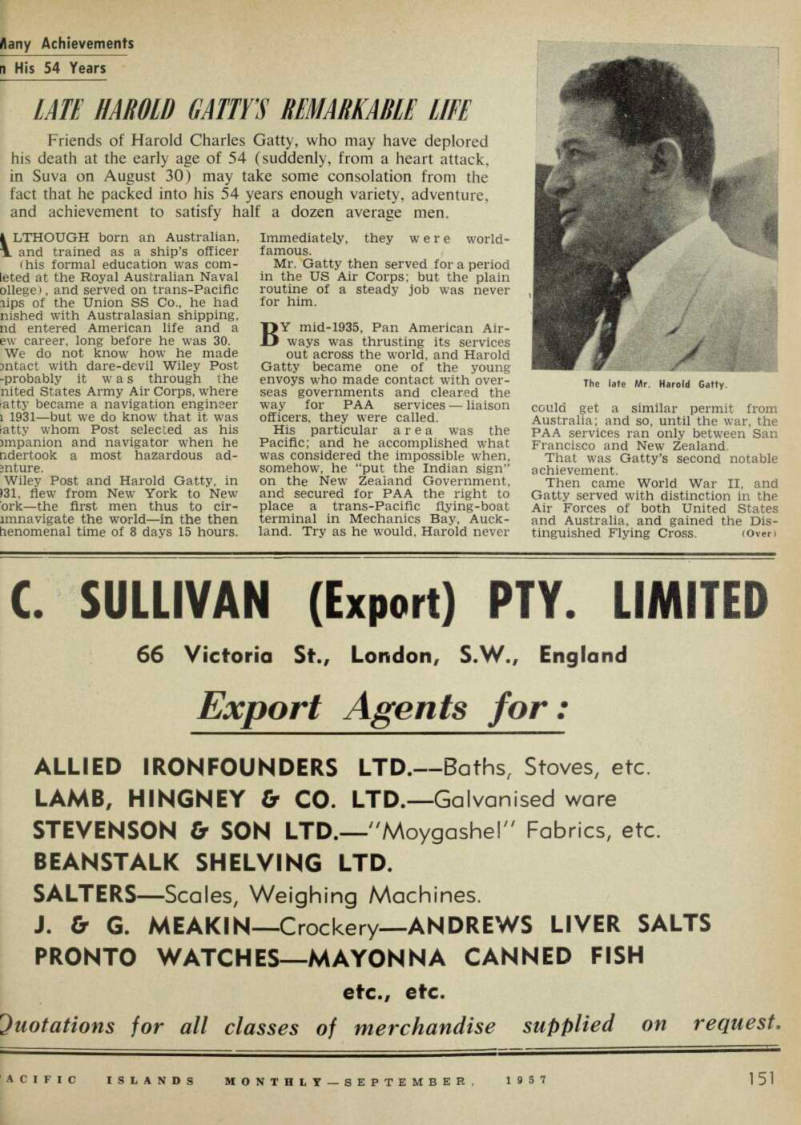
The late Mr. Harold Gatty.
ithin this period, he gave play ne of his ruling passions—the of navigation—and produced Raft Book. It was a guide to lany ways in which an ordinary >n, lost at sea, might navigate loat (or his raft) to safety, and iwhile sustain life. The USA Drities bought tens of thousands pies, for distribution among the which might have ocean ilties. Harold had so much time trouble in getting printing 2e for his book that he bought nting-office in New York, and lis own printing, at book —and its distribution — t rank as his third notable cement. e conditions governing Trans ic airlines changed after World 11, and Gatty took a less active in PAA services—although he led his status as a PAA liaison r until his death. had visited Fiji before the war, and at about the same time he married (his second iage), Miss Fenna Bolderhey, mber of a wealthy Amsterdam y. They liked Fiji; and, after far, they decided to make their i there. was then that Harold Gatty to introduce a new industry to >outh Pacific —tuna canning. ;urvey established the fact that seas abounded in tuna. He 3d a new corporation, South Marine Products, with ships, headquarters, etc., at Bay of ds, a section of Suva Harbour, a factory for canning at Pago , American Samoa, was a complete failure. For reason the tuna in this section ie Pacific could not be caught le methods then employed else e in the Pacific. The corpora broke up, and the equipment sold. The establishment in irn Samoa, however, is now ing large quantities of tuna — it regularly by small ships em ng the Japanese deep-level ig methods. hough it was an economic *e, Gatty’s tuna-fishing enter may fairly be called his fourth achievement. 5 restless mind, and his endless apacity for organisational work urned again to aviation, was obvious that big and grow riji needed internal air services. >us interests had attempted to de them, but had not succeeded.
Id Gatty studied the problems— then, in 1951, he established Airways—and this efficient and idable air transport organisa was a success from the start, rovides the busy link between international airport, at Nadi, Suva; and it maintains regular ces between Suva and every rtant centre in Fiji.
Fiji Airways began with De Havil land Rapides; and, later Gatty added the 3-engined Drovers, which had been written off as a failure in New Guinea. Gatty, the expert air man, found that, while Drovers were not dependable at the high-altitude airfields in New Guinea, they were quite safe at sea-level, and practic ally all Fiji’s airfields are at sea level.
The establishment of Fiji Airways was his fifth great achievement.
Mr. and Mrs. Gatty became well known residents of Suva, and notable people from all over the world visited them there, and accompanied them to their lovely island home out on Katafaga, in the Lau group. He took a keen interest in Fiji affairs, and served for a couple of terms as a nominated member of the Legis lative Council.
BUT he was never still. If he was not attempting to solve the mystery of the October-November rising of the Palolo coral worm, he was observing ocean currents or studying the migratory habits of birds (which he regarded as the world’s greatest navigators).
He maintained a large and growing library, and his own contributions to the world of literature, apart from The Raft Book, were considerable.
He was co-author, with Wiley Post of Around the World In 8 Days.
In February, Collins of London (the head of the famous firm was a guest of the Gattys in Suva only last year) will publish Harold’s new book, Nature Is Your Guide; and this commentator, having seen some parts of it in manuscript, is con fident that it will go on record as Harold Gatty’s sixth —and last— great achievement.
He was a brilliant, pig-headed, most lovable, argumentative, hos pitable man, whom it was a delight to know. His mind at 50, was like that of an eager youth of 20. He may have died at an absurdly early age—but no one ever can say of
him that he Uved in vain.-
R.
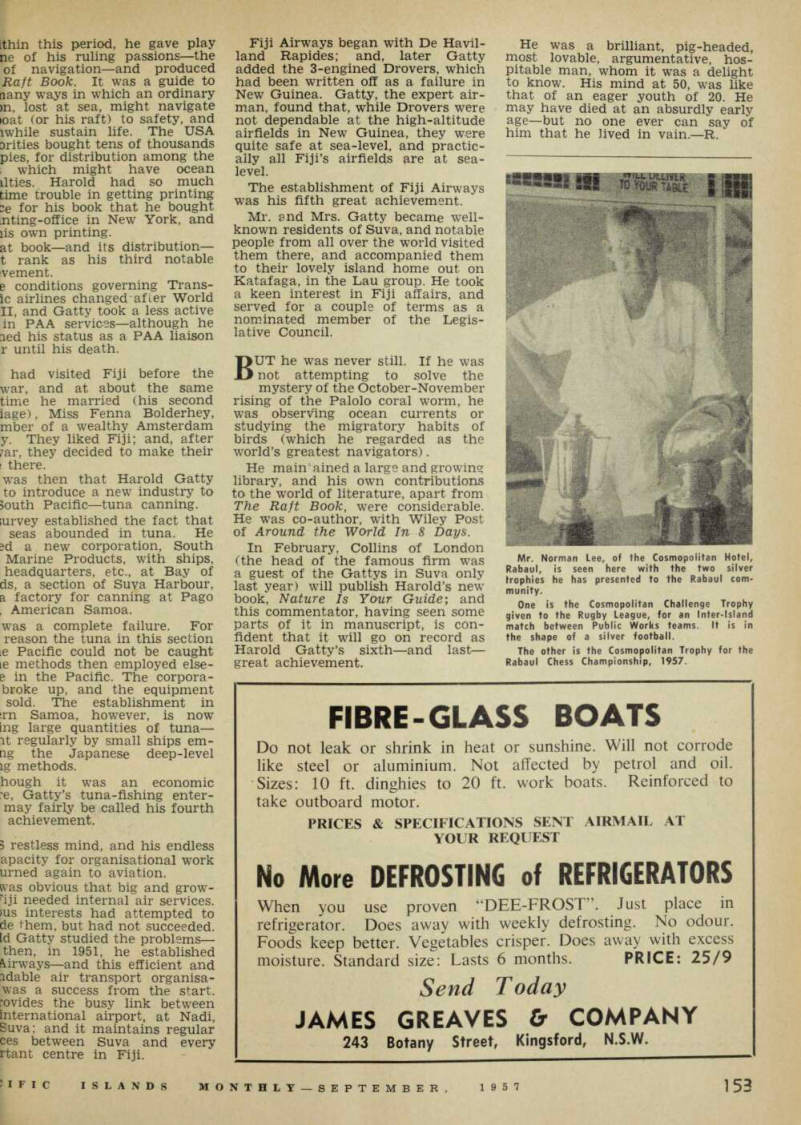
Mr. Norman Lee, of the Cosmopolitan Hotel, Rabaul, is seen here with the two silver trophies he has presented to the Rabaul com munity.
One is the Cosmopolitan Challenge Trophy given to the Rugby League, for an Inter-Island match between Public Works teams. It is in the shape of a silver football.
The other is the Cosmopolitan Trophy for the Rabaul Chess Championship, 1957.