Enemy More Deadly Than The Japs
pp. 90-121 · Read in the full issue
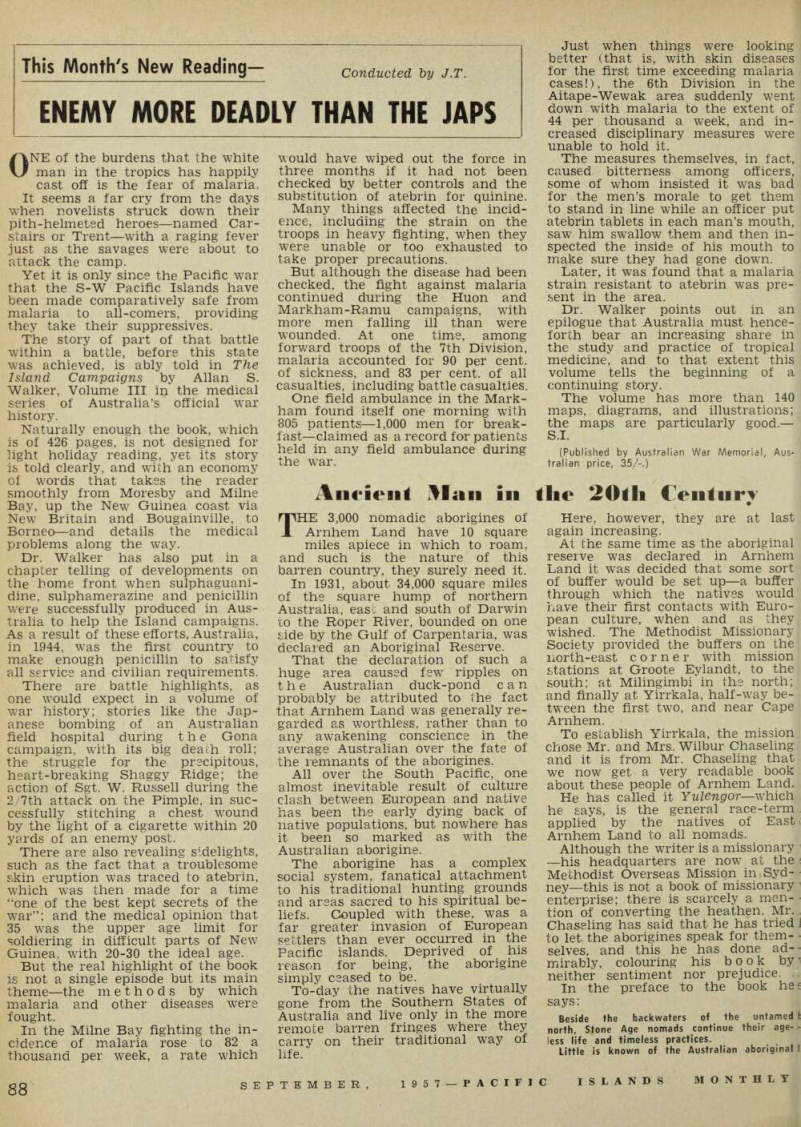


This Month's New Reading—
Conducted by J.T.
ONE of the burdens that the white man in the tropics has happily cast off is the fear of malaria.
It seems a far cry from the days when novelists struck down their pith-helmeted heroes—named Car stairs or Trent—with a raging fever just as the savages were about to attack the camp.
Yet it is only since the Pacific war that the S-W Pacific Islands have been made comparatively safe from malaria to all-comers, providing they take their suppressives.
The story of part of that battle within a battle, before this state was achieved, is ably told in The Island Campaigns by Allan S.
Walker, Volume 111 in the medical series of Australia’s official war history.
Naturally enough the book, which is of 426 pages, is not designed for light holiday reading, yet its story is told clearly, and with an economy of words that takes the reader smoothly from Moresby and Milne Bay, up the New Guinea coast via New Britain and Bougainville, to Borneo—and details the medical problems along the way.
Dr. Walker has also put in a chapter telling of developments on the home front when sulphaguani dine, sulphamerazine and penicillin were successfully produced in Aus tralia to help the Island campaigns.
As a result of these efforts, Australia, in 1944, was the first country to make enough penicillin to satisfy all service and civilian requirements.
There are battle highlights, as one would expect in a volume of war history; stories like the Jap anese bombing of an Australian field hospital during the Gona campaign, with its big death roll; the struggle for the precipitous, heart-breaking Shaggy Ridge; the action of Sgt. W. Russell during the 2/7th attack on the Pimple, in suc cessfully stitching a chest wound by the light of a cigarette within 20 yards of an enemy post.
There are also revealing sidelights, such as the fact that a troublesome skin eruption was traced to atebrin, which was then made for a time “one of the best kept secrets of the war”; and the medical opinion that 35 was the upper age limit for soldiering in difficult parts of New Guinea, with 20-30 the ideal age.
But the real highlight of the book is not a single episode but its main theme—the methods by which malaria and other diseases were fought.
In the Milne Bay fighting the in cidence of malaria rose to 82 a thousand per week, a rate which
would have wiped out the force in three months if it had not been checked by better controls and the substitution of atebrin for quinine.
Many things affected the incid ence, including the strain on the troops in heavy fighting, when they were unable or too exhausted to take proper precautions.
But although the disease had been checked, the fight against malaria continued during the Huon and Markham-Ramu campaigns, with more men falling ill than were wounded. At one time, among forward troops of the 7th Division, malaria accounted for 90 per cent, of sickness, and 83 per cent, of all casualties, including battle casualties.
One field ambulance in the Mark ham found itself one morning with 805 patients—l,ooo men for break fast—claimed as a record for patients held in any field ambulance during the war.
Just when things were looking better (that is, with skin diseases for the first time exceeding malaria cases!), the 6th Division in the Aitape-Wewak area suddenly went down with malaria to the extent of 44 per thousand a week, and in creased disciplinary measures were unable to hold it.
The measures themselves, in fact, caused bitterness among officers, some of whom insisted it was bad for the men’s morale to get them to stand in line while an officer put atebrin tablets in each man’s mouth, saw him swallow them and then in spected the inside of his mouth to make sure they had gone down.
Later, it was found that a malaria strain resistant to atebrin was pre sent in the area.
Dr. Walker points out in an epilogue that Australia must hence forth bear an increasing share in the study and practice of tropical medicine, and to that extent this volume tells the beginning of a continuing story.
The volume has more than 140 maps, diagrams, and illustrations; the maps are particularly good.— S.I. (Published by Australian War Memorial, Aus tralian price, 35/-.)
Ancient Man in the 20ih Century
THE 3,000 nomadic aborigines of Arnhem Land have 10 square miles apiece in which to roam, and such is the nature of this barren country, they surely need it.
In 1931, about 34,000 square miles of the square hump of northern Australia, east and south of Darwin to the Roper River, bounded on one side by the Gulf of Carpentaria, was declared an Aboriginal Reserve.
That the declaration of such a huge area caused few ripples on the Australian duck-pond can probably be attributed to the fact that Arnhem Land was generally re garded as worthless, rather than to any awakening conscience in the average Australian over the fate of the remnants of the aborigines.
All over the South Pacific, one almost inevitable result of culture clash between European and native has been the early dying back of native populations, but nowhere has it been so marked as with the Australian aborigine.
The aborigine has a complex social system, fanatical attachment to his traditional hunting grounds and areas sacred to his spiritual be liefs. Coupled with these, was a far greater invasion of European settlers than ever occurred in the Pacific islands. Deprived of his reason for being, the aborigine simply ceased to be.
To-day the natives have virtually gone from the Southern States of Australia and live only in the more remote barren fringes where they carry on their traditional way of life.
Here, however, they are at last again increasing.
At the same time as the aboriginal reserve was declared in Arnhem Land it was decided that some sort of buffer would be set up—a buffer through which the natives would nave their first contacts with Euro pean culture, when and as they wished. The Methodist Missionary Society provided the buffers on the north-east corner with mission stations at Groote Eylandt, to the south; at Milingimbi in the north; and finally at Yirrkala, half-way be tween the first two, and near Cape Arnhem.
To establish Yirrkala, the mission chose Mr. and Mrs. Wilbur Chaseling and it is from Mr. Chaseling that we now get a very readable book about these people of Arnhem Land.
He has called it Yulengor— which he says, is the general race-term j applied by the natives of East; Arnhem Land to all nomads.
Although the writer is a missionary 1 —his headquarters are now at the i Methodist Overseas Mission imSyd- ■ ney—this is not a book of missionary enterprise; there is scarcely a men- ■ tion of converting the heathen. Mr..
Chaseling has said that he has tried J to let the aborigines speak for them- ■ selves, and this he has done ad- mirably, colouring his book by neither sentiment nor prejudice.
In the preface to the book he-s says: Beside the backwaters of the untamed fc north, Stone Age nomads continue their age- less life and timeless practices.
Little is known of the Australian aboriginal I
except, that in the Stone Age he broke away or was driven out from the rest of the human race and wandered to Australia. He possessed a continent at the cost of becoming isolated from the rest of the human race. Other nomadic hunters evolved into pastoralists or agriculturalists but the aboriginal was denied normal development, for neither Stone Age nomad nor modern scientist has succeeded in adapting (Australian) indigenous food-plants to everyday needs, and no Australian animal has been domesticated.
Mr. Chaseling’s story of the Yulengor as they were, and are, naturally brings up the question of the future of these people. Can the remnants be saved? Without delv ing into the ancilliary question— saved for what? —it now seems: likely that they can.
The buffers provided through the mission stations are now over a generation old and their influence can be gauged.
There is no restriction put on, liberty of the nomads, but there: are signs that they, like most other primitives, could turn from nomadic existence to that of more settled: agriculture. In time.
Around the missions they have been encouraged to build simple; houses of available material; to; cultivate with simple tools. Medical aid is available and this has helped; to save lives —particularly infant lives. Tribal warfare, if not altogether wiped out, is actively dis couraged in the sphere of mission influence, and this, too, has saved lives.
Alien penetration of Arnhem Land has in the past been small, the areai being of little interest to anyone except shell poachers, fishing luggers (on the coast) and stray scientists and prospectors in the interior. The entry of prospecting parties is strictly controlled by the Northern Territory administration—and little of moment has been achieved until recently.
Deposits of bauxite (the raw material of aluminium) on Wessel: Island off the north coast are now regarded as valuable; and in the
:iast few months, even more valuable deposits of the sames mineral on the Arnhem Land mainland have ireceived considerable publicity ( PIM, -June, p. 20).
Whether the introduction of a large industry of this sort could be set-up without having reper cussions on the tribal life of these people remains to be seen. If, in this case, it can be sealed off it will be a complete reversal of the usual form that big industry takes, and of a minor miracle.
The development of the aluminium industry—if it eventuates —will cer tainly be watched with interest by many who have had the Arnhem Land Aboriginal Reserve experiment at heart. In the meantime, Yulengor gives an admirable picture of the foundation on which the future building in the area must be done. (Published by Epworth Press. Distributed by ''Mm. Heinemann. Australian price, 26/-.)
Canton Exit
ifpHERE is something dimly rem- JL iniscent of Nevile Shute (in the days when he confined himself to aircraft and air-services) in the .•second novel of Andrew Geer — Canton Airlift. But at aircraft level, the resemblance disappears and the story becomes completely American, the chief character being a tailored to-fit Clark Gable role: A male part ways noble, part rat, rough, tough, gambling on his own luck, shrewd,
and decidedly not overscruplous in seizing the main chance.
The other characters—apart from those who are reserved for pure nobility—are in somewhat lesser shadings of the above pattern.
For all that, the book is excellent of its type—quite the best action story since Guns Of Navarone of a few months back.
Jeff Jordan was one of the original Flying Tigers but at the end of the official war in the Far East, he had managed to collect together (by rather dubipus means) some wardisposals aircraft. As the story opens, he is operating his own ser-
vice out of Canton cashing in on the last of the civil war in China as Chiang Kai Shek’s forces are making steady “strategic withdrawals” from the Chinese mainland—ultimate destination Formosa Like Jordan himself, his pilots— mostly Americans with a few Chinese —were also soldiers of fortune and these were the complicating and unknown factors in Jordan’s scheme for making a quick fortune, Into the story also come the de voted English doctor and the un scrupulous Chinese merchant, both of whom unwisely believed that they would be respected by the Com
munists when Canton ultimately fell; the Duchess, destitute relict Of a White Russian; Meng Wong the River Lady who is the big voice in the operations of all the junks in South China; and Mary Stuart, the beautiful Eurasion from Singapore, whose reason for being in the story never quite rings true.
As a love interest had to be introduced into the story—to give Jordan something other than money to think about—it might have been done much more easily than in this way.
Having spurned Jordan in Singapore some years previously, and spurning him again in Canton, it remains something of a mystery why Mary turned up in that particular place. In matters of the heart, the author is apparently determined that fiction is a great deal stranger than truth.
Canton finally falls to the Communists, Jordan meantime having moved his headquarters to Hongkong. The climax of the story comes when he and the river people move back into the fallen city to try to rescue those who, not believing that the Reds could be as bad as painted by Nationalist propaganda, remained behind.
You need to be without any antipathy for tough Americana for this—but with this proviso the average reader will find Canton Airlift a fast-moving and entertaining
piece of adventure fiction. (Published by Wm. Collins, Ltd. Australian jrice, 18/9.J
Independence-
Feminine Gender
ONE can wonder, after reading Ronald Kirkbride’s Jenny Wren why, having gone to so much trouble to gain The Vote, women have done so very little with it.
Much of this story concerns the pre-World War I activities of British suffragettes: street brawls, gaol, hunger-strikes, forced-feeding and so forth. The ladies’ sufferings for the Cause were considerable but mostly forgotten now, two genera tions later. Possibly our grand fathers, who so vigorously opposed political freedom for their women, predicted the direct consequences from the new-fangled notion of letting untutored females vote. They need not have worried, as events have turned out. Militant feminism seems to have burned itself out by the end of the First War and most women of 1957 are as politically apathetic as their Early Victorian ancestors. Which perhaps is a pity.
The best parts of Jenny Wren are the sequences that deal with those days when these hardy souls, some men as well as women, and regarded as political radicals, bucked polite society with the idea of rais
ing the status of the female above that of domestic chattel. For the rest, it is a queer conglomeration of disjointed superficial episodes which lead to a conclusion that is completely improbable.
Miss Jenny Wren, an elderly spinster, lives in a genteel boarding house in London. It is only when
a young American playwright wants to turn a long-forgotten book she has written into a musical comedy, that her unusual early life emerges.
This is the general theme of the story but onto this early 20th century canvas, the author has flung, like some surrealistic design, additions of post-War II vintage. A bit of Lesbianism; a few hearty dollops of more normal sex; a bit of post-war Austerity; and some pseudo-Ameri canism—as though the author were writing to a formula designed to interest as many varieties of reader as possible.
It would have been a much better piece of work if Master Kirkbride had given us a straight story of Jenny Wren—who alone amongst the characters appears human—and left out the extraneous bits and pieces. (Published by Angus and Robertson, Ltd.
Australian price, 16/-.)
Love, etc., etc., etc.
THE writer of the spiritual novel has a considerably harder task these days than his literary grandfather of a half-century ago when values were more easily and dogmatically expressed in plain black and white.
The religious or spiritual motif is
usually left exclusively to the senti mental-mush treatment of Reader’s Digest type. Although the longer treatments are also done mostly by Americans —which may perhaps be considered significant.
William E. Barrett (The Left
Hand of God ) makes a better fist of it than most and in his latest book, The Sudden Strangers, pro duces a credible story of contem porary American life into which emotional conflict and religious scruple are skilfully woven.
However, as in real life, church dogma does not solve all.
Should Dorinda, mid d 1 e-aged musical comedy star, continue there fore to eschew marriage (and “live in sin”) with Carter Brill because the Catholic Church says that she is still married to a Mcßride — although said Mcßride has these many years been Brother Anselm, inmate of a monstary? Author Harrett does not solve this problem.
Meantime, Bart Mcßride, a pro fessional baseball player, and son of Dorinda and Brother Anselm, some what adrift on a sea of his own -emotions, falls in love with Mary.
It takes 330 pages to straighten Bart and Mary out and although the same pages do nothing per manent for Dorinda, at least they give an interesting enough account of American life and show-business.
This is not one of those books that “make you think”; possibly, (as far as this reviewer is concerned anyway) because it is hard to take a professional baseball player too seriously. (Published by Wm. Heinemann, Ltd. Aus tralian price, 20/-.)
To Be a Sailor-Boy
(Second Class)
IN the continuing spate of factual war-books, one sometimes needs a microscope—or a crystal-ball— to sift the good from the f.a.q.
For no perceptible reason, Home Is the Sailor (John Whelan) n above the average class, presented with a natural exuberance, consid erable humour and an easy style, to tell the story of a youngster of middle-class Welsh parents who joins the Navy (lower deck division) for a 14 years’ stretch in the days of peace.
Before service is more than half completed, war intervenes and the tempo quickens—although this is mostly incidential to life in Wheelan’s Navy.
He joined in 1932 at the age of 16, on the lowest rung of the nautical ladder, Boy, Second-Class, at 5/3 per week. He emerged at the other end of the stretch as a Petty Officer.
Therefore this is no dramatic story of giddy promotion to officer class; but an often humorous tale of considerable entertainment value based on the life, fears, aspirations, pleasures and endurance of plain sailors, gun-layers and technicians in home waters or in foreign parts. (Published by Angus and Robertson, Ltd.
Australian price, 16/-.)
Vive Le Roi!
STEINBECK fans of the Grapes of Wrath, Cannery Row variety ' will probably not admire such
departure from tradition as The Short Reign of Pippin IV.
If you are not normally for Steinbeck, however, this piece of fantasy may change your mind—in spite of the fact that 5,000 book reviewers have already gone on record to say such satire is not the Master at his best.
To those without prejudice, it is a delightfully extravangant leg-pull based on the absurdities of French politics; with a broad slap at American bounce in business; and a jab at British tradition.
To get the multi-partied French Parliament out Of a hopeless deadlock, it is decided to restore the
monarchy. In order to avoid the problems attendant on more recent history, it is decided to go far back —t° Charlemagne, in fact. In the person of a retiring, middle-aged amateur astronomer is found a direct descendant, and he is per suaded (wife and daughter assist mg) to accept the French throne as „^ P ? ir ? IV ' .. „ .
What happens thereafter affords Master Steinbeck plenty of oppor tumty to sharpen his pen (or bend on . ™ost of th e Gallic institutions, inhibitions, and lack of same> (Published by Wm. Heinemann, Ltd. Aus tralian price, 15/6.) (Over)
Far Better Fate
Than Death
THE sea is in a rollicking mood this month. As well as Home Is the Sailor aforesaid, it has washed up A Wren Called Smith, by Alexander Fullerton, which contains one passage of somewhat stark tragedy and a larger quantity of something else which will enhance the author’s reputation for provid ing light entertainment.
The time is late in the Pacific War; the place is the Philippines; the characters are nautical —including, of course, Mary Lou, the Wren called Smith. The only other lady in the piece is the Norwegian freighter Gangerolf, commanded by Captain Harry Christiansen, who believed that whatever was woman’s place, it was not on board his ship.
On board Gangerolf, when she left Subic Bay, were Bill Dsrby, a British submarine captain return ing to the UK for medical board ing; Lieutenant-Commander With eringham, an ineffectual piece of aermanent Navy equipment who had apparently been mislaid in far parts Df the globe by the Admiralty; Cap tain Spatter, of the US Navy, who was in charge of 30 Germans whose U-Boat had been sunk; and, of course, Mary Lou, the only Wren in the Philippines amongst 40,000 aen, most of them Yanks. Maybe
they were sending her home for her own good.
Mary Lou was young, very pretty, with a natural gift for what she called having fun, but above all she was a woman who could face up to realities. It was the last talent that provides the focal point of the whole story—and its surprise end ing.
Gangerolf had not proceeded very far on her voyage before she met a Japanese submarine. The survivors reached an island, and this is really where the fun commenced: it was playing at desert islands with a difference and although not accord ing to Navy ethics, it is amusing. (Published by Peter Davies, Ltd. Australian price, 17/-.)
Australian
Shop Window
THE very highest grade work in book production can now be done —and is done —in Australia.
And one of the glossiest jobs that we have ever seen has recently been edited and produced by Oswald L.
Ziegler—with the active co-opera tion of long-established publishers and printing trade suppliers and State and Federal Government de partments.
Obviously designed as a shop window for Australia, it is the kind
of fare that would turn the waver ing migrant’s footsteps southward; or inspire the tourist to put Aus tralia on his lift of “must” travel.
It shows, in picture and story, the best that Australia has to offer by enlisting the aids and arts of the pictorial, typographical and journal istic professions.
It covers all phases of life, history, Industry, culture and development In the Commonwealth in a large and lavish book, containing hundreds of black and white and colour photo graphs and without advertising, in the usual sense. As book produc tion costs go these days, we should say that at £2/10 -, it comes within the bargain bracket.
If one is inclined to spend this sort of money on overseas relatives and friends, we cannot imagine a better gift for those who might be interested in the land Down Under; it should also be an invaluable re ference book for schools and libraries overseas —particularly in the Pacific Islands, where ties with Australia are strong. (Our copy from Angus and Robertson, Ltd.)
War Among the Neutrals
Kenneth dodson's first book, Away All Boats, received the modern writer’s accolade: it was made into a movie. It was a novel of the American attack trans
ports in the Pacific war and, as we said at the time, rather unique for an American novel in that it con tained no women.
The writer has made good the deficiency in his second novel, Stranger to the Shore, recently published.
The time is still the wartime 1940’5; the service still that of th. sea; but this time it is in a Merchani Navy ship and a great deal of th. action takes place in port.
Kurt Mueller (American) waj carpenter on Cape Falcon ; Cap\ Falcon was in a technically neutm
outh American port, loading cargo Dr San Francisco after a long assage across the Jap infested acific.
Mueller was a quiet, retiring man ho avoided trouble when possible nd he was not much struck with uerto Felicidad and would not have one ashore if he had not been urged y a solicitous captain to “stretch is legs.”
Once ashore, Kurt becomes mixed p with pro-Nazis, fell in love with girl in a cafe, who has run away •om a mis-spent youth; got across 7e necks of the town’s Big Noise; as beaten up by thugs; killed the lllain; was put in gaol and, finally, i a yawl conducts a running en- Dunter with a German raider.
It will be observed that it is a □ok of considerable action. Readers r ho enjoyed Away All Boats will kewise enjoy this. (Published by Angus and Robertson, Ltd. jstralian price, 17/6.) eviewed Briefly . . .
CONFLICT: Reprint of the book üblished first in 1934; written by . V. Timms before he returned ome to Australia and devoted him flf to writing an Australian saga, his is an historical romance, the Dene being mostly Mediterranean — DUthern France and Italy. The tory concerns the doings of a lysterious Englishman and the raids f Muslim pirates using red galleys 3wed by slaves. (Published by Angus and Robertson, Ltd. ustralian price, 16/-.)
The Man From Oodnadatta:
ly R. B. Plowman, is also a re rint, having first appeared in 1933. , second edition was printed in 937; this is the third. It tells of he padre who visited his 2,500 quare-mile parish in Australia’s entre using a string of camels for tie 5 months’ task. In the interven ig years much has changed in the Jentre: flying-doctors, air-trans tortation, sealed highways and a Durist industry. But any Australian ook that runs into three editions s something of a classic and the tory still has plenty of interest. (Published by Angus and Robertson, Ltd. ustralian price, 20/-.) THE SHEPHERD, represents an ttempt by Robert Payne, who has litherto written mostly about China md the Far East, to portray the arly life of Jesus of Nazareth. It 3 planned as the first of three books nd covers the period from his child lood as the son of a prosperous larpenter, to his Baptism in the brdan and his proclamation by his :ousin Yona as the Messiah long iwaited by the Jews.
The story of Jesus has been pre ented in many ways; whether the Jresent version will do anything for he cause of Christianity is doubtful. r or our money, we could have dis
pensed with the Old Testament manifestations —pillars of fire, black panthers, white flames, storms that shook the heavens, etc. —which accompanied moments of crisis in the Shepherd’s life. (Published by Wm. Heinemann. Australian price, 18/-.)
What's New in Pocket Books
New Pan and Fontana books, which should be available in your local book shops now, include the following large batch (our copies from Wm. Collins (Overseas) Ltd.) : GOLF BOOK. (Louis T. Stanley).
An original, published especially for
Fontana tells you how to reduce your handicap; simple text and over 100 drawings and photographs.
Naught For Your Comfort,
by Father Trevor Huddleston, the Anglican priest who became world famous when he bucked the Afrikans government of South Africa over its racial policy. Fr. Huddleston for 12 years ministered to the negro slum of Sophiatown, outside Johannes burg. He became non persona grata with the Government, and raised the ire of many white South Africans although to the natives he remained The Dauntless One. He was recalled to England in April, 1956. Over
(Continued on page 117)
00,000 copies of the library edition f his book have been sold. The oyalties on the book go to Fr. [uddleston’s Order to further work mongst non-whites in South Africa.
Fontana).
Life In Our Hands: Pamela
iright describes the experiences of nursing sister who landed with the -Day troops on a Normandy beach, nd with an advanced casualty learing-station followed the British dvance through France and Bel ium into Germany. (Pan).
Cure For Serpents: By
Iberto Denti di Pirajno. The uthor’s Dukedom was created in >42, but he is also a doctor and i 1924 went first to Italy’s North frican colonies in that capacity. In )41 he became Governor of Tripoli; vo years later in that capacity he ad to hand over the city to Gen *al Montgomery, and four months ter vacate his headquarters. (His srvant announced: “English in irden; red-hat with gun.”) How rer, in between 1924 and 1943 he ad time to collect an amazing jlume of stories that read like a *oss between the Arabian Nights id Axel Munthe. (Great Pan).
Secrets Of Suez: This Is A
an Special, published at the same me as the library edition of the oo k. Written by two French urnalists who were in Port Said : the time of the Suez crisis, it msed a sensation on both sides of le Channel when it was published . Paris earlier (his year. The uth o r s are Merry and Serge romberger, and it was translated r James Cameron, News Chronicle ireign Correspondent. The authors y to apportion the blame for this ost face-loosing of all Anglo rench operations, and get near tough to the bone to hurt a number people. Their translator disagrees ith their conclusions—he takes the ew that it should never have ippened. The Brombergers, on the her hand, believe that it was a irthy action, disgrace intruding hen it was cut short without aality through political interfer ice.
Lieutenant Hornblower:
n episode in the earlier life of C. S. jrster’s salty character. This par cular story was, some time ago, ade into a film starring Gregory sck. Neither Forster nor Hom ower needs any introduction to the ading public. (Great Pan).
The Day Must Dawn: Agnes
igh Turnbull’s story of pioneering Pennsylvania in the days of the merican War of Independence, idian raids, extreme poverty and remitting toil made up the lot these people who laid the founda m of the American nation, ’ontana).
The Golden Summer Is As
satisfyingly full of French titles, chateaux, dashing noblemen and charming women as Anne Duifield’s stories usually are—for those who care for this type of romantic story. (Pan).
Miss Pym Disposes: This
mystery story by Josephine Tey was reviewed in PIM some years ago when it appeared in the library edition (published by Peter Davies).
Although by no means the best Tey mystery in the view of this reviewer, it was popular with most Tey fans. (Pan).
Its Different In July: By
Kevin Fitzgerald, was also reviewed in PIM when it was first published by Heinemann a couple of years ago. This is one of those highly mysterious mysteries where heroes turn into villains and villains into heroes with disconcerting frequency. (Pan).
The Hunchback Of Notre
DAME: Victor Hugo’s masterpiece is published in Fontana for the first time, following the recent release of the film starring Italian star Gina Lollobrigida.
HORNED PIGEON: Another war time escape story—this time by George Millar, DSO, MC, who was taken prisoner by the Italians in North Africa, tried to escape from Italy after the country surrendered, but was transferred to Germany, where he made another and suc cessful attempt, and with the help of Resistance leaders reached Paris.
Death In The Clouds: This
particular Agatha Christie is 22 years old—but the doings of Hercule Poirot never seem to grow too old to attract new admirers or refresh
the memories of old friends, (.Fontana).
SILVER ROCK: Author Luke Short writes Westerns, but up to date. In this one, Tully Gibbs re turned home from the Korean War intending to get rich quickly at the little mining town of Azurite, but he soon had another shooting war on his hands. (Fontana).
The Lonely Skier: This
Hammond Innes thriller is set in the Italian Dolomites, It concerns movie makers as w-ell as skiers. (Fontana).
Out Of Asia Alive: By Mark
Derby, is an adventure story of
South East Asia—mostly about an island in the Indonesian area. The story of a convicted murderer who escapes prison to seek vengeance on the man he regarded as his enemy. (Pan).
JUNGLE CHASE: Adventure in East Africa this time, by Roy Farran. A young mining engineer meets an elderly ivory hunter; they become firm friends but then the young man realises that the elder has committed some sort of crime and is hiding out from the police. (Fontana).
The Spoletta Story; James
Dillon White, who wrote the story about Genevieve, the vintage car, has produced something quite dif ferent in this—the story of love, crime, and vendetta amongst Sicilian bandits. (Pan).
The Gold Of Their Bodies;
The story of the artist Gauguin, by Charles Gorham. This book is based on fact—with some embroidery.
According to Gorham, Gauguin would never have turned to other women if Mette, his wife, had been able to believe that the world is well lost for art. Others, however, may feel that Mette had some justification on her side. Fontana).
EARTHLIGHT: Arthur Clarke has taken a leap in science fiction.
His story assumes that inter planetary travel is an accomplished fact and that mankind has estab
lished itself on most of the planets —most of which are claiming inde pendence from the mother world. It seems to be the old problem on a still bigger scale. (Pan).
Ellery Queen’S Book Of
MYSTERY STORIES: This is a col lection of 25 stories by writers not
usually regaded as crime writers;: Hemingway, Sinclair Lewis, and Steinbeck being just three of them.
The mystery of “Ellery Queen” is alsc explained. This is a pen-name of two Americans who for 30 years and 30 novels collaborated to pro duce the Ellery Queen books. Their
names are Frederic Dannay and Manfred B. Lee. (Pan Giant).
The Young Lions: The Best
selling first novel by Irwin Shaw has now been reprinted unabridged as a Pan Giant. The book covers a huge canvas. Three young men meet in Bavaria before the Second World War. Two of them are Americans and the other a member of the Nazi party. The story follows them in dividually through the next few years and brings them again to gether for the climax. This book flaimed considerable attention when it was first published in 1949.