Six-Feet Men, With Five-Feet Axes
pp. 86-87 · Read in the full issue
Mokolkol[?]e Come!
By Kent Williams
HIGH in the mountains, above Open Bay, slightly north of the volcanic Father Mountain, dwell the Mokolkol tribe, the last of several killer tribes which once in habited New Britain.
These people were greatly feared by the more peaceable and civilised natives, and the name Mokolkol is still enough to throw a scare into a plantation labourer (and others).
The Mokolkols roamed compar itively near Rabaul, the capital of New Britain —within 80 or 90 miles of it; and they persis ed in their primitive, savage, nomadic exist ence until recently.
For many years, during German administration of New Guinea, the Government sent out expeditions in vain endeavours to contact the Mokolkols.
After the 1914-1918 war, when Australia took over, many more attempts were made to contact Mokolkol savages. Such expeditions were entirely fruitless until a couple of years ago when, following a kill ing raid by the tribe, a Government patrol was at last successful in capturing a Mokolkol woman and two men.
These were taken to Rabaul, to calaboose. However, the detention was mentally, medically and physic ally friendly and humane.
These guests of the Government were well fed and kept in Rabaul until a fair smattering of local Pidgin talk was assimilated by them. Then a Government patrol took their now happy captives back to the solitude of their mountains. Contact then was easily made with the tribe by virtue of the assistance rendered by the erstwhile captives.
The chief man of the tribe was made Government Head Man— Luluai—and ceremoniously crowned with the “Hat” (a red braided, peaked cap). He was an able student of the ceremonial foot slam and sweep ing salute.
Now these primitives were safely under control. Or were they?
One day a planter on a lonely, embryo cocoa area on Open Bay was planting seedlings with a few boys when a terrific uproar was heard from the vicinity of the house com pound.
Nothing could be seen from the planting area, densely screened by temporary shade growth, but the din coming from the quarters seemed a veritable donnybrook. The few seedling boys yelled, “Mokolkol he come!” and promptly disappeared.
The planter felt that the only thing he could do was go and see
“wattinell” was doing. This is his story: IGOT up near the house and saw a mob of natives milling around near my house-cook tank. a c T crr»t rinspr a hi? naked
savlee curving a gfeamfng five-
feJt hafted ale mf towards me
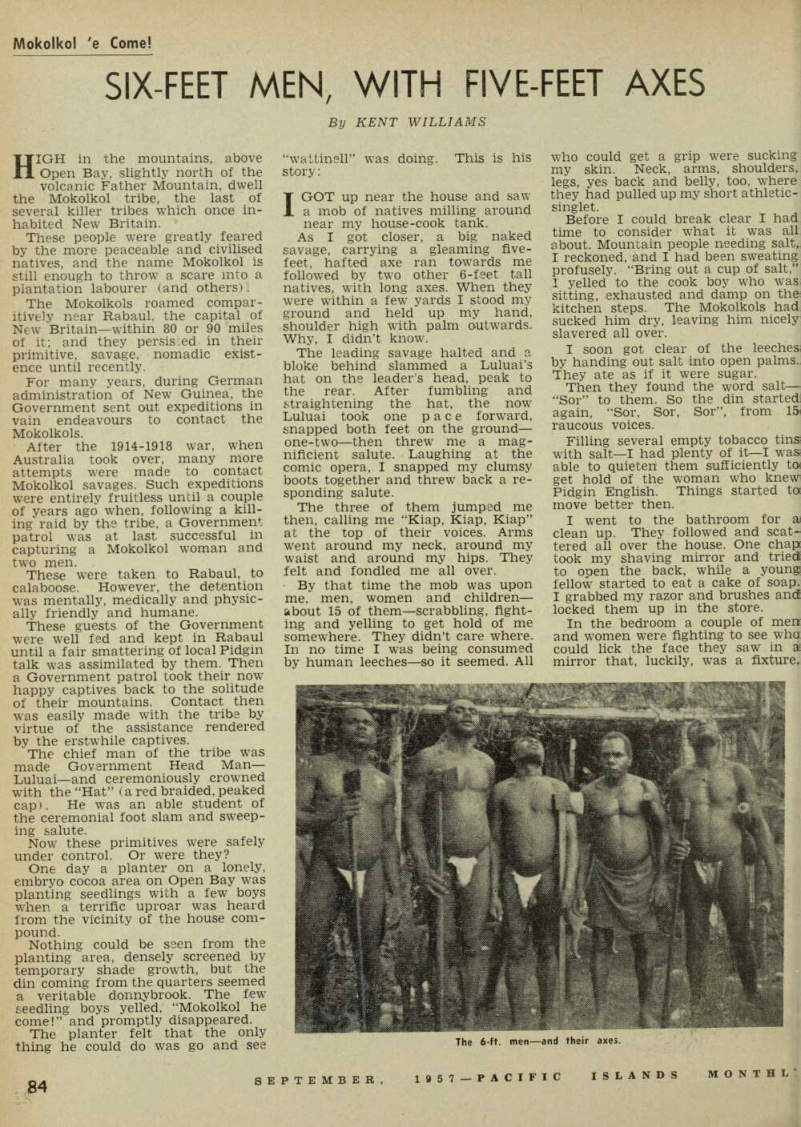
followed bv two ither 6-feet tell natives with long axes. When they were within a few yards I stood my ground and held ud mv hand shoulder high with palm outwards, Why, I didn't know The leading savage halted and a bloke behind slammed a Luluai’s hat on the leader’s head, peak to the rear. After fumbling and straightening the hat, the now Luluai took one pace forward, snapped both feet on the ground— one-two—then threw me a magnificient salute. Laughing at the comic opera, I snapped my clumsy boots together and threw back a respending salute.
The three of them jumped me then, calling me “Kiap, Kiap, Kiap” at the top of their voices. Arms went around my neck, around my waist and around my hips. They felt and fondled me all over.
By that time the mob was upon me, men, women and children — about 15 of them—scrabbling, fighting and yelling to get hold of me somewhere. They didn’t care where, In no time I was being consumed by human leeches—so it seemed. All
who could get a grip were sucking my skin. Neck, arms, shoulders, legs, yes back and belly, too, where they had pulled up my short athletic singlet.
Before I could break cleai I had time to consider what it was all about. Mountain people needing salt,, I reckoned, and I had been sweating Profusely. “Bring out a cup of salt yelled to the cook boy who wasi sitting, exhausted and damp on the' kitchen steps. The Mokolkols had. sucked him dry, leaving him nicely slavered all over. 1 s °on got clear of the leeches; by handing out salt into open palms., They ate as if it were sugar, T hen they found the word salt Sor to them. So the started^ again, Sqr, Sor, Sor , from 15< raucous voices.
Filling several empty tobacco tins; with salt—l had plenty of it—l was; able to quieteil them sufficiently to< get hold of the woman who knew' Pidgin English. Things started toe move better then, I went to the bathroom for ai clean up. They followed and scat tered all over the house. One chape took my shaving mirror and triedi to open the back, while a young fellow started to eat a cake of soap, I grabbed my razor and brushes and! locked them up in the store, in the bedroom a couple of merr and women were fighting to see whoc could lick the face they saw in at mirror that, luckily, was a fixture.
The 6-ft. men —and their axes.
Two or three others were sitting on my bed chewing and spitting betel nut on my limbung palm floor.
I gradually herded all out to the verandah dining room, where some were already sitting on the dining table and some stretched full length on the floor. Three at once tried to balance themselves on a couple of chairs placed together.
Three of my labourers started to show great courage and came up to help. These, with two local Kanaka friends, were placed at strategic positions in the house whilst I took all the Mokolkols below, under the shade of a green creeper arch. There I spent a couple of hours dressing many festering wounds, sores and ulcers, all smelling vilely. One old lady complained of a joint pain so I rubbed in a sweet smelling medica ment. The whole of the tribe then had to be rubbed with it, some where or other.
I gave them a few old axe heads, bush knives, lap laps, razor blades, salt and other things and told them next time they came I would have more presents to give them, from the No. 1 Kiap in Rabaul.
With a parting salute the Luluai gave forth a fiendish cry and started for the untracked bush at a quick pace. All his retinue fell in behind and without a single good-bye gesture set off after him and dis appeared.
THE Mokolkols paid us another visit about six weeks later. There were about 30 of them this time.
This time, too, my wife and daughter, aged fifteen, were with me, fresh from Australia.
It was after belo kaikai, when I saw them coming from the bush.
Not knowing what mood they might be in, whether friendly or hostile, I sent my wife and daughter inside and met the Mokolkols outside.
I received the same official salute but there was no more skin licking.
They asked at once for “Sor, Sor”.
And received it promptly.
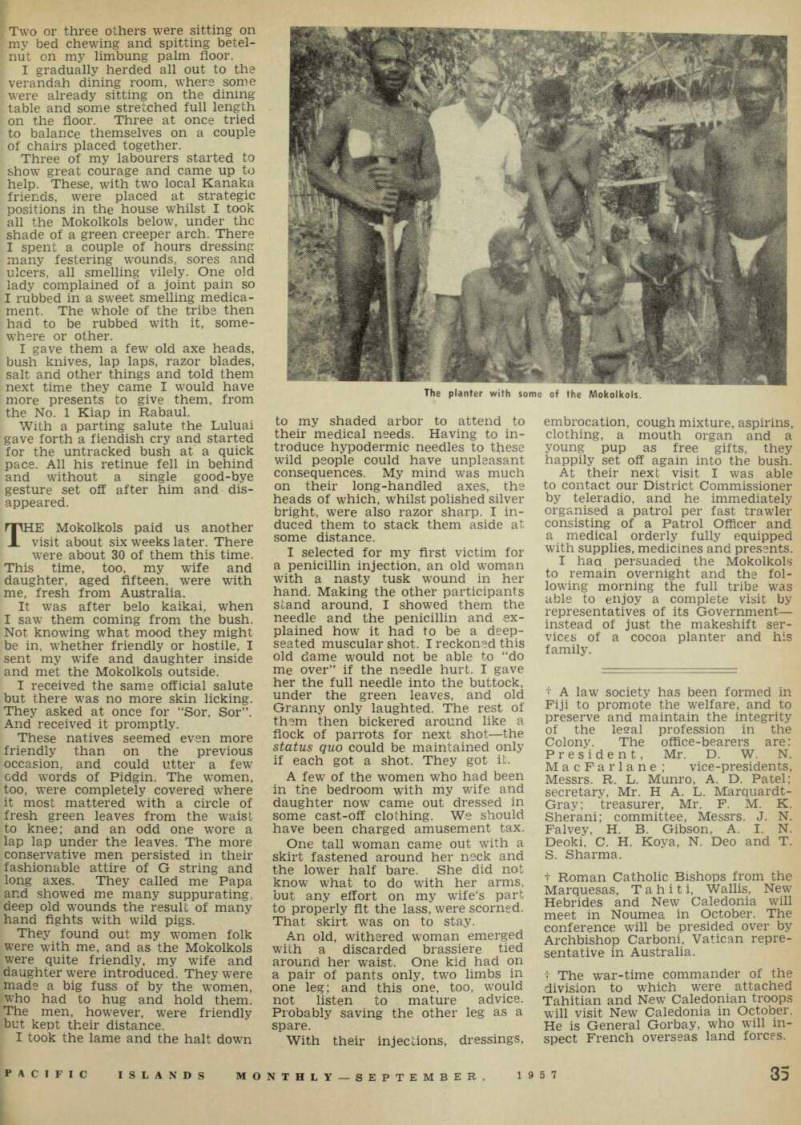
These natives seemed even more friendly than on the previous occasion, and could utter a few odd words of Pidgin. The women, too, were completely covered where it most mattered with a circle of fresh green leaves from the waist to knee; and an odd one wore a lap lap under the leaves. The more conservative men persisted in their fashionable attire of G string and long axes. They called me Papa and showed me many suppurating, deep old wounds the result of many hand fights with wild pigs.
They found out my women folk were with me, and as the Mokolkols were quite friendly, my wife and daughter were introduced. They were made a big fuss of by the women, who had to hug and hold them.
The men, however, were friendly but kept their distance.
I took the lame and the halt down
to my shaded arbor to attend to their medical needs. Having to in troduce hypodermic needles to these wild people could have unpleasant consequences. My mind was much on their long-handled axes, the heads of which, whilst polished silver bright, were also razor sharp. I in duced them to stack them aside at some distance.
I selected for my first victim for a penicillin injection, an old woman with a nasty tusk wound in her hand. Making the other participants stand around, I showed them the needle and the penicillin and ex plained how it had to be a deep seated muscular shot. I reckoned this old dame would not be able to “do me over” if the needle hurt. I gave her the full needle into the buttock, under the green leaves, and old Granny only laughted. The rest of them then bickered around like a flock of parrots for next shot —the status quo could be maintained only if each got a shot. They got it.
A few of the women who had been in the bedroom with my wife and daughter now came out dressed in some cast-off clothing. We should have been charged amusement tax.
One tall woman came out with a skirt fastened around her neck and the lower half bare. She did not know what to do with her arms, but any effort on my wife's part to properly fit the lass, were scorned.
That skirt was on to stay.
An old, withered woman emerged with a discarded brassiere tied around her waist. One kid had on a pair of pants only, two limbs in one leg; and this one, too, would not listen to mature advice.
Probably saving the other leg as a spare.
With their injections, dressings,
embrocation, cough mixture, aspirins, clothing, a mouth organ and a young pup as free gifts, they happily set off again into the bush.
At their next visit I was able to contact our District Commissioner by teleradio, and he immediately organised a patrol per fast trawler consisting of a Patrol Officer and a medical orderly fully equipped with supplies, medicines and presents.
I haa persuaded the Mokolkols to remain overnight and the fol lowing morning the full tribe was able to enjoy a complete visit by representatives of its Government — instead of just the makeshift ser vices of a cocoa planter and his family. t A law society has been formed in Fiji to promote the welfare, and to preserve and maintain the integrity of the leffal profession in the Colony. The office-bearers are: President, Mr. D. W. N.
MacFarlane ; vice-presidents, Messrs. R. L. Munro, A. D. Patel; secretary, Mr. H A. L. Marquardt- Gray; treasurer, Mr. F. M. K.
Sherani; committee, Messrs. J. N.
Falvey, H. B. Gibson, A. I. N.
Deoki, C. H. Koya, N. Deo and T.
S. Sharma. t Roman Catholic Bishops from the Marquesas, Tahiti, Wallis, New Hebrides and New Caledonia will meet in Noumea in October. The conference will be presided over by Archbishop Carboni. Vatican repre sentative in Australia. t The war-time commander of the division to which were attached Tahitian and New Caledonian troops will visit New Caledonia in October.
He is General Gorbay, who will in spect French overseas land forces.
The planter with some of the Mokolkols.