Tropicali ties
pp. 83-84 · Read in the full issue
Magazine Section
The Policeman’S Lot
THE new Solomon Islands Police uniform made its first appear ance in July.
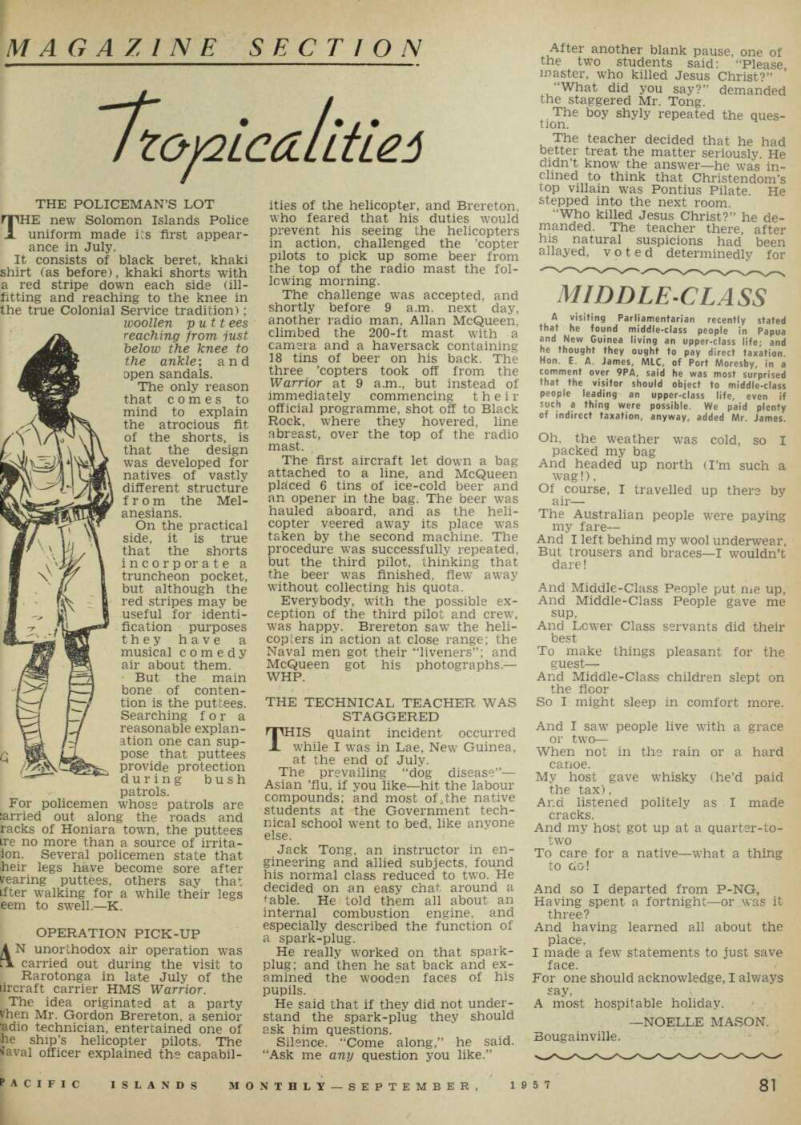
It consists of black beret, khaki shirt (as before), khaki shorts with a red stripe down each side (ill fitting and reaching to the knee in the true Colonial Service tradition);
woollen putt ees reaching from just below the knee to the ankle ; and open sandals.
The only reason that comes to mind to explain the atrocious fit of the shorts, is that the design was developed for natives of vastly different structure from the Mel anesians.
On the practical side, it is true that the shorts incorporate a truncheon pocket, but although the red stripes may be useful for identi fication purposes they have a musical comedy air about them.
But the main bone of conten tion is the puttees.
Searching for a reasonable explan ation one can sup pose that puttees provide protection during bush patrols.
For policemen whose patrols are larried out along the roads and racks of Honiara town, the puttees ire no more than a source of irrita ion. Several policemen state that heir legs have become sore after rearing puttees, others say that ifter walking for a while their legs eem to swell. —K.
Operation Pick-Up
A N unorthodox air operation was lV carried out during the visit to Rarotonga in late July of the lircraft carrier HMS Warrior.
The idea originated at a party vhen Mr. Gordon Brereton, a senior adio technician, entertained one of he ship’s helicopter pilots. The *aval officer explained the capabil
ities of the helicopter, and Brereton, who feared that his duties would prevent his seeing the helicopters in action, challenged the ’copter pilots to pick up some beer from the top of the radio mast the fol lowing morning.
The challenge was accepted, and shortly before 9 a.m. next day, another radio man, Allan McQueen, climbed the 200-ft mast with a camera and a haversack containing 18 tins of beer on his back. The three ’copters took off from the Warrior at 9 a.m., but instead of immediately commencing their official programme, shot off to Black Rock, where they hovered, line abreast, over the top of the radio mast.
The first aircraft let down a bag attached to a line, and McQueen pldced 6 tins of ice-cold beer and an opener in the bag. The beer was hauled aboard, and as the heli copter veered away its place was taken by the second machine. The procedure was successfully repeated, but the third pilot, thinking that the beer was finished, flew away without collecting his quota.
Everybody, with the possible ex ception of the third pilot and crew, was happy. Brereton saw the heli copters in action at close range; the Naval men got their “liveners”; and McQueen got his photographs. —
Whp.
The Technical Teacher Was
Staggered
THIS quaint incident occurred while I was in Lae, New Guinea, at the end of July.
The prevailing “dog disease” — Asian ’flu, if you like—hit the labour compounds; and most of ; the native students at the Government tech nical school went to bed, like anyone else.
Jack Tong, an instructor in en gineering and allied subjects, found his normal class reduced to two. He decided on an easy chat around a table. He told them all about an internal combustion engine, and especially described the function of a spark-plug.
He really worked on that spark plug; and then he sat back and ex amined the wooden faces of his pupils.
He said that if they did not under stand the spark-plug they should ask him questions.
Silence. “Come along,” he said.
“Ask me any question you like.”
After another blank pause, one of the two students said: “Please, master, who killed Jesus Christ?”
“What did you say?” demanded the staggered Mr. Tong.
The boy shyly repeated the ques tion.
The teacher decided that he had better treat the matter seriously. He didn’t know the answer—he was in clined to think that Christendom’s rop villain was Pontius Pilate. He stepped into the next room.
“Who killed Jesus Christ?” he de manded. The teacher there, after his natural suspicions had been allayed, voted determinedly for
Judas Iscariot. Mr. Tong stood loyally by Pontius Pilate.
I do not know how they settled it —but the student got a solemn answer, and seemed satisfied.
A large proportion of New Guinea students come from mission schools, and are naturally preoccupied with Biblical subjects.—RWR.
Land In The Making
NO doubt there are other places in PNG where landslides occur but the Fuyuge country of the Papuan Central Division is a noted place for fhem. The Fuyuge (Sacred Heart Mission) country is part of the Southern slopes of the Owen-Stanleys. Once, on the Upper Loloipa River the late Charles Karius and I missed one, a most fearsome affair, by a few hours.
Countless thousands of tons of hill side slid into the river and walking across it half-way up the slope to get to Auga Village was a nightmare.
Sometime later, when returning from a store-collecting patrol to Kanosia Plantation, on the coast, to Kambisi Police Camp (1926), a decent-sized hill slid into a tributary of the Vanapa River. Thousands of tons of rock and rubble completely blocked the creek and were respon sible for the formation of a lake 100 feet deep at the block.
The dam eventually broke and the resultant wave scared the daylights out of the villagers downstream.
Luckily, there was no loss of life.
Later on in this area two RC Fathers (Dubuy and Garreau), were caught in the middle of two sep arate landslides and both lost their lives. —SANASI.
Pine Lodge’S Card-Indexed
Native Staff
HOTEL management in Papua and New Guinea is supposed to call for a specialised degree of local knowledge—so much of the hotel’s activities are carried on by natives who possess little more than a lap
lap and a knowledge of simple Pidgin.
But Mr. E. E. Ferrie, a highly trained hotel man who first saw New Guinea only a few months ago, and who now runs Pine Lodge, at Bulolo (the best, and most expensive hostelry in P-NG), has surmounted the local servant problems with signal success. He has imposed a card-control system on the in dentured labourers.
The work of the hotel is divided and subdivided into individual jobs.
Each daily job has a number and a card, and each native servant gets a card. Differently coloured cards mean different things. The servants are organised in groups.
Each group has a supervisor. As each job is finished the card goes back to the supervisor. The super visor inspects, marks the card, then gives the servant another job, and a card.
It sounds like the kind of theoretical nonsense so often set out in quadruplicate by Canberra planners. But it works —and most efficiently.
The luncheon and dinner menus at Pine Lodge are something right out of this New Guinea world, and the service is excellent. But the waiters are merely some of these card-indexed natives, drilled and scrubbed and uniformed.
Here one is not left at the mercy of Pidgin. Mr. Ferrie follows the common Territory hotel practice of numbering his menu items; but he tries to keep the same numbers for the various menu items, and he in duces his well-trained dining-room corps to memorise the numbered items. —RWR.
Coals To Newcastle!
WHEN Warrior called at Raro tonga, Cook Is., recently, the commanding officer offered as a special prize for a Cook Islands Crippled Children’s Fund raffle, a ride round the island in one of the
carriers’ helicopters.
The raffle was duly drawn. The: winner: pilot of the helicopter!
In a furthef draw, Mr. Dominique* Peyroux, of Rarotonga, also had aj ride. t A dietitian with the Department] of Health, Papua-New Guinea. Miss Lucy Hamilton, passed through Lae and Kainantu recently on her way < to Okapa, where she is to carry outt work with the research team there: Miss Hamilton was accompanied btf Miss J. Whiteman, of Suva, who expects to be at Okapa for two weeks and will then go to the Solomon Islands.
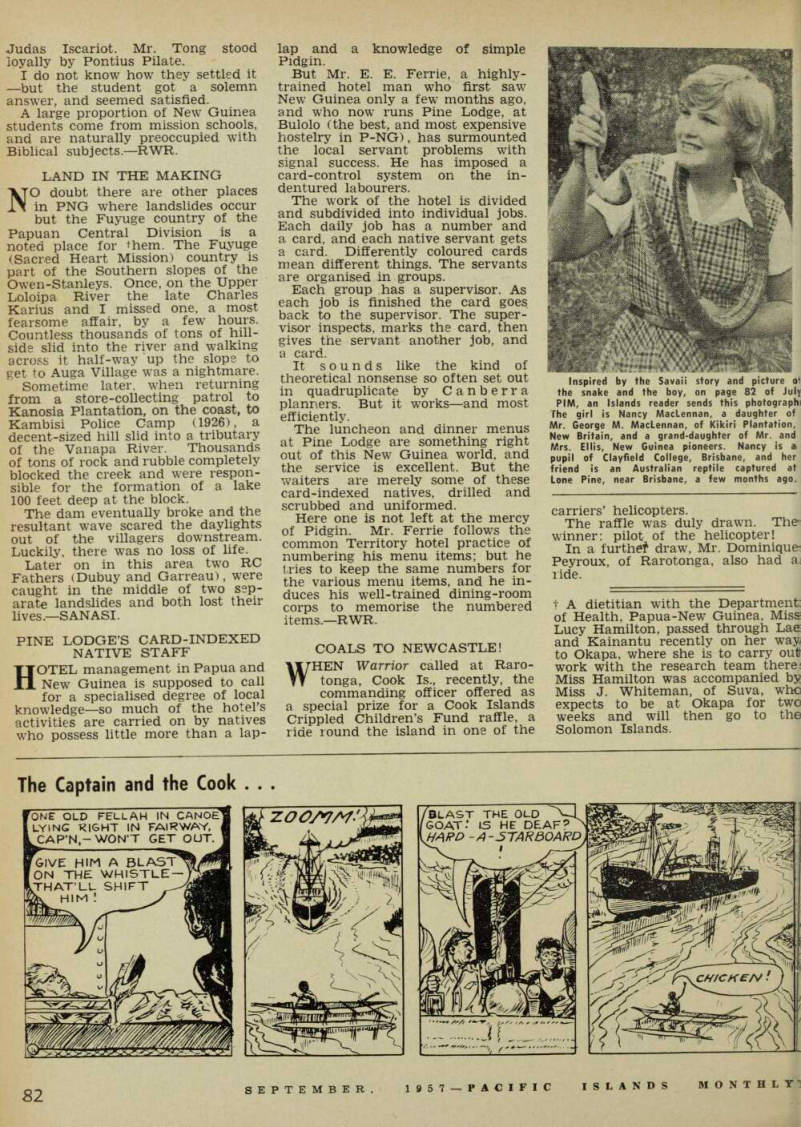
Inspired by the Savaii story and picture o[?] the snake and the boy, on page 82 of July PIM, an Islands reader sends this photograph The girl is Nancy MacLennan, a daughter of Mr. George M. MacLennan, of Kikiri Plantation, New Britain, and a grand-daughter of Mr. and Mrs. Ellis, New Guinea pioneers. Nancy is a pupil of Clayfield College, Brisbane, and her friend is an Australian reptile captured at Lone Pine, near Brisbane, a few months ago.