Pacific Shipping And Cruising Yachts
pp. 61-113 · Read in the full issue
This Month's News of—
Maritime Safety Enforced
In Micronesia
With maritime safety measures in some areas of the South Pacific the subject of criticism from various quarters in recent months, what goes on in the North Pacific is of interest.
PIM instituted inquiries as to the situation governing small-shin operations in the American Trust Territory of Micronesia in the North Pacific, and received a full and in teresting reply from Trust Territory Administration’s Contracts and Pro grammes Officer, John M. Spivey.
Currently, sea communications be tween the 2,141 islands of this Terri tory are maintained by 9,137 gross tons of shipping. Of these, the Gov ernment owns two 3,805-ton vessels, two of 558 tons each, one of 270 tons, and one 141-ton schooner.
Under private ownership, partly Co operatives, are a vessel of 250 tons, one of 175 tons, and some thirty-five 40-50 ft former US Navy Liberty craft, which have been converted to commercial usage, with sail and/or
power, each capable of carrying 10-15 tons of cargo.
Every vessel operating within the Territory is registered with the Gov ernment, classified into one of four groups according to overall length, and according to whether or not a passenger licence is sought.
On proof of ownership and satis factory survey the vessel is allocated a number, which must be painted in large letters on hull and deck for easy air identification. An annual haul-out and survey are en forced and a certificate of inspec tion issued. Minimum safety equip ment is called for and set out in the regulations, and includes at least one life-buoy aboard any vessel, at least one life-jacket for each person aboard, and rafts capable of carry ing all aboard.
Every piece of floatable equipment, including hatch-planks, must carry the vessel’s registered number for easy identification in the event of disaster. Life-rafts must be bright orange.
Every deck opening must be
capable of being made properly water-tight. Every vessel must carry 12 red distress flares, and a 5-gallon approved container of fresh water must be stowed in each raft Approved fire extinguishers must be carried according to the vessel’s grading.
No petrol-engined vessel will be licensed for the passenger trade, and passenger licences are issued according to the scale of one passenger per seven square feet of unobstructed deck space as a maxi mum allowance. Depending on the type of vessel, the passenger licence may allow fewer than the above maximum. Navigation lights are called for according to international requirements.
Local ship-masters are not certi ficated in the ordinary sense, but they do have to face a thorough investigation of their experience and abilities and an oral examination, whereupon they are issued with a licence to operate that particular class of vessel for five years.
They are then liable for re-exam ination by the marine authorities, to see that their capabilities are not impaired.
Although the area is not under US Coast Guard jurisdiction their safety regulations are applied as far as reasonably possible.
None of the regulations is un-
reasonable or could not easily be applied in any South Pacific area, except that one calling for annual haul-out for hull survey, as there are areas where no slipways are available as yet. In Micronesia there are six survey areas, so no vessel has to travel too far for survey.
Local regulations covering the carriage of radio-telephone sets have recently been revised, and every vessel over 39 ft 11 ins. 1.0. a. must conform.
Instead of the international dis tress frequency of 2,182 kc/s being jmployed, continuous watch is maintained by Kuror, Truk, Yap, and Ponape on 2,724 kc/S, and Majuro also guards this frequency from 1800 through to 1300 GMT. fhere is also a continuous watch n the area on the big-ship morse frequency of 500 kc/s and on the lir/sea calling and distress frequency )f 8,364 kc/s. As there are few ressels of under 40 ft making deep water passages, virtually every vessel s so equipped.
However, as in the South Pacific, he regulations do not call for the carriage of an approved type of 001-proof distress transmitter in lependent of battery power, failure if which so often silences the smaU hip’s R/T voice in time of trouble.
There is ample evidence to show hat the distress-type of transmitter hould have priority in South Pacific larine regulations. Still, it is also vident that small-ship safety is well c the fore in Micronesia and that i areas where no regulations exist, tie regulations applying in Micro psia might form a useful model.
Safeguard For Shipping
‘T is reported in the Fiji official ; newsletter that the colony i expects to introduce a Colony ide 24-hour listening watch for lipping in Fijian waters next Bar. The Standing Committee on mance has agreed in principle lat provision for this should be lade in the 1958 Government rtimates.
The existing 24-hour listening watch is on only one radio channel.
Under the new proposals, there
would be a 24-hour watch covering all radio channels in the islands.
There would also be a staff of
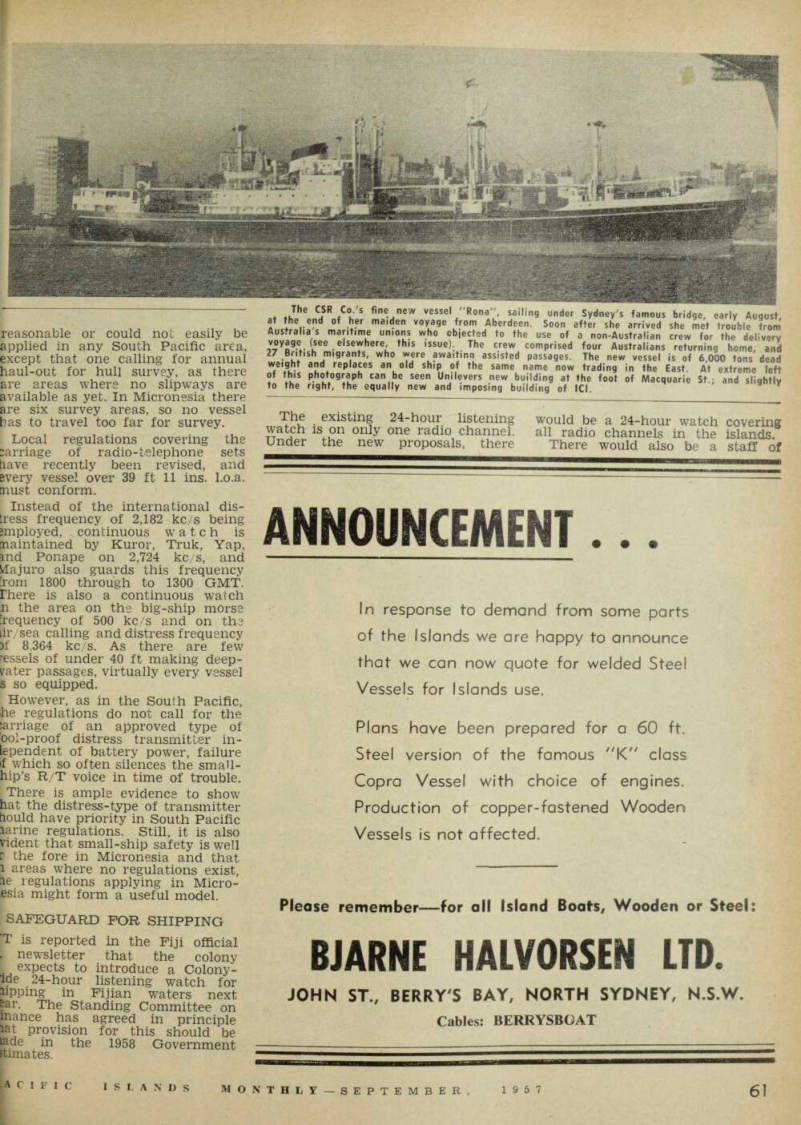
The CSR Co. 's fine new vessel "Rona", sailing under Sydney's famous bridge, early August, at the end of her maiden voyage from Aberdeen. Soon after she arrived she met trouble from Australia's maritime unions who objected to the use of a non-Australian crew for the delivery voyage (see elsewhere this issue). The crew comprised four Australians returning home, and 27 British migrants, who were awaiting assisted passages. The new vessel is of 6,000 tons dead weight and replaces an old ship of the same name now trading in the East At extreme left of this photograph can be seen Unilevers new building at the foot of Macquarie St.: and slightly to the right, the equally new and imposing building of ICI
four operators to overcome the present shortage of staff. Payment of staff would total £1,140 a year, including provision for overtime.
Cost of equipment, including re placement of seven-year-old sets, would be £4,350.
Surprise In Auckland
A surprise arrival in Auckland on August 14 was the Pago Pago vessel Manu’a Tele, owned by the Chiefs and people of American Samoa’s Manua Islands, and under the com mand, for this voyage, of Captain Borge Bentzen, of Western Samoa.
With no slipway at Pago Pago capable of handling her, and with all slipways at Suva, where she normally refits, fully booked until October, the one-time US Navy minesweeper YMS-143 was forced to head south. She is probably the first Pago Pago-registered vessel ever to refit in Auckland.
Manu’a Tele was acquired from Hawaii by the Manu’a people early 1948 Later her owners found them selves in financial difficulties and she was taken over by the American Samoa Government. Recently she was handed back, but her navigation certificate expired in July. Per mission was given for her to proceed to Auckland for refit.
She is now normally commanded by Captain Pou Seleti, who came south as Mate.
Captain Bentzen, who retired from the Union Steamship Co.’s service some years ago—he was last in the trans-Pacific freighter Waikawa —to settle on Kasala Plantation at Fasito’o, Upolu, was prevailed upon to break out his uniform from its moth-ball packings and take a
winter holiday. Auckland’s 64 deg., temperature compared unfavourably l with Samoa’s 85 deg., he said oni arrival. Good weather was experi enced for the 7-day run south.
Materials have been assembled for construction of a slipway at Pager Pago, probably to be sited across the
larbour from the wharves and in :he vicinity of the tuna cannery, but t is not known when construction vill commence.
Manu’a Tele, which normally pro rides sea communications between and the Tokelau Islands on a iharter basis, in addition to her ’ago Pago-Manu’a and Pago Pagoruns, was expected to be in Auckland for some weeks, depending m the work found necessary.
Tongan Merchant Marine
The day following the arrival of lanu’a Tele in Auckland, the Tonga topra Board’s Su v a-built ketch ’oniu moved under an Auckland harf crane to receive a completely igged new 72-ft Oregon mast in the nal stages of her annual refit. The jplaced foremast was found on ex mination to be so deeply rotted in sveral places that it was surprising lat it had not gone overside; this -spite the fact that the vessel has ndergone regular survey in Auck nd each year recently.
Captain David Fifita, only holder a Tongan deep-water master’s sket, said it is not known what ie fate of the ketch will be when e modern, new steel, Dutch-built 0-tonner A’oniu arrives early 1958.
South with him for training in ickland were four men who will 'icer the new A’oniu or Hifofua. r Amanoni, chief engineer of e present A’oniu, and David lumoepeau, chief of the present fofua, were making voyages in the ickland coaster Sumatra, which s engines similar to the new Tonga ssels. They will go to the re active new vessels.
Villiam Ha’angana, full-time radio erator in the present A’oniu, was :mg a course in radar, radio direc n finding, and echo sounders, at J government school of naviga n in Auckland in preparation for i new vessel.
J olonga Taualupe, mate of the isent A’oniu, was undergoing Ida! training as a rigger with an ckland firm. Their training was ng overseen and supervised by E tai L. Finta and Captain Scott, Speddmgs Ltd., Agents for Tonga New Zealand.
'he ketch was to clear Auckland
late August for Suva, where Mate Taualupe was to take command of
new 30-ft, 30 dwt bow-loading steel barge Kao, which had arrived there from London on the deck of a freighter. Captain Fifita’s brother Peter, was to serve as Mate in A omu. Kao’s engineer for the run down to Nukualofa was to be David Taumoepeau.
The barge is powered with two direct reversing 88 bhp fresh-water cooled Kelvins. She has twin rudders and hand steering. There are no auxiliary motors.
On trials she made 84 knots, and in a static bollard test-pull she pulled 32-cwt at normal engine revolutions. She has a loaded draft of 3 ft 6 in. and will be used for general government duties, includ ing barge-towage, within the Tonga Group. (Over)
"Manu'a Tele”, owned by the people of the Manu'a Islands, E. Samoa.
Photo: J. P. Shortall.
Man With The Know-How
Back in March, 1954, the Tonga Department of Agriculture and Fisheries purchased the Auckland fishing vessel Pearlin, renamed her Alaimoana, and put her to work on experimental fishing in the area in an investigation of methods and prospects for the possible establish ment of a commercial fishery.
Well, it seems that results have not been as good as some people feel are possible. In this sort of situation it is generally conceded ;hat the thing to do is to send for i Japanese expert. One arrived in Nukualofa in July to take command >f Alaimoana, and will doubtless juickly prove that the tuna were here all the time. Anyway, Tongan ingers are firmly crossed.
Whaling Is Big Fun, If Not
Big Business
There has been a great spurt to fongan whaling activities these past wo seasons. For years the Cook amily had it on their own at their fukualofa-based whaling “station” the town beach). Last year, how ver, five similar outfits started up n business, another at Tongatabu, ne south at Eua, two in the central la’api Group, and one is the north it Vava’u.
This season yet another went into justness at Vava’u.
Going into the whaling business i Tonga has simply meant acquir ig a surf boat, hand-harpoon and :ne, and some knives.
The Unilever combine has not rofited and the International Whal ig Commission has not been othered with statistics. In Tonga hey eat their whales—or as much f them as is possible before the limate takes charge, after which ley eat sharks which come to de our the remains, which are towed ar out in the lagoon from the town each. At the town beach the cuts re sold on the spot, with no short ge of customers.
This season, for a change, some I the Tongan blubber-oil may reach orld markets, and in future seasons iere may be more.
Prince Tungi is encouraging whal ing as an export trade —but there are still no new-fangled and ex pensive whale-chasers and million dollar shore stations. The old tri pot will do, and if a surf boat cannot be bought, a canoe will serve—like
the one in use by the man in busi ness down on Eua.
Last year he took three whales.
Adm i 11 edly he found a few sticks of dynamite lashed to the harpoon a useful - pacifier, and shore boats came to his aid once he was well
fast to his quarry. The world’s newsreel camera men have not yet heard about Tongan whaling— out when they do there will be something to see on the screen.
Getting Around
Captain D. K. Matheson, known in Island craft, re turned to Auckland in July after an interesting few months in Eastern waters.
Early in the year he delivered the New Zealand coaster Pukeko, re named Winery, to Yong & Lee Timber & Shipping Co., of Hongkong, then remained to master the vessel for a while in her new trade—mainly scrap metal from Borneo to Hong-
Captain Borge Bent zen and Chief Engineer Busby Koko who brought "Manu'a Tele" to Auckland for refit in August.
Photo: J. P. Shortall.
Captain David Fifita and ketch "A"oniu", and right, trainees for the new Tongan vessels: Engineers Amanoni and Taumoepeau, Radio man Ha'angana, and Mate Taua lupe.
Photo: J. P. Shortall.
kong, but with sorties to Singapore and Japan as well.
Next job? Perhaps another Eastern delivery; of perhaps to relieve his brother. Captain R. D. Matheson, in the Suva-based Kurimarau while the latter comes south on vacation.
Kurimarau, Sydney-owned and Hongkong-registered, freights pe.ro leum products to Samoa and the Gilberts.
Another Raft Book
Most Islands ship-masters are probably familiar with the castaways manual, The Raft Book, written by Harold Gatty, who died in Suva in August. Published in New York in 1943, it became in war-time —and perhaps still is—a standard issue in the life-saving equipment of Ameri can aircraft and some ships. It was issued in a water-tight envelops complete with navigational chart, and was intended primarily for per sons with limited navigational knowledge.
New from Maritime Press Ltd., London, comes Survival At Sea: In flatable Life Rafts, by Commander N. F. Keene, DSC. RNR, selling at 2/6.
While not covering the ground as extensively as The Raft Book, this British publication is considered sufficiently valuable to also appear in a waterproofed edition, and a
copy is being enclosed in the pack ing of every rubber raft issued by at least one of the two main UK life-raft rtianufacturers.
This publication, incidentally, warns seamen of the British scientific finding that, Dr. Bombard
notwithstanding, the drinking of; salt water under whatever circum stances is extremely ill-advised.
New Hebrides Round-Up
Hard and fast on Million Dollar Point, at the eastern entrance tex
he Segond Channel, south coast of ianto, since May, 1953, the 249-ton, 5-year-old freighter El Retiro (ex fZ coaster Kapiti ) may (repeat, lay) float again.
This little ship took her present ame when purchased by Captain Imile Savoie, of Noumea, at Auck ind, late 1950. She was sold to Mr. tonald Gubbay, of Luganville, anto, in 1953, and put to work off lillion Dollar Pt. salvaging dumped Jnerican war equipment but uickly found herself on the beach, long with the war scrap.
Subsequently she was offered for lie “as is, where is”, but found no ikers.
Mr. Gubbay, still busy salvaging jap, now hopes to float El Retiro a and get her to Japan’s scrap letal market, though perhaps not a her own bottom.
Also likely to depart Island waters 1 Mr. Roy Gubbay’s 465-ton, 29- 2ar-old freighter Tutuba, better down in Lloyd’s disaster columns 5 Holmglen, ex Argus.
With her may go—in tow—another py duckling, Mr. Marcel Marinacce’s cl-ton Melbourne-built Deutgan, of
unknown vintage, which failed to raise a bid in Sydney this year, sub sequent to survey following strand ing in the New Hebrides last year.
It is believed that both vessels have found a Singapore purchaser. A photo of this duo on their final South Pacific cruise should form a touching contribution to the SPC historical archives. Both have pro vided lots of thrills in the Sunday press.
Yet another interesting craft to depart the New Hebrides—for the Solomon s—is the English-built Brixham trawler Arthur Rogers, best remembered for her all-girl crew cruises. Tom and Diana Hep worth headed her north for new
horizons in July, whether to return or not is not known.
Lying doggo, and reported burd ened with writs, is another Vila headliner, the war-time Australian built deck barge Pacific Star (ex ALC-120 ) which first caused a stir when, en route from Rabaul to Vila via ports, she went missing, though still with radio contact.
She turned up on the New Caledonian coast. Then two months later, in April, 1956, she stranded at South River, Erromanga, but got clear.
Though Pacific Star is not starring in the present New Hebrides ship ping boom, others are making money.
(Continued on Page 101)
Owner Bill Mangan and sailing companion [?]ck Mohun Auckland-bound with (lower) Taki-o-Aotahi" (see p. 113).
Photo: H. R. Hart.
Numerous mineral prospectors have nvaded the group and are charter
fa‘goU v r e S transport 01 There will be other activity, too, as Japanese fishing vessels presently commence supplying the new tuna freezer at Palikula. (Over)
"Naruta", old Japanese tanker, with the Hong Kong tug "Golden Cape", which towed her [?] Japan in July from Rabaul where she has had an up-and-down existence since the Pacific War [?]ombed by the Allies during the war, she was submerged and raised alternatively several [?]mes. A few years ago she was offered at auction—but bids did not reach the reserve. She [?]as raised again by the Japanese salvage team operating in Rabaul, and patched up for the [?]w back to Japan.
Competition In Time-Sigs
For years Pacific navigators have heen well served by the US National Bureau of Standards’ time-signal station WWV, at Washington, DC, and relay station WWVH, at Kaneohe, Hawaiian Islands.
This past winter the Pacific cover age has been further augmented by a comparitive newcomer, on the same frequencies—JJY, Tokio, whose voice announcement every five minutes has been cleverly arranged to quickly follow the American voice announcement. Occasionally, too, the English station MSF is heard coming through.
Those Ocean Cables
Another voice heard much on the maritime R T frequencies during August was the British cable ship Ocean Layer talking with Hanama Bay cable station as she steadily trailed a multi-million-dollar tele phone cable out across the Pacific between Hawaii and the West Coast of North America. She and another ship will soon meet midway to splice their separate cables.
At about the same time it was announced from London that an In ternational conference will be held in Hamburg this year to discuss the increasing problem of fishing vessels fouling and breaking the ocean
cable in the Atlantic and North Sea with their trawling gear.
A Portuguese fishing fleet had just then caused havoc to five of the
seven cables between the UK ant US off Newfoundland. The trawler' cannot free their gear from tlu cables, once fouled, so haul them uj
id cut them adrift with axes, thus lusing thousands of pounds of image in delays and costly work 7 cable ships.
A PIM correspondent who served radio operator in a Milford Haven awler in 1938, saw such cables cut irift several times in waters 200 iles south of Ireland.
Faces Are Red
The world’s marine surveyors seem have been thrown into confusion t a test report from Denmark, con •med by carefully conducted tests r the South African Society of aster Mariners, showing that the andard kapok life jacket is useless r its purpose in oil-covered waters, lich is a normal situation in many rms of marine disaster.
Such life jackets must normally pport 16 h lb of lead (equal to the erage load of a floating man) in esh water, for 24 hours. Tests have >w shown that in an oil pollution 1-in-40, such jackets sink in am 16 to 50 seconds, depending on e type of oil. Linen covers have ghtly better performance than tton.
Cork fillings are uneffected by oil. ;rtain plastic fillings are useless, it other bubble-type plastics and Ratable rubber jackets are OK.
How these facts escaped the sup sedly eagle eye of marine safety perts through two world wars is yond comprehension, but it now ipears almost certain that the pok jacket’s days are numbered.
Lilos Saved By Sustained
Effort
We have received the following e-witness account of the stranding -d refloating of the MV “Milos ”, the Australian West Pacific Line, lich went up on the outer reef, inikoro, Santa Cruz Group, BSIP, • August 12: Milos, southbound from the Far ust to Australia, was calling at nikoro to load logs from the Kauri mber Co.
When she grounded on the reef the entrance to Pallu passage, lich is the main entrance through e reef into the lagoon at Vanikoro was a nearly full tide. The Master, iptain Gustav Paulsson, immedi ely used every effort and tried ery method known to him to get e vessel off under her own power, there was no other vessel in the ea to assist, and the Company d nothing heavy enough to help in greatly.
Company labour, launches and barges were put at his disposal and every possible assistance was ex tended to him.
After many confusing rumours from various radio centres concern ing what help was available and was coming to the rescue, an American
MV "Nikau" of Suva, built on the Clyde in [?]07 (gross tonnage 248.22, net 97.18), shown Vila Harbour, New Hebrides (see p. 103, [?]y PIM). Now the BP flagship in that Group, [?]e arrived there in June from Suva, and re [?]aced "Moala". "Nikau" herself was pur [?]ased last year in NZ to replace "Vasu" — [?]ich sank on a voyage between Apia and va.
Photo: Capt. Brett Hilder.
'Javy Stores ship, ;he Virgo, arrived jn the night of \ugust 15, and on ;h e morning of L6th the Com nander and his >ffi c e r s went hoard Milos and, if ter a conference pith Captain ’aulsson, decided o make an at -empt to pull Milos off with the ligh-tide at about f p.m.
For the whole ►f the 5 days the hip was aground, he Captain, his Officers and the :rew had worked :ontinuously with rery little sleep or est, to trim holds, ettison cargo,
,nd do all the other work associated nth an operation such as this and n their efforts they were assisted o a very great extent by all the Cauri employees available.
The BSIP Government vessel Melanesian also arrived early on the norning of 16th, but she was too
small to be of any great assistance.
On the one occasion that she did get alongside Milos, her mast be came tangled in the ship’s derricks and she had to be pulled off by the Company tug.
With Milos trimmed to suit the attempt to pull her off and every
The Carr family's 60 ketch "Havfruen [?]II", now in the Pacific see p. 114).
Phone: M. R. Hart.
thing in readiness, the American vessel, having made a trial run along the edge of the reef, made ready for the real thing and at about 3 p.m. she commenced her run.
The handling of the ship was perfect in every detail, creeping along, dead on line with not a hair’s breadth variation from her course, skirting the reef so as to pass Milos’ stern with no more than 70 or 80 yards to spare.
We in the Company launch, sit ting in between the two ships wait ing for the firing line so that we could pick it up should it fall short, witnessed every move at very close range and the highest possible praise must be given to the Commander and his navigators for the mag nificent exhibition of seamanship shown in the run in.
The line was fired and fell short; we picked it up and raced to Milos with it, heaving it aboard, where it was pulled in. A succession of heavier lines were sent aboard until the towing rope was finally made fast.
In the meantime, Virgo had con tinued on her course until she was amidships the stern of Milos, when she commenced her starboard turn until she was stern to stern to the grounded vessel, whose crew were working like demons to get the line positioned and fast in time for Virgo to take the strain.
We watched the line gradually
tighten; lift out of the water, take the strain, then dip a little, tighten again—and then snap like a piece of cotton!
It looked as though the attempt was a failure and we went aboard Milos to see if there was any more we could do, as the night was com
ing down and we wanted to get in. side the reef before dark.
The crew was busy heaving ir the broken line to clear the pro< peller so that an attempt could again be made on the morning tide We got away and were on our in through the passage in the half
ght, and turning for a final look t Milos, when we saw with amaze tent that she had swung her stern ght away round from her position Ground, and that her engines were at out, with the propeller thrash ig the water, as Captain Paulsson lade a final attempt on the high ater to get his ship off.
Then off she came and we, who ad witnessed the drama frof* 1 ° e “ Inning, were filled with all the re ef that comes with seeing a fine lip saved, and with admiration for ie courage and devotion of tne iaptain, officers and crew, who had ot for one hour halted in then [forts to re-float their vessel.
Mv own opinion is that the jerk the tow line first tightened, len slackened, then tightened, and roke, was just sufficient to shake lilos loose so that her own power nd the high water allowed her to ree herself. , . .
All praise must go to the Captain nd his crew for a magnificently istained effort; to the Commander nd crew of Virgo for a magnificent a at of navigation and seamanship; nd to the employees of the Kauri 'imber Company, both European nd Native, who were put at the hip’s disposal by the Company s lanager. , „ The usually treacherous weather f Vanikoro on this occasion failed d materialise and for the whole [me that the ship was on the reef, south-easter of never more than t-ade force kept blowing, with no ig seas or rain to hinder efforts.
The “Milos” was carrying a cargo f about 1,350 tons, made up of imber, and ply from New Guinea, crap metal and Far East produce.
L considerable amount of this cargo, i stimated value of £ 15,000, was ettisoned. The owners of the cargo lave been notified.
She carried 10 passengers—three n,en, three women and four children -who were landed in small boats :nd made comfortable in houses be longing to the Kauri Timber Co. ”hey rejoined her not long before he sailed.
The master reported that after a preliminary examination the vessel vas tight and the motor was in food order. She loaded logs at lanikorc.
The “Milos” arrived at Brisbane m August 22, where a Lloyd’s rep esentative made a thorough exam nation.
The inspection revealed minor lamage only to the bottom of the hip, very little more than a scratch. r he “Milos” will now be able to re nain in service.
The Swedish Consul in Sydney )pened an inquiry into the ground ng on August 27, but it is unlikely hat the result of this will be made ’iublie.
The “Milos” (4,292 tons) was built n Japan ,and went into the Far £as£-SW Pacific-Australia run in
mid-1956.
The Australian agents for the “Milos” are Wilh. Wilhelmsen Agency Pty. Ltd., of Sydney.
French Warships In Suva
La Confiance, an escort vessel, and Petunia, a patrol vessel, were in Suva from August 19 until August 22.
Dog Watch For 1957
The Annual Dog Watch for 1957 (No. 14), is now available at 4/6 Australian, from the Shiplovers’
Society of Victoria (Box 1169 K, GPO, Melbourne, Vic.).
it contains the usual interesting assortment of stories about ships past and present, and in this issue we meet some old Pacific friends.
Captain Brett Hilder describes how he and some of his officers explored the limestone caves at Port Purvis Mboli Passage, BSIP, where BP ships usually take on water. Harry Du * ne °*S? ai -^ Nordll i a: % scribe the old Mariposa and Tahiti 50 years ago. And Captain F Klebingat, now of California, tells us something about the Falls Of Clyde, which in 1900 was sold to Captain William Matson, who
unded the Matson Navigation Co.
Dog Watch is written by sailors r sailors; but is sufficiently in resting to claim the attention of ose who do their navigating from deck-chair on the promenade ‘ck
Wewak Escapes
The converted lan d i n g-craft r ewak , which has been doing a agnificent job carrying cattle be jeen North Queensland ports and >rt Moresby and Lae, came close to saster in August.
The vessel was stranded on the uth coast of Timor and it was ared she would be a total loss.
Dwever, she freed herself and made i emergency crossing to Darwin, here she was undergoing repairs the end of the month.
Eward For Norbryn Tow
Captain Polkinghorn, master of P (SS) ship, Ratanui, has received cash reward for his work in tow g the disabled Norwegian ship, nhryn, into Suva under difficulties.
The Norhryn was disabled by fire >out 140 miles from Suva in March lis year, and arrived in Suva under w on April 1 (see May PIM, page Captain Polkinghorn has dis puted the money (amount un lown) among his five officers.
Saining Scheme Announced
The necessity for some facilities r the elementary training of lands engineers for the small lips fleet, especially in those areas ce the Cook Islands, where there no possibility of training through lore apprenticeships (as in Fiji, r example) was emphasised in this )lumn some months ago.
A very important contribution to
such a scheme was announced by the New Zealand Minister of Island Territories on August 21. Four scholarships are to be offered to Islanders from New Zealand terri tories to train in either engineering
or navigation at Wellington. Each course would last only a few months —but even this should be long enough to give keen boys a ground ing in the operation of common types of marine engines, and in celestial navigation for budding skippers.
Under the scheme, the employers
The 9-year-old Levuka-built 11-ton, 36 ft. wooden auxiliary cutter "Adi Gaetane", recently [?]ecked on Santo, New Hebrides. Holding the BP vessel's name-plate is her former 19-year-old [?]ipper, Mr. Stephens.
Photo: E. W. Lamberty.
will pay half the cost, which seem reasonable enough, considering ths ship-owners may be saved considei able expense in damage to motoi through ignorance or through vessels losing their way on the hig; seas.
The Minister also indicated ths “other improvements in Island ship ping facilities are now being looke into” —possibly a reference to long mooted plans to build a reasonabl safe harbour for small-craft a Avarua, Rarotonga.
Delay In Norfolk Is.
Whaling
In August, the whale-c hasei Norfolk Whaler was withdraw from the Norfolk Is. whaling static by Norfolk Island and Byron Ba Whaling Co., and sent to Byron Ba; in Northern NSW.
Only 80 of the 120 NI quota catc of whales had been caught whe the vessel withdrew —due to ba operating conditions, and becaus the northern migration of th whales past the island had slackens* It is expected that after fillin the Byron Bay quota, the compan will catch its other 40 whales ot NI.
The southern migration of whale past NI usually commences abou mid-September.
Tied Up
The Rarotonga - based-converte Brixham trawler Inspire, registere in the name of Mr. Archer, an operated by Mr. D. C. Brown in th inter-island trade, cannot continu trading until overhauled.
Action to tie up the vessel wa taken by the Administration, it believed,.as the result of a repon from the British Consul at PapeetJ subsequent to the vessel being dry docked there several months agj Inspire had earlier suffered hull an rigging damage as the result of seismic wave which put her ashor briefly in Avarua Harbour. There ai no slipways in the Cook Islands.
Personal
Captain D. M. Thorsen, Pon Officer of Honiara, British Solomo: Islands, sailed from Sydney on ttl Oronsay on August 23 on furlough accompanied by his wife and tw small sons, Derek and Christophs Captain Thorsen was in charge t the delivery of the BSIP’s new vess?
Melanesian, from Hongkong, lax December; he says she is noc operating satisfactorily throughon the Group, under Captain J. Davie Captain W. J. Bunney, formo master of the MV Shansi, has rr covered from a recent illness. H flew to Hongkong, where he joine. the Sinkiang, at present on Gilbes and Ellice Islands duties, as Mast©
Reef Cruises
Completion of Vincent Storckf 31-ft launch, 00100100, opens u
ossibilities for Fiji’s tourist in ustry.
On August 18 the launch made an tcursion trip to Nukulau Island, ccursions which were popular many ears ago, but which somehow 7 ;emed to lapse.
Her owner plans to make an ccursion to Nukulau each Sunday, nd also to use her for weekly cx irsions in Suva harbour. OoiocJoo ill also be available for private larter and fishing expeditions.
Her name is said to correspond to le sound made by the legendary ermaid when calling under water.
Stc Ship In Trouble
Steamship Trading Co.’s 50 tons laster Manugoro was beached in a nking condition at Kairuku (on ie Papuan mainland opposite Yule land) on August 12.
She had radioed for assistance the ■evious evening and the APC issel, Papuan Explorer, went to her d and escorted her to Kairuku.
Manugoro began to take in water tien she was about 45 miles from irt Moresby; the leak was such at the pumps could not cope with and at the time she was joined r Papuan Explorer she had 4 ft of iter in the engine room.
La Perouse Also Had
Trouble At Vanikoro
The Kauri Timber Company established itself on Vanikoro in 1923, and although overseas ships have been calling there for timber for 30 years, shipping mishaps have been rare indeed.
However Milos is not the first ship to have trouble there; the French expedition under La Perouse is be lieved to have come to grief there about 170 years ago and only about a month before Milos stranded a large white cross was placed on the reef off Vanikoro by the officer com manding the French naval forces in the Pacific, who called there in the Francois Gamier.
Relics believed to have come from La Perouse’s two ships have been found off the reef and on Vanikoro.
Fiji Shipping Mishaps
Yanawai, BP (SS) Co.’s sturdy little motor vessel of 22 tons, a rescue ship three times this year, went aground on a reef in Nukulau passage, Fiji, in a torrential storm on August 31.
She remained on the reef for more than eight hours. She then floated off, just two hours before high tide, and continued her journey to Suva.
Her master, Captain J. Lumsdale, was seeking an anchorage when the ship grounded. At the time the passengers were at lunch.
Yanawai’s first mercy mission this year was to go to the assistance of HP’s ketch, Macuata, which grounded on Moturiki Reef.
Four days later she picked up passengers and crew from the Joyita, which had become stranded on the notorious Horseshoe Reef in the Koro Sea.
Her last effort was to assist the Ratanui to tow the 10,000-ton Nor wegian steamer, Norhryn, to Suva (see PIM, May, p. 78).
The day before the Yanawai grounded, the 43-ton Fiji Govern ment auxiliary ketch, Adi Maopa, went on to a reef off Viwa Island, in the Yasawas.
The Government cargo ship, Degei, left Suva to try to pull Adi Maopa off.
Later, marine engineers dismantled and removed the Adi Maopa’s engines to lighten the vessel before attempts were made to refloat her.
The ship’s ballast was also removed.
The passengers were landed on Viwa Island.
At the time Adi Maopa was on a voyage from Lautoka to Rotuma.
Captain E. Anderson is master of the Adi Maopa. (Over)