Territories Talk-Talk
pp. 30-38 · Read in the full issue
By Tolala
Radish-Man, Move Over! fIIHE Didiman argument moves X from vegetable to animal king dom now. Sydney Chance (well known in both Territories, pre-war), writes: • A couple of real old hands (I gather, from the Solomons and Rabaul early in the century), joined a gathering of old New Guineaites regularly held in Bris bane, and we talked of “ Didiman”, and one put forward an ingenious solution to the mystery of the name by saying that ages ago a man who kept cows lived where the Agricultural Department and Gardens were and was known as a
Titiman. (Why not Susuman, I do not know!) And that Titiman became Didiman. I wonder; it’s not as if the letter T is hard to say, for half the natives in the area have names begin ning with T.
I strongly suspect the old hand had his tongue in his cheek, but let that go. I would be very sur prised if any cows were kept in or near Rabaul at that early period, around 1908-10.
The only cattle I saw there in 1911 were of the Zebu type, used for hauling the
plantation carts. “Susu” for the table came out of a tin, as did most European food, though certainly a freezer was started about that time by Louri and Mouton. The former was an engineer, the latter had the dough.
The first properly organised dairy, serving the Rabaul township, was run by “Sleevy” Reed, starting there in the middle ’thirties.
As for Syd’s remark about the locals pronouncing the letter T, which is so general in their names; Most of the names start with “To”, which is equivalent to our “Mister.”
The females answer to “la”. But a strange fact with the Blanche Bay
natives is that they invariably con fuse the sounding of the “t” and “s”
Derivations Another note came to me recently about Pidgin derivations. This time regarding the lowly duck.
“Why Pato?” asks my enquirer; so I repeat: “Why Pato?” Whence and why?
There are many other Pidgir words whose deriva t i on s are shrouded in mystery, and it might be a good idea to search for the source of their origin before it is toe late.
This thought is prompted by the rumour that “Pidgin” is to be wipec and already I from news broadcasts, an “English League” has been started amongst the natives who will speak only true English.
I often wonder how many more schoolings and regimentations we
whites are going to inflict on thi P-NG guinea-pigs in our sociologies experiments. There’s already a corit fusion of creeds; a conflict oc tongues and a medley of mors ethics.
Turning Back
the Clock
Seldom does one read of real oldt timers’ (repeat, old-timers’) persons experiences in New Guinea.
Actually, there aren’t many res old-timers left, and those who stil exist seem to have neither the timn nor the inclination to record theh early adventures.
I think most of them feel that tin present generation couldn’t care les; what happened in the days whes the whites were laying the foundas tions of what the Territory is to day.
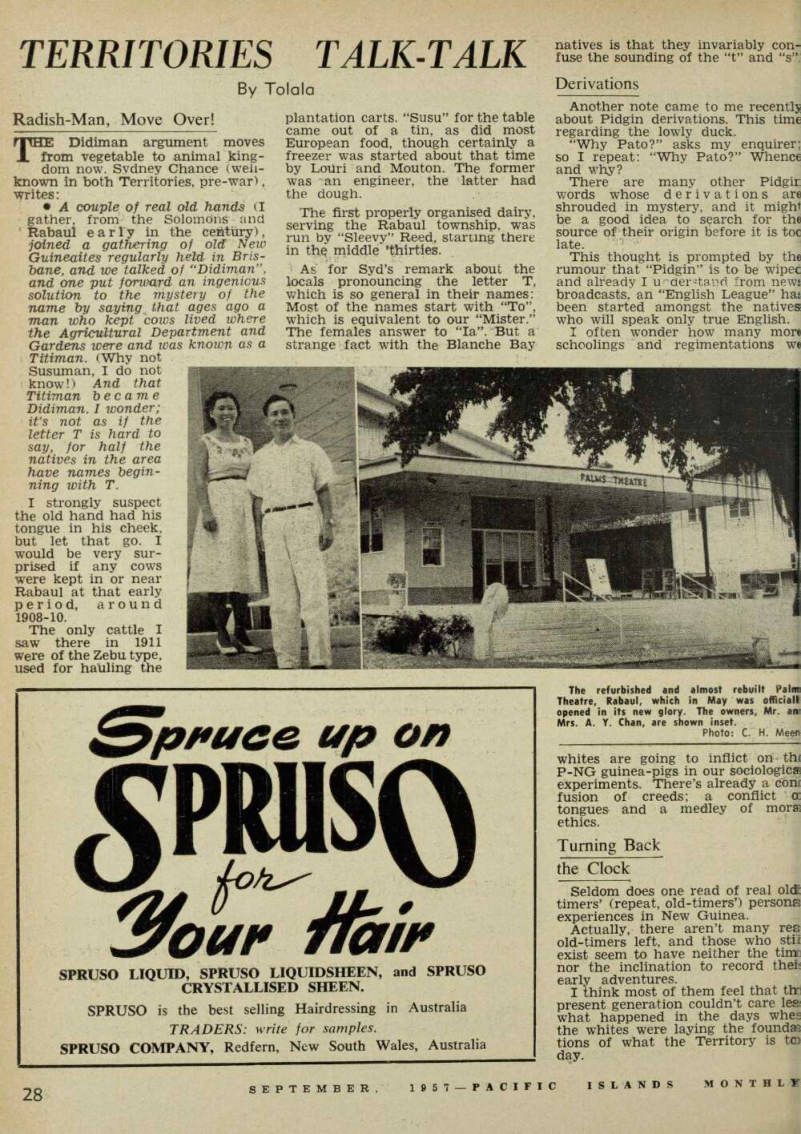
The refurbished and almost rebuilt Palm Theatre, Rabaul, which in May was officiall opened in its new glory. The owners, Mr. an Mrs. A. Y. Chan, are shown inset.
Photo: C. H. Meen
I was pleasantly surprised, there ore, when there came to me recently i copy of the Hamburger-Hafen Vachrichten, of August 1, 1956, in phich I found a most interesting irticle by Capt. Carl Haug, entitled, Un Traum wird Wirklichkeit (A Dream That Came True), telling of lis early days in Sydney and his 'earning to visit the South Sea slands back in 1897.
He almost made the grade, but was onsidered too young to ship in the chooner Alexandra, though he had net three of the crew: Charlie Charlie Ost r o m and Jharley Ohlsen.
Instead he went to Frisco and en years later (now armed with ds master’s certificate) he found limself back in Germany and ffered a job in the South Seas.
He accepted, found himself ear aarked to relieve Capt. Vogt in the leu Guinea Kompagnie’s island teamer Siar.
During a trial trip he met up again nth the three “Charlies” of his Sydney days ten years previously, nd all doing very well for them elves.
The old-time skipper has many ateresting remarks on affairs arrent in 1907, and his article makes pod reading, especially for noughtful people of to-day. I com lend it to the New Britain Historical society as a vignette of the life that sed to be: “When Dreams Came xue. ’ (Over)
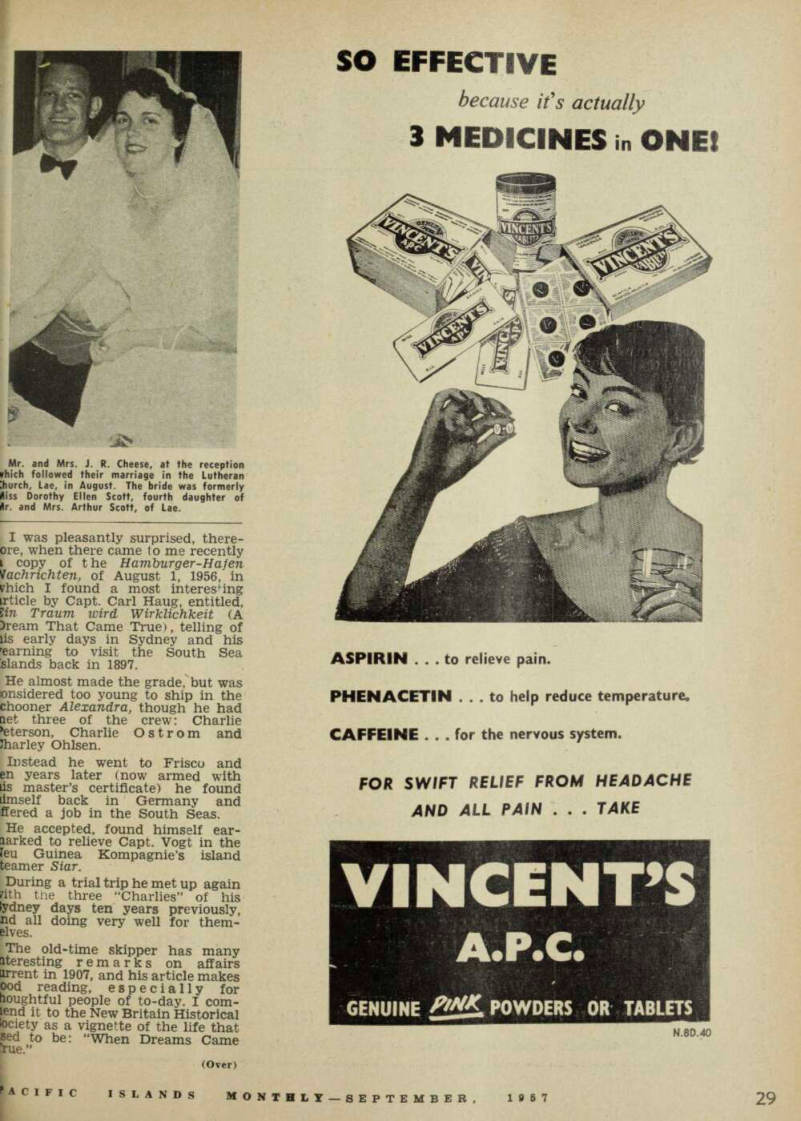
Mr. and Mrs. J. R. Cheese, at the reception which followed their marriage in the Lutheran church, Lae, in August. The bride was formerly Miss Dorothy Ellen Scott, fourth daughter of Mr. and Mrs. Arthur Scott, of Lae.
The Old Matunga E. W. Harrison’s contribution to the “Editors’ Mail Bag” ( PIM, Aug., p. 20), brought back memories, although the good ship was not ply ing in the German islands at the date he mentioned —1911.
But I recall a trip I made in Matunga in 1915, with Donaldson as skipper. I joined the ship at Faisi, and we travelled to Rabaul then back through the Solomons to Sydney.
Willy Dupain was acting super cargo to Rabaul, where he dis embarked to take over BP’s store there.
Willy, one of BP’s oldest managers, was at Cairns when I came out from durance vile with the Japs in October, 1945, travelling on Marella, with Skipper Donaldson as master.
Many a good yam we had of the old days. Willy came aboard with his charming wife, as glamorous as when I first saw her in ’22 aboard the Speejacks in Rabaul harbour.
Matunga was, of course, captured by the German raider Wolf, and passengers and crew taken for a ride to Europe, all of which was recorded by Donaldson in his story of the raider Wolf. Mortimer, the skipper mentioned by Harrison, spent most of his years on the Sydney-Singapore run after leaving Matunga. (Mr. Harrison supplied an old
programme with his letter to the Mailbag. It was typed on a “ Matunga” letter-head and we do not think we made a mistake with the date. The programme has now been returned. Mr. Harrison did not actually say " Matunga ” was trading to German NG, but she must have been up that way. — Editor).
Twenty Years Ago
The preamble to “Do You Re member” (P/M Aug., p. 22) recal the visit of Lord Gowrie to Rabau following the eruption at the end c May, 1937. In many ways the vis was quite informal.
The G-G was a man of assure
Dsition and consequently gracious ) all. There was the usual follow ig of newspaper correspondents, nd amongst them was young David tcNicoll (son of the Administrator) )r the SMH.
David has gone a long way since len; he is now editor-in-chief of le Sydney Telegraph.
!argo Cult
A Mr. Valentine appears to have irown a stick of dynamite into the ission machinery of P-NG with his atements concerning responsibility >r encouraging cargo cult amongst >me of the natives of New Britain.
So much so as to draw somewhat sated replies in the local Press from Bads of two mission societies.
It is a bad business, but by no leans a new argument to attempt sheet home the blame on a par lcu 1 a r denomination. Thumbing irough a few back numbers of PIM came across a lengthy screed by a utheran missionary from the USA inying any mission influence in the lit and placing the blame on “un iristian white man’s culture.”
And that was 11 years ago (PIM, me, 1946, p. 44).
I can envisage greater dangers arising out of this form of native Socialism now than in the pre-war years before the introduction of native co-operatives, which are re sponsible for lowering many of the old tribal barriers, and have created a greater co-ordination of native thought and action in opposition to European domination.
It is the thin end of the nationalist wedge and will grow as the isolation
ism due to tribal animosities diminishes.
An Eye for
An Eye
There has been a considerable amount of publicity given lately con cerning the “pay-back” system as practised amongst the indigenes of the Goilala folk in Papua, and a
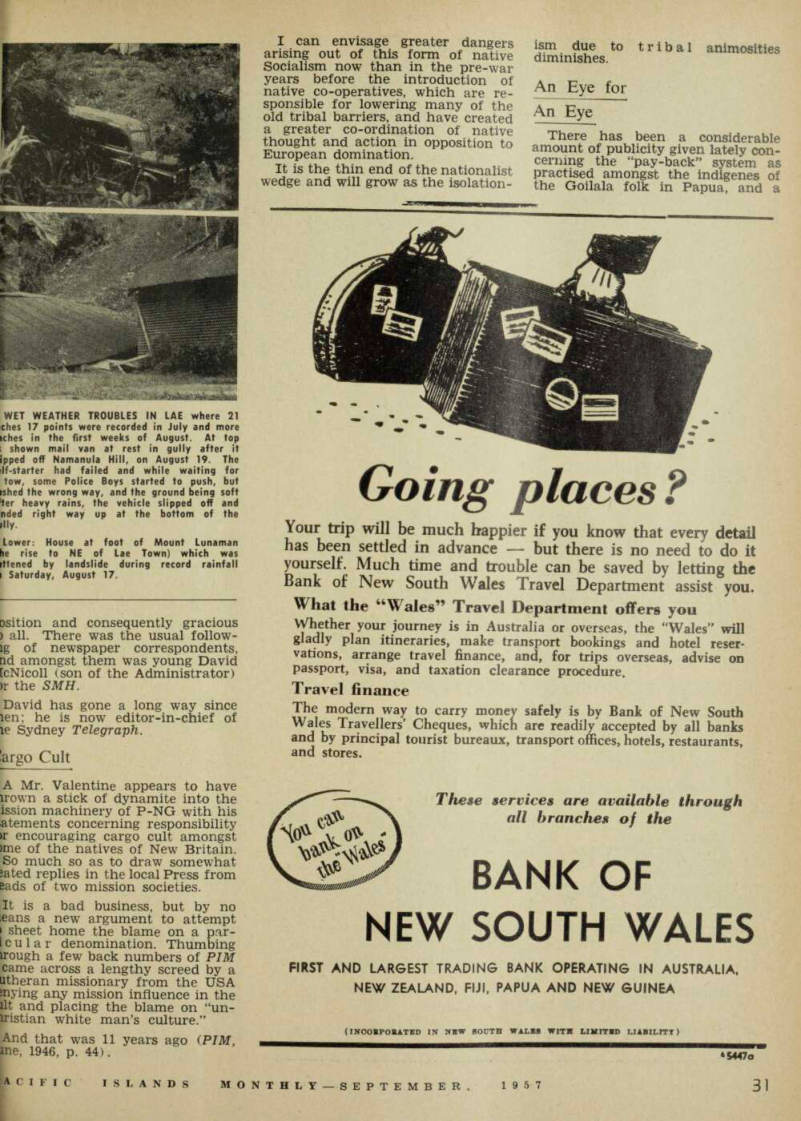
WET WEATHER TROUBLES IN LAE where 21 ches 17 points were recorded in July and more [?]ches in the first weeks of August. At top [?] shown mail van at rest in gully after it [?]ipped off Namanula Hill, on August 19. The [?]lf-starter had failed and while waiting for tow, some Police Boys started to push, but [?]shed the wrong way, and the ground being soft [?]ter heavy rains, the vehicle slipped off and [?]nded right way up at the bottom of the [?]lly.
Lower: House at foot of Mount Lunaman [?]he rise to NE of Lae Town) which was [?]ttened by landslide during record rainfall [?] Saturday, August 17.
native Crown witness was given police protection as a result of his evidence before the Court.
The “Back ’im” system is naturally rife throughout the Pacific —or the world generally, if it comes to that;; but the tactics adopted in the SW Pacific Islands are usually of a more primitive type.
In later years death has attained a monetary valuation and irrational actions can be “bought” by the pay ment of goods or some variety ol currency. This was illustrated last month when P-NG’s Chief Justice arranged with Goilala relatives tc accept payment for the death of a woman; Two pigs, a couple of dogs and a tooth necklace were agreec upon as the value of the deceased plus the loss of face.
It would be nice if Malaitamen down in the BSIP, could be inducec to follow the same idea.
In some quarters down in th» “Sorrowfuls” the loss of the twe missionaries last May off the Makirs coast, and the stabbing to death lasi month of Fred Gilliland, are deemeo to be connected with the Poole case This may or may not be the case At any rate it leaves room for s certain amount of speculation.
The Weed in P-NG More about New Guinea’s tobacc: industries past and present (PIM Aug. p. 146) ; A syndicate of local New Britai:. planters produced stick tobacco a a factory on the North Coast, on of Rabaul, back in the middl thirties. Its produce had quite successful run for a time: but fc some reason the venture petered oui The Madang area has bee identified with the tobacco industn since the early nineties when th old Neu Guinea Kompagnie de veloped it with Asiatic labour air exported a considerable quantity.
Without doubt TNG could becom a world-famous tobacco country only properly directed. Vested in terests in other lands, no doubt, wr see that it is not so directed.
The same, of course, applies • sugar. As is well known, TNG the natural home of the sugar cam whence other sugar-producin countries obtain fresh stocks froc time to time.
Incidentally—and nothing to ( with old-fashioned lines—the mode? trend for kiddies’ hoops made cane would become a money spinnr for some energetic Island exporter Sydney retailers are getting aboc a bob a foot for those circles kanda. • The current hoop craze amonc& Australia's small fry is almost et tirely confined to females. This hoops with a difference. You don bowl them , you put them round yoz middle and by swinging the hips
(Continued on Page 36)
P-NG Has Some New
Public Servants
On August 12, 83 natives in spotless white [?]irts and shorts or laplaps were presented [?]ith letters of appointment as officers of the [?]xiliary Division in the Papua-New Guinea [?]ublic Service.
They are the Port Moresby section of 169 dministration servants chosen for the new [?]vision.
They have received substantial rises in pay [?]nd ail higher offices of the Public Service [?]re now open to them.
The letters of appointment were presented [?] the Administrator of the Territory, Brigadier M. Cleland, and Public Service Commissioner, [?]r. N. Thomson.
Brigadier Cleland told the new officers that [?]ey were helping to administer their country [?]behalf of their own people.
"We are here to help and guide you, and [?]e want your help," he said.
The Port Moresby men are shown above, [?]ith, front row (left to right); Mr. L. F. [?]tier, Senior PS Inspector; Mr. Neil Thomson, [?]Commissioner; Brigadier D. M. Cleland, dministrator; Dr. J. T. Gunther, Assistant dministrator; Mr. D. I. Glastonbury, Inspector [?]raining), PS Commissioner's Department.
a circular motion keep the hoop re volving—hence the name “Hula hoop.”
What’s Wrong With
Their Sums?
“Please Explains” and depart mental minutes between the Auditor- General and the P-NG Adminis tration have become so consistent that one hardly takes much notice of them —feeling that nothing will ever be done —or, any rate, be publicly explained.
Nevertheless, news that “Investi gators Probing” under a section of the Public Service Ordinance into the manner in which outstation officers are administering official
funds gives one to ponder, more especially in view of the criticism levelled against the P-NG Admin istration in the expenditure of grants by the Public Accounts Com mittee in Canberra.
Mr. C. E. Reseigh, of the Finance and Economic Division of the Terri tories Dept, told the Federal Accounts Committee that evidence existed of lack of financial control in the Territories, pointing out that monies for grants had been socked away in the old oak chest. Of one allocation of £20,000, only £39 had been spent. A Labour Member of the Committee referred to these sums as “spare pocket money.”
In the Moresby TAG, strong criticism was recently levelled at a
Public Works quote of £50,000 a mil for sealing a Moresby road. “Twelv times more than a Dept, of Maii Roads estimate in NSW,” said th critic I asked a local municipal counc engineer what the cost was in and he gave me £l2O a chain fc the average job and, according 1 my electronic brain that works oi at something like £9,600 a mil There’s got to be a lot of extra won to make up the difference.
Very confusing. Or is it?
Delayed Action
In early December, 1956, follov ing payments to former POW’s ■ the Japs from £4.5M (Sterling) pa. by the Japs to the International Re Cross, the Australian Governme: announced that it would provu £20,000 for civilians who had su fered hardships as internees of tl Japs.
On August 17, 1957, an advertis; ment appeared in the Sydney pape calling on Australian citizen qualified to receive such assistani from the Civilian Internees’ Tm Fund, to make application.
“No claim will be considered received after August 31, 1957”, re:i the advertisement.
Seems a bi stiff. Eight mont; for the bureaucrats to get busy, b only 14 days for the “civilians.”