New Caledonians Flay
p. 24 · Read in the full issue
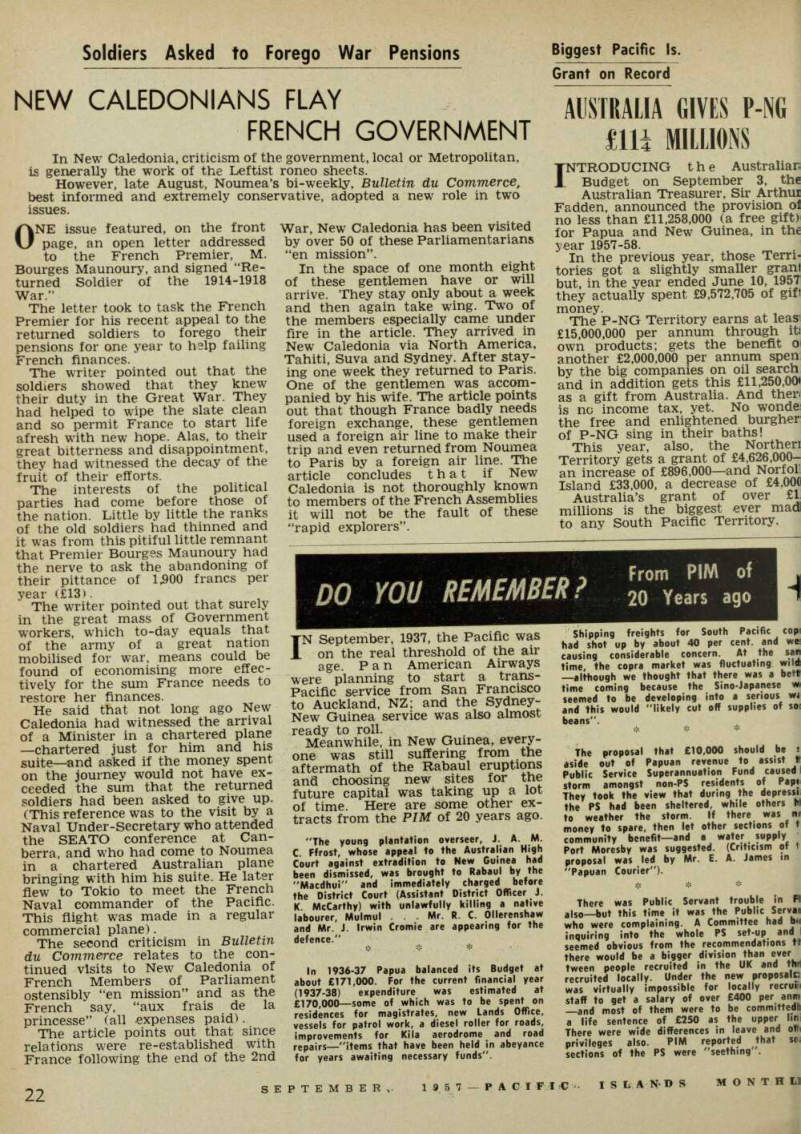
Soldiers Asked to Forego War Pensions
French Government
In New Caledonia, criticism of the government, local or Metropolitan, is generally the work of the Leftist roneo sheets.
However, late August, Noumea’s bi-weekly, Bulletin du Commerce, best informed and extremely conservative, adopted a new role in two issues.
ONE issue featured, on the front page, an open letter addressed to the French Premier, M.
Bourges Maunoury, and signed “Re turned Soldier of the 1914-1918 War.”
The letter took to task the French Premier for his recent appeal to the returned soldiers to forego their pensions for one year to help failing French finances.
The writer pointed out that the soldiers showed that they knew their duty in the Great War. They had helped to wipe the slate clean and so permit France to start life afresh with new hope. Alas, to their great bitterness and disappointment, they had witnessed the decay of the fruit of their efforts.
The interests of the political parties had come before those of the nation. Little by little the ranks of the old soldiers had thinned and it was from this pitiful little remnant that Premier Bourges Maunoury had the nerve to ask the abandoning of their pittance of 1,900 francs per year (£l3).
The writer pointed out that surely in the great mass of Government workers, which to-day equals that of the army of a great nation mobilised for war, means could be found of economising more effec tively for the sum France needs to restore her finances.
He said that not long ago New Caledonia had witnessed the arrival of a Minister in a chartered plane —chartered just for him and his suite —and asked if the money spent on the journey would not have ex ceeded the sum that the returned soldiers had been asked to give up. (This reference was to the visit by a Naval Under-Secretary who attended the SEATO conference at Can berra, and who had come to Noumea in a chartered Australian plane bringing with him his suite. He later flew to Tokio to meet the French Naval commander of the Pacific.
This flight was made in a regular commercial plane).
The second criticism in Bulletin du Commerce relates to the con tinued visits to New Caledonia of French Members of Parliament ostensibly “en mission” and as the French say, “aux frais de la princesse” (all expenses paid).
The article points out that since relations were re-established with France following the end of the 2nd
War, New Caledonia has been visited by over 50 of these Parliamentarians “en mission”.
In the space of one month eight of these gentlemen have or will arrive. They stay only about a week and then again take wing. Two of the members especially came under fire in the article. They arrived in New Caledonia via North America, Tahiti, Suva and Sydney. After stay ing one week they returned to Paris.
One of the gentlemen was accom panied by his wife. The article points out that though France badly needs foreign exchange, these gentlemen used a foreign air line to make their trip and even returned from Noumea to Paris by a foreign air line. The article concludes that if New Caledonia is not thoroughly known to members of the French Assemblies it will not be the fault of these “rapid explorers”.