Copra In 1958
pp. 23-145 · Read in the full issue
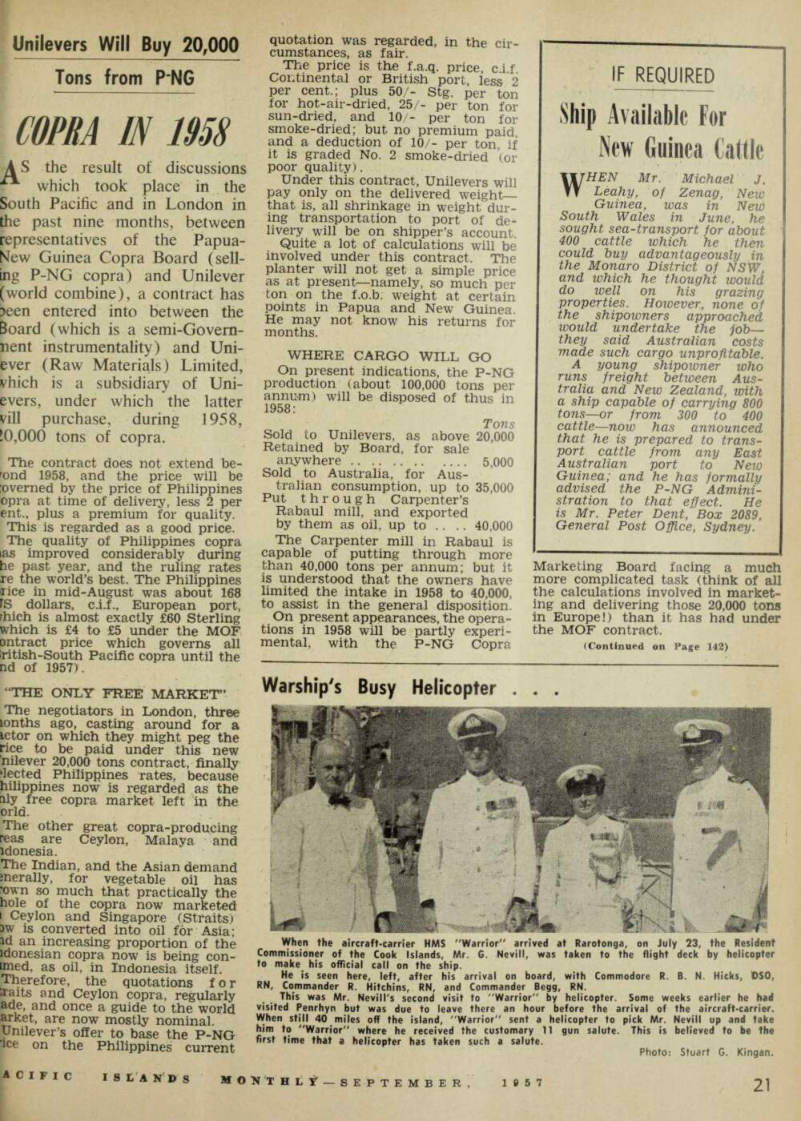
Unilevers Will Buy 20,000 Tons from P-NG
A S the result of discussions ** which took place in the South Pacific and in London in
the past nine months, between
representatives of the Papua-
New Guinea Copra Board (sell
ing P-NG copra) and Unilever (world combine), a contract has seen entered into between the Board (which is a semi-Govem
nent instrumentality) and Uni
ever (Raw Materials) Limited,
vhich is a subsidiary of Uni evers, under which the latter
vill purchase, during 1958,
JO, OOO tons of copra.
The contract does not extend be yond 1958, and the price will be pverned by the price of Philippines opra at time of delivery, less 2 per ent., plus a premium for quality.
This is regarded as a good price.
The quality of Philippines copra las improved considerably during he past year, and the ruling rates re the world’s best. The Philippines rice in mid-August was about 168 FS dollars, c.i.f., European port, rhich is almost exactly £6O Sterling which is £4 to £5 under the MOF ontract price which governs all iritish-South Pacific copra until the nd of 1957).
“The Only Free Market”
The negotiators in London, three lonths ago, casting around for a ictor on which they might peg the rice to be paid under this new nilever 20,000 tons contract, finally ‘lected Philippines rates, because hilippines now is regarded as the tily free copra market left in the orld.
The other great copra-producing reas are Ceylon, Malaya and idonesia.
The Indian, and the Asian demand merally, for vegetable oil has •own so much that practically the hole of the copra now marketed i Ceylon and Singapore (Straits) aw is converted into oil for Asia; id an increasing proportion of the idonesian copra now is being con imed, as oil, in Indonesia itself.
Therefore, the quotations for Sraits and Ceylon copra, regularly ade, and once a guide to the world arket, are now mostly nominal.
Unilever’s offer to base the P-NG ice on the Philippines current
quotation was regarded, in the cir cumstances, as fair.
The price is the f.a.q. price, c.i.f Continental or British port, less 2 per cent.; plus 50/- Stg. per ton for hot-air-dried, 25/- per ton for sun-dried, and 10/- per ton for smoke-dried; but no premium paid and a deduction of 10/- per ton, if it is graded No. 2 smoke-dried (or poor quality).
Under this contract, Unilevers will pay only on the delivered weight— that is, all shrinkage in weight dur ing transportation to port of de livery will be on shipper’s account.
Quite a lot of calculations will be involved under this contract. The planter will not get a simple price as at present—namely, so much per ton on the f.o.b. weight at certain points in Papua and New Guinea.
He may not know his returns for months.
Where Cargo Will Go
On present indications, the P-NG production (about 100,000 tons per annum) will be disposed of thus in 1958; Tons Sold to Unilevers, as above 20,000 Retained by Board, for sale anywhere 5,000 Sold to Australia, for Aus tralian consumption, up to 35,000 Put through Carpenter’s Rabaul mill, and exported by them as oil, up to .. .. 40,000 The Carpenter mill in Rabaul is capable of putting through more than 40,000 tons per annum; but it is understood that the owners have limited the intake in 1958 to 40,000, to assist in the general disposition.
On present appearances, the opera tions in 1958 will be partly experi mental, with the P-NG Copra
Marketing Board facing a much more complicated task (think of all the calculations involved in market ing and delivering those 20,000 tons in Europe!) than it has had under the MOF contract.
(Continued on Page 142)
It could be that, as the marketing and shipping conditions following the MOF contract develop, the Car penter crushing mills established in Rabaul and Suva will become rather important factors. They will tend, probably, to stabilise factors like freight and handling charges.
Future Profit Is Obscure
AT present, a NG planter gets £57/15/- for a ton of hot-air dried copra delivered at Terri tories port; and calculates his profit accordingly.
Under the 1958 arrangements, now coming into sight, there is little indication of what he will get, eventually.
The Australian consumers, and the Carpenter mill, will not pay more than is to be paid by Unilever, under the new contract.
There is no indication of what de ductions will be made, in 1958 onwards, by the Marketing Board for its services and for the funds which Government insist on accumulating.
Under the Unilever contract, a ton of good copra may realise, in Europe, on to-day’s Philippine prices, £5B/10/-, after deducting, say, 5 per cent, for shrinking and 2 per cent, for discount, and adding 50/- per ton for No. 1 premium. £5B/10/-
Sterling would be equal to about £73 Australian How much will the Board deduct in 1958 for storage, handling charges, freight, and insurance? It is anyone’s guess. But it will be substantially more than £l5/5/ — which is the difference between what the planter now gets, and the £73 Australian which might be paid by Unilever for the ton of copra in a British port.
Fiji Position
THE position in Fiji is not .quite the same as in Papua-New Guinea.
In Fiji, the Carpenter mills could take all the copra produced, if neces sary; but it may be deemed prudent to sell a proportion of the Fiji pro duction to Unilever, under a contract similar to that made by the P-NG Board.
Up to the date of this writing, no announcement has been made in Fiji.
Copra Prospects Generally
MEN who should be sound judges consider that the copra in dustry prospects are good. Not only is the world population increas ing rapidly, but the standard of liv ing of great masses of people is im proving, so that they demand more food, and a greater variety of it.
For example, there are 400 million people in India, and their living
standards are rising. They a essentially consumers of vegetal oils —they will not eat animal fats and they want more and me vegetable oil, as the changes in t copra market in Ceylon and Mala indicate.
Other countries with large popu. tions—in South America, for exam] —also are now demanding cocor oil supplies.
“It is not so much a question demand, as of exchange”, said c experienced observer. “If only tr had the means of buying, 1 countries of Asia could consu every ton of coconut oil produced the Pacific area. . . If only 1 Asians could produce goods acce able to the copra-producing counti (or to the countries from which ; copra-producers buy their requi ments) there would be no bott to the copra market in Asia.”
Unilever's Offer to BSIP
UNILEVERS have made an o: to buy the bulk of the co production of the BSIP. 1 was announced recently by chairman of the BSIP Co Board, Mr. A. M. Wilkie.
The Board has been consider the offer and it seems likely t they will follow P-NG’s lead in matter—reserving some copra sell on the open market and sene some to Australia. (It was arran
ie years ago that in order to intain communications with Aus lia, a certain amount of BSIP ira would be reserved for back ding for Burns Philp ships). ’he BSIP’s representative at the le conferences in UK and rope, Mr. E. J. Thomsett, re ned recently to Honiara. He i that wherever he went, buyers I crushers had some complaint iut the quality of South Pacific >ra. Many of the complaints e about dust which makes the ning process difficult. At least per cent, of copra now is used edible purposes and it is there ; necessary to have better lity than if it were to be made ) soap. he BSIP Copra Board had ned that on present indications re will be a sharp fall in copra ir the end of the agreement in ember, 1957.