Nsw Maritime Unions Challenge
pp. 21-151 · Read in the full issue
Rona Tied Up By Black Ban
Csr Company
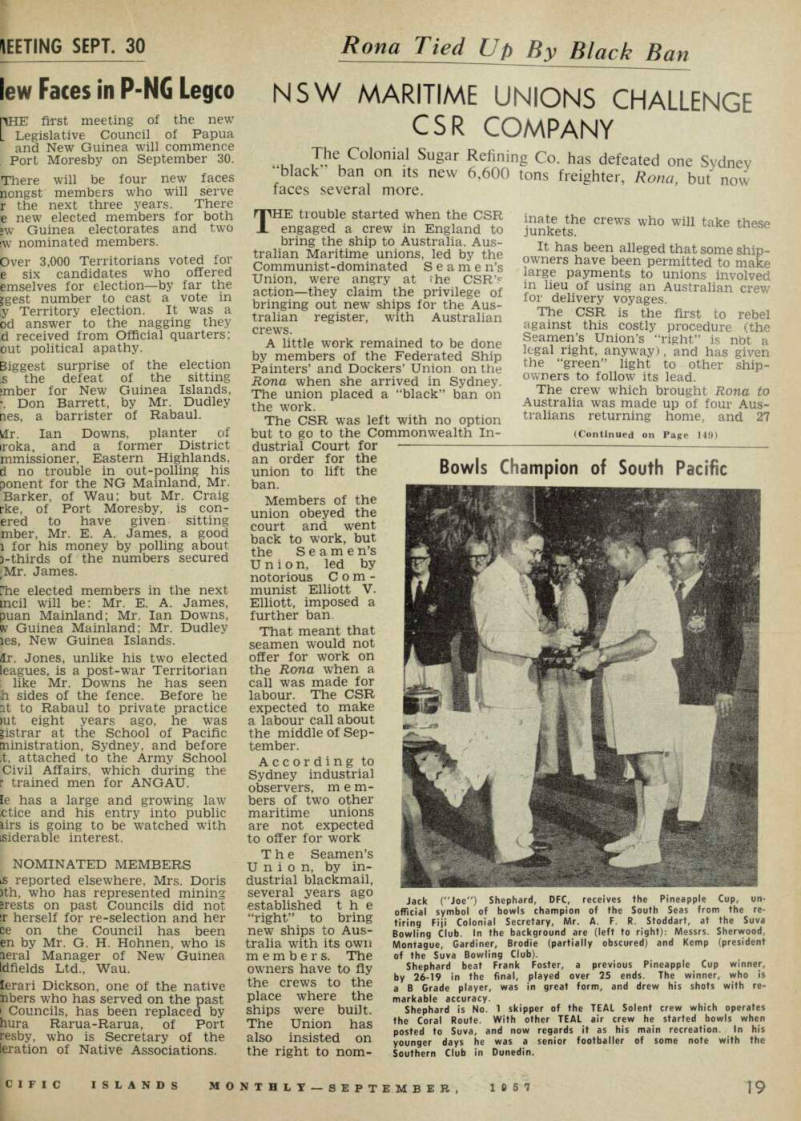
uu , Tjie Colonial Sugar Refining Co. has defeated one Sydney black ban on its new 6,600 tons freighter, Rona, but now faces several more.
THE trouble started when the CSR engaged a crew in England to bring the ship to Australia. Aus tralian Maritime unions, led by the Communist-dominated Sea m e n’s Union, were angry at the CSR’ c action —they claim the privilege of bringing out new ships for the Aus tralian register, with Australian crews.
A little work remained to be done by members of the Federated Ship Painters’ and Dockers’ Union on the Rona when she arrived in Sydney.
The union placed a “black” ban on the work.
The CSR was left with no option but to go to the Commonwealth In
dustrial Court for an order for the union to lift the ban.
Members of the union obeyed the court and went back to work, but the Seamen’s Union, led by notorious Com munist Elliott V.
Elliott, imposed a further ban That meant that seamen would not offer for work on the Rona when a call was made for labour. The CSR expected to make a labour call about the middle of Sep tember.
According to Sydney industrial observers, m e ru bers of two other maritime unions are not expected to offer for work The Seamen’s Union, by in dustrial blackmail, several years ago established the “right” to bring new ships to Aus tralia with its own members. The owners have to fly the crews to the place where the ships were built.
The Union has also insisted on the right to nom
inate the crews who will take these junkets.
It has been alleged that some ship owners have been permitted to make large payments to unions involved in lieu of using an Australian crew for delivery voyages.
The CSR is the first to rebel against this costly procedure (the Seamen’s Union’s “right” is not a legal right, anyway), and has given the “green” light to other ship owners to follow its lead.
The crew which brought Rona to Australia was made up of four Aus tralians returning home, and 27
(Continued on Page 149)
Titish migrants who were awaiting n assisted passage to Australia, he fact that the migrants were ble to work their way out, in ddition to earning pay, meant a iving of some thousands of pounds ) the Commonwealth Government.
Elliott himself expected to get a •ip to England to bring out the ona, and because he missed out he now out for vengeance.
If pressed hard enough by the ;sults of Mr. Elliott’s policy, rank nd file seamen may be brought to leir senses. Communist policies i the Australian waterfront in the -st eight or 10 years have led to diminuition of shipping, and work hard to get.
There are now more than 130 embers of the Seamen’s Union un ale to get a ship. While waiting for ship they are unable to take other ork.
The Rona itself would offer work >r 15-17 seamen.
The ban on the Rona could mean lat Australian seamen will never ave the privilege of working her ad living in luxury—her crew carters are of a standard equal to assenger accommodation on a big tier.
The CSR has already moved to ansfer the Rona from the Aus alian to the British register in uva. This will enable the company ► engage a crew in Fiji.
It has been reported in Sydney lat Elliott is so annoyed with the SR that the Rona has been intenced to a 12-weeks tie-up, and nless the CSR accepts this the iona will also be tied up when she ext reaches Australia. The Sea en’s Union in the past has imposed sentences” on shipowners who have lucked” them.
Nothing has been said publicly in Australia, but such a ban could also lead to the transfer of Fiona from the Australian registry.
Seamen’s Union members are be ginning to realise that Elliott’s Communist policies, instead of safe guarding their jobs, have led them to unemployment. A faction within the union has been plotting to get rid of Elliott and other Communist officials, but the Red grip is so strong that such a move is not likely to succeed quickly.
Union dues go on even though some seamen are out of jobs; Mr.
Elliott is amongst the officials whose salaries are always paid promptly.
II Mr. Lee Ashton, well known merchant of Lae, New Guinea, suf fered a heart attack in mid- September, and is undergoing a course of treatment in hospital.