Industrial Empire Of Unilever
pp. 80-81 · Read in the full issue
Creation of the mighty—
The expiry of the British MOF Copra Contract at the end of this year and the recent visit of the chief buyer of oils and fats for Unilever Ltd. to Fiji, Australia and Papua, have aroused much speculation in South Pacific copra circles as to future market conditions. The very great and rich organisation of Unilever was the subject of an article in Truth of April 28, which is reproduced here in full as being of particular interest in view of present developments.
SOME years ago, a British busi ness executive on a visit to Indonesia found his company s Djakarta factory terrorised by blood curdling “evil spirits.” Obviously, there was only one thing to be done; the “evil spirits” had to be exorcised. In his striped pants and bowler hat, the Man From The City consulted the priests. The re sult was a “Selamatan,” a flam boyant, gaudy function partly re ligious, partly festive.
Its highlight was the slaughter of a bellowing bullock. Then, with the priests, the business executive and the native workers forming an exotic procession, the bullock’s flower-garlanded head was carried through the factory “attracting” the spirits, which were finally interred with the head in a deep pit.
Afterwards, the businessman was gratified to report, business efficiency return to normal.
Balding, bespectacled Lord Hey worth, 61-years-old boss of Unilever, the world’s biggest trading empire, doesn’t look like an “exerciser of spirits.”
He is a shy, modest man. When he speaks it is softly, nervously— like a kindly mathematics master chiding an erring pupil.
But when Heyworth gives orders . . . the West African peanut harvest is gathered . . . whaling fleets set course for the Arctic Circle . . . business deals proceed in Istanbul, Sydney, Amsterdam and Paris.
On Unilever, the sun never sets.
It bestrides the globe like a Colossus, dominating the lives of millions in 43 nations outside the Iron Curtain.
Beside Unilever, the empires of the Wolfsons’, the Onassis’ and the Henry Fords’, shrink to Lilliputian size.
It enfolds more than 500 subsidiary companies.
It has a turnover of £1,671 millions a year.
From massive headquarters wedged beside the misty River Thames Em bankment in London. Heyworth masterminds this Leviathan.
He markets millions of tons of
North Sea fish —fresh, canned, smoked, frozen—making him the world’s biggest fisherman.
Four hundred gleaming, modern British fishshops handle the harvest.
HE is Lord Soap —m anufac tu r e r of beauty prepara tions and inter nationally - adver tised toilet brands from Lux, Sun light and Life buoy—right down to the detergent the charwoman shakes into her bucket.
He is Lord Marg arine—the world’s biggest producer, operating on a 100,000,000 tons scale.
He dabbles in plywood, frozen food, ice-cream, chemicals, fat s, baby food, fertilis ers—and sausages.
Once a year, 198,000 share holders gather at the feet of this Lord of the Uni verse to split up the profits. In 1956, they divided £98,000,000.
The Unilever Colossus is the product of the dreams and ambitions of a Lancashire grocer’s son — William Hesketh Lever, Young Lever began work in his father’s grocery warehouse in 1867.
He was 16.
At 21 he was in partnership with his father.
At 33 he had a
fortune of £60,000 and was sidering retiring.
Instead he went into soap.
Soap was already an estah< business in England. But tcckled it in a new way. He bn it, and advertised it.
In two years, Lever’s soap t world best-seller. The name —and is—“ Sunlight.”
In 1888 the young tycoon looking around for a huge; factory site. He found it on M* side, near Liverpool, and foil Port Sunlight.
By the end of the century, L feverish energy had estahi factories in Switzerland, Cat Germany, America and Austrs [A new £1,000,000 Unilever I ing is being built near Circular Sydney, now.] Soon afterwards, the Soap T —already with a dubious repui for ruthless efficiency—c 1a t bitterly with famous Fleet !
Press Baron Lord Northcliffe.
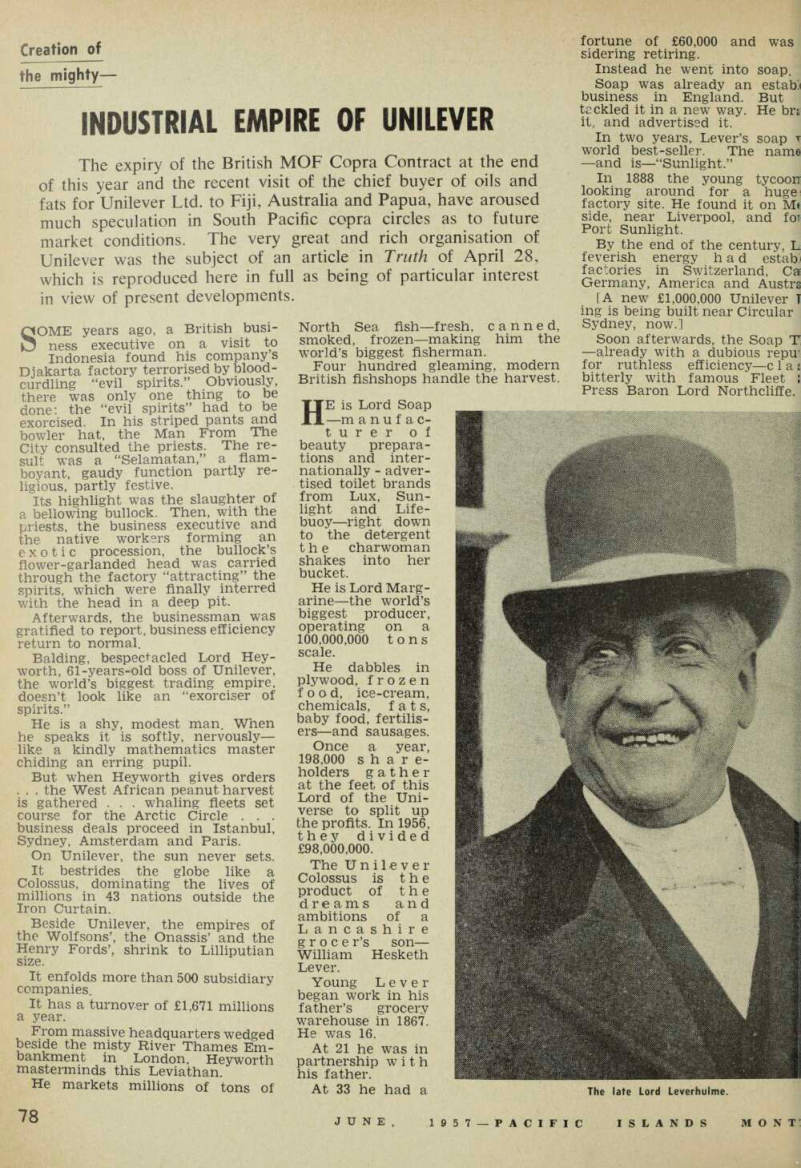
The late Lord Leverhulme.
om 1900 onward, the soapmakers begun to feel the strain of ris prices. argarine and other new food s began to compete for the same and oils used by the soapmakers. id in 1906, the soapmakers ed on a general price advance, stead of raising the retail price ►unlight, Lever made the bars ler. He also began to think, aloud, of the advantages of a s ring. rd Northcliffe’s reaction was ediate. He blasted Lever’s pro i “soapmakers merger” through Daily Mail. He attacked it as inst the public interest.” itially, the attack succeeded, r was forced back to making :ull-sized bars of Sunlight soap, i he brought against Northcliffe nsational libel action, cost the Press Baron £50,000 amages—the then biggest sum awarded in an English court, early as 1901, while sailing from ralia to Canada, Lever had de -1 the time was ripe to establish iwn South Seas copra planta had also been examining the bilities of starting plantations frica. ht years later, in 1909, Lever isingly received from the an King Albert a mandate for st empire of 1,800,000 acres in Belgian Congo. r er eventually discovered the reason he had received the late was that King Albert had d Port Sunlight incognito, and been hugely impressed with ’s model settlement, his life Lever took an enormous ;st in this Congo enterprise. /as said not a palm tree was [anted on the entire estate that ever didn’t know about, day, the Congo estate produces quantities of palm oil, rubber ;ocoa. er more than fulfilled his itions to King Albert to pro adequate living standards for mployees. tie ranches provided workers fresh meat. There are ample al, educational and social ser er had only two failures in his imenal career. In 1920, he ased the mighty Niger Com for £8,000,000. It was bought I a boom period, and in the yar slump, Lever faced a fall arket. worried the multi-millionaire ;st of his life. other failure was the Isle of , 720 wind-swept square miles : Hebrides, off Scotland, soap tycoon’s plans for Lewis
far-reaching.
Times commented sardonic “He attempted to play the )f an earthly providence. The r population welcomed him at
first when he established a fishing company.
“But when they realised they would have to pay for their property by being ‘industrialised’ they re belled, and ultimately, after five years struggle, Lord Leverhulme accepted defeat.”
In 1925, the “greatest industrialist of the age”—now elevated to the peerage—died suddenly, aged 74.
His death brought condolences from King George V and Queen Mary, and control of his £50,000,000 Soap Empire to Francis D’Arcy Cooper—brother of Duff Cooper.
It was Cooper, who died not very long after, who recognised in Geoffrey Heyworth a spark of Lord Leverhulme’s own genius, and started him up the stairway to power.
In 1929, the soap empire amalga mated with the massive English and Dutch margarine interests, to form Unilever.
Heyworth took on the job of re vising the new company’s marketing methods. He found 50 selling organ isations —and left five!
In 1936, Heyworth became manag ing director of the organisation’s soap-making companies.
Six years later, then 47, he suc ceeded to the throne of the entire organisation.
Heyworth, the master-salesman, w r hose genius keeps the cash registers spinning at the rate of more than £4,000,000 a day, travels endlessly.
In the last few years he has been to Africa, to Asia and to every country in Western Europe.
HE has inspected Unilever planta tions in the Solomons, and Uni lever stores in West Africa — where a subsidiary, United Africa Company does business with 50,000,000 Africans in an area the size of the United States.
From hi s world-wide travels, Heyworth brings back a stream of ideas, suggestions, reports and criticisms to be thrashed out by his staff.
If Lever, the soap tycoon, could see Unilever as it is to-day—with its 260,000 employees and a staff pensions fund topping £64,000,000 —he would still recognise in it many of his original policies.
In 1891, Lever told William Gladstone: “It is a necessity in continuous, persistent and successful advertising that the quality of the articles advertised be irreproachable.”
That basic tenet, says Unilever, still remains. t Mr. F. E. M. Warner has been appointed Registrar of Co-operative Societies in Fiji. He has been Act ing Registrar since the death of Mr.
D. Collins, who was drowned while landing from a ship at Kadavu early in January. Mr. Warner became Assistant Registrar of Co-operative Societies in 1952.