Charming Smile
p. 79 · Read in the full issue
Magazine Section
Rtrait
Ingeborg de Beausacq: Three Cameras and a Charming Smile
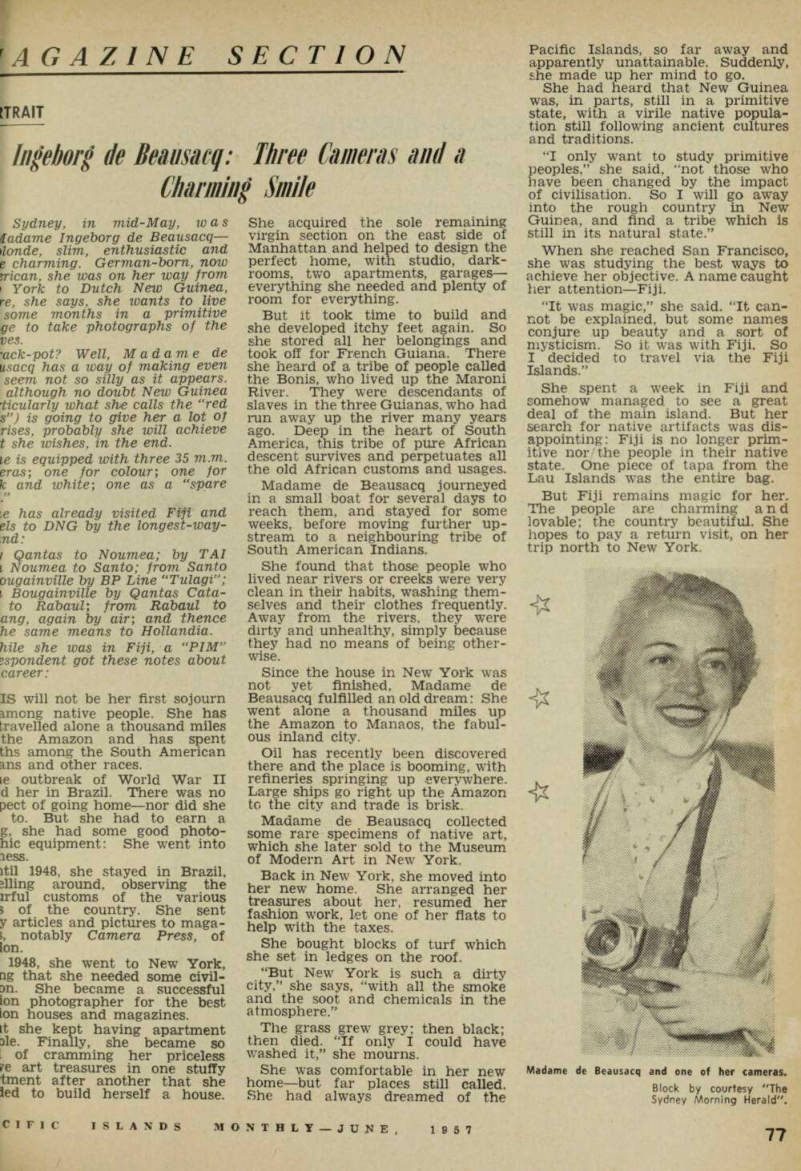
Sydney, in mid-May, was dadame Ingeborg de Beausacq— i londe, slim, enthusiastic and e charming. German-born, now vrican, she was on her way from ) York to Dutch New Guinea, re, she says, she wants to live some months in a primitive ge to take photographs of the ves. •ack-pot? Well, Madame de usacq has a way of making even seem not so silly as it appears, although no doubt New Guinea ■ticularly what she calls the “red s”) is going to give her a lot of rises, probably she will achieve t she wishes, in the end. le is equipped with three 35 m.m. eras ; one for colour ; one for k and white ; one as a “spare yy \e has already visited Fiji and els to DNG by the longest-way \nd: i Qantas to Noumea; by TAI i Noumea to Santo; from Santo ougainville by BP Line “Tulagi”; i Bougainville by Qantas Cata to Rabaul ; from Rabaul to ang, again by air; and thence he same means to Hollandia. hile she was in Fiji, a “PIM” tspondent got these notes about career: IS will not be her first sojourn among native people. She has travelled alone a thousand miles the Amazon and has spent ths among the South American ans and other races, le outbreak of World War II d her in Brazil. There was no pect of going home—nor did she to. But she had to earn a g, she had some good photo hic equipment: She went into less. itil 1948, she stayed in Brazil, filing around, observing the irful customs of the various 5 of the country. She sent y articles and pictures to maga ;, notably Camera Press, of lon. 1948, she went to New York, ag that she needed some civil in. She became a successful ion photographer for the best ion houses and magazines, it she kept having apartment lie. Finally, she became so of cramming her priceless /e art treasures in one stuffy tment after another that she led to build herself a house.
She acquired the sole remaining virgin section on the east side of Manhattan and helped to design the perfect home, with studio, dark rooms, two apartments, garages— everything she needed and plenty of room for everything.
But it took time to build and she developed itchy feet again. So she stored all her belongings and took off for French Guiana. There she heard of a tribe of people called the Bonis, who lived up the Maroni River. They were descendants of slaves in the three Guianas, who had run away up the river many years ago. Deep in the heart of South America, this tribe of pure African descent survives and perpetuates all the old African customs and usages.
Madame de Beausacq journeyed in a small boat for several days to reach them, and stayed for some weeks, before moving further up stream to a neighbouring tribe of South American Indians.
She found that those people who lived near rivers or creeks were very clean in their habits, washing them selves and their clothes frequently.
Away from the rivers, they were dirty and unhealthy, simply because they had no means of being other wise.
Since the house in New York was not yet finished, Madame de Beausacq fulfilled an old dream: She went alone a thousand miles up the Amazon to Manaos, the fabul ous inland city.
Oil has recently been discovered there and the place is booming, with refineries springing up everywhere.
Large ships go right up the Amazon to the city and trade is brisk.
Madame de Beausacq collected some rare specimens of native art, which she later sold to the Museum of Modern Art in New York.
Back in New York, she moved into her new home. She arranged her treasures about her, resumed her fashion work, let one of her flats to help with the taxes.
She bought blocks of turf which she set in ledges on the roof, "But New York is such a dirty city," she says, “with all the smoke and the soot and chemicals in the atmosphere.”
The grass grew grey; then black; then died. "If only I could have washed it,” she mourns.
She was comfortable in her new home—but far places still called.
She had always dreamed of the
Pacific Islands, so far away and apparently unattainable. Suddenly, she made up her mind to go.
She had heard that New Guinea was, in parts, still in a primitive state, with a virile native popula tion still following ancient cultures and traditions.
“I only want to study primitive peoples," she said, "not those who have been changed by the impact of civilisation. So I will go away into the rough country in New Guinea, and find a tribe which is still in its natural state."
When she reached San Francisco, she was studying the best ways to achieve her objective. A name caught her attention —Fiji.
"It was magic,” she said. "It can not be explained, but some names conjure up beauty and a sort of mysticism. So it was with Fiji. So I decided to travel via the Fiji Islands."
She spent a week in Fiji and somehow managed to see a great deal of the main island. But her search for native artifacts was dis appointing: Fiji is no longer prim itive nor the people in their native state. One piece of tapa from the Lau Islands was the entire bag.
But Fiji remains magic for her.
The people are charming and lovable; the country beautiful. She hopes to pay a return visit, on her trip north to New York.
Madame de Beausacq and one of her cameras.
Block by courtesy "The Sydney Morning Herald".