Why The Dutch Hold On In N. Guinea
p. 133 · Read in the full issue
[?]ers to the Editor
[?]teeting Some Ideas About Why The Dutch Hold On In N. Guinea
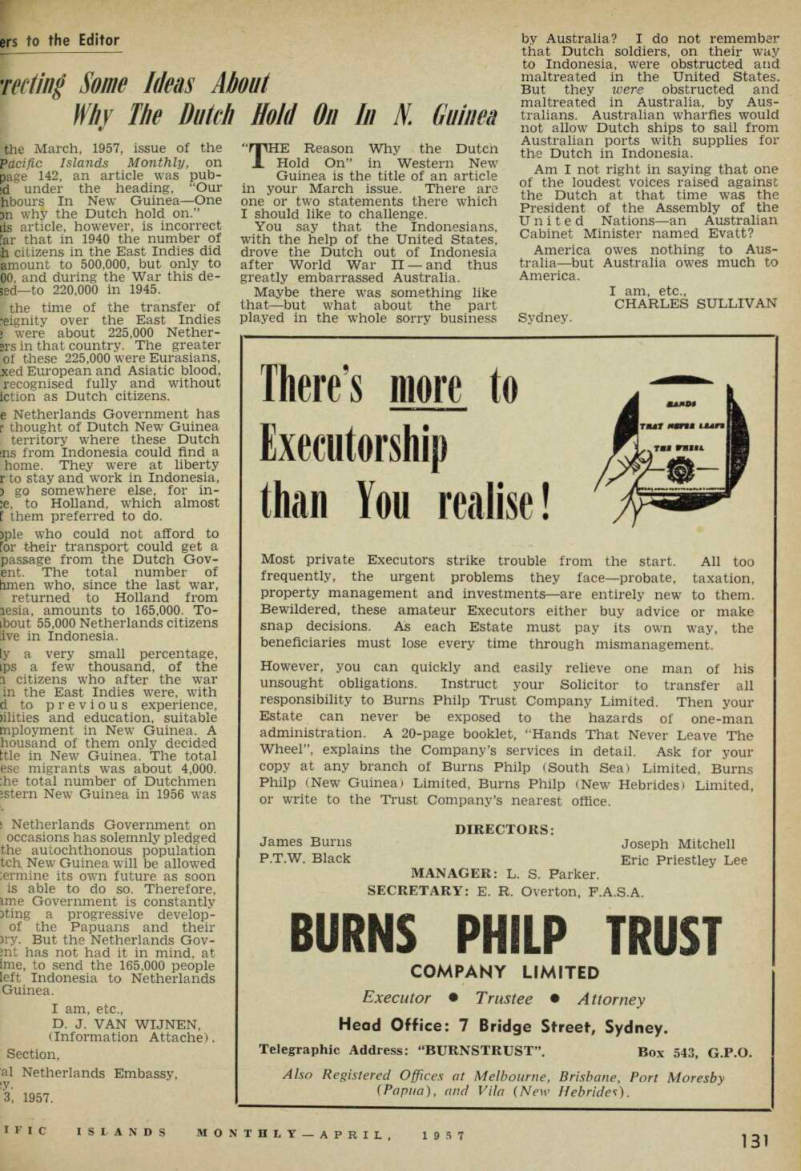
the March, 1957, issue of the Pacific Islands Monthly, on page 142, an article was pub id under the heading, “Our hbours In New Guinea—One 3n why the Dutch hold on.” lis article, however, is incorrect far that in 1940 the number of h citizens in the East Indies did amount to 500,000, but only to 00, and during the War this de sed—to 220,000 in 1945. the time of the transfer of reignity over the East Indies j were about 225,000 Nether ers in that country. The greater of these 225,000 were Eurasians, xed European and Asiatic blood, recognised fully and without iction as Dutch citizens, e Netherlands Government has r thought of Dutch New Guinea territory where these Dutch ins from Indonesia could find a home. They were at liberty r to stay and work in Indonesia, ) go somewhere else, for in ;e, to Holland, which almost f them preferred to do. )ple who could not afford to for their transport could get a passage from the Dutch Gov ent. The total number of iimen who, since the last war, returned to Holland from lesia, amounts to 165,000. To ibout 55,000 Netherlands citizens live in Indonesia, ly a very small percentage, ips a few thousand, of the i citizens who after the war in the East Indies were, with d to previous experience, jilities and education, suitable mployment in New Guinea. A housand of them only decided btle in New Guinea. The total ese migrants was about 4,000. he total number of Dutchmen astern New Guinea in 1956 was i Netherlands Government on occasions has solemnly pledged the autochthonous population tch New Guinea will be allowed iermine its own future as soon is able to do so. Therefore, me Government is constantly 3ting a progressive develop of the Papuans and their )ry. But the Netherlands Gov mt has not had it in mind, at ime, to send the 165,000 people left Indonesia to Netherlands Guinea.
I am, etc.,
D. J. Van Wijnen,
(Information Attache).
Section, al Netherlands Embassy, *y. 3, 1957.
td .. mKE Reason Why the Dutch Guinea°is the ln in your March issue There 1 are one y or two Statements there whfch
hketo chluenee
1 that the Indonesians with the help of the United States! drove the Dutch out of Indonesia after World War II —and thus greatly embarrassed Australia.
Maybe there was something like that—but what about the part played in the whole sorry business
by Australia? I do not remember that Dutch soldiers, on their way to Indonesia, were obstructed and maltreated in the United States.
But they were obstructed and maltreated in Australia, by Aus tralians. Australian wharfies would not allow Dutch ships to sail from Australian ports with supplies for the Dutch in Indonesia.
Am I not right in saying that one of the loudest voices raised against the Dutch at that time was the President of the Assembly of the United Nations—an Australian Cabinet Minister named Evatt?
America owes nothing to Aus tralia —but Australia owes much to America.
I am, etc.,
Charles Sullivan
Sydney.