[?]pical leave
pp. 99-101 · Read in the full issue

[?] Tackles Old ,
[?]Tating Problem
[?]ir Allowances For
[?]pical leave
VING to its geographical situa tion, and its proximity to the self-governing Dominions of Australia and New Zealand, British Colony of Fiji has some iliar angles in its administration, ne, in particular, is connected i the privileges and emoluments he administrative staff sent out :he home country. somewhat similar situation & in the French Colony of New donia. le non-official Europeans in are almost all Australians and Zealanders. A very large pro ion of the trade, commerce and istry of Fiji is controlled by ralian companies, such as nial Sugar Refining Co. Ltd., is, Philp & Co. Ltd., and W. R. (enter & Co. Ltd. All the banks ; (New South Wales, New Zea , and Australia and New Zea ) are owned by the Dominions, not the mother country, is, in fact, an Anzac economy, le staffs of the commercial con -5 are almost wholly Australian New Zealanders. They receive les and leave privileges calcu
lated on the claims that the costs of living are higher in Fiji; that tropical conditions demand more lengthy leave, to enable the persons concerned to visit more temperate climates (although Fiji-born Euro peans laugh at this, and insist that Fiji is just as comfortable and healthy a place to live in as is Queensland); and that their chil dren must be sent “South” for train ing and education after the age of ten, or so.
The various non-official employers of Europeans, in the course of time, have reached standards of pay, leave, etc., which are generally acceptable.
But they are becoming complicated by three factors: • There is an increasing number of local-born Europeans, educated and trained to serve in offices, stores, ships, workshops, etc., who seek none of the privileges referred to above. • The Civil Servants (or officials) sent by the British Colonial Office to Fiji enjoy considerably greater privileges (especially in relation to overseas leave) than the Australian and New Zealand staffs of the com mercial concerns. • The Colonial Office has been taking into the Fiji administrative service a growing number of Aus tralians, New Zealanders and local born Europeans, Fijians and Indians; and the latter, doing similar work, naturally claim similar leave privileges and emoluments, although
it is much easier and cheaper for them to go home.
THE Colonial Office scale of allow ances for tropical leave, as applied to Fiji, has been a source of argument and irritation for a long time. The Fiji taxpayers (mostly local-born Europeans, Aus tralians, New Zealanders and Indians) have shown increasing re sentment at being asked to bear this particular cost.
The present Governor of Fiji. Sir Ronald Garvey (who has courage ously faced up to many Fiji problems which most of his predecessors ran away from), set up a Committee to study these problems of Civil Service leave conditions and make recom mendations. The Committee has re ported, and it was announced in mid-March that the following changes and alterations will be made:
(Continued On Next Page)
There will he a general reduction the period of leave. Senior ;■ ors. for example, will get four V leave for each completed v, h of service, instead of five They will receive an amount in -ash in lieu of the leave thus lost to them. instead of officers being allowed iditional leave to compensate for ; ze time lost in travelling (amount ■zg in some cases to 80 days, when ■he officer travelled by ship to Britain and back), they will be dlowed only the time needed to ravel there and back by air. If ihey elect to travel by sea, the ’driitional time required is taken out of their normal leave period.
Officers will be encouraged to take f heir leave in Australia or New 'Zealand every two years, instead of n Europe every three years, as in the past.
For purposes of leave calculation, in future will be regarded as the mal means of travel. In the past, ior officials taking their leave ry three years, and claiming full we for sea-travel, would be absent eight or nine months: and the : of the man’s salary, travelling .■ voenses and relief-officer repre sented a heavy burden on the enances of the country, and inter ference with service efficiency. /here before a senior official got days’ leave at the end of three wears’ service, plus his return fare to United Kingdom, he now will
get 150 days (4 days for each of 36 months, plus 5 days for air travel); and efforts will be made to induce him to accept, instead, 98 days (4 days for each of 24 months, plus two days of air travel) every two years in Australia or New Zealand.
The thing that the Committee obviously has been aiming for is not
so much a saving in money alii for leave, as avoidance off dreadful waste of time (and diai tion of service) representeoe travelling time added to the period.
The change will be welcome! both employers and taxpayer Fiji. Three months’ leave ever;i
rs is about on a par with what rate employers allow to their opean staffs from overseas, his is almost about equal to the e allowances and privileges wed in respect of Papua and j Guinea service by both Admin ition and private employers— illy three months after 21 iths, which is about days’ e for each month of service
Ong Feeling About
Privileges In New Caledonia
.there has been discontent in *iji in connection with emolu lents allowed British officials i overseas, it is a mild thing pared with what the local-born >peans of New Caledonia feel irds the salaries, allowances and [leges given to the French ials of the French Colonial Ser commentator recently in New donia writes to PIM: hey are horribly overpaid—and is one of the reasons why the of living in New Caledonia is
igh. . . The administrative per
el from France—i nclu d i n g d 1 teachers —get all the favours; 3 the unfortunate local-born, no er how qualified, receive onlv ir positions. . . ew Caledonians who have saved lalf their lives in order to buy econd or third-class return ige to France often find the •ious first-class half-filled with jrivileged officials from France, illing on leave at the expense le Colony. . . here is always a lot of snobbery le part of French-from-France als, who will not mix on terms [uality with the local-bom. lere long has been a demand an overhaul of the New
lonia administration, with a
to admitting the educated and ed local-born people to the ce; but the chief aim of the officials is to keep salaries and eges at the highest possible and maintain them as a close rve for the gentlemen from ;e.” ® Gladys Gebbie, NZ organis secretary of the Girls’ Life de, left for Niue in March to use GLB work there. , Kurt Meyer, one of W. a s most successful cocoa plant nil represent the NZ Govern on the W. Samoa Trust Estates iration, which took over con -3f NZ Reparation Estates at nd of March. i Nessbank left Apia on March th 950 tons of copra for the h Ministry of Food, and 338 of cocoabeans for the English The Matua left on March th 9,000 cases of bananas for Zealand, and 53 tons of cocoa-
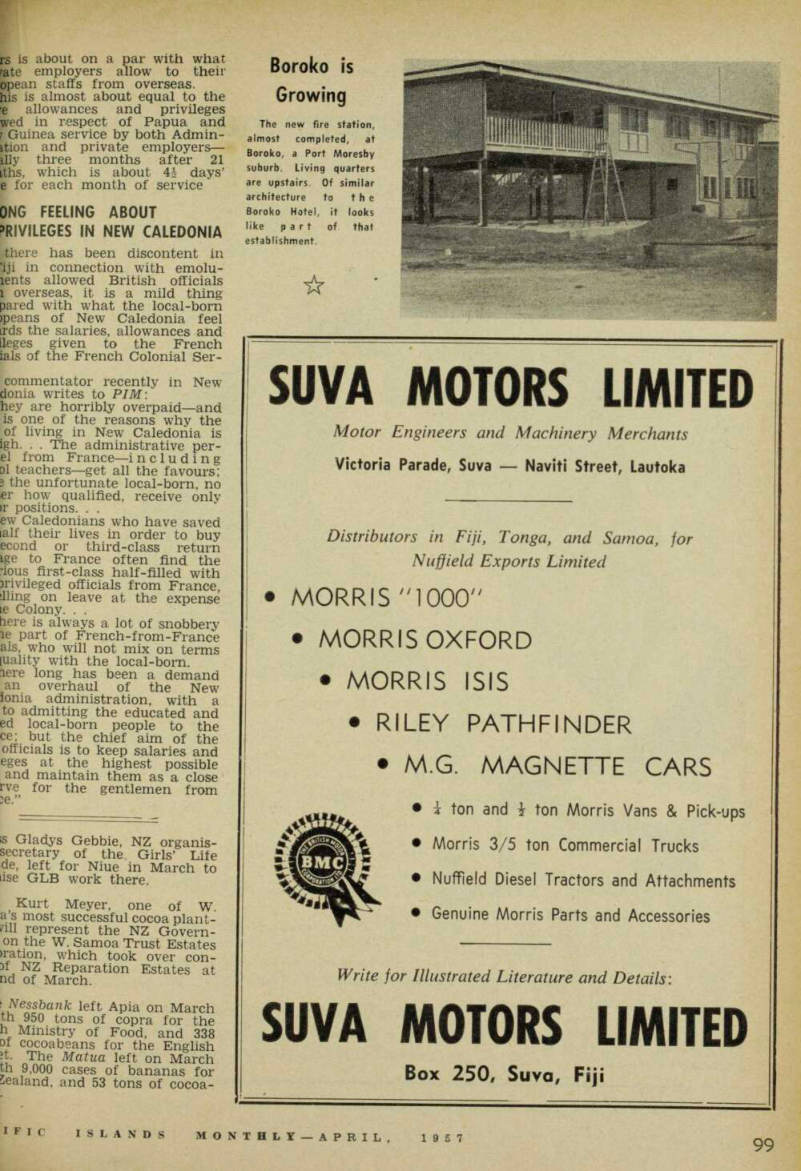
Boroko is
Growing
The new fire station, almost completed, at Boroko, a Port Moresby suburb. Living quarters are upstairs. Of similar architecture to the Boroko Hotel, it looks like part of that establishment.