Tropicalities
pp. 79-80 · Read in the full issue
Magazine Section
T Is The Highest Cross
r\HE Highest Cross in the [ Southern Hemisphere” was the description under a photo iph published on page 13 of ptember PIM, 1938. This showed cross of iron, 16 feet high, ich was placed on top of Mount >ert Edward, in Papua, 13,213 t above sea-level, on July 24, 8. by Roman Catholic >sionaries. tor some reason, this title lighest Cross in Southern misphere”) intrigued a former Titories District Officer, Mr. S.
Chance, of Brisbane: and he ! done some research on the iject. When he made inquiries, was tola that there was a her cross in South America.
Iventually, Mr. Chance learned t the other high cross had also n placed in position, in the les Mountains, by Roman iholic missionaries and it was led “The Cross of Christ the leemer”. They said it was her than the one in Papua.
Ir. Chance now has settled the tter. The South American cross in the top of the Andes, near Trans-Andine railway, between :entine and Peru, and its base cording to the South American idbook ) is at a height of 13,051 0 the Papuan Cross is 162 feet tier —and so it is the highest th of the Equator. his cross is occasionally seen clear weather by passengers aircraft flying between Port •esby and Lae.
Eople In Sydney Drink
Kava
r the Holiday and Travel Exhibition held in Sydney Town Hall from March 19-26, nding tourists were able to pie Kava and get the atmos re of “real” Fiji, his novel advertising idea was 1 by White’s Travel Agency, i bowl and liquid were sent n to Sydney by the Suva lager, Mr. Bob Parkes. ne of the columnists on a ney daily paper was so ressed with the idea that he te a paragraph about it in his imn. Among other things, he . . I am now a member of Ai
Lawalawa Dau Gunu Yagona (Fellowship of Fiji Kava Drinkers) and I am now permitted to drink anywhere in the Sunny South Seas.”
Best-Seller, 1886
IN December, 1886, a book by Hugh Hastings Romilly (see story page 71, in this issue) was a best seller in England, end had run into a second edition. It was advertised in the Times column of new books and editions as The Western Pacific and New Guinea —“With Notices of the Natives, Christian and Can nibal, and some account of the old Labour Trade.” This second edition had an additional chapter
on the “Ghost in Rotumah This book was written, of course, before Romilly went to the New Hebrides a s Consul.
It is interesting to note, in the same Times column, in amongst the popular books of the Victorian era (Family Devo tions, Collected Sermons, and what might have passed for a marriage guidance manual for those far-of days How to be Happy Though Married, which was de scribed as a “Baedeker of Bliss) a book called Reconnaiss ance and Scout ing.
It was by Cap tain R. S. Baden- Powell, 13th Hussars.
It was on this that a later book for boys was based —so beginning the world’s first, and biggest, youth movement. The centenary of Baden- Powell’s birth was cele brated in March, 1957.
Native Honey From
Imported B’S
Announcement that the Nausori sugar-mill presently will be closed, and will disappear from the Rewa landscape, in Fiji, brought nostalgic memories to Mr.
C. Wager, of Sydney—an old-timer of Fiji. Here is one of his famous stories: I was a breakfast guest at" the Overseas’ quarters, at the Nausori mill. A fellow-guest was a new arrival in the Colony—he had come m the previous evening.
A basin of molasses, fresh from the mill below, was placed on the table, and caught the eye of the new arrival.
“Ha!” he exclaimed. “Fresh honey, eh? Tell me, is it native honey?”
“It was “Smithy” who answered; “Yairs —and we’re the poor blanky hppcl”
Nor’ West
IT’S north west weather and the . wind bloweth to some order and the seas go racing past the island —white capped and angry looking.
“Plenty bloody white horses now,” says Sarawa, the Boss Boy. (Over)
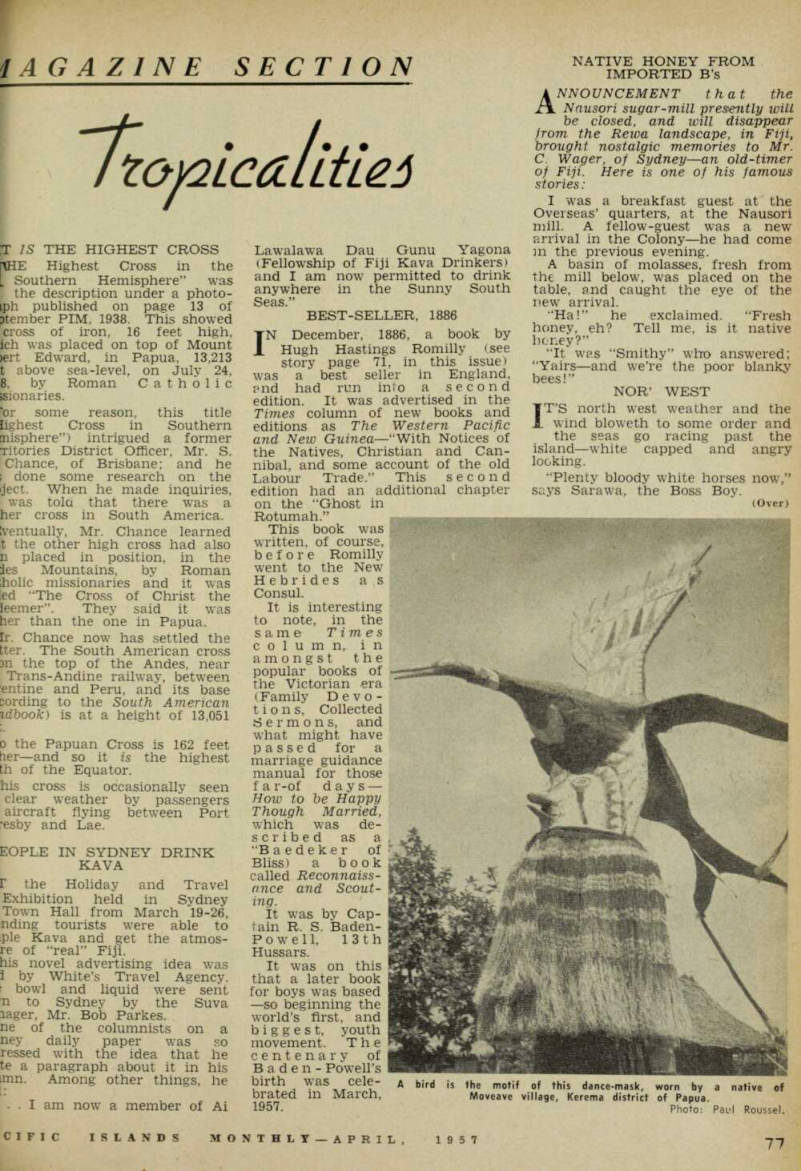
A bird is the motif of this dance-mask, worn by a native of Moveave village, Kerema district of Papua.
Photo: Paul Roussel.
The rain is plentiful and comes in fierce gusts and blots out the scenery, whilst it lasts; the coco nuts sway and the tops have the turned-out umbrella appearance that beach palms get at such times; the casuarinas sigh heavily and bend gracefully. And, one way and another, you can imagine nicer conditions, and nicer places to be!
I once, when at the Ninigoes in nor’ west weather, found a diary of a former overseer who, at such a period, had written in it “B this weather and these atolls. I wish I was out of the Goddam place and back with my girlie in Mel bourne.”
I read more and walked up and down the room, brushing off the mosquitoes, whilst the rain pelted outside and winds blew, and I said to myself, ses I—“By God! That
bloke said a mouthful.”-
Fpa.
Cat And Dog Existence In
Model Villages
rpHE offshoot of practically every JL organisation in the world exists in the Territory of Papua-New Guinea—including 57 brands of mission. But for some
reason there is, as far as I know, ao local branch of the RSPCA, although this is a country pre senting boundless opportunities for this work.
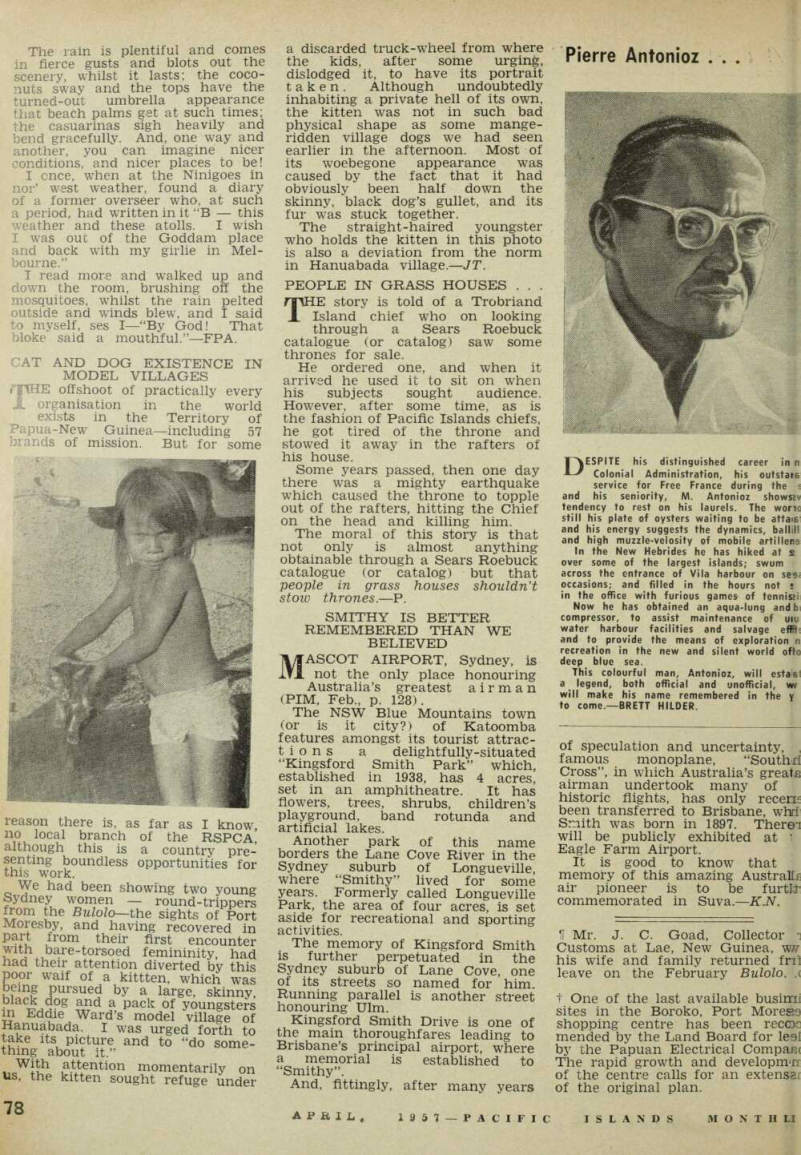
We had been showing two young Sydney women round-trippers from the Bulolo— the sights of Port Moresby, and having recovered in pa f,£ from their first encounter lt i\ 1 - bare ’ torsoed femininity, had had their attention diverted by this poor waif of a kittten, which was bemg pursued by a large, skinny, P and a pack of youngsters m Eddie Ward’s model village of Hanuabada. I was urged forth to take its picture and to “do some thing about it.” attention momentarily on us, the kitten sought refuge under
a discarded truck-wheel from where the kids, after some urging, dislodged it, to have its portrait taken. Although undoubtedly inhabiting a private hell of its own, the kitten was not in such bad physical shape as some mange ridden village dogs we had seen earlier in the afternoon. Most of its woebegone appearance was caused by the fact that it had obviously been half down the skinny, black dog’s gullet, and its fur was stuck together.
The straight-haired youngster who holds the kitten in this photo is also a deviation from the norm
in Hanuabada village.-
JT.
PEOPLE IN GRASS HOUSES . . . r[E story is told of a Trobriand Island chief who on looking through a Sears Roebuck catalogue (or catalog) saw some thrones for sale.
He ordered one, and when it arrived he used it to sit on when his subjects sought audience.
However, after some time, as is the fashion of Pacific Islands chiefs, he got tired of the throne and stowed it away in the rafters of his house.
Some years passed, then one day there was a mighty earthquake which caused the throne to topple out of the rafters, hitting the Chief on the head and killing him.
The moral of this story is that not only is almost anything obtainable through a Sears Roebuck catalogue (or catalog) but that people in grass houses shouldn’t
stow thrones.-
P.
Smithy Is Better
Remembered Than We
Believed
MASCOT AIRPORT, Sydney, is not the only place honouring Australia’s greatest airman (PIM, Feb., p. 128).
The NSW Blue Mountains town (or is it city?) of Katoomba features amongst its tourist attrac tio n s a delightfully-situated “Kingsford Smith Park” which, established in 1938, has 4 acres, set in an amphitheatre. It has flowers, trees, shrubs, children’s playground, band rotunda and artificial lakes.
Another park of this name borders the Lane Cove River in the Sydney suburb of Longueville, where “Smithy” lived for some years. Formerly called Longueville Park, the area of four acres, is set aside for recreational and sporting activities.
The memory of Kingsford Smith is further perpetuated in the Sydney suburb of Lane Cove, one of its streets so named for him.
Running parallel is another street honouring Ulm.
Kingsford Smith Drive is one of the main thoroughfares leading to Brisbane’s principal airport, where a memorial is established to “Smithy”.
And, fittingly, after many years
of speculation and uncertainty, , famous monoplane, “South'd Cross”, in which Australia’s greats airman undertook many of historic flights, has only recene been transferred to Brisbane, whri Smith was born in 1897. Therei will be publicly exhibited at i Eagle Farm Airport.
It is good to know that memory of this amazing Australis air pioneer is to be furtlf'
commemorated in Suva.-
K.N.
IT Mr. J. C. Goad, Collector i Customs at Lae, New Guinea, wv his wife and family returned fnf leave on the February Bulolo. .( t One of the last available busimi sites in the Boroko, Port Morese shopping centre has been reccDo mended by the Land Board for leal by the Papuan Electrical Compact The rapid growth and developmTr of the centre calls for an extensar of the original plan.