Acific Shipping And Cruising Yachts
pp. 43-120 · Read in the full issue
Month's News of—
Ria Leaves For Japan
veteran Maria del Mar, sold ly by Savoie to the Carr Ship and Trading Co., of Sydney, ransferred to Chilean register left Noumea in March for lama. She was carrying 350 if scrap, following Oliver Mac fliers on this one-way passage.
New Caledonia crew and p Master, Captain Helme, were ard when she left Noumea.
Alties: Met. Man, 2 Pigs
484-tons New Zealand ;er Holmglen, well known i Norfolk Island and Kerma had a hard battle with the March weather, losing an ■ and running short of food.
Master, Captain E. Rainbow, hat at Raoul (Kermadecs),
ischarged with difficulty and
hen they had left for Norfolk irere recalled to pick up an I member of the NZ meteor -1 staff. A RNZAF Sunderland tempted to take off this man, id been prevented from do by the bad weather. He was ally taken on board Holmglen inded at Norfolk, where he le rest of the journey back i Zealand. use of this delay, and bad
weather between Norfolk and NZ, the crew was forced to kill and eat two pet pigs taken on at Raoul.
Very Small Ships Dept.
A Gilbert Islands outrigger canoe made a public appearance on Waite mata Harbour (Auckland) in March, sailed by two Gilbert Islanders, Atanraoi and Taba’ga.
This canoe is, in fact, a museum piece—it was given to the Auckland War Memorial Museum about two years ago.
Its public appearance was in order to allow people to see it in its right element; and also in order that the Museum staff could take movies and stills of it.
Launching Device At
Pitcairn
Since the middle of last year, Pit cairn Islanders have been launch ing their long whaleboats with the aid of a powerful New Zealand-in vented timber-jack. The timber-jack was presented to the islanders by a NZ firm, A. and G. Price Ltd., and is about the first aid to navigation the Pitcairners have had since they arrived on the Bounty, 167 years ago.
Pitcairn’s rocky shores have neither harbours nor wharves. The big whaleboats are kept above high
water mark.
To show their appreciation of the new launching device, the island’s best carvers have been at work
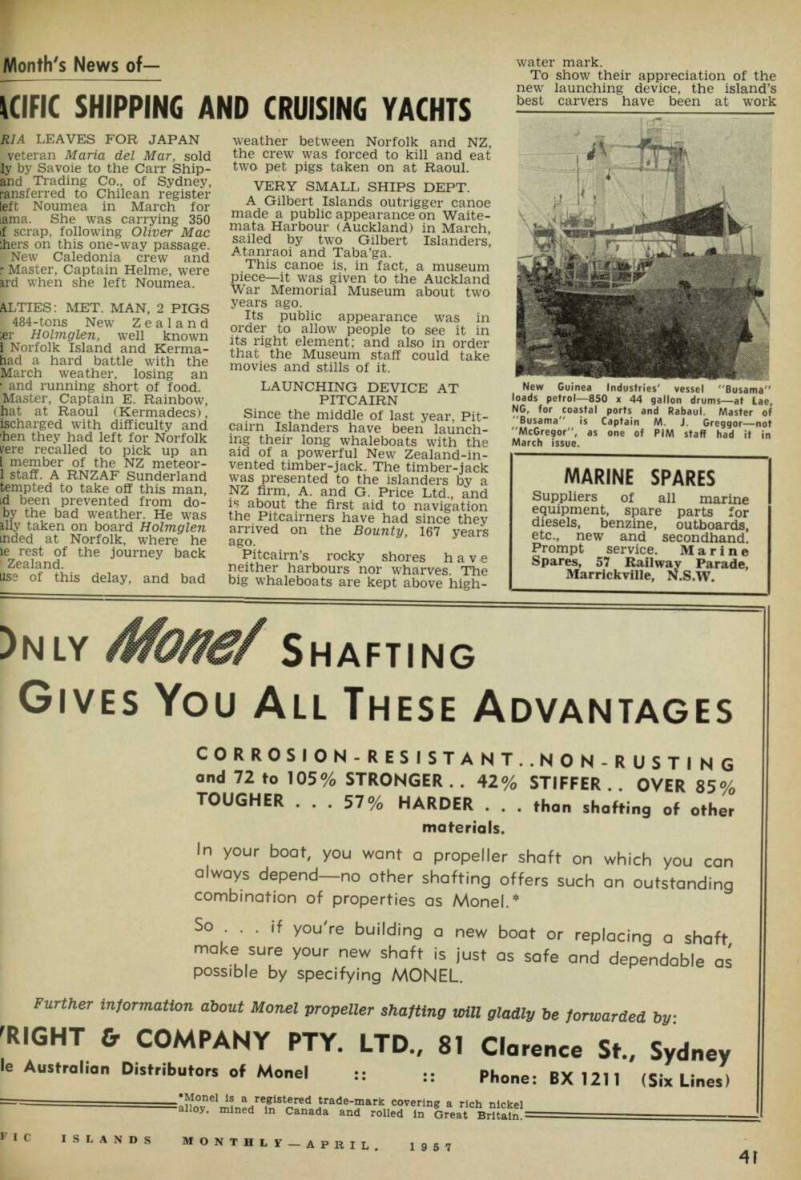
New Guinea Industries' vessel "Busama" loads petrol—850 x 44 gallon drums—at Lae, NG, for coastal ports and Rabaul. Master of "Busama" is Captain M. J. Greggor-not "McGregor", as one of RIM staff had it in March issue.
fashioning a vase for the firm that provided the jack.
Tidal Waves Travel 6,000
Miles
The tidal waves set off by the disturbance in the Aleutian Islands in early March reached as far south as New Zealand within 24 hours of the disturbance —a 11 hou g h, of course, so greatly reduced in force that scientific instruments were needed to measure them. As re ported elsewhere, the waves were felt in Manus, and off the New Ire land coast, in the New Guinea area.
The most affected spot in the South Pacific appears to be Raro tonga, where on March 9, at the peak of the waves, which came at intervals of under three minutes, the sea was about five ft. higher than normal, with a 10 to 12 ft drop as it drained out of the harbour again.
Damage To Inspire
The tidal waves almost caused the wreck of the Cook Is. inter island trading vessel Inspire.
The Inspire, a Brixham trawler converted for Islands trading, was moored alongside a lighter and two launches of the Union Steamship Company at the Company’s wharf at Avarua. At about 3.30 p.m., the first waves came into the “harbour,” a break in the reef which is now badly silted up, and the Inspire be gan to work against her moorings.
None of the crew was aboard.
At five o’clock the harbour sud denly drained of water and the In spire canted over with her keel rest ing on the bottom. Some of her mooring lines parted and when the next wave came into the harbour the rest of the lines parted and an iron bollard was snapped in half.
The vessel was carried backwards with damage to her bulwarks.
She grounded about fift;f from the wharf with her n fouled by the lines. A skii cleared the propeller and thesj was finally anchored in thri stead.
The Rarotonga harboc Avatiu and Avarua have 9 drained by tidal waves fouj' since 1945, and on two <d
as A. B. Donald Ltd. nearly ieir schooner Tiare Taporo, er subsequent replacement, 'arlotte Donald.
The Japs Have Fishing
Troubles
imber of interesting points ting Japanese tuna fishing )ns in the South Pacific used at a meeting between itatives of the industry and overnment-sponsored Tuna Investigative Committee months ago. ig co-operative represent ors unanimous that it was ig increasingly necessary for vessels to proceed further irther afield. When the in-imposed past-war re is on areas of operation ised it was found that boats )tain a load close to Japan, th the regular fishing of eas the tuna schools moved south and east, and the nsity has declined in almost s.
VI. Kojima, owner of the ship Daikoku Maru, who n working the Micronesian the past 20 years, said that 3oat catches over this have declined from about • per day to an average of '• to-day.
J. Mabune, Assistant Man the Misaki office of the jyoeyo Co., said that his
company has operated 13 South Pacific mother-ship expeditions, mostly to the Fiji area. During this time the catch there had fallen from as much as 16,500 lbs per day per boat to as low as only 3.300 lbs average for some boats in 1956.
Mr. Mabune said that this last expedition had a hard time.
Mr. M. Teramoto, of the Tuna Fishery Investigative Committee gave the 1956 average per boat catch in the Pacific as ranging between 3.300 lbs and 8,300 lbs per day.
All agreed that more research into tuna migrating habits was urgently called for, There was also much criticism regarding the operations of some 90 fisheries guidance vessels, owned
by the Government or Universities and other organisations. These vessels are supposed to be engaged entirely on research work but many appear to be employed in ordinary fishing operations, to the profit of the owning organisations in com petition with the commercial fish fleet, They were absorbing many of the best fishermen as they could offer regular salaries as against the profit-sharing arrangement pre vailing in the commercial fleet. Only about 50 per cent, of these vessels were doing any real research work.
The fishing-boat representatives were emphatic that the industry has entered a depression and that Government assistance was called
for.
(Continued on Page 45)
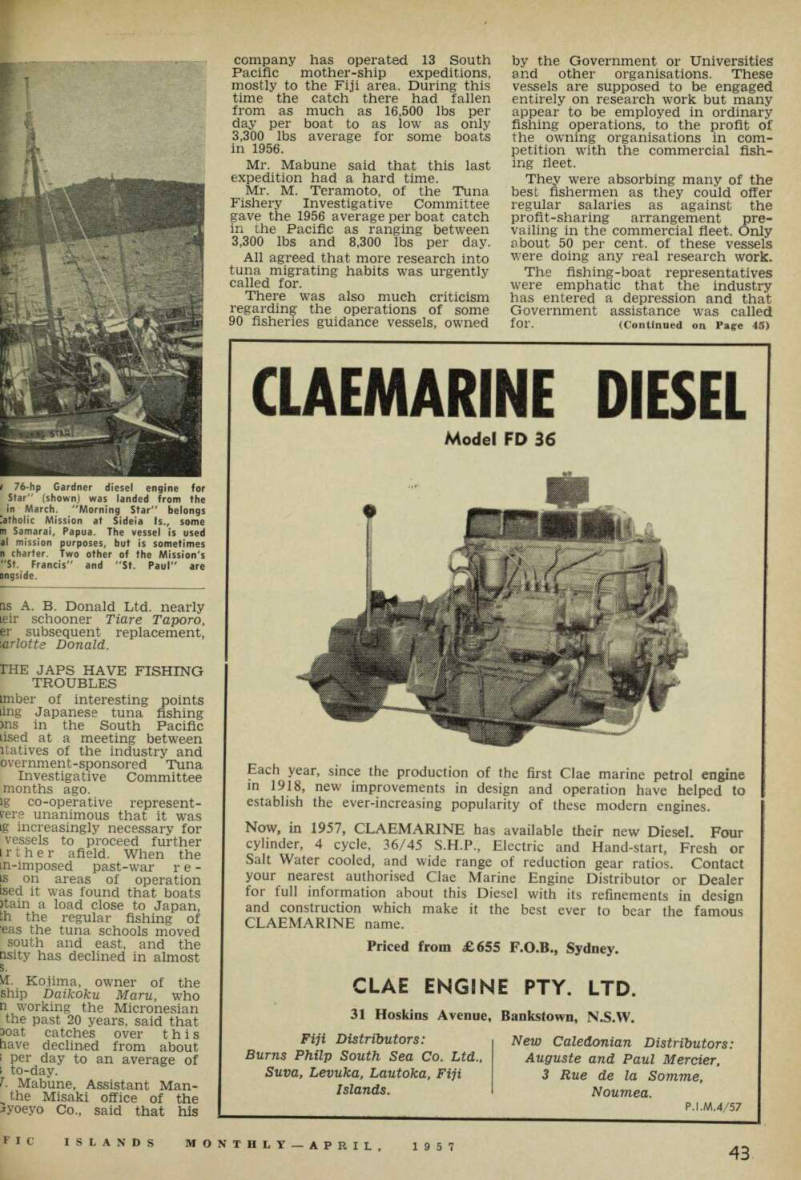
[?] 76-hp Gardner diesel engine for Star" (shown) was landed from the in March. "Morning Star" belongs Catholic Mission at Sideia Is., some [?]m Samarai, Papua. The vessel is used [?]al mission purposes, but is sometimes [?]n charter. Two other of the Mission's "St. Francis" and "St. Paul" are [?]ongside.
lother report from Japan gave results of a cruise in French inia waters between June 28 and ;ember 5, 1956. A total of )00 lbs of fish was taken at ifferent fishing stations during period by the Shiyuoka Pi-e -ve's fisheries guidance vessel mji Maru (470 tons). The fish I yellowfin, big-eye and albacore, a majority of the latter. The Its were viewed as promising, idering that this was not the season for the area, ry heavy catches were taken his vessel in another area 1,000 5 ESE of Hawaii during the I cruise. om the above it seems likely Japanese fishing vessels prob will be seen well to the south east of the main South Pacific ids Groups, fishing the more nt areas.
Fle Ships’ Arduous Tow
To Suva
i shipping people spent some ing days and nights in March g to get the disabled 10,000jr Norbryn, into Suva, e Norwegian freighter, laden newsprint, etc., was on her way Los Angeles to Sydney when, on h 19, between the Ellice Islands the Yasawas (northwards of I a fire broke out, and it put *ngine-room and dynamos out ition before it was subdued, b Fiji coastal ships, Yanawai Ratanui, went to the help of [isabled Norbryn, and took her iw for Suva, some 100 miles ; the sea was rough and the I helpless. It was found that 'anawai would not steer while
she was fast to the tow; so she abandoned the task to the Ratanui, and stood by.
The Ratanui hung on gamely; but the tow rope kept breaking, mak ing the job very difficult and slow.
The two little ships still were struggling with the task, northwards of the Yasawas, on March 25.
LATER: The Norbryn was brought in to Suva April 1, 12 days after she called for aid.
Delivered—And
Undelivered
While some of the steady stream of veteran Australian and New Zea land coasters recently going to Eastern purchasers have struck trouble en route, some at least have made the distance.
Captain D. K. Matheson, well known in Islands waters—his brother, Captain R. D. Matheson, is master of Kurimarau —reported from Hongkong in February that the NZ coaster Pukeko —renamed Winery —was uneventfully delivered to that port.
Captain Matheson is remaining with the vessel for a while in her new trade, running timber from Formosa and the Philippines to Hongkong. No Island calls were made on the trip north but Rabaul and Truk provided useful radio-telephone contact.
Less fortunate is the NZ coaster Holmdale —renamed Pacific Pearl — purchased by the owners of Sea Pearl, which uplifted tomatoes at
Stirling" stays in Port Moresby for [?]t season, in the course of a world see page 114).
Rarotonga last year. About to clear Wellington, for Japan, after months in port, this vessel was arrested late March and a writ for £ll,OOO placed on her mast.
At about the same time two other NZ hulks, Matange and Totara, were Hongkong-bound in tow of the 1,100-ton British ocean salvage tug Bustler, and would probably be seen in NG waters.
Back To School
News of another Pacific mariner, Mr. Willie Schutz, came from Eng land. Signing clear of the British freighter Midhurst, at Christmas — after taking part in the Suez in cident—he joined the University of Southampton’s School of Navigation and will sit for his deep-water Mate’s ticket in April.
Meanwhile he’s keeping a weather eye on the new Tongan vessel A’oniu, building across in Holland, for a possible delivery voyage back to the Pacific late 1957 —unless some more tempting nautical sortie pre sents itself.
Mr. Schutz belongs to Tarawa.
That Distress-Watch
A recent circular from the Cook Islands Radio Department contains a reminder that the safety of Islands small-craft does not rest only with Pacific coast stations; shipmasters, too, must play their part.
Many Islands shipmaster and other persons in charge of ship
radio-telephones in the Islands trade do not hold proper radio certificates, are not trained in the matter of radio regulations, or are lax in their responsibilities. A great many Island craft which could easily maintain the 3-minute distress watch on 2182 kc/s twice each hour —on the GMT hour and at 30 minutes past—never bother to do
so, though the radio installable frequently right on the bridge w the helmsman or officer of i( watch could keep speaker watcoe Some operators have never 11 of the distress signal “MAYDd the safety signal “SECURITE3 the urgency signal “PAN,” or I their correct use.
It appears that there may
tening up of this situation in Cooks, and the same might well lone in some other areas. 50 wanted is a simple booklet 1 T operators—less complicated the British “Handbook for iless Operators,” which in any can usually only be obtained lecial order from HM Stationery e Agencies in England.
Iper Craft Launching
Qg behind the original target the first of the three £20,000, medical patrol launches build er the NZ Lepers’ Trust Board ackland, was launched in mid . and delivered to the Mel an Mission (Anglican) for use le Solomons. NZ Islands Terri \ Minister performed the official aony. b other two vessels should be jred before the end of the year. 2 will go to the Methodist on in the New Hebrides, and final vessel to the Catholic on in the Solomons. ; first vessel was named Fauabu ley. The second vessel, for the odist Mission, will be named Zonga Twomey, and the )lic Mission’s vessel will be d Mala Twomey. The suffix is rk of gratitude to Mr. P. J. ley, secretary of the Board for years past. The prefixes are names —Mala being a con on of Malaita. vessels were designed by Mr.
Collings from preliminary les by Captain James Forbes, s also supervising construction rtialf of the Board. Captain s is well known in Tonga and lere.
*Ce Tugi’S Pin-Up Girl
tnotor-ship, the Hifofua, de d as “despatch vessel, tug and i ship,” now being built in
Holland to the order of the Goveminent of Tonga, is promised for delivery next February.
She will be 112 feet long, have a draught of 11 feet, and a speed of 11 knots. She will be used for general communications work in Tonga; and, once a month, she will proceed to Suva for re-fuel, to pick up cargo, and to tow petroleum products in bulk to Tongan ports, thus eliminating the present system of delivery in drums.
The same shipbuilding firm, in Holland, also is building for the Tonga Government a 500-tons freighter, for the Tongan Copra Board. It also will be delivered early next year.
These ships represent the culmination of plans long cherished by
Prince Tugi, Premier of Tonga, He showed a drawing of the new Hifofua to a reporter in Suva, and said it was a picture of his “pin-up girl.” „ ~,
John R. Manning Returns
From Marquesas Islands
Tuna Survey
The fisheries research vessel John R. Manning, of the US Fish and Wildlife Service, returned to its Pearl Harbour base on March 2. Com pleting a 2-months tuna fishing cruise to the Marquesas and Society Islands area.
The purpose of the cruise was to survey, by means of longline fish ing, the abundance and distribution of large, deep-swimming yellowfin
(Continued on Page ns)
Ling Family Takes To The Mountains:
[?]nd Mrs. D. N. Ashton (of "Lahara") with [?]ters Lynette and Jennifer, who are now in the NG Highlands (see story page 115).
albacore tuna in a region which interest as a potential fishing id for the United States tuna nultaneously with the Manning’s itions, two other Honolulu i Fish and Wildlife Service . were studying the live-bait surface tuna resources and the lie environment of the region, ling from Hawaii on January 5 Manning fished one series of ns southward across the ;or to a position southeast of [arquesas group, another series g the islands, and, after re ig at Tahiti, a third line of ns was fished northward across Equator on the longitude of eg. W. lough the abundance of deep ning yellowfin tuna was gener ,ow on the two longitudinal ns, some excellent longline I was experienced in the lesas, particularly in the western part of the archi ►. Yellowfin catch rates there is high as 8 fish per 100 hooks ly, and the tuna were large, ring 139 pounds each. In all, anning took about 23 tons of fin in 38 days of fishing, as s smaller quantities of alba- Jigeye, and skipjack tuna.
S Of Cruising Yachts
r AKAYA and owner Teddy i of Auckland, were in the
The Colonial Sugar Refining Co.'s new "Rona" just after her launching at Aberdeen on January 15. The naming ceremony was performed by Lady Knox, wife of Sir Edward Knox, Chairman of CSR. The vessel of 6,600 tons d.w. is specially constructed for the sugar trade and is expected in Sydney via Suva on her delivery voyage about the middle of this year.
She replaces another CSR Co. "Rona" which was sold last year to John Manners & Co., and is now operating out of Hongkong as "Suva Breeze". It is John Manners and Co. that has recently purchased the BP steamship "Mangola", and MV "Muliama". (See story p. 115.)
news in March when an unin gun-man opened up on yachh owner one evening as the crs'j at her Auckland moorings. .1 Hayes, who was on deck s time, hastily retired belowv doused his lights. The polidJ investigating. Wakaya has n several Island cruises in years. ® DEBONAIR’S former t Sydney Patrick Fisk, has beconc subject of an intensified search in NZ. Details were 9 in a recent PIM. In Marchl detectives were assigned to o up the mystery of the man Government car was found as oned on a lonely road, a thl: flask opened, a cup of tease drunk, and jacket lying neate the back seat. • SOLQUEST , 40-ft Tasrra yacht, is to clear Sydney foi US via Auckland and Island b in April. Aboard is Mr, L. Sig wife, and two young sons, H and Wayne, 4. • WHITE HART’S Bridget I held an exhibition of her H paintings and woodcuts at an j land gallery in March—whilesl band Tony headed the fishinggj back towards a season of sa fishing in Canadian waters..« plans to return to Aucklandb year. • LADY STIRLING was anor among other small craft atfl Moresby in March and tni after the fury of “Cyclone O which battered the port for • days. The 48-ft auxiliary schri powered by a 65-hp diesel moo well known in Fiji, where i ypars ago, and with different o T o she was on loan to the Cas; 'mission.
She is refrigerated and cam to 9 months food supply at all I All rigging is stainless steell anchor, windlass, lighting, etc.,.c trically operated. She carrioi flag of the Royal Akarana Club, Auckland, NZ.
Owner Worthington told ofi slow cruise through the Barries i to Thursday Island, Bramble and Port Moresby. “The fish, ! ,r Mr. Worthington, “were elusia we collected shells instead.”
They left Auckland last Junn planned to make a leisurely plef cruise to the Mediterranean!, ports via Suez but on Brisbane news of the Suez dh changed their plans.
They are at present refittfh Port Moresby and marking s until the wet season is overr then departing about the eis April for New Guinea ports, BtS Philippines, possibly Japan, tt Singapore and Ceylon; later tt West Indies. Time is unimpo:oi the Worthingtons expect to bee< about 5 years.
Mr. Worthington is accompp by his wife and small son andbi member Clark Ebbett. The one team had a female crew mtxx who left the ship at Hayman II and later married there.
leaving Port Moresby, Mr. ngton hopes to pick up two crew member s—male or L HARA owners, Mr. and Mrs. shton, and daughters Lynette snnifer, have exchanged the lins for the sea. They re to New Guinea in March, r. Ashton will take up duties ) at the sub-district of Minj, Western Highlands. He was y at Kandrian, New Britain, lumber of years.
Ashton sailed over 16,000 n his 33-ft auxiliary sloop , which he had built in in 1951 for the Hobart yacht race of that year, ished second in the race. was entered immediately n the trans-Tasman race obart to Auckland and again 1 second. During 1952-53, iton was attenting the Aus- School of Pacific Adminis in Sydney, and sailed Lahara in Montague Island races, g in second places. Christmas, w the family off on a cruise Zealand aboard Lahara for 2 months, after which she iken to Kandrian, New 56, Mr. Ashton, with three Europeans, sailed to Sydney B, taking 7 weeks for the This year he entered her Hobart-Sydney boat race last time before selling her.
Igola Sold To East
Burns Philp Line cargo ship has been sold to Far interests and will be seen J on the Sydney-New Guinea where she has been for Jars. likely that she will be re
placed on that service by the new Montoro which is currently on a voyage to Singapore.
Mangola was one of the Com monwealth “E” class World War I “standard ships” (after the style to the Liberty ships of World War II).
It was said of them that they were “built by the mile and cut off by the foot.” The amidships section de termined their size; bows and sterns being added to suit She was built in Australia about the end of War I and christened Eudunda, but during the post-war disposal of government-owned ship ping, was purchased, about 1922, by Burns, Philp and Cos. It was said that she paid for herself on the first voyage—to Singapore and on
to Rangoon for rice.
For periods during the depression she was laid up, and occasionally ran up to Ocean Is. and Nauru to bring back phosphate.
During the Pacific war, coming south along the Queensland coast in company with Wanaka, both ships were blown up on a reef by a hurri cane.
Mangola went back to the Singa pore run after the war, but several years ago was switched to the P-NG cargo service. She now goes into John Manners and Cos. service.
Mu Li Am A Also Sold
Burns, Philp’s small motor-vessel Muliama was, early April, disposed of, also to John Manners and Cos.
Her crew of Solomon Islanders were
[?]re" aground after tidal-wave at Rarotonga, in March (see page 42).
Photo: F. M. MacKenzie.
jpatriatsd on the Tulagi, which left Iney for Islands ports on April 5.
'he ship, it is believed, has been consistent profit-maker in the icult post-war period, but it is known whether she will be re ;ed by the company. \uliama, 689 gross tons, was built Hongkong in 1937 for the New nea inter-island service and »red that service at the end of \ year. After the war she be le a sort of maid-of-all-work, tly on the Solomons run, but i side excursions to Papua, and Gilbert and Ellice Is. as re ed.
1 Vua For Cook Islands
tie Union Steamship Co.’s fruit jhter Navua, normally in the -Samoa-Tonga-New Zealand ana trade, is to be employed also the Cook Islands citrus trade Winter, operating in conjunc with Maui Pomare and with tever USS Co. trans-Pacific hbound freighters are available. ivua, one of the company’s jr vessels, has no passenger mmodation. She was to make first run from Auckland to the [s in early April.
Befitting In Auckland
iptain Hugh Williams took his jitly purchased MV Melva back uckland from the Cooks inter id trade in March for some ne alterations.
I white-metal main bearings in motors were being replaced bearings of a higher melting t. Oil coolers were also being 1 and the salt-water cooling lation pumps replaced by large ps. e motors had shown a tendency verheat in their new tropical ce. Captain Williams said that alterations, while not absolutely dial, should be a considerable ovement. The vessel was ex id to clear Auckland again for 2ooks by mid-April, e Tonga Government’s aux y ketch Hifofua was expected ickland during April to under nnual survey.
Aims Paid For Loss Of
Vasu
idon underwriters have now in full all claims in respect e MV Vasu, which was lost dur a voyage between Suva and in June, 1956. spokesman for Burns Philp Company, owners of Vasu, said iva on March 22, that the evid taken in Fiji before a Marine t of Inquiry into her loss, and hidings of the Court, had been to London for perusal by the rwriters. (The text of the re pf the Court was published
iM in January).
) Inquiry Into Matua
Grounding
ere will be no formal inquiry the stranding of the USS Co.’s a on Duff Reef on January 22. , Feb., p. 63). *r z Minis ter of Marine said Vellmgton, in late March, that
preliminary inquiry showed that the mishap had been caused by an error in an instrument which corrected the compass. Captain J. Broughton and his officers and crew were com plimented on their exemplary standard of seamanship. ..Matua was on a routine voyage between Apia and Suva when she grounded on the reef. She was on the reef only a few hours before she was pulled off by American de stroyers who were in the area. She suffered no damage.
Joy It A Still Out Of
Circulation
Two months after she had gone ashore on Horseshoe Reef, Fiji, and had been towed to Levuka, Joyita was still pulled up on a beach there.
Her engine and other mechanical gear are in a Levuka workshop but there has been little attempt to make her hull seaworthy. Joyita was holed amidships on the star board side while she was on the reef. There was damage also to keel and rudder.
Job of making Joyita seaworthy is going to be expensive; and there appears to be some doubt as to whether it will be done at all.
Joyita was bought last year by Fiji planter, Mr. David Simpson, to be used in inter-island trading. It is believed that she was not carry ing much insurance when she went up on Horseshoe Reef.
Mary And Margery
Aground
The BSIP Marine Department had a little trouble with reefs in the Solomons area in February.
MV Mary went aground on Rua Sura Reef on February 3 and re mained there five days until pulled off by MV Baruku. Mary reached Honiara under her own power but she sustained considerable under water damage, which was repaired at Tulagi.
Margzry went aground in Suava Harbour on February 19, but was
pulled off by Betua with only slight damage. (Continued on Next Page)
Loss Of Mv Buka
The 66-ft trawler MV Buka, owned by Mr. Bruce Bragg, of Lae, New Guinea, which had run a regular cargo service from Lae to Finschhafen, Madang, and occasion ally Wewak, went up on a reef 4 miles west of Saidor Point on the night of March 29.
She had discharged her cargo and was on her way back to Lae with a load of 100 to 130 empty drums which have since been jettisoned.
The vessel radioed Saidor Weather Station, which advised DCA Tower, Lae, that she was aground and re quired assistance, and the Harbour Master at Madang despatched the Henrietta to her aid.
Mr. Bragg decided to see for him self the extent of the damage and chartered a plane to fly over the vessel.
After viewing it, he decided that something bigger than Henrietta was needed to pull her off. Arrange ments were made for the Lutheran Mission vessel Sindang, with the Madang Harbour Master aboard, to try, but this attempt failed.
The Harbour Master reported that Buka was making water steadily and that the position was un favourable. At high tide on 31st, about 6 p.m., another unsuccessful attempt was made to free the stricken vessel, after which the Master and crew of the Buka were
taken off and returned to Madang.
Although the vessel was fully insured, the loss is a severe set back to Mr. Bragg, who was plan ning to extend his wharf at Lae and equip his other vessel, MV Morna, for local trips.
Morna will now have to replace
Buka. Mr. Bragg hopes to salvl the engine from the Buka. t A cheque for £IOO was rece;o sent from Honiara, BSIP, to ■ Hungarian Relief Fund. The mcoi was the proceeds of St. Valentii: Ball, held by the local branch!
Red Cross.