Territories Talk-Talk
pp. 27-33 · Read in the full issue
By Tolala
More Frontier Posts Shortly after the UN Trusteeship Council showed its impatience over NG independence last month, Minister Hasluck released the state ment that nine new patrol posts would be opened up in areas now classed an “uncontrolled.”
This is, of course, all part of the present policy “to bring all areas under control by 1959.” But, follow ing on the Council’s resolution, it could give the impression of toady ing to these international politicians, most of whom are far less con cerned about the NG natives than we are, and heckle us only for racial or political reasons.
Someone asked me recently what jurisdiction the Supreme Court of P-NG has in an “uncontrolled area”?
If such an area comes under the Court’s jurisdiction is it then “un controlled”? As a layman, I wouldn’t know; but a keen Legal Eagle might make something out of it.
A “Times” In
Rabaul Again
To hand recently the first issue of The Rabaul Time s—l9s7 Model, born March 22 and just 15 years and two months since its orig inal namesake went into smoke.
Naturally, there is little re semblance to the old “rag”; banner head-lines and narrow columns were not so popular in those days before War II as they are now. Readers got more reading matter perhaps; but then they had more time to read in those leisurely gracious days.
But it is a neat sheet, and I wish it and Editor Gus Smales well and an ever-increasing circulation and support from advertisers.
The sword of Damocles, which hangs over every editor’s head, will not be suspended on such a thin hair for the new Times as in the old days when the cogs of the printing plant were kept turning, to a great extent, by Government printing.
Ergo; When editorial comment was considered by Administrator Wisdom to have exceeded his idea of the limit to the Freedom of the Press the owner and/or editor were promptly told to “pull their heads in”—or else. Subsequent Admin istrators (Griffiths and McNicoll) were more tolerant. And now, as I think back down the years, I am surprised at what we got away with then.
One factor which the new Times has to face, and which was not so great in pre-war days, is the greatly increased number of the native
people who are capable of reading —and understanding—English. This means a more guarded expression in print. The real danger lies in true meaning being only partially understood by the native who is apt to place wrong constructions on idiomatic terms.
A Good Publicity
Medium
P-NG will be well in the lime light this year so far as the Gentler Sex is concerned in NSW, at any rate.
NSW branches of the Country Women’s Association have selected Papua-New Guinea as the Country of the Year. Each year a country is chosen for study by the members; last year it was Switzerland.
There are 534 NSW branches, with a membership of some 32,000, so you can write your own figure as to how many folk will be hearing about P-NG in the homes of that State during the coming year.
In the International edition of the Association’s journal, The Country women, published last month there were several very good articles on the Territory—factual and not over glamourised as is the usual trend.
One article in particular, by Mary Backhouse, contains an excellent description of life back in 1921 at Kavieng (New Ireland) when, be fore her marriage to the eminent Government Pathologist at Rabaul, Dr. Clive Backhouse, she was living with her brother the late Colonel
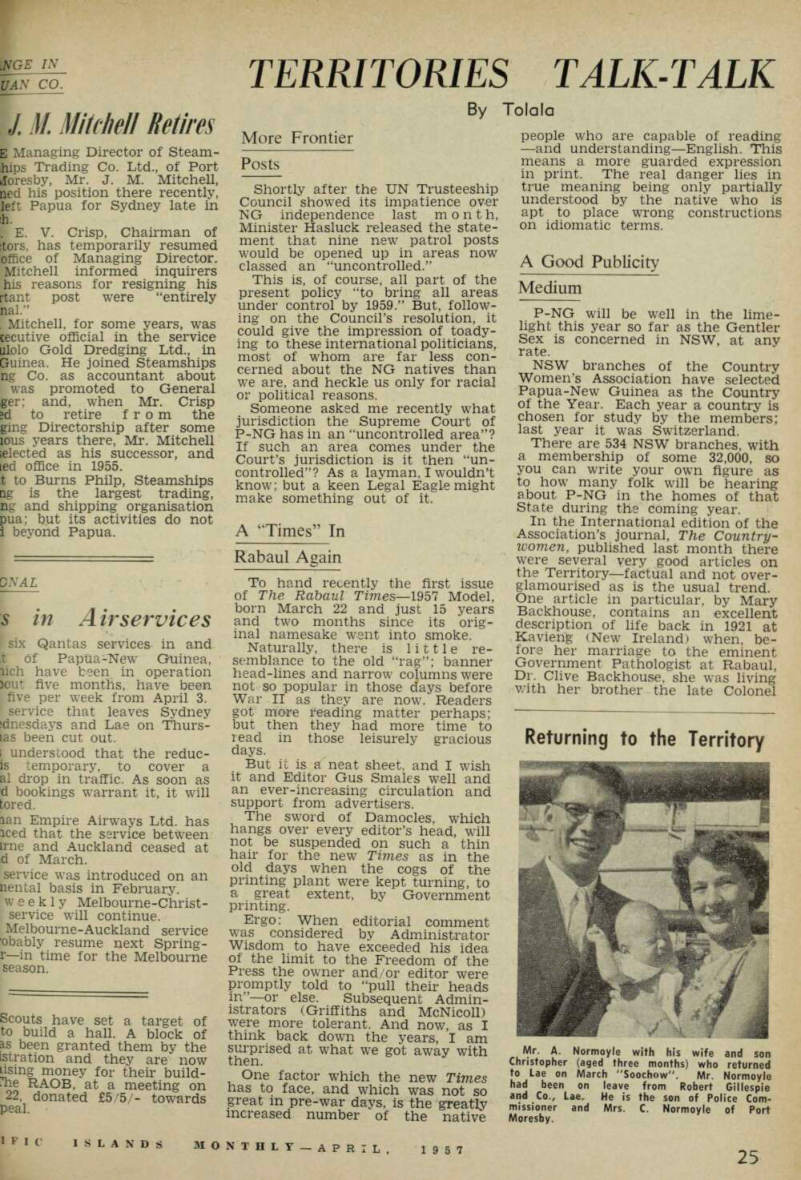
Returning to the Territory
Mr. A. Normoyle with his wife and son Christopher (aged three months) who returned to Lae on March "Soochow". Mr. Normoyle had been on leave from Robert Gillespie and Co., Lae. He is the son of Police Com missioner and Mrs. C. Normoyle of Port Moresby.
tab, who was DO at that port » time. try Backhouse is a gifted ste and organised many a :al feast in Rabaul when she up residence there. During years and afterwards she de -1 herself to Red Cross work, for years was in charge of the ty’s libraries. She recently re >re are other informative es about the Territory based ita supplied by our old friend, r Downing. 5 a good idea for making people [ conscious and the originator be congratulated.
iodem
a rule, ABC news items are for their accuracy; but the morning I was surprised to an item describing the in ion of New Britain coconut itions by the rhinoceros beetle, h had been imported into the ry by the Japs during the m’t have that. Giant snails — And also a big red-eyed blue fly (of which, by the way, » heard no mention since our upation of NB.) But the ist i d tribe —rhinoceros and mt species—were there to my edge 46 years ago.
Method of com bat was gangs of “monkeys” collect ing them and their larvae for which, invariably a premium of stick tobacco was paid. Some “monkeys,” more astute than others, used to have secret breeding spots for the beetle to ensure a steady income of tobacco.
In these days, however, with “monkey” labour abolished and the high rates of wages, such pest gangs are probably out of the ques tion. The ABC
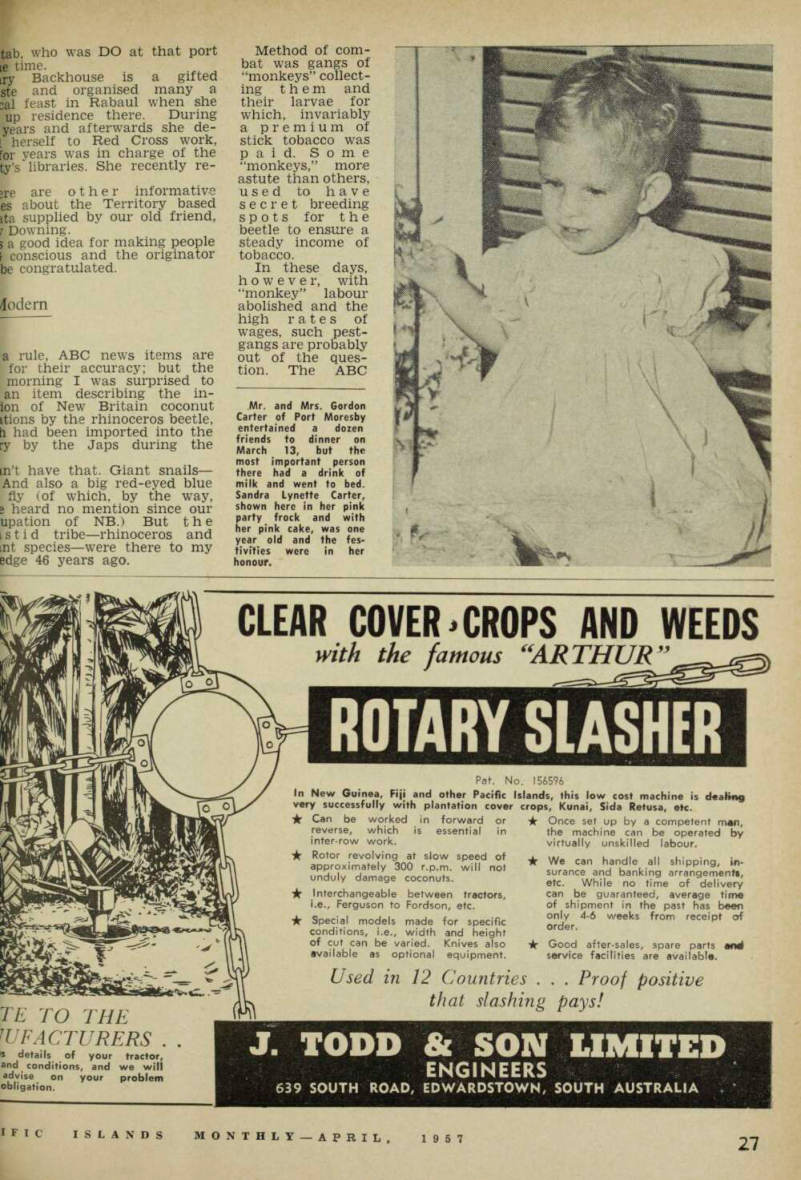
Mr. and Mrs. Gordon Carter of Port Moresby entertained a dozen friends to dinner on March 13, but the most important person there had a drink of milk and went to bed.
Sandra Lynette Carter, shown here in her pink party frock and with her pink cake, was one year old and the fes tivities were in her honour.
mentioned the importation of an African beetle to prey upon the rhino. Let’s hope it proves efficient, for the dynastid is a costly pest.
Editorial Note
According to South Pacific Com mission researchers, Oryctes Rhino ceros (the Asian variety of the pest) was introduced to New Britain somewhere between 1942 and 1944 and spread later to New Ireland, but was not positively identified until 1950; it had been thought that plantation damage was due to a great increase in the populations of native Rhinoceros beetles ( Scapanes
australis or S. grosse-punctatus Sternberg).
It is Oryctes which is the de stroyer, and which has greatly de creased copra production in Western Samoa, where it was introduced in 1909; in Wallis Is., where is arrived in 1931; caused virtual devasta tion in some of the Palau Islands, where it was introduced in the Pacific War years; and complete panic in Tonga and Fiji, where it was found in 1952 and 1953 re spectively.
The greatest damage has been done on true Pacific islands; the least damage in Oryctes’ homeland, tropical Asia. New Britain, New
Guinea and New Ireland garded as an “intermediated tion” they are “Conn tropical islands” and so o Oryctes’ natural enemies are 9 This is fortunate, for in parison with such places as* and Fiji, New Guinea isai virtually nothing to control tf As It Is
Written
I have always been a sm< of Pidgin as an oral langussi have never been so keen present phonetic system of s which will only cause confui those who reach the pure stage.
But this is no monograph ri subject, merely to record as what unusual Pidgin heading issue of the roneo-ed Rabam which came to hand rei
“Bikwin I Bagarapim I
GEN.” I suppose one would tied it as “Gale Devastates ME (wherever Mengen might bee
“Victory In Papua”
We have been able to m views of a book by a US < who writes about the morsi other things connected wiv Yanks in the early days Papuan campaign during tl± Punches are not pulled criticism of the US troops.
I wonder, will we get a trur from the Australian angle—s punches be pulled?
Post-mortems on War II ] especially in the early, gri;h days of Rabaul’s rape, in my y opinion, are not going to c anywhere in these days ofic button warfare and guided n Victory in the future appeam; assured for the bloke whf T pushes the button.
We certainly didn’t appear particularly worried about ovo northern bastion, which is aJ out so appealingly: “MAM.
And, if geographical nomena counts for anything in stratef Admiralty Islands should 1 ficient incentive for us to dob thing.
Local Government
In Png
The Winders Report on therl lishment of Local Governmm Moresby, Rabaul and Lae isai ally causing considerable coo: I hope local residents will II disappointed when they evev obtain their objective in this gj I cannot see the Adminlir giving away one tittle of itsgJ nor can I see Canberra loossc reins of regimentation it h:ri
rmly down the years. But, still a gesture and I hope it makes i happy.
t That Mossie
tresby is apparently having [uito trouble, which seems ige in this Year of Grace with nr scientific approaches to This That and the experience ;d during the war years. (See j, page 51 this issue). >ny' Anthony, Deputy-Chair of the TAG, said the present m of fighting the pest was un fcctory in swamp areas. Surely is not forgotten the very effec nethod adopted by the Rabaul [years ago when it introduced energetic little fish gambusia s, which worked around the scoffing the mosquito larvae. (over)
Mr. and Mrs. C. H. Patterson after [?]dding at the Roman Catholic Church, [?]resby, on March 5. Bride was formerly Tracey. [?]R: Mr. and Mrs. R. A. Latch, after [?]vedding at Taurama Chapel, Port on March 16. Mrs. Latch was Miss Margaret Baker.
Photos: Papuan Prints.
Thinking Native
Administrator Cleland has ex pressed the opinion that it is neces sary “in the future” to start a pro ject in order to find out what the native of P-NG is thinking about.
The statement was made in refer ence to a South Pacific Post editorial suggesting such a project was vitally important.
But why “in the future”?' present is the time when tB Brass, especially, should haw feet firmly on the ground s in closest contact with mentality. This transitory pec the most important time of : officials to “think native,” ; thus be aware of what is goo not on the neatly-kept from but behind the scenes in thei
Territorian Travellers . . .
LEFT: Inspector J. Carroll of the Rabaul Police Investigations branch and Mrs. Carroll were farewelied by the P-NG Commissioner of Police (Commissioner C. Normoyle) and Mrs.
Normoyle (who are on leave) when they re turned to the Territory aboard "Soochow" on March 12.
RIGHT: Mr. G. Griffith, stores superinten-
dant for BGD at Bulolo, New Guinea Lars Bergstrand, wife of a BGD and Mrs. Griffiths, who sailed from on "Soochow" in March. Mr.[?] Griffiths have been in the Territory years. At right of group is Mr. sister Mrs. T. Morieson, who farew[?] travellers.
d.
'o “think native” one must be »’to speak native, and how many e the ability?