Sugar Industry
pp. 26-27 · Read in the full issue
Indigenous Cone of N. Guinea
Factor In World
PAPUA-NEW GUINEA is unliii to have its own sugar-(industry within the forseeable fuir but it makes a valuable contribu' to the cane industry throughout!i world.
It has a variety of “chewv canes, most of which are usefu breeding better commercial varh of sugar-cane.
Since about 1896, expediti have been going to New Guinea collect indigenous chewing co for breeding better sugar-canea. other countries.
The latest expedition to comprises Dr. John N. Wai senior geneticist at the experini station of the Hawaiian S 5 Planters’ Association, and Mr.
O. Grassl, a botanist in the stu; crops section of the US Dejj ment of Agriculture.
They told PIM that t M expedition is twofold —to se« cane, and to make a scieis
investigation into the origin; sugar-cane in New Guinea.
“We suspect that the n;r, had some type of cane almost from the time they err; the Islands”, Dr. Warner saidb “We do know that, as the no migrated throughout the P*3 they carried these chewing along with them, presumably v New Guinea. It is almost c«o that the sweet chewing originated in the New Gumeafi
(Continued on Next Page)
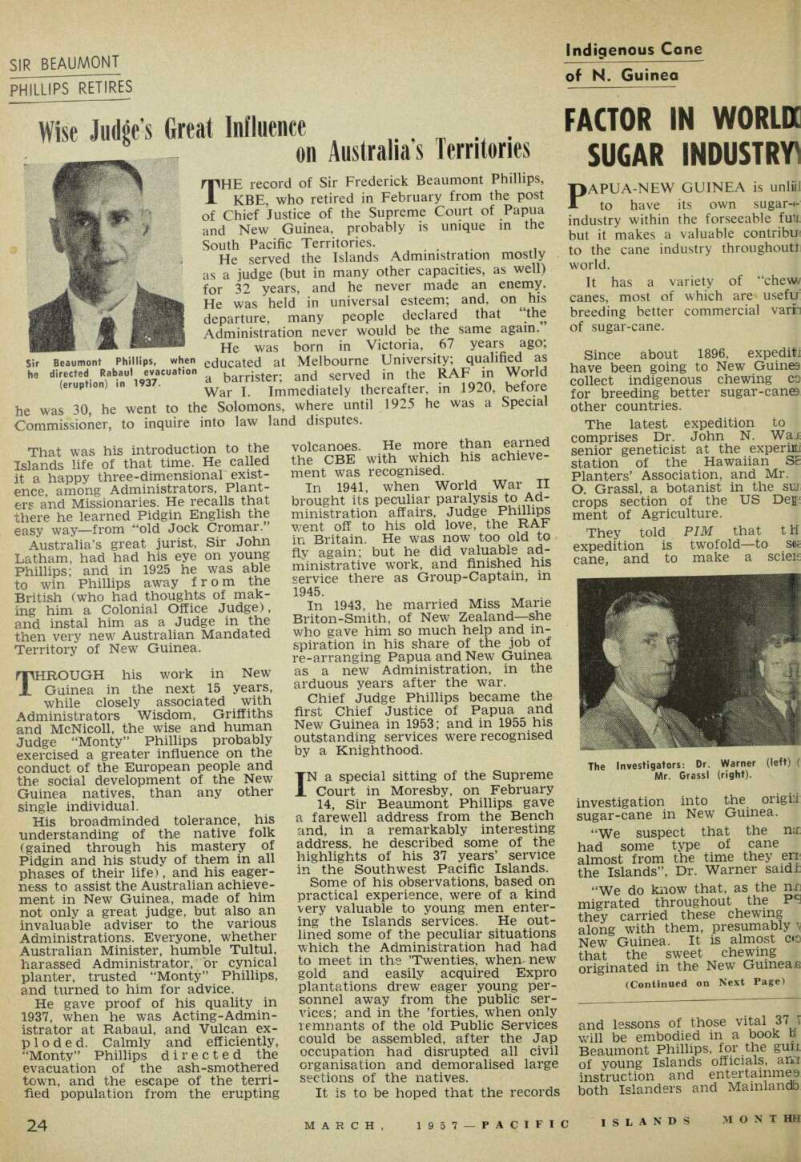
The Investigators: Dr. Warner (left) Mr. Grassl (right).
we don’t know where, and we ’t know how.” f. Grassl said that the natives improved the cane themselves, ough they probably did not ise they were doing so.
I. WARNER said there was wild cane in New Guinea known as "pit-pit”, which was suitable breeding. hat is one group of wild •rial we are after,” he said. :y are useful for breeding, ig increased vigour and resist co disease in sugar-cane. But vill have to try it out first.” said that in the cane grown [awaii to-day was some which
Vote from Tolala, from page 33: . . Calling Mrs. Eadie Huson, le time of Tulaen plantation, Buka way, and last heard of e living at Kings Cross, Syd- Margaret Campbell wants to ,ct her urgently, through the ITrust Co., Sydney, by March But perhaps a few days later make much difference. Come adie!”
tided from cane collected by r expeditions to New Guinea, j realise the material we want won’t be useful as cane but it will be useful in ■cane breeding,’’ he said, nay find only one useful cane e hundred, but the potential i is enough to justify this tv ” v • cane collected in New uinea is sent to Washington, ter going to Magnetic Island, ►ueensland, for quarantine, aally, it ends up in the two collections of cane—at Canal Florida, and Coimbatore, in Jrn India. n these points it is available sugar planters in the world.
Jre is a very good interchange les throughout the world, for tig and commercial purposes,” arner said. the P-NG Territory, Dr. r and Mr. Grassl plan to ir the cane along the Ramu iepik river systems; in the .1 and Western Highlands: Port Moresby, Lae and I; in Dutch New Guinea; in the British Solomon I. r areas they may visit are nville, New Caledonia and lebrides. 4d and 7d Papua and New ■ stamps became available at iof January. The 4d stamp overprint of the bird of 2hd stamp, and the 7d an overprint of the trading
I/- stamp.
islands Tours by Luxury Seaplane
THE luxury seaplane owned and operated by Sir Gordon Taylor will resume its South Pacific cruises in April.
It will carry a party of tourists from Sydney to Noumea, Fiji, Tonga, Samoa, Aitutaki (Cook Islands), Bora Bora, and other points in French Oceania, before returning to Sydney.
There will be a shorter cruise in May—to Noumea, and the Loyalty Islands, and various points in that area.
The April cruise, to Tahiti via New Caledonia and Fiji, will be re peated in July. t A land-plane service on the TEAL Coral Route (Fiji-Samoa-Cook Is.- Tahiti) is being considered as a re placement for the present flying boats says Auckland Star of March 3.