Wise Judge's Great In iluence
p. 26 · Read in the full issue
Sir Beaumont
Phillips Retires
Wise Judge's Great In iluence on Australia's Territories
THE record of Sir Frederick Beaumont Phillips, KBE, who retired in February from the post of Chief Justice of the Supreme Court of Papua and New Guinea, probably is unique in the South Pacific Territories.
He served the Islands Administration mostly as a judge (but in many other capacities, as well) for 32 years, and he never made an enemy.
He was held in universal esteem; and, on his departure, many people declared that “the Administration never would be the same again.
He was born in Victoria, 67 years ago, educated at Melbourne University; qualified as a barrister; and served in the RAF in World War 1. Immediately thereafter, in 1920, before
he was 30, he went to the Solomons, where until 1925 he was a Special Commissioner, to inquire into law land disputes.
That was his introduction to the Islands life of that time. He called it a happy three-dimensional exist ence, among Administrators, Plant ers and Missionaries. He recalls that there he learned Pidgin English the easy way—from “old Jock Cromar.”
Australia’s great jurist, Sir John Latham, had had his eye on young Phillips: and in 1925 he was able to win Phillips away from the British (who had thoughts of mak ing him a Colonial Office Judge), and instal him as a Judge in the then very new Australian Mandated Territory of New Guinea.
THROUGH his work in New Guinea in the next 15 years, while closely associated with Administrators Wisdom, Griffiths and McNicoll, the wise and human Judge “Monty” Phillips probably exercised a greater influence on the conduct of the European people and the social development of the New Guinea natives, than any other single individual.
His broadminded tolerance, his understanding of the native folk (gained through his mastery of Pidgin and his study of them in all phases of their life), and his eager ness to assist the Australian achieve ment in New Guinea, made of him not only a great judge, but also an invaluable adviser to the various Administrations. Everyone, whether Australian Minister, humble Tultul, harassed Administrator, br cynical planter, trusted “Monty” Phillips, and turned to him for advice.
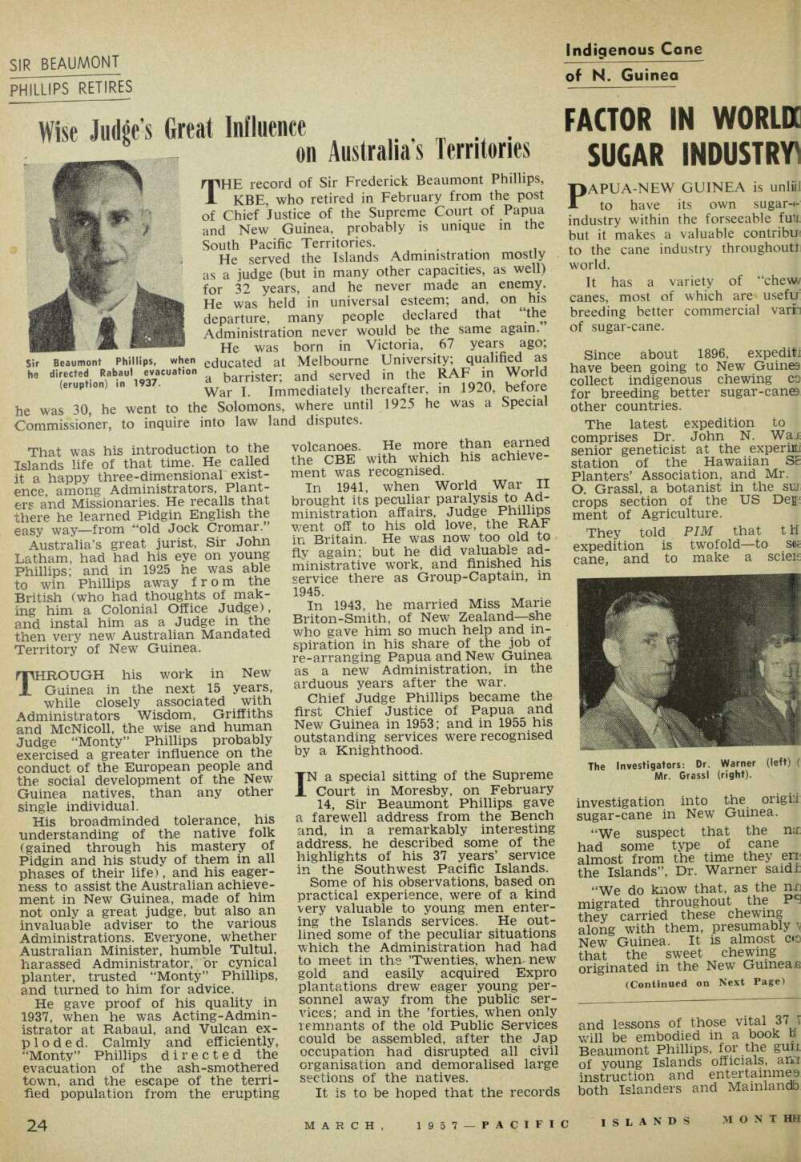
He gave proof of his quality in 1937, when he was Acting-Admin istrator at Rabaul, and Vulcan ex plod e d. Calmly and efficiently, “Monty” Phillips directed the evacuation of the ash-smothered town, and the escape of the terri fied population from the erupting
volcanoes. He more than earned the CBE with which his achieve ment was recognised.
In 1941, when World War II brought its peculiar paralysis to Ad ministration affairs, Judge Phillips went off to his old love, the RAF in Britain. He was now too old to fly again; but he did valuable ad ministrative work, and finished his service there as Group-Captain, in 1945.
In 1943, he married Miss Marie Briton-Smith, of New Zealand—she who gave him so much help and in spiration in his share of the job of re-arranging Papua and New Guinea as a new Administration, in the arduous years after the war.
Chief Judge Phillips became the first Chief Justice of Papua and New Guinea in 1953; and in 1955 his outstanding services were recognised by a Knighthood.
IN a special sitting of the Supreme Court in Moresby, on February 14, Sir Beaumont Phillips gave a farewell address from the Bench and, in a remarkably interesting address, he described some of the highlights of his 37 years’ service in the Southwest Pacific Islands.
Some of his observations, based on practical experience, were of a kind very valuable to young men enter ing the Islands services. He out lined some of the peculiar situations which the Administration had had to meet in the ’Twenties, when new gold and easily acquired Expro plantations drew eager young per sonnel away from the public ser vices; and in the ’forties, when only remnants of the old Public Services could be assembled, after the Jap occupation had disrupted all civil organisation and demoralised large sections of the natives.
It is to be hoped that the records
and lessons of those vital 37 T will be embodied in a book B Beaumont Phillips, for the gun. of young Islands officials, am instruction and entertainmee both Islanders and Mamlandb
Sir Beaumont Phillips, when he directed Rabaul evacuation (eruption) in 1937.