100 Years In The Sweetening Business
pp. 86-87 · Read in the full issue
CSR Co., which can now put tiles on your floor, as well as sugar in your tea, has written a book which tells how it was done.
WHEN I first went to Fiji, and wandering aroundLautoka, was wandering arou a som/oj 16 pom ed to a r °H P with^ed 1 Toofs and said; *SSS*SS Verier was to the contrary. The occupants of the bungalows mixed, aU right . and a they believed that the source of
inspiration °/, the . them-
was divine, they kept it to them “Se Colonial Sugar Beflnmg Comr e »a a nTa g nf U F g fjl-is Kg Busf-’
Z and any Business as Big as St one is a sitting shot forpoliUcta
X, PU wit rSSFT creatat
who wish y know what fv»Pv rS are ’ talking about. But people £ T?Le pro and con, flcatmns of CSR hterauy.^ca; P nrov?ded l by no less than a book proviaea y the Company . nnhlished
South pubhshed
recently by Mips and Robert«>n Ltd., and wrjtten partly yP' P S^h°e Ur c n ompany^" has ‘ not however!
been produced in a spirit of justi f i c a t i o n or apology. As Sir Edward Knox, present chairman of the CSR, says in an introduc tion, the object is to “communicate an understanding of the nature of the company, how it works and the role it plays m the communities of the South Pacific. Our plan has been to pre sent the evidence and let readers draw their own
conclusions.”
The book sets out to tell the story of the com pany, but it is in evitable under the
circumsta nces
that it tells also the story of the sugar industry in the Soutn Pacific —an in dustry that has been the subject of more Royal
Commissions and Special Inquiries than possibly any other. It is significant that from all of these Q icial witch-hunts, little has emerged that provides ammunition ga °" e aCtion by the in ' » of me CWfs nm century in Actual y ’fashion the growth of a great corporation andSts place in
p?li«cal development
of a community, lag? mste and than originally envisaged, and one that is certatoly umque at least mAustria, pant of 6 SUdarewont to pursue their course, remote and—as our Lautoka friend inferred—Godlike, disdaining to explain their un- SXn bl£ Pl3Ce in the ProgreSS ° f 3 nanon. sQ dlverse have the operations of CSR become, that as well as the sugar you put in your tea the rum that you put in your tea the jum that you pm n y that floor g yo ur shop, the plastics thai make Y your radio cabinet-
drugs, chemicals, pharmaceuticals— all may be end products of various company enterprises.
Yet this mammoth company, with assets of over £50,000,000, grown and down by the founder , Edward Knox, and his son, E. W. Knox, who from 1880 for half a century guided the destiny of the company, They were-to agam quote Sm
hard locepLd refpoi^
« counted costs and respected persons.
N 1843 Edward Knox . then 24 , and 1 only three years in the Colony became manager of Australia S first refinery, the Australasian Sugar Company. He remained with it until
cotpa^.
the colonial Sugar Refining Coin- P»hy was formed on JMuary 1,1855.
It was an unlimited liability com pany with a capital of £150,000 and fen shareholders, of whom Edward K nox was o ne and Edwin Tooth described as a brewer—was another.
All raw sugar was bought on the
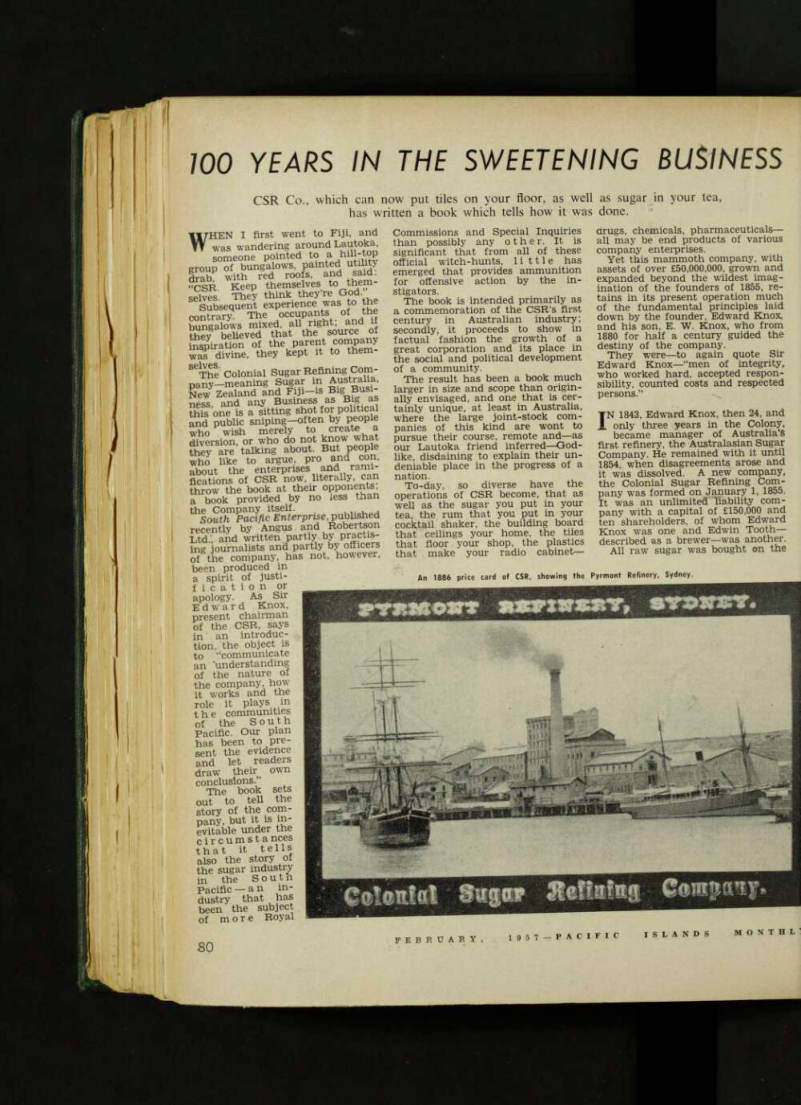
An 1886 price card of CSR, showing the Pyrmont Refinery, Sydney.
open world market and imported— and raw sugar was still being im ported into Australia up until World War I. It was not until the late 1860’s that raw sugar in commercial quantities was produced in Aus tralia, and not until 1870 that CSR entered the field of raw sugar pro duction in Northern New South Wales. It was 10 years later before the company entered the field in Queensland.
Edward Knox’s period with the company was one of cautious ad vance—a canny ploughing back of profits into the business —against a background of an unstable world sugar market that alternated be tween unpredictable booms and slumps. He was followed by his son, E. W. Knox, who for 50 years guided the fortunes of the company and whose far-sighted policies pro vided much of the present-day structure of the organisation.
During the first five years of E. W. Knox’s reign, three mills were established in Fiji—Nausori, on the Rewa River; Viria, which operated for only 10 years; and Rarawai Mill, on the Ba River, in the “dry” zone of Viti Levu. The latter started operations in 1886. The company’s biggest mill in Fiji, at Lautoka, com menced operations in 1903; the smallest acquired from another company in 1926—is at Penang, northern Viti Levu. The company’s fifth mill is on Vanua Levu, at
Labasa, and has been crushing cane since 1893. (It was announced last month that the CSR will be closing its original mill in Fiji—Nausori— at the end of the 1959 cane season).
The company has a monopoly of sugar milling in Fiji, but most Aus tralians in Southern States will be surprised to learn that this is far from the case in Australia. In the Commonwealth it owns seven of the 34 existing sugar mills and produces about one-fifth of the Australian raw sugar. Neither is it quite alone in the refining field; it owns five refineries, but a sixth is the Milla quin Sugar Company, of Bundaberg, which supplies about one-third of the requirements of the State of Queensland.
It is impossible in a short article to give an adequate coverage of the scope of this book, any more than it is to give the scope of the com pany itself whose enterprise has now progressed far beyond its original purpose of refining raw sugar.
The 500 pages of the book cover every aspect of the company, the sugar industry and sugar as an agricultural product. CSR’s side line enterprises in the fields of chemicals and building materials are also covered and there are an ex traordinary number of black and white and colour photographs, graphs, charts and drawings: and, at the back of the volume, numer ous appendices and a detailed index.
We understand that the writing and compilation of this centenary record took about a year longer than expected. We can believe it. Price of it is A 42 /—and at that price, in view of the high cost of book pro duction in Australia, it is likely that this is one department in which the Colonial Sugar Refining Company
will not make a profit.
JT.
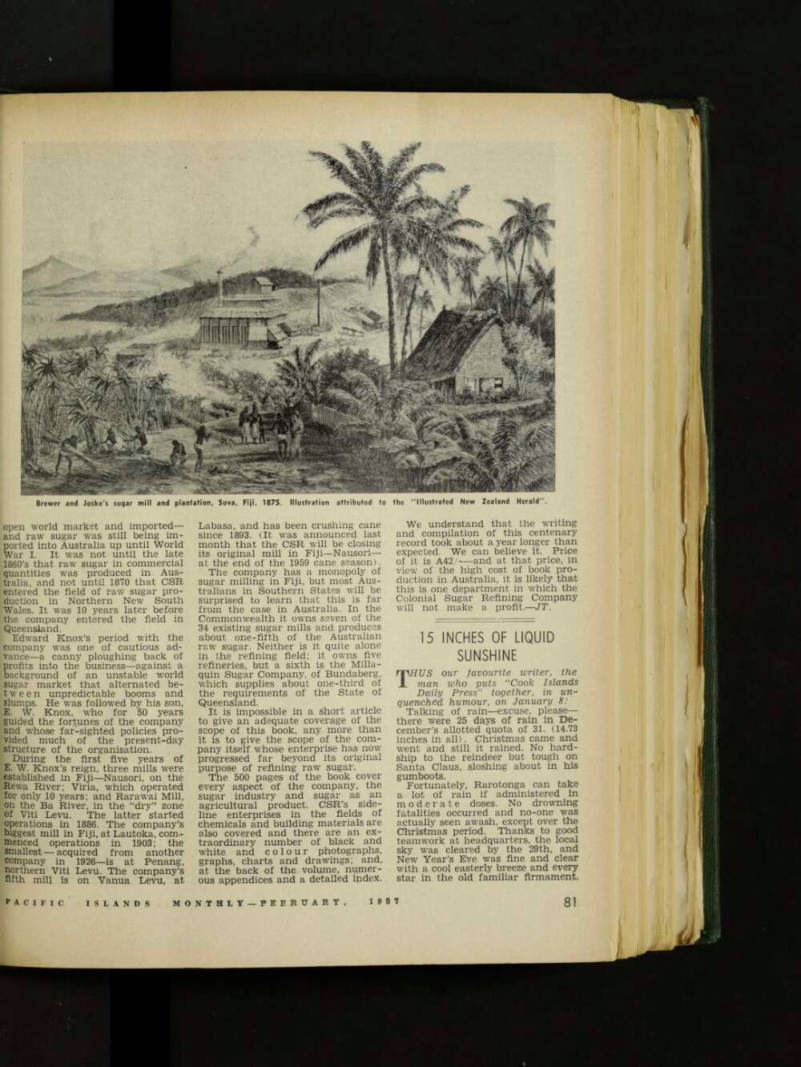
Brewer and Joske's sugar mill and plantation, Suva, Fiji, 1875. Illustration attributed to the "Illustrated New Zealand Herald".