There's Always Been Hot News
pp. 85-97 · Read in the full issue
Don't Blame lord Northcliffe —
From The Islands
By Stuart Inder
r[EY say the newspaper business has never been the same since Northcliffe brought out a new type of rag with a punch, at the turn of the, century.
Since then, they declare, journal istic ethics have been kicked in the teeth twice every day in the scramble for hotter stories; and the facts have been angled to the oddest shapes to fit.
In the Islands especially, the critics despair.
There, all manner of people may be heard noisily choking over fascinating mainland press accounts of the things that happen at their very doors without their knowledge— things like chieftains demanding that the Duke of Eidnburgh kiss -their • feet in homage; Shangri-la’s with* inhabitants 7ft tall; anth dramatic adventures of assorted Islands mystery vessels.
“What has happened,” comes the muffled question, “to the kind of honest treatment we got from the Sydney Bulletin in its hey-day? Or the Sydney Morning Herald before it '’took the advts. off the front page?”
Ah, yes—what indeed has hap pened to the good old days, when reporters weren’t inaccurate, or sensational, or witty at somebody else’s expense?
Well, not always, anyhow ... It seems from some of the reading I’ve been doing lately. . . .
THE name of Dr. William Bromi low i$ a pretty celebrated one among Islands missionaries.
Dead for almost 30 years now, he set up the first Methodist mission at Dobu, in Papua’s D’Entre casteaux Group.
The year was 1891, a time when the Dobuans were eating each other raw, and the missionaries had a tough job convincing them that even when the meat was cooked, can nibalism had become unfashionable in most other places.
The missionaries made their point, but it was a long and 'ough assign ment. Success resulted in Bromilow and his wife being formally adopted into one of the pacified tribes, following what Bromilow described as “a graceful, simple ceremony” in volving the gift of a growing coco nut tree.
About the same time, he was also invited to take over as headman of another friendly tribe, whose chief had recently died.
Bromilow declined this honour as one that would take up too much of his time.
“But the villagers were im portunate,” he recounted. “They were so much in earnest that I agreed to accept It if the office could be made an honorary one. They consented to relieve me of all local and corporate duties, and I became titular headman.”
The news soon found its way to those good, old-fashioned, accurate reporters, and appeared in a London newspaper.
“But it grew in transmission,” noted Dr. Bromilow in his memoirs.
“ ‘ln New Guinea, an Englishman is chief of chiefs of a black and savage tribe of Papuans and original cannibals. . .’ so ran the report.
“It proceeded to give a highly
imaginative and picturesque de scription of my installation as a ruling monarch, and closed with the statement, ‘Mr. Bromilow is in good health and perfectly con tented with his position.
“This was true,” com m e nted Dr.
Bromilow, with irony, “I was in good health and more than content with my position.”
But missionaries, apparently, were fair game, for a famous colleague of Bromilow’s, the Rev. Dr. George Brown, was com plaining about a smart- alec re porter about the same time.
His incident had occurred 20 years before, in New Britain.
Pioneer Mission ary Brown had witnessed the great Rabaul eruption of 1878, when Vulcan Island came out of the harbour. (The island, in
turn, became part of the mainland in the 1937 eruption). Many times Brown had sailed across the spot where Vulcan was to rise, and a week after the new island appeared he had set foot on it.
He recalled in his memoirs, “I was much amused later in reading a contribution from a very facetious London correspondent of one of the largest dailies in Australia.
“This gentleman stated that he had been accustomed to subscribe regularly to a library of fiction, but lately he had met with such in teresting matter in the scientific journal, Nature, that he had decided to give up the fiction library and take in Nature.
“As one reason for this, he said that it had been gravely asserted in the scientific journal that during a recent eruption in Blanche Bay, New Britain, the fish came up ready-cooked.
“This he no doubt considered a very facetious way of expressing his incredulity.”
Dr. Brown then proceeded to put the reporter in his place. ‘For some time after the volcano broke out, all the water in the bay was of scalding heat,” he wrote.
“When we were at Malakuna, it
(Continued on foot of Page 91)
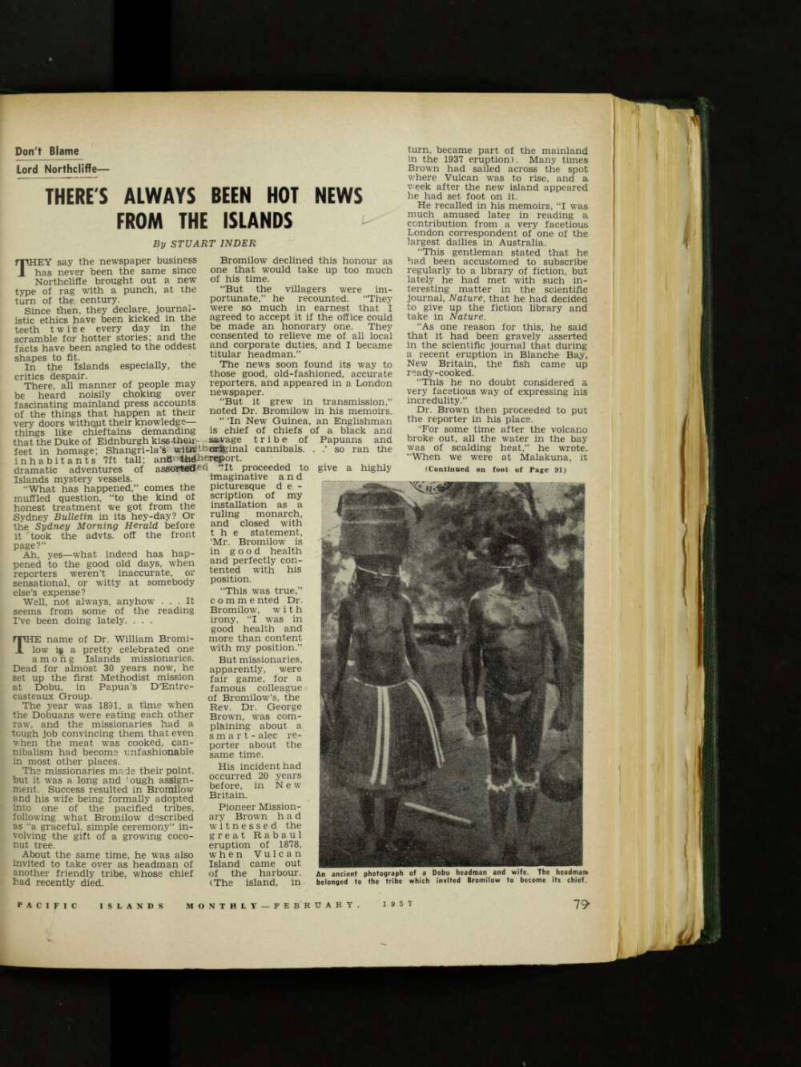
An ancient photograph of a Dobu headman and wife. The headman belonged to the tribe which invited Bromilow to become its chief.
would have been utterly impossible even for that funny correspondent to wade more than a few inches into the water, though the tide had been ebbing and flowing into it for several days.
“All the fish in this immense sheet of water were killed and so far from it being an exaggeration to say that they were all cooked, it is easily proved that they were very much overcooked.
“For example, it is well known that the tortoise shell of commerce is procured from the hawksbill turtle and the plan which the natives adopt for getting off the shell is by means of heat.
“There were hundreds of these turtles destroyed by the boiling water, and yet only 27 lb of tortoise shell was collected from the whole of them, because the turtles had been so much boiled that in many instances nearly all the shell haa dropped off.
“Water hot enough to melt the shell from the back of a hawksbill turtle was hot enough to cook any
ordinary fish!”
Anyone wanting to read a fascin ating adventure story of the early days in the islands should get hold of Bromilow’s, Twenty Years Among Primitive Papuans, or Brown’s Auto
biography.
It’s wonderful reporting by any standards—to-day’s, or of those good old days before Northcliffe brought out that rag.