Unscheduled Stop - Telefomin
pp. 86-87 · Read in the full issue
A 20 Years' Flash-back to the World of B-4
IT was a Sunday in the month of May, in the year 1935.* For four years Wewak had been the headquarters of the Sepik Dis trict, which has an area of 39,000 square miles of mountain, grass plains and river. Wewak had grown from a Police Post into a town ship, within that short time.
The last of the native material houses which stood on the headland had gone and eight modern bunga lows and a European hospital had been built. All the roads had been cut out of the solid coral by prison labour, and perhaps the greatest achievement was the half-mile road through the deep mangrove swamp to the aerodrome, then one of the finest in the Territory.
The aerodrome was built by local native labourers.
On this day we had been playing tennis when a big, three-engined Ford plane of Guinea Airways arrived to use the strip as a starting point in a supply dropping task into the headwaters of the Sepik River.
A patrol party under the leadership of Patrol-Officer J. R. Black was exploring the country between Mt.
Hagen and the Dutch border.
With the arrival of the plane, piloted by “Master Tom, Captain belong balus,” and with a Mr. Allen, who took charge of the supply dropping, the station immediately became immersed in the business of the “drop.” Cargo was sorted for the two flights that would be neces sary, and in the evening the some what inadequate maps of the area were examined in detail.
The Sepik River is the largest in New Guinea. The mouth is 52 miles east of Wewak and often logs and small islands of grass are seen off Wewak headland, having been carried up the coast by the south east drift. „ The Lower and Middle Sepik reaches have a remarkable depth of over 50 feet and are, without much variation, over a quarter of a mile wide.
In 1924, a Government Station had been established at Ambunti, 240 miles upstream, where for some years two officers had worked at one of the most lonely outposts in
New Guinea, bringing under Gov ernment influence the natives living on the banks of the middle river.
There had been several hurried expeditions up the river before Behrmann, in 1912-13, but he. with a survey ship, mapped the river for $5OO or 600 miles upstream.
The headwaters of the Sepik were reached by a patrol party from Papua in 1928 (Karius and Champion), and in the mid-30’s a prospecting company from Papua settled there for five months. They made a landing ground in the one large valley lying in a basin of mountains. Their pilot in an amphibian had, on that occasion, come to Wewak to take the District Officer into their camp, where he spent a week with the prospectors, visiting the native village of Tele fcmin in the valley.
It was at Telefomin that the patrol from Mt. Hagen was now waiting to be supplied by Guinea Airways. The first trip was made on the Monday morning, and the second on the Wednesday. On this second flight it was suggested that I should go as it was necessary only to throw out the cargo.
The day was» clear and by the
time we reached the airstrip, a 8 a.m., all was in readiness.
The door had been taken ofi plane, a plank had been put a the opening. I climbed over cargo to my seat next “Master T who was already in his plane, j trying out each engine in turr put his camera between the and, slipping a writing pad, fast by elastic, onto his leg, he pu his hat and called out to Mr. , to know if he was ready.
Turning over the heavily timl coastal ranges, threaded with bush tracks to native villages gardens, we set a direct coun Ambunti, on the middle rive miles away. On over the great g lands, broken by scattered cl of trees, in which a few n villages were sheltered.
A 2,000-ft mountain backs few buildings of the Govern post at Ambunti. Four yean fore I had visited there by schc and I knew that after the pi boys had taken down the E at sundown,. the mosquitoes < men to their houses, where lived in a small wire room g out on the ever-flowing river lonely place in the early days
*lt is possible that Mrs. Townsend is a little out in this date. I did not see Wewak until February, 1936, and to my knowledge there was then no airstrip at Wewak. Towards the end of that year, an airstrip was cleared at Maprik, and a strip built on the coast at Worn, north of Wewak. Even up to the middle of 1937, stores for the inland mining com munity were still sent by sea to But, further north still, and airfreighted from there to Maprik. From memory, I should say that the airstrip between Boram and Wewak was not iouilt until the end of 1937. —Editor, PIM.
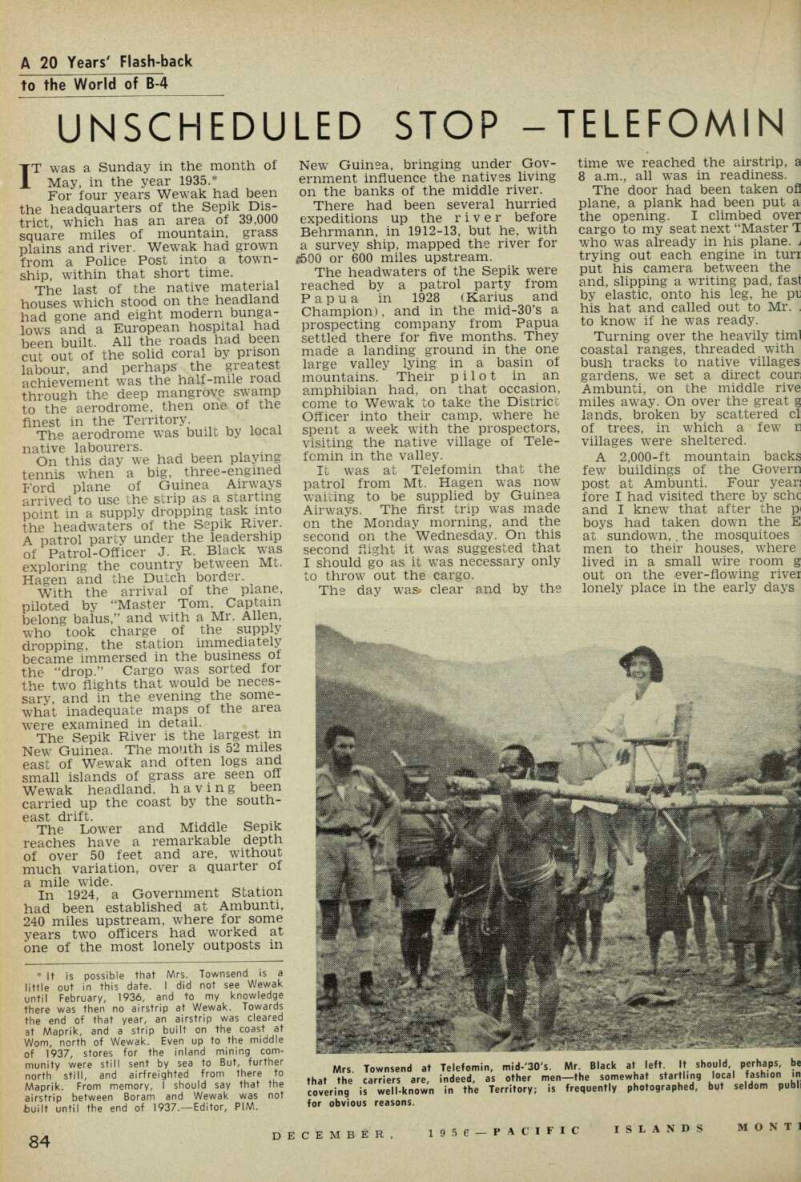
Mrs Townsend at Telefomin, mid-'30's. Mr. Black at left. It should perhaps, be that the carriers are, indeed, as other men—the somewhat startling local fashion in covering is well-known in the Territory; is frequently photographed, but seldom publi for obvious reasons.
Dres and mails went up-stream 1 an average of every four months.
At Ambunti, we crossed over the pik.
On our right, through fleeting mds, 300 miles of the Upper Sepik ►und away towards the Dutch rder. Sandy banks marked the 1 courses in the swamp, making
[he author of this article is the wife of W L. Townsend, for many years until the break of the Pacific War, a District Officer the Sepik District of New Guinea. After a inguished career during the war, Mr. Towns went to United Nations headquarters in r York as a member of Australia's permanent If there. e and Mrs. Townsend have only recently irned to live in Queensland, uring their years in New Guinea, Mrs. rnsend saw a great deal of the primitive ik country and this account of a visit to ifomin is of particular interest, elefomin is, of course, still regarded as of the most "difficult" areas in the Terri- I—it 1 —it will be remembered that two Patrol lers were murdered there about three years and that at the time there was considerable ment —not ail of an enlightened character — the Australian Press. More recently, not i far from Telefomin (as the crow flies, liow), there was another minor war, this ! between two native groups and about 30 [hem were killed. This too caused a news ir sensation.
Irs. Townsend tells how she visited Tele in 20 years ago, and, strange as Australian iland newspapers may find it, how friendly found the people.
i river like one great collection lakes. Ahead were thickening uds, but rising above them to )00 feet, we were in clear sky, h a thick sea of white beneath and no land in sight. Master n had written on his pad: “Left wak 9 a.m.; Ambunti, 9.45. This where all clouds are made.”
'aking up his camera, he photo phed the masses below us. It I chilly and I was glad when an ir later the clouds thinned and started to descend. Just ahead us lay the Sepik, a narrow Jam now, running through a ge in the mountain. At 8,000 t we looked down on a big valley lost hidden by the surrounding ges. In the south-east corner i the landing ground of Tele lin.
SERE was great activity at the back of the plane. Mr. Allen was pushing the bags near to doorway but because of the tion it was hard for him to keep balance. Rounding just over tree tops at the foot of the untains, we banked and came r the runway only a few yards ve the ground. The pilot lalled and five bags were pushed • In the time it took to circle nd, more bags were pushed to doorway. Four bags went next e. Circling again, the pilot ?ot to signal and only one bag it out as we covered the run f> on the fourth round six went —a good round. ■rowds of kanakas lined the Qes of the runway and a white
man (J. R. Black), with a short beard, dressed in khaki shirt and shorts, raised his arm in salute to us as we passed. Running down the valley we turned sharply and returned, but at 40 miles an hour we hit the ground with a thump, thump, thump. We seemed very close to the end; mountains were just ahead as we skidded and the six tons of us come to a stop in a shower of mud facing sideways on to the strip.
Immediately the crowd of kanakas came racing across to us, followed by Mr. Black and the Police and carriers who had been putting the thrown-out cargo to the sides of the cleared ground. They stood around us as we got out, and the kanakas looked at me with great astonishment as they had never be fore seen such an object. The news was passed that I was a woman; and the most venturesome and the most curious came closer to see better.
One old kanaka (he had his hair interwoven with small strips of bamboo, covered with clay, four inches in width at his shoulders and ending in a pigtail which wound round his waist), pointed to a native woman and then to me.
The crowd became convulsed with laughter. A chair out of the plane was fastened to two long poles, I stepped in and four carrier-boys hoisted me up on their shoulders.
The three white men took a dry road round the edge while I went straight up to the camp half a mile along a swampy track. Two Policemen with rifles walked close beside the chair, with a chattering crowd behind of about 200 kanakas.
The Police told me they had arrived about a month before and the valley was now like a second home after the long trip across the mountains.
I asked the carriers if they would like a spell as the road was heavy going, but the Police-boy laughed and said: “Missus, you bone noth ing. Box he heavy more.” . , carr iers had been selected for this patrol from mountain villages recently brought under Government control. They were all short, solid youths with round, happy faces. They had not seen a white woman before and were ask ing curious questions of the Police m the Pidgin English learnt on the tnp They edged closer, and one, shaking his head, took my hand and turned it over. The men arrived, followed by carriers with sacks of cargo which were taken into the enclosure near the main house to be unpacked. The kanakas stood outside, watching every move ment.
We went into the camp house.
The building was of two storeys with a ladder inside the doorway leading up to a room 20 ft by 14 ft, with benches along each side on which were stacked a medicine chest and Mr. Black’s personal gear.
Four posts supported a canvas bed in a corner near the window space which overlooked the valley.
We had a meal around the little patrol table —some sandwiches and a pie, with some canned beer.
Prospects of getting back that after noon were discussed and as clouds were gathering over the mountains it was decided that we should wait until the morning.