The Sweep
p. 85 · Read in the full issue
By H.S.
[E first thing one noticed about him was a green tie spotted with pink spades. i sat, between meals, on a deck r studying maps and working scales of distance with a ruler irtising Zagzig Whisky, lite a number of passengers d each other what the man the only reply the harassed er would give was: “Jones: job lown.” ten one born, and bored, bier started a sweep on the »ct. Every possible occupation written on cards which were in a hat. The draws were two Ings each. i help the prize money even sionary” was included. We rienced Islands travellers knew, ourse, that there never was a ionary with a tie like that, ith my usual luck I drew the issible card; and, as compensa was given the distinguished of discovering the winning job. came up from lunch before s, one day, and slid my chair to his. During the afternoon pped into it and remarked on weather. He quite agreed with and his dreamy eyes registered lure at the prospect of a yarn, on I had led him to tell me ;he was. I simply shook with ht at his information and had xplain to the chappie that I a touch of malaria. He was ig what that was when I the originator of the sweep
strolling down the deck.
Surreptitiously I scribbled the word “Missionary” on a newspaper and, as my accomplice passed, handed it to him with thanks for the loan. He took the paper with a courtly bow and walked on.
I turned to my companion, asking: “What, sir, is your parti cular teaching?”
“Well,” he replied, “I really am not interested in any teaching My job is to get it across to the natives.”
“But,” I asked bewilderedly, “get what across?”
He sat thoughtfully for some time, then ejaculated: “I will tell you all.”
He proceeded to carry out his threat, or part of it. Fellow members of the sweep were passing casually, glancing keenly at the mystery man, then giving me a look of deep distrust.
My companion was too intent on his story to notice all this.
“I had read,” he said, “that the cost of missionaries was fairly high, and there was a chance of the demand exceeding the supply of funds. I worked it out and found that the main cost was for houses and food. It seemed to me that science could easily overcome that difficulty.
“Why, Sir, with radio aid, one house and one lot of rations and allowances can serve a whole race of heathen. The missionary will live at the capital, beside a trans mission set. He will send out receiving gear to every village, and one service and sermon will supply the whole population.
“Of course it may be necessary to have an expert go around and instruct the chief of each village in the working of the things, but I am prepared to do that on a commission basis.”
“It seems an inspired idea,” I exclaimed. “The very terms you use indicate it: ‘transmission’, ‘commission’, and I suppose there will be an intermission between the items. Yours verily is an all round mission. But there is one thing that you seem to have over looked.”
“No, surely not!” he exclaimed.
“What can that be?”
“Well,” I said, “there is the matter of interpreters. You see, the Government courts have collared every native with imagina tion enough for that job.”
“But the missionary would know the language,” he expostulated.
“You must not be singular,” I explained. “There is a decided plurality of languages.”
“Do you mean that there is more than one language?” demanded the intermissionist.
“There is,” I said.
“Well, that’s fine,’’ he cried.
“I have the agency for Selman’s System of Speaking Severally.
Surely there are natives in every village progressive enough to take a course. It is wonderfully easy.
Ten minutes a day with the aid of our gramophone-guides will give perfect pronunciation and comprehension in a few weeks.
Also our instalment plan brings it within the reach of everyone and I had braced my calves for a spring in response to the sense of deep need of a double nobbier in solitude. I was just starting when a man hurried up and, with generous apologies to us, handed me a lot of silver wrapped in a fiver. It was, of course, the sweep prize; but the treasurer obscured that by saying. “Here’s the change for your cheque, old man. The purser has just cashed it.”
“Keep it for a while,” I urged agitatedly. “My pocket has a hole in it.”
“No, no! It’s yours,” insisted the treasurer. “The skipper vouches for your veracity.” He pushed the cash back into my hand and hurried away.
I attempted to rise, but the strange salesman gripped my arm.
“Now, this is providential,” he exclaimed. “The money is a nuisance to you just at present.
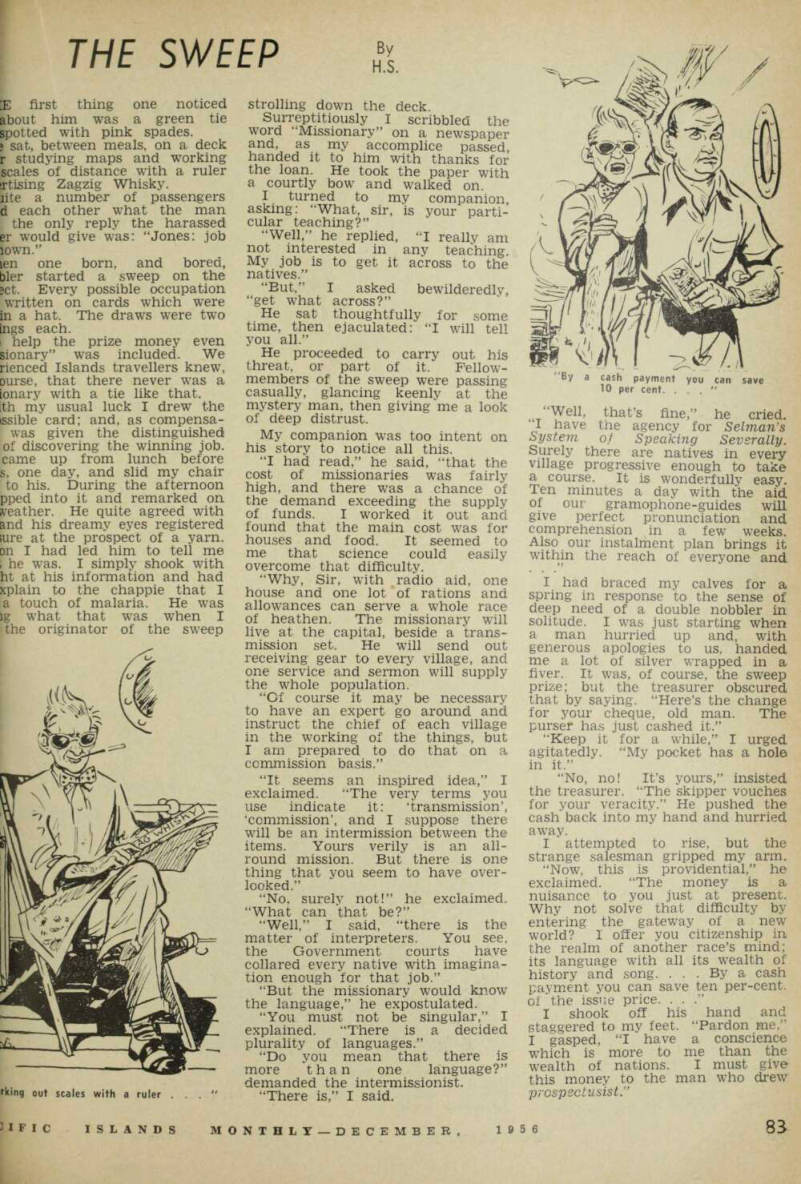
Why not solve that difficulty by entering the gateway of a new world? I offer you citizenship in the realm of another race’s mind; its language with all its wealth of history and song. ... By a cash payment you can save ten per-cent, of the issue price. . . .”
I shook off his hand and staggered to my feet. “Pardon me,”
I gasped, “I have a conscience which is more to me than the wealth of nations. I must give this money to the man who drew
prospectusist.”
[?]king out scales with a ruler . . . "
By a cash payment you can save 10 per cent. ..."