. . . And for Australia
pp. 90-91 · Read in the full issue
September 1, 1906
It was an Historic Occasion for Papua . . . And for Australia
By A. P. LYONS, formerly Director of Public Works in Papua.
THE first of September, 1906, was an historic occasion for Papua, because, on that day, at Port Moresby, the young Commonwealth of Australia took formal possession end control of the Crown Colony of British New Guinea, re-naming it the Territory of Papua. This was Australia’s first Island territory.
This change from UK to Aus tralian administration was legally brought about by the Governor- General’s proclamation that the Papua Act of 1905, which had been passed by the Commonwealth Par liament, would come into force on September 1, 1906. The proclamation had been printed and published in a Gazette Extraordinary by the Government Printing Office at Port Moresby.
The Act provided for a constitu tion for the Territory; for some person to administer it; and for Executive and Legislative Councils to make laws for its administration.
The Governor-General appointed Captain F. R. Barton, CMG, to continue as administrator, and the following gentlemen to constitute the Executive and Legislative Coun cils: J. H. P. Murray (Chief Judicial Officer), A. Musgrave (Government Secretary), D. Ballan tine (Treasurer), R. M. Drummond (Chief Government Surveyor), A. M. Campbell (Resident Magis trate, Samarai), and C. A. W.
Monckton (Resident Magistrate, Northern Division). The following three gentlemen were appointed Non-official members of the Legis lative Council: W. Whitten (Mer
chant, of Samarai), F. Weekly (Miner, of Woodlark Island), and W. Little (Miner, of Yodda gold field) .
Most of the European population then lived at Samarai, or there abouts, or at the Northern and
Eastern goldfields. Samarai w the business and commercial hu an entrepot from which miners at others obtained their goods at native labourers.
The transfer ceremony at P‘ Moresby was impressive for all tnr
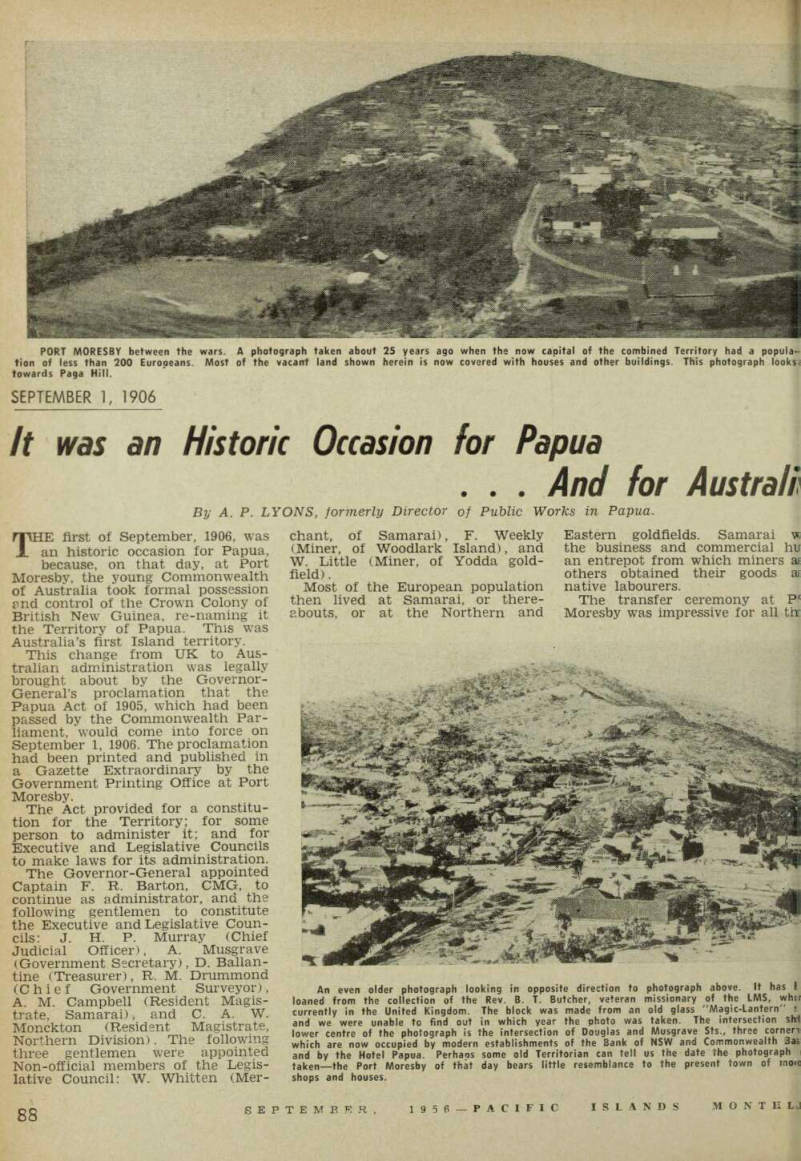
PORT MORESBY between the wars. A photograph taken about 25 years ago when the now capital of the combined Territory had a popula tion of less than 200 Europeans. Most of the vacant land shown herein is now covered with houses and other buildings. This photograph looks towards Paga Hill.
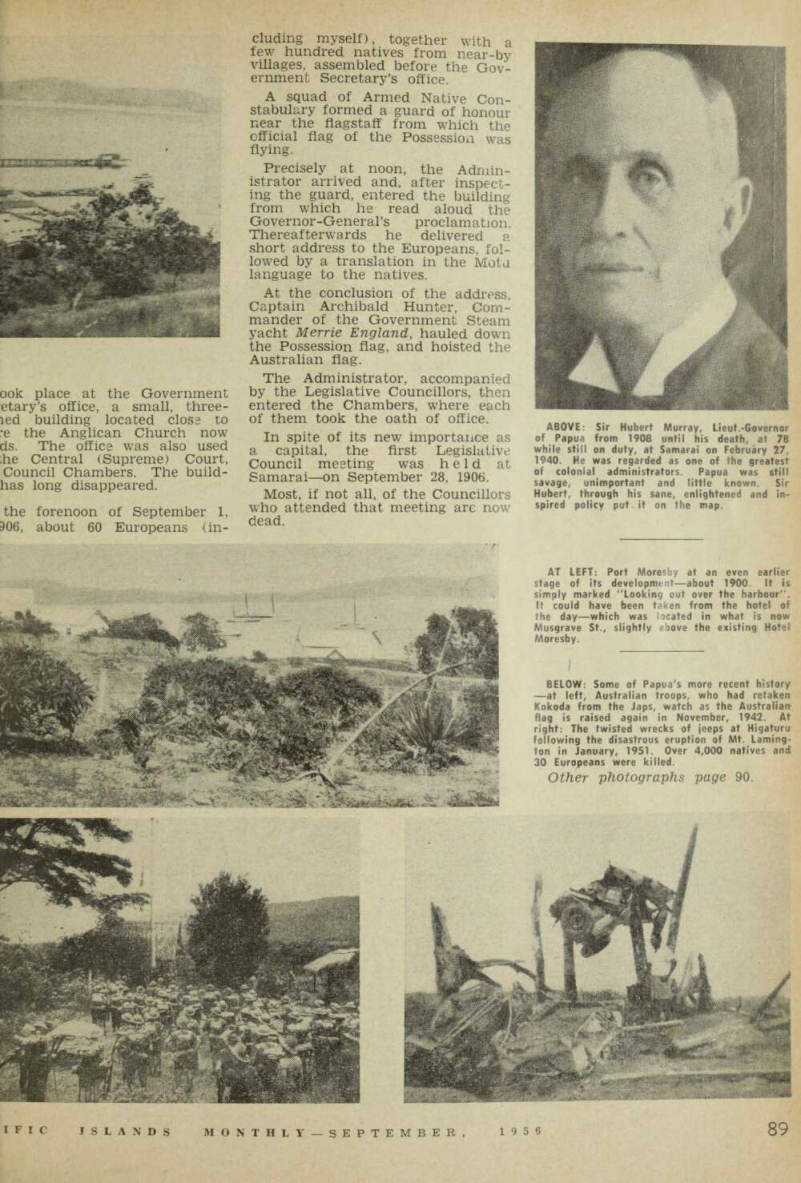
An even older photograph looking in opposite direction to photograph above. It has I loaned from the collection of the Rev. B. T. Butcher, veteran missionary of the LMS, whir currently in the United Kingdom. The block was made from an old glass "Magic-Lantern" ; and we were unable to find out in which year the photo was taken. The intersection Shi lower centre of the photograph is the intersection of Douglas and Musgrave Sts., three cornen which are now occupied by modern establishments of the Bank of NSW and Commonwealth 3as and by the Hotel Papua. Perhaos some old Territorian can tell os the date the photograph i taken —the Port Moresby of that day bears little resemblance to the present town of moio shops and houses.
ook place at the Government etary’s office, a small, three led building located close to :e the Anglican Church now ds. The office was also used ;he Central (Supreme) Court, Council Chambers. The build has long disappeared. the forenoon of September 1, 306, about 60 Europeans (in
cluding myself), together with a few hundred natives from near-by villages, assembled before the Gov ernment Secretary’s office.
A squad of Armed Native Con stabulary formed a guard of honour near the flagstaff from which the official flag of the Possession was flying.
Precisely at noon, the Admin istrator arrived and, after inspect ing the guard, entered the building from which he read aloud the Governor-General’s proclamation.
Thereafterwards he delivered a short address to the Europeans, fol lowed by a translation in the Mold language to the natives.
At the conclusion of the address, Captain Archibald Hunter, Com mander of the Government Steam yacht Merrie England, hauled down the Possession flag, and hoisted the Australian flag.
The Administrator, accompanied by the Legislative Councillors, then entered the Chambers, where each of them took the oath of office.
In spite of its new importance as a capital, the first Legislative Council meeting was held at Samarai —on September 28, 1906.
Most, if not all, of the Councillors who attended that meeting are now dead.
ABOVE: Sir Hubert Murray, Lieut.-Governor of Papua from 1908 until his death, at 78 while still on duty, at Samara! on February 27, 1940. He was regarded as one of the greatest of colonial administrators. Papua was stilt savage, unimportant and little known. Sir Hubert, through his sane, enlightened and in spired policy put.it on the map.
AT LEFT: Port Moresby at an even earlier stage of its development—about 1900. It is simply marked "Looking out over the harbour".
It could have been taken from the hotel of the day—which was located in what is now Musgrave St., slightly above the existing Hotel Moresby.
BELOW: Some of Papua's more recent history —at left, Australian troops, who had retaken Kokoda from the Japs, watch as the Australian flag is raised again in November, 1942. At
right; The twisted wrecks of jeeps at Higaturu following the disastrous eruption of Mt. Laming ton in January, 1951. Over 4,000 natives and 30 Europeans were killed.
Other photographs page 90.