Territories Talk-Talk
pp. 30-36 · Read in the full issue
By Tolala
In September . . .
The month of September com memorates several important events for P-NG folk. On September 26, 1884, representatives of the Ger man Government first arrived in Mioko, Duke of York group, to colonise the Bismarck Archipelago.
In September, 1888, Sir William MacGregor first took office as Ad ministrator of British New Guinea, and fifty years ago (1906) Australia assumed control of B-NG and it be came Papua. (Incidentally, I haven’t heard or seen of any special ceremony to mark this golden jubilee).
On September 12, 1914, Australian forces officially occupied German New Guinea; and exactly twenty years later, in 1934, Administrator Griffiths unveiled the Bitapaka Memorial to those who fell there in 1914. On the day following the unveiling, Administrator McNicoll took office.
On September 13, 1942, the biggest explosion during the Jap occupa tion took place when ammunition dumps in Matupi Farm blew up; on September 13, 1945, Australian troops first contacted civilian in ternees at the Catholic Mission camp at Ramale (near Kokopo).
What’s next?
Time Table For UNO The request, made by the UN Trusteeship Council, for Australia to fix a date when TNG natives
are sufficiently advanced to run their own country has created a series of outcries and protestations far greater, in my opinion, than the UN request warrants.
The surprise packet in the whole affair was the USA’s part in allying itself with the pin-pricking Afro- Asian bloc, which is all-out to em barrass the Western Powers at
every opportunity.
Australia would have been quite justified in giving a date sometime in 2060 AD, and to leave it at that.
In one way, Australia has only itself to blame if the Trusteeship Council expects TNG to become self-governing in the not-distant future. Window-dressing has always been well to the fore in the annual reports, both to the League of Nations and to UNO. The sophisti
cates and the Bright Boys of the Class have always been well on display for UN Mi ssi o n inspec tion; the back ward, primitive
and undeveloped parts of the TI tory have been kept well inr background.
Well do I remember the report to the League of Na£ showing photographs of nr student carpenters, tinsmiths plumbers at work at the M guna Technical School, showed a student, seated lx a typewriter, and the caption i “This student is learning as tecture.”
Little wonder then that: Indian chairman, Rikhi Japs the Trusteship Council, sli think that after 35 years of “advanced” education the T tory should be able to stand o own feet.
We should feel no qualms, cause NZ speaks of 1960 as the target date for Western Sa:j independence. There is no parison between the two territ Western Samoa, consisting of' square miles with a Polyrj population of 90,000, can scs:
be considered the same cup as TNG with its 93,000 square and U million primitive Melaru
The Downs
Deal
About the best long-range; print for inter-racial relatio come out of NG is the char the Goroka Highland Farmer Settlers’ Association. It co more commonsense than aE tomes on native welfare and ilation from the pens of starn theorists.
But then a practical plan fo a purpose is only to be ex •when you realise that such « enced men as the Leahy bn lan Downs, George Greathes Jim Taylor are connected wi association and that Downs
president.
The Charter is such a doc earth document that officialdoj probably try to steal some thunder and claim the ideaj own.
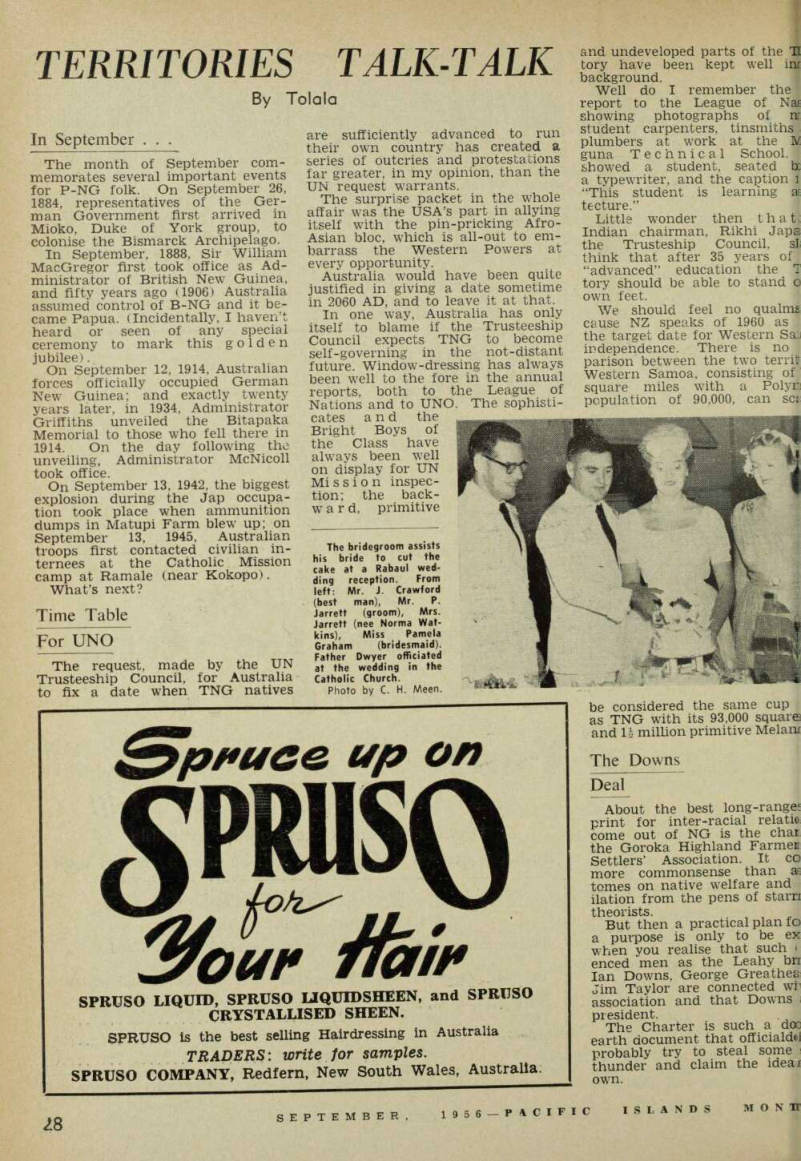
The bridegroom assists his bride to cut the cake at a Rabaul wed ding reception. From left: Mr. J. Crawford (best man), Mr. P.
Jarrett (groom), Mrs.
Jarrett (nee Norma Wat kins), Miss Pamela
Graham (bridesmaid).
Father Dwyer officiated at the wedding in the Catholic Church.
Photo by C. H. Meen.
rticularly refreshing is the nation’s belief “that the social lisation of the Highland people their traditional customs must ►e damaged or changed until, , . desire to make changes,” to it themselves to western civil m. Also the opposition to Icial aids, sub s i dies and ms which are not based on >mic realities and basic facts pply and demand.”
Dse are principles of good, >t horse-sense, suggested by of experience. 3 whole set-up reminds me vhat, of the Capricorn ter, recently drawn up by one I Stirling for the co-operation the inhabitants of Nyasaland arkest Africa, which suggests ution to colour discrimination , palliative to the violent black lalism prevalent in that section “ African continent, one with any knowledge of it affairs can ignore the pre trend of global race discrim n: the Afro-Asian bloc; the •ed majority in UNO; the drift Britain by its coloured sub the over-lauded trend towards ; nationalism; the present Suez ion and the repudiation by nesia” of its debt to Holland ts claim to “Irian.” se are only a few of the straws sway in the wind, ther part of the same picture: ieparture of Europeans from a and the disposal of their :■ plantations: the replace of Europeans in the Malayan es; the unbalanced migration est Indians to England and, a strike of the bus and tram yees in London protesting »t the recruitment of coloured 1 for transport services, a white race we have been ling race equality for the past iecades. During the same the dark races have accentu ace discrimination against the >. So where do we go from
:lpful
Dnary irding to a Sydney newspaper, an g Lutheran missionary, rd Reitz, on arriving in Syd aid: “Natives, some educated istralia, were spreading the diite ‘Cargo Cult’ among back- New Guinea tribes and the las been responsible for the t of scores of Europeans in i areas north of Australia.” iming the Sydney newspaper Dt misreport him, this is the of bilge from a Yankee nary that is not appreciated, lim keep that sort of tripe ickers in the States, loesn’t go down here. (Over)
Signature
Tunes Fashions seem to change amongst the higher brackets officialdom. I was somewhat s prised at the manner of signal* to the official message sent by Acting Administrator of P-NGi H.E. the Governor-General aj his tour of the Territory.
Wishing bon voyage and so fo to the G.G., the message was sim signed, “WILSON.”
The reply from H.E., full of that to all and appreciation of wonderful progress brought ab by all sections of the commun was signed, “W.J. SLIM, Govern General.”
There was a time and, so fan I am aware it still remains practice, for peers of the realm use only their surnames for offi signatures. I wonder whether I had this in mind when he metti cusly signed his initials, name office?
Page Park
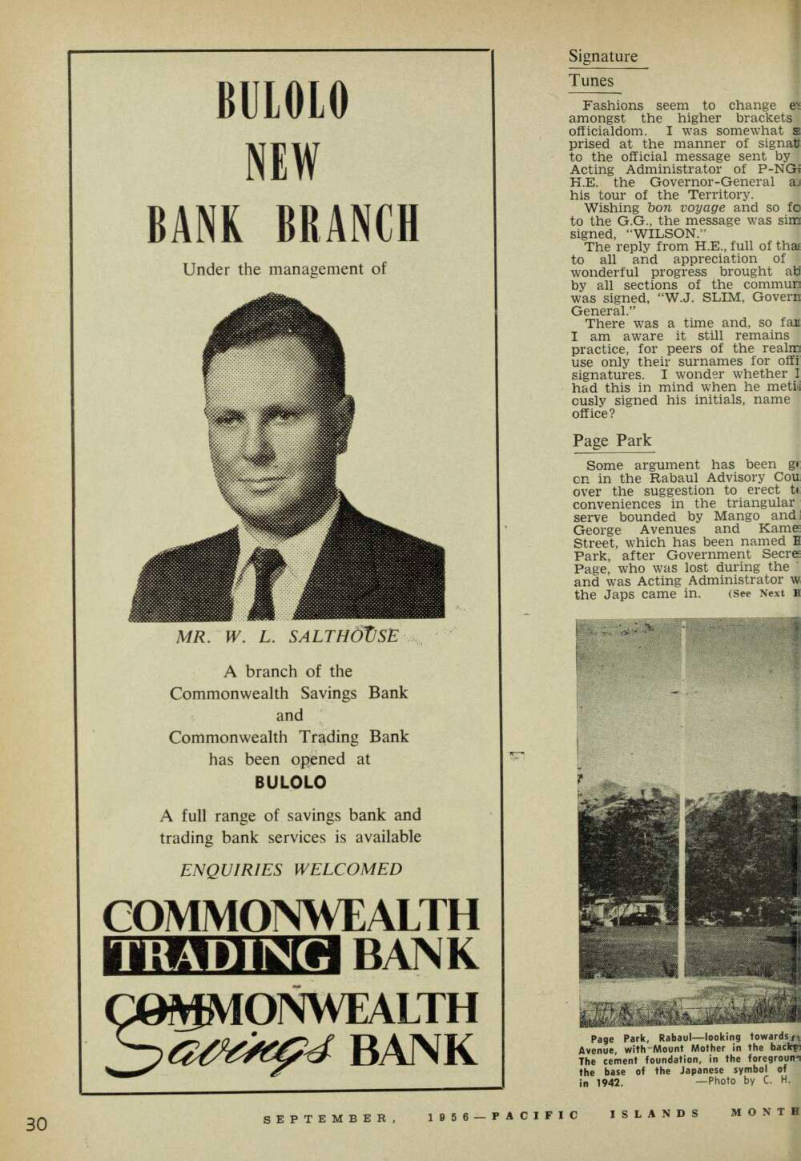
Some argument has been g«: cn in the Rabaul Advisory Cou over the suggestion to erect t« conveniences in the triangular serve bounded by Mango andJ George Avenues and Kame Street, which has been named B Park, after Government Secres Page, who was lost during the ’ and was Acting Administrator w the Japs came in. (See Next h
Page Park, Rabau l—looking towards Avenue, with Mount Mother in the back The cement foundation, in the foregroun the base of the Japanese symbol of in 1942. — Photo by C. H.
■ited protests from two res” —Mrs. U. F. Adams and . L. Chipper—made little im- Dn on the other eight mem
bers of the Council, who apparently regard utilitarian sites as being preferential to aesthetic values.
This small triangular reserve is
an historic spot It was here that the RSL planned in pre-War II days to erect the Soldiers’ Memorial Clock Tower to First War comrades,
it was here the Japanese raised r first symbol to commemorate capture of Rabaul. was a wooden cylinder, stand -15 feet high on a cement base, ping Japanese lettering. I re ber describing this “memorial” larold Page when I met him le POW camp in June, 1942. mph,” said he. “We’ll let it i and then add a plaque when ecapture the town.” But after i bombing, all that' was left of nemorial was the cement base. interest concerning this spot tabaul is the remark of an 'ant vulcanologist which he i to me a short while after the eruption. “Here,” he said, ling his walking stick on the id, just opposite the old BP ;e, “is one of the earth’s test crusts.” But I don’t sup even that will deter the ul ATC from erecting the three s on which they have set their 3.
Duke’s
isiderable publicity has been to P-NG’s criticism of the of Edinburgh’s itinerary dur he forthcoming visit to the ory, and the suggestion that it i be as informal as possible, ring in mind the native tend to appreciate formality and
“hamamas” I cannot but agree with the Administration’s desire to put on formal guard inspections, even if it does entail a galaxy of stuffed shirts.
P-NG is still (to some people'* in the dark ages where dignity and lespect are still appreciated- de precation of formality is by no means welcomed by the average native and ceremonial is dear to his heart. He does not appreciate the easy familarity of the itinerant back-slapping Labour politician who bends over backwards in an effort to expound his theory of race equality. (It was never suggested that the P-NG natives should be informal with the Duke, or he with them The crux of the criticism was whether this visit was for th entertainment of P-NG—including the natives—or for the entertain ment of the Duke, and a great many people were hoping that this time it would be the latter.— Ed. PIM.)
The Kunai
Curtain
Some consternation was caused last month when an alleged leak was discovered in the Kunai Curtain protecting Moresby from news-contact with the outside world.
Why all this hush-hush in re leasing to Australia news items of events in P-NG of which even the
rellT n re th. ar . ki Sf- ? Su PPression o c P^Wic— appears to be done in an effort to cover un ” anr when a government body en deavours to avoid publicity it gives the impression that something is wrong somewhere. g 18 The Administration should pull ur gie eurtam, get itself a good Public Relations Officer and give
him/her a free hand to tell the world what goes on.
Milk and water government hand outs won’t satisfy the Press of to day, and the whole matter of putting a female officer in the boob (which had to be specially erected), is a very sorry business.
Repeat, sorry business.
Bits and Pieces Ron McNicoll, a son of TNG’s late Administrator, has been promoted to Major-General and to become Controller of Design and Inspection, Military Component Dept, of Supply. . . Leslie Austin McAlpine, of Bondi, died on August 2. He was an old Islander, having served with the SID in the Solomons, with CPL at Arigua and was for sometime an inspector for WRC in TNG. . . Six hundred birds-of-paradise feathers will decorate the theatre foyer in Sydney when the premiere of “Walk Into Paradise” is shown on October 5. The fine for having the plumes would have amounted to £60,000 but Chips Rafferty gave them to the Australian Museum first. Query: When is the ban on these BOP to be lifted? They would be a wel come addition to Territorial revenue. . . . Donald, the 22-year-old son of Senator Roy Kendall, crashed his plane recently while flying in Queensland, but escaped without in jury.
t Copies of Mr. N. K. Wallis’s documentary film on the British Solomon Islands Protectorate, In the Wake Of Mendana, which is in colour and has a sound track, are being prepared. Distribution will embrace countries overseas. t New Caledonian natives fought Tahitians outside two hotels in Noumea one night in August. Bottles were thrown at the greatly out numbered police, who took more than an hour to restore peace.
t Fiji Amateur Athletic Assooi tion’s appeal for funds to main# and develop athletic facilities ; Suva’s Buckhurst Park, closed w the target of £5OO reached. t Six new stamps, ranging fr lid to 5/-, will appear in Fiji J October 1. The different illust; tions will depict the Queen, an inu island vessel loading copra, a sug cane train, bananas being broui to a packing station for export,: the Vatukoula gold mines.