Dney-Santiago Across
pp. 27-147 · Read in the full issue
[?]an Govt. [?]ises Air Service
South Pacific By 1958
A direct air service between South America and Australia [ be in operation in 1958 when the Chilean Government apletes a landing field at Easter Island. The service will be irated by L.A.N. (Line Air National), owned by the yernment of Chile.
MANDANTE Robert Parraque, lilean Air Attache in Aus ilia, told PIM that the service be operated initially, once a by DC4’s or DC6’s, but by was hoped to have jets on n. are building a runway 10,000 ag at Easter Island,” he said.
Chile Government plans to aving the runway in January, proposed route in the initial will be Santiago, Easter Bora Bora (Fr. Oceania), >ydney. The Americans built ray at Bora Bora during the This is now being extended DC6’s. But if it is not ready ise aircraft by the time the i service is ready to begin, will be used, Commandante ae said. i jets come on to the route ill make the journey in three Santiago-Easter Isla n d
i Samoa a) Syd g time for )4’s will be 40 hours, fo r DC6’s 36 hours. ie jets will h e DC6’s >y half—to 18 hours, m andante ue said that sent other is were not ;ed in the ecause they it know if ild be a rcial pro i. ink it will 7 to get a ane load r week, lly Ameri urists who :o have a at Easter which is ost unique Pacific,” he tin P. G.
Taylor (now Sir Gordon Taylor) blazed the air trail between Aus tralia and South America in 1951.
Since then Chile has had many discussions with Sir Gordon about
problems which have to be over come.
Commandante Parraque is some thing of a trail blazer himself In 1951 he was in command of a Catalina amphibian which made the nrst flight from Santiago to Easter Island. He landed at Easter Island on a runway 2,000 feet long. This was not long enough to allow him to take-off again with a full load of fuel.
So he put 100 gallons of fuel on board—sufficient to enable him to fly to a bay for a sea take-off. In the bay he had the bad luck to break a float. The float could not be repaired at Easter Island, so like the crew, he had to be taken back to Chile by sea.
The Chilean party arrived at Easter Island about three months before Sir Gordon Taylor.
France. , Too, Examines Trans pacific Aviation
T ONG-VISIONED men in the JU French aviation industry have also been taking another look at Pacific Ocean possibilities lately; and there are indications that a re appraisal of the situation will bring Tahiti and New Caledonia promin ently into the picture.
The position of Tahiti is par ticularly interesting.
In an air sense, Tahiti has been the Cinderella of the South Pacific, In itself, it is fairly large and com mercially important; but it is
isolated, away out in the south east corner of the South Pacific Islands, with no important terri tories in between to commercially justify an airline connection east wards (towards South America), northwards (towards Hawaii) and westwards (towards Fiji, New Zea land and Australia), TEAL (Tasman Empire Airways Ltd.) of New Zealand pioneered and still operates a regular seaplane service between Fiji and Tahiti; but the available traffic doss not pay
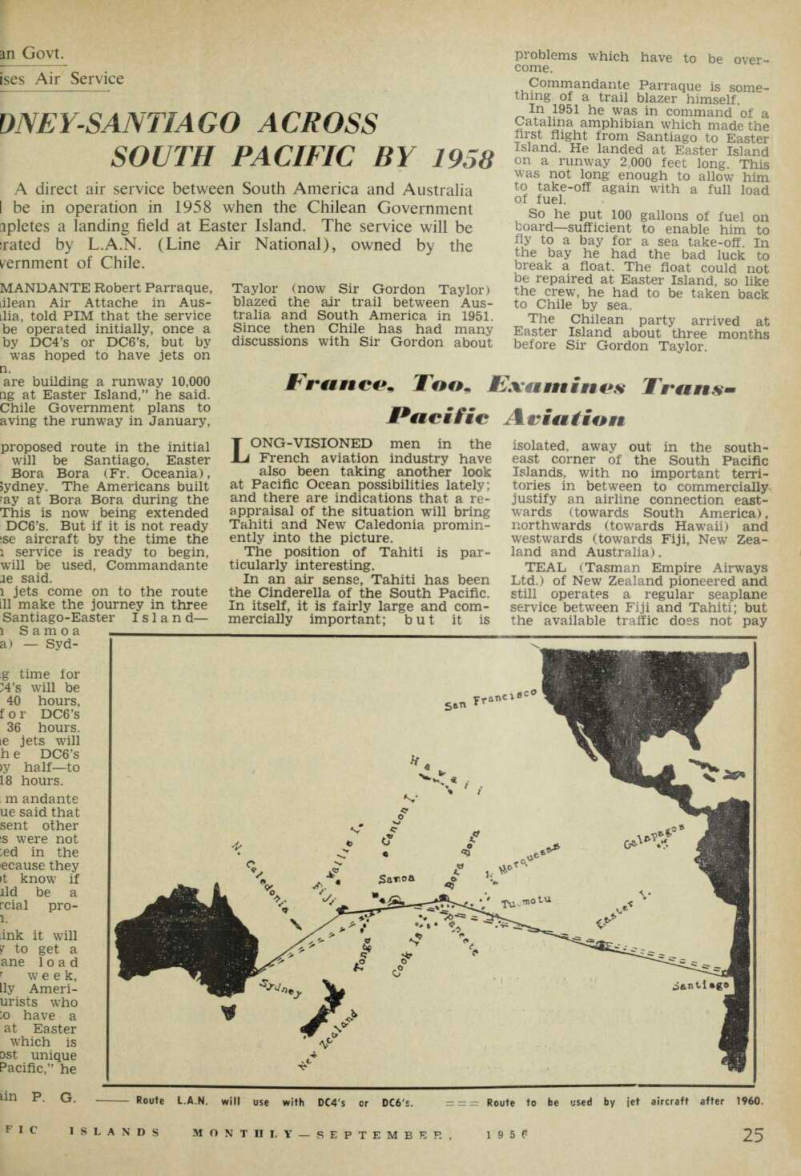
Route L.A.N. will use with DC4's or DC6's. === Route to be used by jet aircraft after 1960.
b long and costly flight, and •vice is kept going by subsidy, ite enterprise has been trying ablish a regular airlink be- Hawaii and Tahiti; the UK’s for using Christmas Island -bomb experiments appears e put “paid” to that, a new factor now is coming ie air transportation industry dy, great land-planes which 3,000 to 4,000 miles, without ling. 0s t overnight, Cinderella has assumed a new import . the eyes of airways planners. ;E is a very large air-traffic ential in South America. At sent, air-travellers and air get in and out of South a mostly in one way—north into Central America and America. Air-planners can ie day approaching when American traffic will proceed rds through Easter Island French Oceania, for Asia, ia, Europe and Africa, rto, France has not taken interest in South Pacific i. French Oceania and New lia have small internal air but both have been too far rom the larger countries ser if the major French air lines. 7, French interests have to see something new and ng in the South Pacific, e end of August, M. Francois b, representing the major air group (TAl—or Com de Transports Aeriens Inter citaux) which followed Air on the Paris-Noumea ser is in Australia, en route to aledonia, New Zealand, Fiji hiti. lieves ardently in the future r-continental aviation, and al of the young Frenchmen ■e determined that France in the forefront of pending nents. ler words, TAI now is mak lose examination of Pacific lir transport possibilities.
IG the chief problems, as 1 by the French planners, is reluctance of Australia and aland to give landing and rights to any more over jmpetitors of the State iviation services, like Qantas AL. e, herself famous for the s she has taken to protect n trade, appreciates the an and NZ situation. But ;he French) competition in •tation is very good for in nal trade. Why withhold, tion, rights and privileges re so readily given in ship □uchet has been in com ion with important aviation wernment people in Aus- Jew Zealand and Fiji; and
his visit to Tahiti is likely to have considerable significance.
It has been apparent, for years that someday, as the South Pacific Islands develop, someone will plan a lateral service—that is, a service running east and west along the southern tropical belt, and thus directly connecting New Guinea Solomons, New Hebrides, Fiji’
Samoa, Cooks and Tahiti—instead of leaving air communication be tween the major South Pacific territories to indirect services, which shuttle back and forth between the Territories, and Australia and New Zealand.
The French appear to be giving some thought to this. A glance at the map shows that they have a small but very Interesting bit of
S ry ? Wallis Island (principal
i|™d of J he French Futunr- Wallisgronp). which lies northeast hL F i’ — ar Sam °a. Wallis has been receiving a certain amount o attention from air-planners, lately, definitely, are thlafc thf n -° W ’ m relati tO the South American potential and comin £ of the giant new air crait.
It is thought that an international airport on Tahiti could become an important staging-port, where traffic between South America and other continents would sort itself out, for Asia, Europe and Aus tralia. Those new air-liners could fly over that vast, empty ocean be tween South America and the South
(Continued on Page 145)
Islands in one hop; and, ;y reached the Islands, there e stop-over places in plenty vards towards Hawaii, st towards Asia and Europe, ds towards Fiji, New Zea ustralia, and on to Africa pe. n ten years, Tahiti could in relation to South the position that Hono »w enjoys, in relation to America. That is, if the can provide, in Tahiti, an ional airport capable of ig with the airport that aw is putting in on Easter has been a lot of talk new airport in Tahiti —but ne. If Chile is not to steal e, the French will have to lemselves.
WHILE, where does Fiji le in, in all this? That is considerable interest to Fiji nal interests, which now n almost daily air service stralia and New Zealand, are some who forecast that be cut out of trans-Pacific ces —just as New Caledonia : out—because planes will nger and longer hops, and need to re-fuel at Nadi, sualise services from North which will make only one ific landing (in the vicinity n Is.), en route to Australia, dlarly one landing (maybe en route between South and Australia.
I no major Territory nearer South Pacific than Indo i’rance was not in the early acific aviation developments, ier the new conditions, the hope that they may play jrtant part in the South air developments of the ture. ley want landing-rights in a and New Zealand. And w are reminding Australia 5 is one way in which Aus n remedy the very lopsided lalance between Australia nee. France buys a great Australian produce. Aus lys very little from France.
Auckland Extension
ations between the French r Zealand Governments over rights in the Dominion for e continuing in September, i received by the Sydney f the air company in early er was to the effect that the a of the Paris-Noumea ser >m Noumea to Auckland
would not now come into operation before October.