When the Eastern Highlands Put on a Show
pp. 90-92 · Read in the full issue
GOLD, AND TEA AND BIRD OF PARADISE FEATHERS—
THERE were two things about the Eastern Highlands Agricultural Show, held in Goroka, NG, on Queen’s Birthday week-end that were unique: (a) The people who attended the show; and (b) the diversity of exhibits.
Possibly, as (c) or as a sub section to (a), one could say that it was unique, for a third reason — the number of people who, hung around with expensive cameras, exposure metres and tripods, were taking movies or expensive coloured stills of (a).
There was, of course, nothing extraordinary about the Europeans who attended the show, except per haps in that instead of arriving by bus, as they would have done in countries a little near to the heart of civilisation, they arrived in air craft from hundreds of miles away.
Some came for the whole week end: some just for the day.
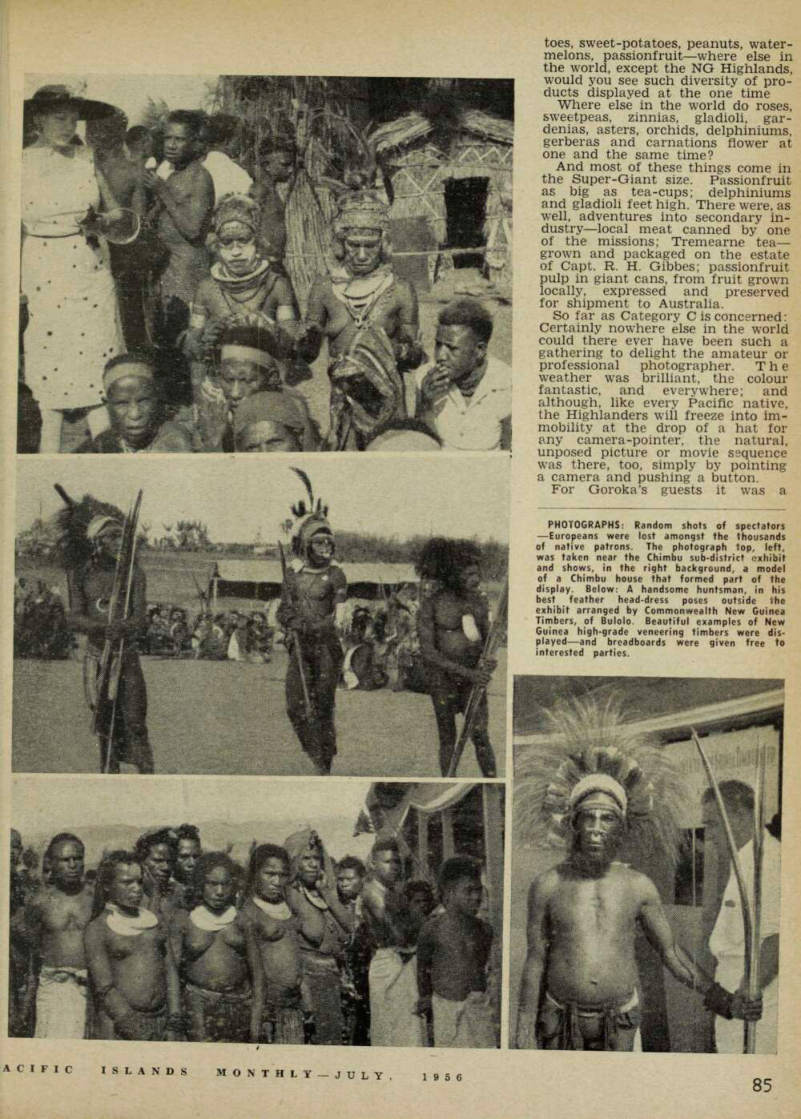
But the native spectators at the Goroka Show were as equally out standing as the exhibits. Estimates as to how many natives attended vary—probably 10,000 would be a reasonable guess. A sprinkling have adopted the usual New Guinea uniform of lap-lap or mother hubbard; but the great overwhelm ing bulk of them were in their normal every-day garb of shells, feathers, bows and arrows, bark and hand-rolled string.
These are the fellows, first dis covered in the early 30’s, who shortly afterwards murdered a few white men and caused the High lands area to be declared “uncon trolled” territory and therefore for bidden to Europeans for many years.
European settlement of the High lands is less than 10 years old — yet here at Goroka, on Queen’s Birthday, 1956, thousands of armed warriors mingled with a few hundred unarmed Europeans com pletely without tension on either side. This is New Guinea fashion, of course. But if it could happen anywhere else, we have yet to hear of that place.
This was the natives’ first show and as there is nothing similar in their life, it says something for the persuasive powers of Administrative officers from the sub-districts that they were able to get the idea across at all.
A man has a right to be suspici ous when he is told —for no good reason that he can imagine—that it isn’t a sing-sing, but to bring in his best pig and his best handi work, anyhow. He has to go see for himself to believe that the pig is not to be eaten, but simply to be admired. Now he has seen, and the task of the organisers will be that much easier in future years.
On the morning of Show-day, the thousands of native people clustered thickly around the district exhibits —Chimbu, Kainantu and Goroka.
As the day wore on, they formed a solid phalanx of brown bodies around the arena, where the young European men of the Highlands ran off the innumerable heats of the motor-bike flag race. It is a safe enough bet that in five years time, the 6th Goroka Show will feature motor-bike flag-races for Chimbus. Certainly the white man may be regarded as completely crazy in many respects, but the exquisite joy of screaming over the turf on a howling motor-bike is not one of them.
In the meantime, even the first show was educational: One Chimbu laid aside his bow and arrows long
enough to investigate the side-shows and therein, on hoop-la or choco late-wheel, won a prize. Verily, the ways of the master are past finding out: A strange-shaped wooden object, punctured by innumerable holes from each of which protruded a little stick!
Should you be visiting the High lands some time within the next few months and there, at a sing sing, chance to see a well-undressed Chimbu with a wooden holder for savouries-on-toothpicks snugly in corporated in his head-dress, you may rest assured that this one was a visitor at Goroka’s first show.
WOOL, wheat, coffee, tea, gold (in small nuggets), corn, green pea s, pineapples, cabbages, carrots, pumpkins, European pota-
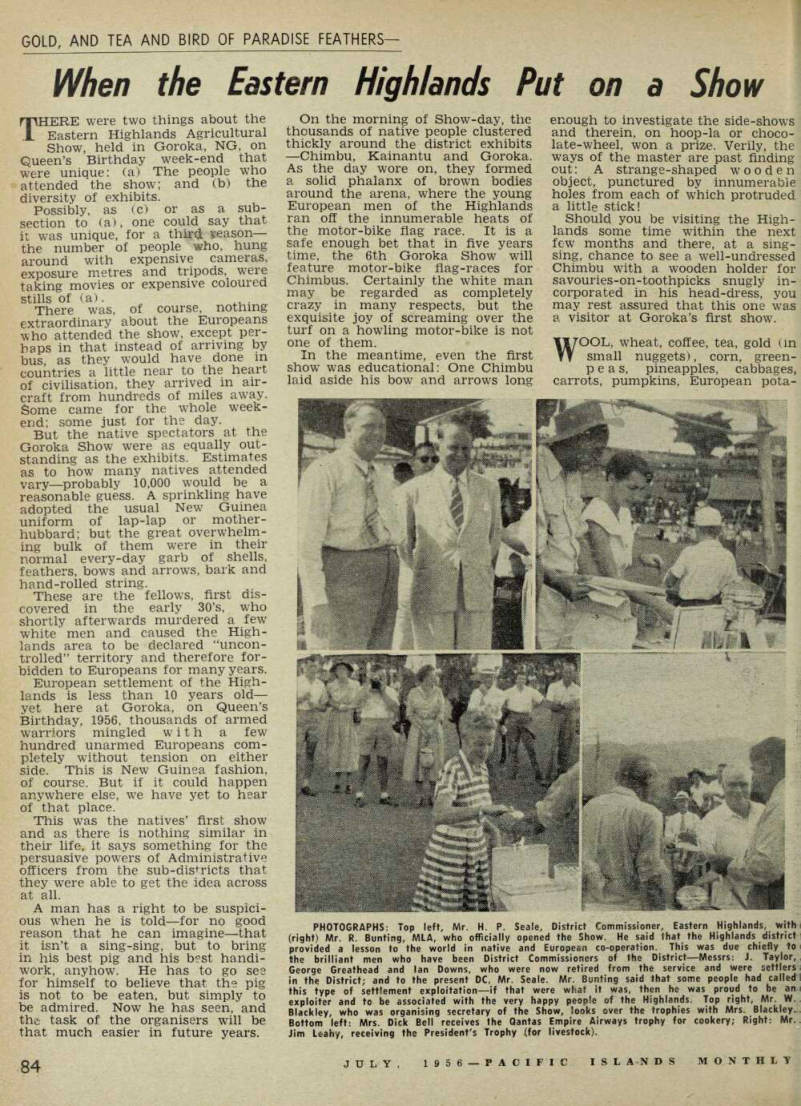
PHOTOGRAPHS: Top left, Mr. H. P. Seale, District Commissioner, Eastern Highlands, with (right) Mr. R. Bunting, MLA, who officially opened the Show. He said that the Highlands district provided a lesson to the world in native and European co-operation. This was due chiefly to the brilliant men who have been District Commissioners of the District—Messrs; J. Taylor, George Greathead and lan Downs, who were now retired from the service and were settlers in the District; and to the present DC, Mr. Seale. Mr. Bunting said that some people had called this type of settlement exploitation—if that were what it was, then he was proud to be an exploiter and to be associated with the very happy people of the Highlands. Top right, Mr. W.
Blackley, who was organising secretary of the Show, looks over the trophies with Mrs. Blackley.
Bottom left: Mrs. Dick Bell receives the Qantas Empire Airways trophy for cookery; Right: Mr.
Jim Leahy, receiving the President's Trophy (for livestock).
toes, sweet-potatoes, peanuts, water melons, passionfruit—where else in the world, except the NG Highlands, would you see such diversity of pro ducts displayed at the one time Where else in the world do roses, sweetpeas, zinnias, gladioli, gar denias, asters, orchids, delphiniums, gerberas and carnations flower at one and the same time?
And most of these things come in the Super-Giant size. Passionfruit as big as tea-cups; delphiniums and gladioli feet high. There were, as well, adventures into secondary in dustry—local meat canned by one of the missions: Tremearne tea — grown and packaged on the estate of Capt. R. H. Gibbes; passionfruit pulp in giant cans, from fruit grown locally, expressed and preserved for shipment to Australia.
So far as Category C is concerned: Certainly nowhere else in the world could there ever have been such a gathering to delight the amateur or professional photographer. The weather was brilliant, the colour fantastic, and everywhere; and although, like every Pacific native, the Highlanders will freeze into im mobility at the drop of a hat for any camera-pointer, the natural, unposed picture or movie sequence was there, too, simply by pointing a camera and pushing a button.
For Goroka’s guests it was a
PHOTOGRAPHS: Random shots of spectators —Europeans were lost amongst the thousands of native patrons. The photograph top, left, was taken near the Chimbu sub-district exhibit and shows, in the right background, a model of a Chimbu house that formed part of the display. Below: A handsome huntsman, in his best feather head-dress poses outside the exhibit arranged by Commonwealth New Guinea Timbers, of Bulolo. Beautiful examples of New Guinea high-grade veneering timbers were dis played—and breadboards were given free to interested parties.
happy and carefree week-end, re sult of long months of hard work bv the organising committee. Even ings were well taken care of by a Ball on June 4, and a three-act play on the other two nights.
The inspiration and drive of Mr.
Jeff Joynton-Smith had produced
a smooth team of piayers who per formed the James Thurber-Elliott Nugent play (The Male Animal ) of American college life like old troup ers and gave their audiences genuine entertainment.
Those taking part were: Mane Bailey, Gloria Zigas, Jeff Joynton- Smith, Anne Brown Beresford, John Martin, Ashley Wakefield, Frederick Perry, Marie Blackley, Maureen Brown Beresford, Fred Seefield, John Martin and Philip Reilly.