Takibaina—Otherwise Known As Fox
pp. 89-99 · Read in the full issue
Somewhere on the island of San Cristoval, BSIP, there is—or was—a lonely grave marked with a cross and bearing the name of Charles E. Fox. But the pioneer missionary does not lie beneath the cross; he is at present somewhere on the high seas between Australia and the United Kingdom, having completed 54 years of active missionary work in the Solomons. He plans to return there after his business in England is completed.
Dr. Charles Fox, M3E—He
received the honour in Queen Elizabeth’s first Honours List — is a remarkable man; 78 years old and still active, he has been, in his half century in the Protectorate, teacher, language expert, anthro pologist, Coast-watcher and native chief—hence the grave with the cross and his name upon it.
His work as a missionary has been associated mainly with native languages: he is the author of Threshold of the Pacific, a text cook on anthropology, three diction aries (Auckland Museum recently published his latest, on Gela Island languages), and various grammars and papers on other Solomon Islands’ languages.
His present mission in London is to seek a publisher for two other cooks, One Hundred Years of Melanesian Missions; and his own t eminiscences of 54 years in the Solomons.
Dr. Fox’s introduction to the Solomons was in 1902, when the Melanesian Mission sent him to Pamua on San Cristoval, to open i school for young native boys. He conducted the school for three rears before being sent to Norfolk island as headmaster of a big nission school there—Norfolk Island ;hen was HQ of the Melanesian
Mission. After a year he returned to San Cristoval to take charge of general mission work there. Ten years of teaching followed, then 11 years in the native brotherhood, travelling through the Solomons and New Britain.
When the Japanese entered World War 11, Dr. Fox served as a Coast watcher on Malaita, observing enemy movements and sending out information by native runner until the arrival of American forces several months later.
In later stages of the war he stayed on Gela Island as a guest of the American Seebee Construc tion Corps. There followed more years of mission work on Malaita, more teaching, and finally return to headquarters on Gela.
Recalling early days in the Solomons recently for PIM, he said that cannibalism was still com monplace when he arrived in BSIP and that in his early years there he had many times been offered human flesh.
So well loved by the natives was he during his stay on San Cristoval that he was permitted the unique distinction of exchanging names with a young chief, and was accepted into the clan.
Under this exchange system his native name became Takibaina, and the chief became Charles Fox. Fox took over the other’s debts, among other things. He lived with the chief’s brother, while the chief lived in Fox’s small European house.
Dr. Fox carried on with his missionary work and, at the same time, was looked upon as the chief of the village.
Later, a writer of a book on the Solomons referred to this incident, stating that Dr. Fox took over the chief’s wife and children. However, this is emphatically denied by Dr.
Fox.
During the time the exchange of personalities was in operation, the chief died, and a cross was put up over his grave with Fox’s name, etc., on it. It was, he says, “rather interesting looking at a grave with one’s name over it!”
It was during his stay on San Cristoval that he wrote his first book. He had a fluent command of the native languages, was able to read the natives’ innermost thoughts, understand them, and be come one of them.
It was a tribute to his popularity
and lasting influence that, on re turning to S. Cristoval many years later during the birth of Marching Rule, he was able to advise the natives not to join the movement and to have his advice accepted completely.
DR. FOX was on Malaita during the earliest days of Marching Rule, and was able to study its growth, its progress over the years, and its “shaking down” into the more creditable national movement that it is to-day.
He believes that Marching Rule saw its birth towards the end of the American occupation during World War 11, when a number of American communists advised the natives to establish several com munal farms on South Malaita.
However, this first effort failed, as the farms produced insufficient food, and the natives returned to their own small farms. Despite this setback, Marching Rule, built on a platform of independence for the Melanesians and out with the Euro peans, spread rapidly. Membership was one dollar American for adults and five cents for a baby.
“Masinga” was the original native name given to the movement, but nobody knew what it meant, so Europeans changed the name to Marching Rule.
As the movement spread through the Solomons, certain chiefs re cruited Marching Rule guards and built stockades round their villages to prevent Europeans from enter ing. Their policy was passive re sistance to the Government, and many hundreds of natives went to gaol for not paying Government taxes.
At first the Government had favoured the movement, as it wished to use Marching Rule as an in strument for self-government, but eventually turned against it when it began to get out of hand.
Marching Rule was eventually forced underground, but to-day its purpose has, according to Dr. Fox, undergone a complete somersault During the early years of March ing Rule, there was unveiled hostility towards Europeans, and Dr. Fox was one of the few people who travelled round Malaita in safety.
More recently it has become an instrument for instruction and the Government has appointed March
(Continued on Page 93)
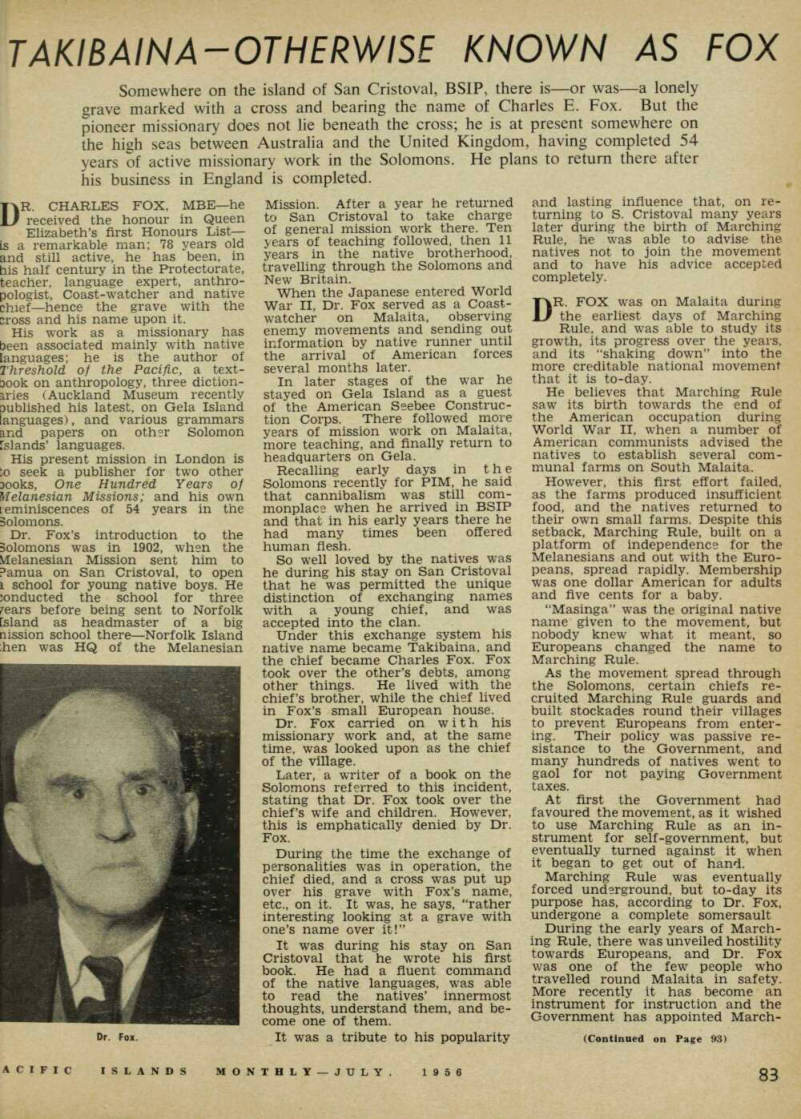
Dr. Fox.
ng Rule leaders to positions as and council members on :ach island. These councils, which .re comprised solely of natives, have ixed taxes to be levied on their >eople, and the money so collected s spent on the establishment and naintenance of schools. The Dis rict Commissioner sits in at the ouncil meetings purely in an ad isory capacity.
On that recent BSIP cause celebre, he Poole murder case, in which lis Mission was intimately con erned, Dr. Fox had this to say: Malaita natives are bitter at the esult, as they know that had the ccused been a Melanesian, under be circumstances he would have een hung, having no barrister to efend him, and being unable to ppeal against his sentence.
Dr. Fox believes that the Solomon slanders would be happier if a ative advocate were placed at their isposal on such occasions. He feels lat nothing will come of Malaita itterness, although it would have sen a different story in the old lys of cannibalism.
A half-century is a long time in country barely on the threshold civilisation. It has been 54 ;ars packed with incidents far lyond the imagination of the most
enthusiastic Sunday- newspaper writer—he has seen headless corpses, known cannibals and professional assassins: seen thousands die in introduced epidemics; seen other natives simply lose the will to live.
There has been war and peace— and another, closer war, and again peace; and through it all there has been the devoted missionary’s ser vice to the natives whom he sees not as fuzzy-wuzzy angels but as human beings with their full share of human cussedness.
Life for the natives and for the missionary has sometimes had its full load of sorrow, trouble and difficulties. Often the difficulties have been leavened by that indis pensable piece of equipment, a sense of humour.
Dr. Fox recalls with a twinkle cne day when a total of 54 runs
were scored off one stroke in a game of cricket.
A match was under way on a patch of hard sand about 20 feet from the surf when one of the bats men clouted the ball into the water.
As the batsmen ran, the fielders appealed for “lost ball,” but Dr. Fox, who was umpiring, would not allow this as he could still see the ball floating in the sea.
With the batsmen still running, the whole fielding team gathered to throw into the heavy surf the elected member who, on the third attempt managed to reach the ball.
One of Dr. Fox’s last public appearances in the Protectorate was on behalf of another sort of Mission when he spoke before the British Solomon Islands Society on “The Solomons 50 Years Ago and How They Have Changed” —an amusing address which captured the complete attention of the audience.
The function raised £32 for the British Antarctic Expedition Fund.