Transplanting Pearls and Coconuts
pp. 86-87 · Read in the full issue
in the Pacific of 1906
An item about the "Upolu" in the ships section of the RIM in February caught the eye of Mr. C. Buchanan, now a resident of Melbourne, Victoria, and he has kindly sent this story about the voyages of the ship for Lever ■ Brothers and some colourful reminis- cences and photographs of the Islands ' as they were then, 50 years ago.
PERHAPS a little of the early history of Levers in the Pacific may interest the readers.
Lever Bros, entered the Islands when they formed a company known as “Levers Pacific Planta tions Ltd,” and bought Captain Svensen’s property in the Solomons.
They also bought out, about the same time, the interests of the old Pacific Islands Co., with the exception of Ocean Island.
Levers purposed to form planta tions in the Solomon Islands for the growing of coconuts and other islands products.
I joined Upolu in 1906, and was on board her for 4i years before being promoted to Asst. Manager in the Solomon Islands. She was then known as the happiest ship sailing out of Sydney. To get the BSIP plantations going we made regular visits to Apia, W. Samoa, to collect seed nuts, as the local BSI coconuts were considered too small.
When we took over the Pacific Islands Company we had a regular beat Suva, Niue, Suwarrow, Manihiki, Flint, Christmas, Fanning, Apia, Swain’s, Phoenix Group, Ellice Islands, Gavutu, Sydney. But, gradually we cut these visits out as the Solomon Islands plantations started to pro duce.
In 1911 Levers sold the Upolu and brought out the Kolam bangra from Scotland.
The round trip in the Upolu
which lasted 11 to 12 weeks, cost in those days approximately £47.
Nonetheless, people were not interested in this bargain round trip as the Union Company had the Atua and the Tofua running from Sydney to Fiji, Samoa, Tonga, Auckland and return.
During this phase in the Com pany’s development we planted pearl oysters in Suwarrow; but it was not a success and this island was sold with Christmas Island and the Phoenix Group to other interests.
In 1907 LPPL, brought a number of axemen from Australia to direct the felling of timber on the plantations and the good logs were shipped to Australia for use by Levers.
In those days there were not many Europeans in the Solomons.
Men like Captain Svensen, Colonel Younger, D’Olevera, Harding, and Gill had carved out plantations in different parts of the Group; then there were traders like Wickham at Roviana; Risby at Savo, Markham, Kuper, Wheatley and others.
Burns Philp had their main store on Makambo, while Levers had theirs on Gavutu. Who of the old-timers will forget Captain Voy of the Moresby, or our skipper, Captain Charles-Mill Menmuir; Captain Buchart; or the sailing of Capt. Sandy Macphail, from* the Bampton reef, 700 miles to the mainland, in a 16 ft. lifeboat to
tell of the wreck of the Malekul We in the Upolu were told ' call in and salvage as much .
Malekula’s gear as possible. I st have the barometer.
Already at that time su< missionaries as the Rev. J. i Goldie (who died last year), tl Rev. Mr. Sprott and Dr. Ivens, we already established. So were tl Catholic Fathers, and the R€ Charles E. Fox, who still has t headquarters there.
Recruiting then was bo difficult and dangerous.
Malaita was the worst spot, b Malaitamen, then as now, were tl best workers.
The method used to get laboi was for two boats to go in. Oi would go in to water just shallc enough for the recruits to con out; and the other boat wou cover. The same method was us< in landing time-finished labour.
Treachery was rampant and tl recruiters had to be on the ale all the time.
Gradually the natives becan more civilised as it became knov that they got a fair deal from tl white European, either Recruiter i Government Resident.
It may be of interest to no that Scotch Whisky in those da; was retailed at 30/8 a doze:
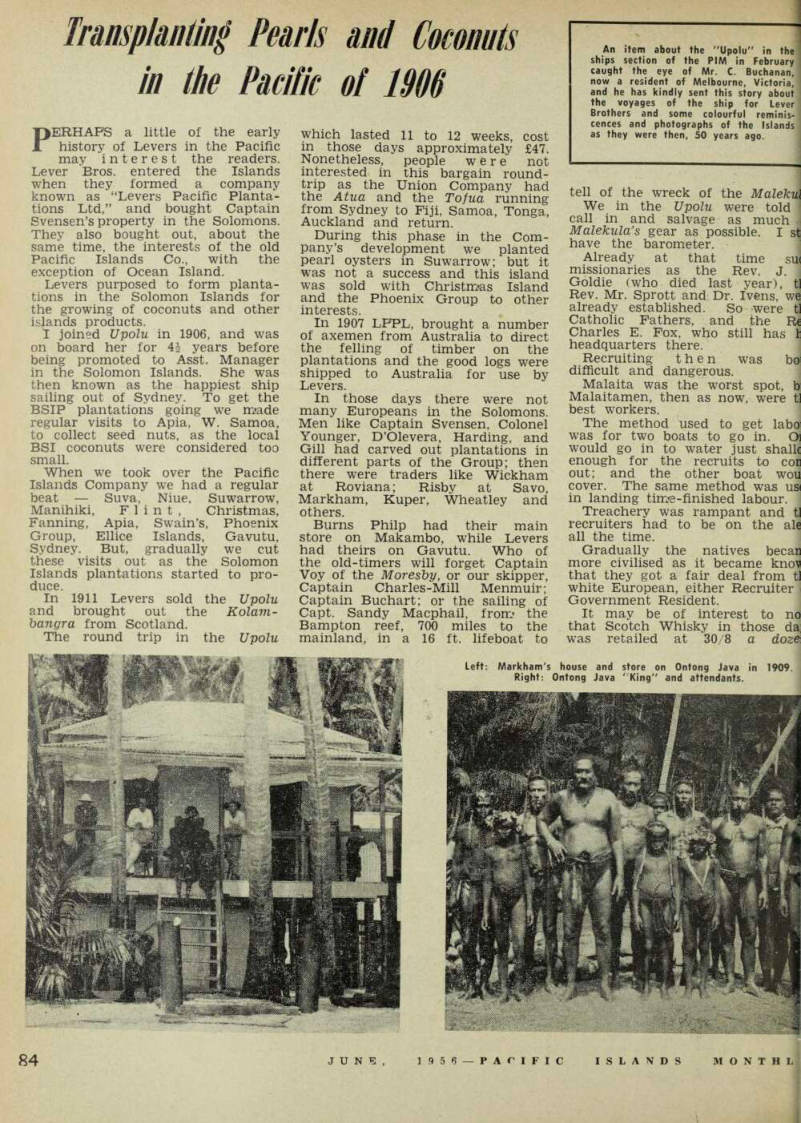
Left: Markham's house and store on Ontong Java in 1909.
Right: Ontong Java "King" and attendants.
te a difference to to-day’s es. jmmercial radio communica was unknown in those days, while I was aboard the Upolu cperimented with it; and later n I was stationed ashore at utu, I made a larger set which lequently was mentioned in the man log books captured at aul. l 1914 the first wireless station erected on Tulagi—but it did operate until after war broke ti my set I heard the signal mt for all British ships to make the nearest neutral port and ported this to Mr. Barnett, who then Acting Resident Com ioner. Legally I should have shut n my private station but Drdered me to keep going and dvise him of developments, le day war broke out in 1914. as able to inform him of this le Kolamhangra was due in she called me to hold the HMS ark until she arrived. Sealark alongside and coaling (we were Admiralty Coaling Station), l all was bustle to get her ed with coal. She made a iezvous with one of the Aus an destroyers where she sferred the coal from the decks sailed on to Sydney. She was itually sold to Capt. Patrick, afterwards formed the James ick Line of steamers. She was athed with
; copper, and deli e v e he >ped her and m what he e from the >er he bought first steamer interstate c. le outlying ids of the mon Islands ■ e visited
by Upolu. At Ontong Java, the late Harold Markham was our trader; he had rather a lonely task there for a few years, until the Methodists stationed a missionary there.
Ontong Java graveyards with their coral headstones were immaculate, probably due to the custom whereby the widow or other relative had to live there for a long period of mourning, cleaning the grave each day and putting fresh white sand on it when necessary.
The natives of Santa Cruz, were then regarded as being very treacherous; none was allowed on board but we were able to trade for arrows which were poisonous, and woven bags (they were taught to weave by Mendana in 1595). Our trader here had a very thin time of it.
We visited also the Polynesian outlier of Tikopia, where the people believed that they had descended from a blown-away canoe load of Samoans; the Ellice Islands and the Tokelaus in which Swain’s (now American Territory) was then incorporated. It had been occupied by Mr. Eli Jennings, of American- Samoan descent.
Fanning was even then a cable station, with a lagoon entrance that was at certain times dangerous— the water ran out at great speed.
Christmas Island was not held by
Levers for very long. It was too far to go for the meagre amount of copra that it produced—although so far as I personally was concerned Christmas was the best shark fishing spot I have ever found.
There was a certain shallow area off the atoll where I fished for Pelau —a variety of schnapper which tastes like crayfish when cooked. However, on one occasion as fast as I caught one of these fish a shark would make off with most of it, so I began to fish for the sharks and caught 23 in 45 minutes. I cut off and dried the fins and tails and subsequently sold them to a firm in Sydney at 8d per pound, which was considered good money in those days.
At Suwarrow. Levers in 1906 started to transplant pearl oysters.
We went to Thursday Island and received the live oysters packed on trays something like eggs. All the way to Suwarrow we kept salt water pouring through them and finally planted them in the lagoon.
But the scheme was deemed a failure and later abandoned. At this time there was a monument to a supercargo on Suwarrow—he had been murdered on that atoll which in all has had a tragic history.
In 1911-12, Levers got the contract for American Samoan copra and I spent one of my happiest years there handling the deal for them.
The “Upolu”.
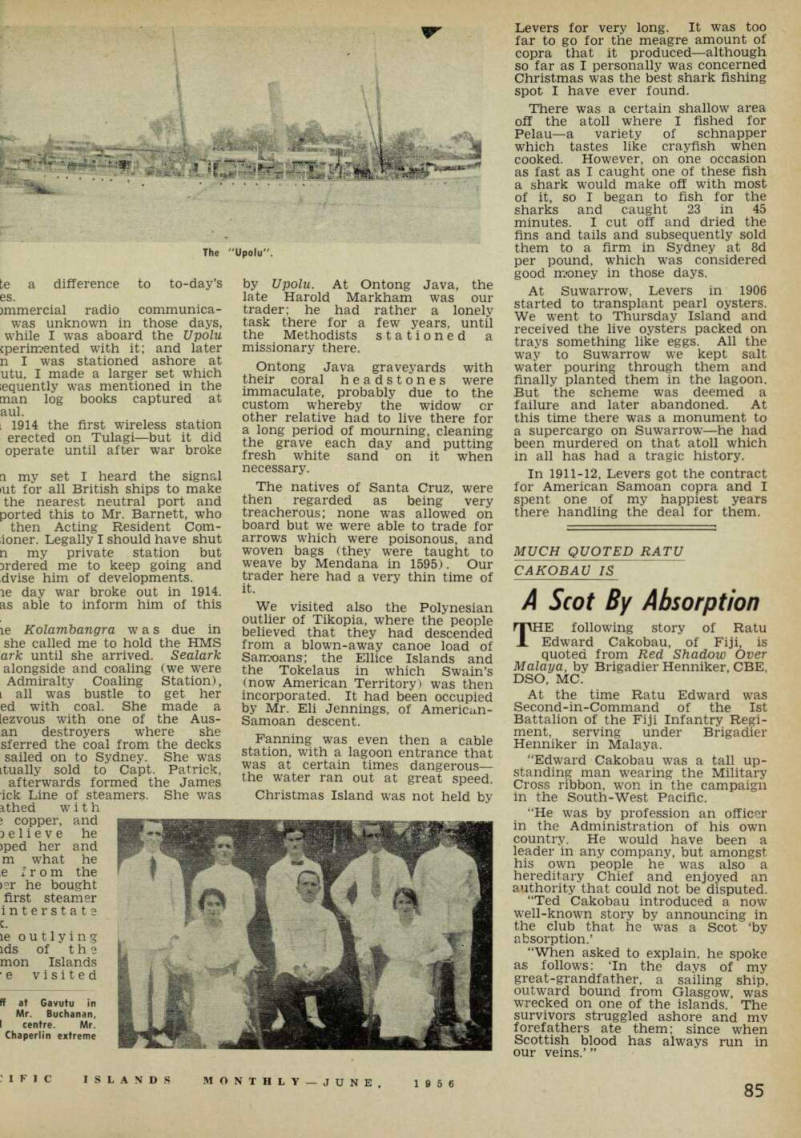
[?]ff at Gavutu in Mr. Buchanan, centre. Mr.
Chaperlin extreme