Whatever Became of Jerry?
pp. 85-93 · Read in the full issue
By C. P. Ware
’S been ten years since I saw Jerry I hope he’s all right married and prosperous. It ild be good if he were contented, I doubt if he is. erry was one of the first men to i our fighter-squadron after it ired to New Guinea m 1942. it was when we were still losing war in the Pacific The Nips ie over daily to clobber Port resby. Their ground troops were v a few miles away, up on the intains. All our equipment was ked up, ready to go. 0 a lot of people, the atmospheie impending defeat gives a strange isure Trivialities lose their ins tance. Only honesty seems to bt er—aside from survival. It was t way with us and it was that >py anarchy that Jerry shared ti us. Always afterwards he was reminder of the carefree days 3 n we were getting licked, erry went with us when the sel relied our way and we began ; t slow progress to the North, sn, suddenly, he was barred m going any further. ’hat was at one of those air bases the Ramu-Markham Valley— > forgotten the name. We were tut to make another highly secret ve. The transport planes were dv to carry our camp eqmp nt; our P-39’s had been checked ; for the ferry trip; our families 1 our girl friends had been given • new APO number, and Tokio se had dedicated a complete (gramme of Harry James hits to and assured us that we were mt to be exterminated, again, ie n the Engineering Officer Iked into the pilots’ tent, his ibrin-yellow face longer than Jerry can’t come,” he announced.
Ve dropped our cards. “What the 1?” we wanted to know.
He’s not allowed to. Wrong bal territory or some damn ng.” *.nd that was the first time we d to face the fact that Jerry was 3 apuan native. [E came from a coastal village L near Moresby. He was short, thick-chested with the inevit [e fuzzy hair and wide, calloused ;t. He had been hired as laundry y for the squadron and had done ; job, just like the rest of us, • two years. 3eing a mission boy, Jerry spoke Dd English with just a trace of sas drawl which he had picked up mewhere. I remember when a w pilot once tried out Pidgin tglish on him. The flyer was all [med with it, having had it drilled ;o him at the replacement pool
down in Australia. The sight of a real “boong” was tempting—a chance to see how Pidgin would work.
He pointed to a plane doing acro batics far up over the area. “You lookim lik-lik balus,” he said to Jerry.
Jerry cocked an experienced eye at the “little bird” and replied, “Man, somebody shore wringin’ out that P-40.”
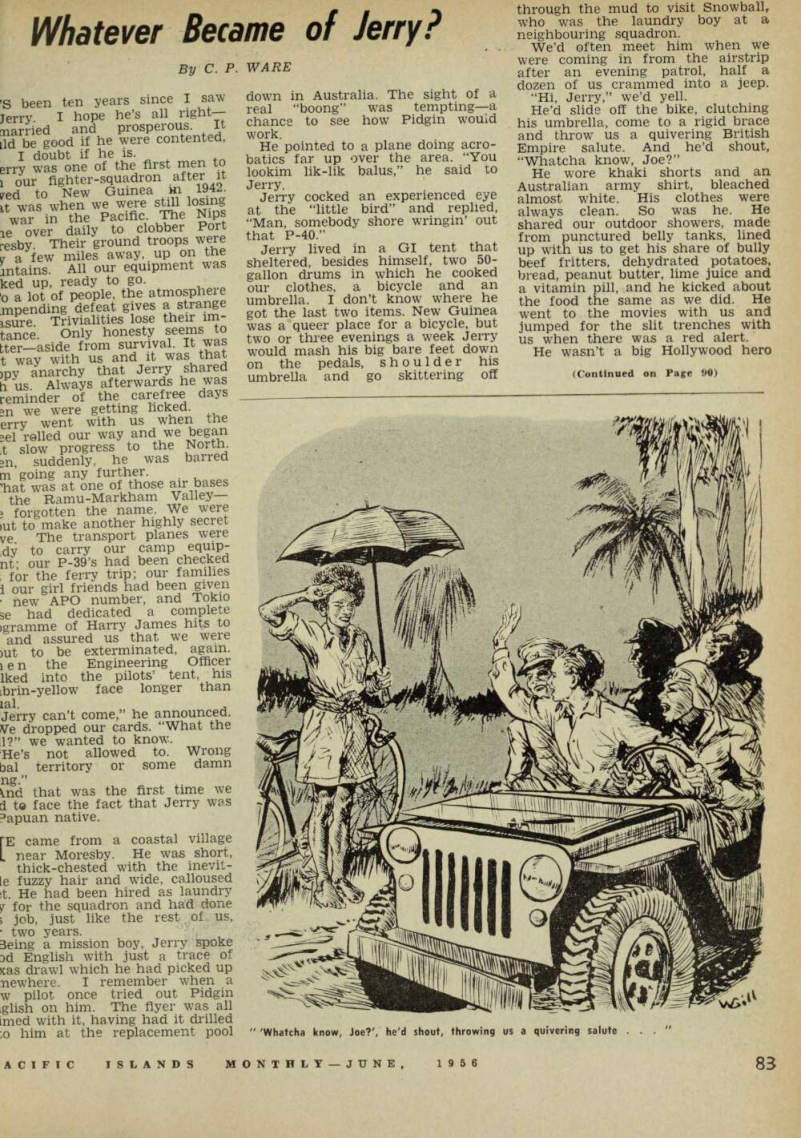
Jerry lived in a GI tent that sheltered, besides himself, two 50gallon drums in which he cooked our clothes, a bicycle and an umbrella. I don’t know where he got the last two items. New Guinea was a queer place for a bicycle, but two or three evenings a week Jerry would mash his big bare feet down on the pedals, shoulder his umbrella and go skittering off
through the mud to visit Snowball, who was the laundry boy at a neighbouring squadron.
We’d often meet him when we were coming in from the airstrip after an evening patrol, half a dozen of us crammed into a jeep, “Hi, Jerry,” we’d yell.
He’d slide off the bike, clutching his umbrella, come to a rigid brace and throw us a quivering British Empire salute. And he’d shout, “Whatcha know, Joe?”
He wore khaki shorts and an Australian army shirt, bleached almost white. His clothes were always clean. So was he. He shared our outdoor showers, made from punctured belly tanks, lined up with us to get his share of bully beef fritters, dehydrated potatoes, bread, peanut butter, lime juice and a vitamin pill, and he kicked about the food the same as we did. He went to the movies with us and jumped for the slit trenches with us when there was a red alert.
He wasn’t a big Hollywood hero
(Continued on Page 90)
" Whatcha know, Joe?', he'd shout, throwing us a quivering salute
who saved the CO’s life or a thing like that. He was just] same as the rest of us.
Well, not quite. He never that essential dignity of the Pap —the grace of movement, the so purposeful manner. And there i the little formalities in his relatl ship to us—like the saluting b ness—that he never forgot.
I gave a Japanese uniform Jerry once—green pants and a ti which I’d picked up after the I tralians took Lae. It cost m bottle of whisky and then it woul fit. I thought Jerry might wea: at least for the sake of a pict But he never even tried it on.
“I’ve washed the hell out oj but it still smells of Nip,” he plained.
He was proud of it, just the S£ It went into his tent along j the bike and the umbrella i from then on I always found extra towel or shirt or sometl in my laundry when I picket up. I don’t know who lost out Our first move from Mon was to an isolated mountain v£ called Tsilli Tsilli. There wa dirt airstrip which we were J posed to defend hacked out of valley trees. On every side \ bald hills of waving kunai g] eight, ten feet tall. Camp was r in the jungle so it would be ou sight.
Jerry never liked it there. Tl were only two squadrons am handful of infantry. The Japs \ all around. There were no me or Red Cross trucks with tea coffee. The jungle smelled of; and death all at once and ta in whispers and ruthless and dis calls. The food was lousy, tooj The camp was right on a na track. One day a whole tribe pa through the area. They were all naked, scarred by tattoos, with 1 splinters stuck through their n( The women were loaded like j mules, with bundles wrapped bark and burlap. The men man in the rear, each one carryiq cluster of spears. One gr< guarded a weary looking albino j pink hair and flour-white skil guess he was a sacred tribal session.
Jerry watched the along with the rest of us. Bui seemed pretty dubious about When the albino passed by, J went back to his wash tubs. J wouldn’t tell us why the sigh these hill people depressed j but even we could tell they I very different.
Back at Moresby, when you pa a work party of “boongs” strii along, aloof in their dignity, y usually shout out, “Hi, boy!’ them. Then they’d dissolve
white grins and wave their betes at you and yell back >ily. But when we tried it on party there was no response, r faces never changed ex sion. ter Tsilli Tsilli, we went to sab, where everything was dif it—a huge, open river valley, :ing hot, but cheerful. The was alive with the sounds of an power—B-25’s taking off, mering the hot air into a jelly jverberations, Liberators growl into formation, fighters snarl distantly as they patrolled, e were people everywhere, ricans, Australians and “boongs.” :ab reeked of success. :ry loved it there. His smile omed and his tongue tried out the new catch phrases like )ba hubba” and other equally i expressions. was there that rotation began ist to affect us. Emaciated, -yellow veterans who had been the squadron for years began it their orders for home. We delighted to see them go. It it that we all might get those i orders some day (“Home by ‘fifty-five”). But when they around to shake hands with r , they noticed a shallowness is grin. They reminded him his own life with the squadron as temporary as it was ant. m after, we had to leave Jerry id.
“Who says he can’t come with us?” the CO demanded.
The Engineering Officer shrugged.
“The native authority, or what ever it is. He’s not allowed out of a certain zone.”
And when we moved on North, Jerry wasn’t with us.
I suppose he was sent back to Moresby. I can picture him climb ing soberly into a C-47 in his bleached shirt and clean khaki shorts. But I doubt if any im patient transport pilot would have taken along his bike and his umbrella. They weren’t squadron property any more.
We didn’t brood about him. We were too used to changes in per sonnel. We wondered briefly if he would be put to work doing laundry for another outfit. But we dis missed the thought. It was sort of distasteful.
I wonder now what happened to him. The accumulation of his pay could have made him a rich man in pre-war New Guinea. But inflation was already on the way during the war, “Boongs” who had once worked for half a cigarette a day now demand three or four shillings.
Jerry’s collection of trinkets and money wouldn’t have given him much head start over the rest.
And the intangibles he had acquired—the Texas drawl, the slang, the sense of belonging to a family of thin worried hard-work ing white men must have left him
only a burden of discontent when he returned to his own people.
Jerry ran the laundry pretty well.
Socks were sometimes lost and buttons came off as they always do, but he was as good at his job as any of us were at ours. He wasn’t dramatic or heroic or a camp comedian.
I hope he’s okay.
V Mr. T. R. Cowell, Assistant Resident Commissioner in New Hebrides, goes on long leave, in June, and Mr. M. M. Townsend, MC, will act in that capacity during Mr. Cowell’s absence. Mr. R. J. S.
Hutchinson on transfer from Gilbert and Ellice Colony probably will be appointed British Agent in the Central District. t In the four months, January- April, 1956, New Hebrides exported 10,206 tons of copra, 288 tons of cocoa, and 18 tons of coffee. The respective figures in the 1955 period were 9,913; 121; and 85.