How In 1910 Britishers Discovered Pygmies In
pp. 88-97 · Read in the full issue
Netherlands New Guinea
Those were the days when love of adventure took men off the beaten track without thought of reward.
PRESENT-DAY residents of New Guinea are frequently accused of believing that history began thereabout in 1942, but even old timers will probably be surprised to learn that there was a British ex pedition into Dutch New Guinea as early as 1910, and that during the party’s 15 months in the country they discovered pygmies.
Pygmies, of course, were a favourite “discovery” in the Man dated Territory in the 20’s and 30’s but this appears to be the first record of their discovery by Britishers on the mainland of New Guinea.
"This (is a) country with continual rain, flood and swamp, with sickness rampant amongst our coolies, the natives ravaged by yaws and syphilis the picture which my memory will conjure up in later years will be rather one of loathing for a country which is so utterly God forsaken and stamped with the mark of Cain.”—Dr. Marshall, Oct. 18, 1910.
A dismal picture, indeed —but at all events, science has marched on since then. We now know that if a native has yaws he does not have syphilis, and that yaws can be cured by just one shot of penicillin.
An account of this expedition— which otherwise was close to com pletely abortive —has come to us through the diary of Dr. Eric Marshall, a member of the party; Dr. Marshall had previously gone with Shackleton on his 1909 expedi tion to the South Pole.
He now lives on the Isle of Wight.
Dr. Marshall, in a separate note, says that the expedition was sponsored by the British Ornitho logical Union and was backed by Sir Edward Grey, of the Foreign Office.
But because funds were very short, the Royal Geographical Society was invited to participate and sent two geographers.
The objective was to reach Mt.
Carstenz, the highest peak in the Central Snow Range bordering Ger man and Dutch New Guinea. The area in which they explored is south-east of the “neck” that sep arates Vogelkop from the bulk of the mainland.
Members of the party were: Ornithological section, Walter Goodfellow, Wilfred Stalker, Guy Shortridge Claude Grant (who joined the party later as a replace ment), A. F. R. Wollaston (Ento mologist and Botanist).
Geographical Section, Capt. C. G.
Rawling, surveyor; and Eric S.
Marshall, assistant surveyor and surgeon.
Officer in charge of Dutch escort, Lieutenant Cramer.
The expedition tried to penetrate the country from the south coast of the Dutch territory, and as the Dutch at that time had not re covered from Britain’s part in the Boer War they were not particularly co-operative. Dr. Marshall writes; “The negotiations were prolonged but the Dutch finally agreed, and in the meantime organised an ex pedition, on the same lines as ours but from a different base, for the same purpose. They ‘rode us off the main river route,’ the Oetakwa River, and arranged for us to use the Mimika River which, as rivers go in NG, was a ditch leading to the hills!
“We arranged for 10 Gurkhas as our personal escort, but the Dutch insisted on 40 Javanese soldiers with the necessary convict coolies.
“Stalker, a collector for the BOU, recruited our carriers from the Dutch El, instead of from Borneo, Dyaks being the most suitable.
“Walter Goodfellow, a bird col lector who had sold a famous hum ming-bird collection to Gould, which the Natural History Museum later acquired, was appointed
‘leader.’ ”
As with many such expeditions, dissension arose almost from the start —a great deal of it stemming from the fact that most members of it had little faith in their leader, as a leader.
Then, almost as soon as they had landed on New Guinea soil, Stalker became lost in the swamps bordering the river and his body was recovered some days later.
Goodfellow and Shortridge both were subsequently invalided out of the country. Of those who returned eventually to Eng land, Rawling was killed during the First War and Wollaston was shot by an undergradu ate at King’s Col -leg e, Cambridge, about 1929. All other
members of the expedition, except Dr. Marshall, have since died.
The expedition lasted from De cember, 1909, until March, 1911—a great deal of that time completely bogged down by frustrations through which no one appeared able to break a clear and decisive way.
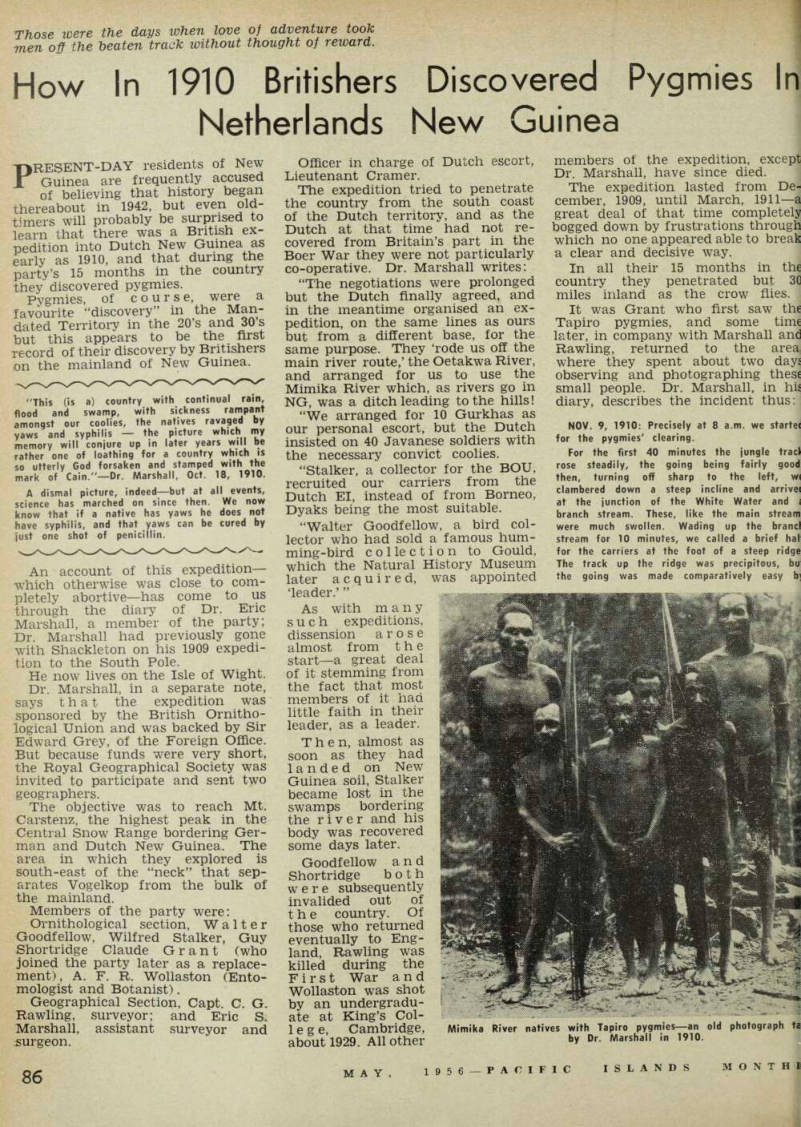
In all their 15 months in the country they penetrated but 30 miles inland as the crow flies. : It was Grant who first saw the Tapiro pygmies, and some time later, in company with Marshall and Rawling, returned to the area, where they spent about two days observing and photographing these small people. Dr. Marshall, in his diary, describes the incident thus: NOV. 9, 1910: Precisely at 8 a.m. we started for the pygmies' clearing.
For the first 40 minutes the jungle trad rose steadily, the going being fairly good then, turning off sharp to the left, wi clambered down a steep incline and arrive* at the junction of the White Water and « branch stream. These, like the main stream were much swollen. Wading up the brand stream for 10 minutes, we called a brief hal‘ for the carriers at the foot of a steep ridge The track up the ridge was precipitous, bu the going was made comparatively easy b]
Mimika River natives with Tapiro pygmies—an old photograph ta by Dr. Marshall in 1910.
he network of roots, and the ledges and lefts, worn by the toes of generations of ygmies, in what is probably their highway i the river. At 11 a.m. we reached the meeting place".
It is here that the pygmies had, on previous ccasions, met Grant, escorted him into the illage or clearing and, when departing, taken lave of him.
It appears that the etiquette is to wait •re until properly introduced, for on one ;casion Grant failed to observe it and arched straight into the first village and, tiding it deserted, shouted across to the earing, from whence came a score or so these little men, running hard, gesticulating olently and much excited, evidently angry at the customary etiquette had not been (served, and no doubt fearing that Grant as in search of their womenfolk, who, bow er, were not in evidence.
Halting at this meeting place, we could stinctly hear the high treble voices of the >men on the clearing opposite, although it is impossible to catch a glimpse of them, shouted twice and we then marched straight the clearing, our carriers keeping up a rt of running conversation with the pygmies, 10 did not seem to relish the idea of this rasion by the white men.
Entering the clearing, I caught a fleeting mpse of one or two naked forms disappear j into the jungle, but whether men or >men it is impossible to say. A good deal excitement prevailed.
Diminutive figures carrying bows and arrows peared at the top of the clearing, and, spite the fact that the ground rises at an gle of 30 degrees and is obstructed by led trees, creepers and undergrowth, it imed to offer no hindrance to these agile le fellows, who ran along the tree nks and cleared the obstructions as easily we might step on to a curbstone.
Fhe foremost pygmy brandished an arrow one hand, and shouting excitedly, soon ne in touch with Peau, our pygmy runner, o closed in on him, possibly with the idea preventing him using the weapons. understanding appeared soon to be ived at, for, although still boisterous in manner, he joined the main group at the t of the clearing. About 20 Tapiros had now put in an appearance, coming in from ry direction. lur motives were hastily explained in the lika dialect, which most of them seemed understand, although they have a distinct ;usge of their own, and all moved in direction of the village, situated on a 11 immediately opposite the clearing. he first village consisted of four huts of e or less uniform style, scattered over the ulations. It was entirely deserted. We ;ed through, and topping a slight rise, were astonished to see another village of huts laid out in two terraces and nestling the N.E. side of the same knoll, n the upper of these two terraces we ded to pitch our camp. No opposition or est was offered by the owners, although made no attempt to assist, standing nd in sulky silence or whispering in little ips. le water problem had now to be solved, here again the pygmies refused help, ig that it was "far away", pointing to a ntam stream some hundreds of feet down hillside but we rightly concluded that the ge would not be here unless a constant ly was fairly accessible.
(Continued on Page 9S>
ie promise of beads finally induced one h to fill our canteen and boiler, disclosing fact that the source was a small stream -100 yards to the rear of the village. All time and, in fact, during our two-days' , they made it quite apparent that they not want us or our trade, and that they idered our visit an intrusion.
I questions were looked on with suspicion answers stolidy refused. Every little ce had to be paid for in beads or cco, the bribed pygmy being subjected to jlent tirade from a diseased old man who jn the verandah of the nearest hut. ere seemed to be no chief, although the men commanded some respect, but how i is shown by one instance when an old head was given some tobacco, which was st immediately taken from him by the is. aberi-mirbiri—the village—is built on no al plan, save that the group of huts on terrace has an open level space, around i the huts are built according to the •ility of the ground. The floor space of hut is from 12-15 ft. square, but from nust be taken about 2 ft. which answers urpose of a verandah in the front. Spiit r fills the walls, outside which are fixed strips of bark. Access is gained by steps, made from two upright or sloping across which are lashed two or three r pieces. The roofing is made from
XL”' fan pa ""' sui,ad far lhe The huts were 3,1 , l uite bare and empty, save for the " fire p| a ce", or rather the patch of sand on which the fire is made. The huts are barer than those of the plainsmen, which a t least have one or two crude shelves on which to place sago, dry wood, etc., while at Nimei, on the coast, they enjoy the luxury of roughly carved wooden pillows.
N. carving o( anv description relieved the ies , huls of , heir worknl a „, ike appearance , ai > and rrr 5 " ,hev are superior to the low jungle huts.
TN height, the pygmies range from 4 ft. 1 3 i n ches-4 ft. 10 inches, averaging 4 ft. 6 inches . 0 f a chocolate, or deep brown co oor , they are nonetheless of a lighter hue than the plainsmen, but their coatings of dirt might lead one to think otherwise, Their hair, which is woolly and fuzzy, is matted and caked with dirt, and the general uncleanliness of their persons makes associa tion with them most repugnant.
They all adopt a phallic ornament in the shape of a penis koka, made from a gourd, varying from 9-15 inches. Some of these, which are of exceptional shape and length, They are extremely proud of, and are unwilling to part with them for anything less than red cloth.
Armlets of woven grass are occasionally worn, and wristlets similar to those of some of the plainsmen, are commonly seen on the left wrist, no doubt as a protection against the recoil of the bowstring, The lobe of the right or left ear is pierced, in which they hang a variety of ornaments
Headdresses are various and wonderful. One youthful warrior favoured a cassowary wig which, being made from the long black feathers of the bird, gave the wearer the appearance of an animated gollywog.
Two old men wore tufts of the young casso wary dyed with red earth. Another keen hunter adopted a coronet made from the collar-bones of the cus-cus, while one old man, almost bald, attempted to hide his infirmity with a string, plaited wig ornamented on top with cowrie shells, his lank greasy locks falling to his shoulders.
Each man carries a string bag slung over the right shoulder and over the left arm.
The contents are miscellaneous, such as fire sticks, pipe tobacco, food in the form of roots, and a folded pandanus mat. The hunters ornament their bags with boars' tusks, or pigs' tails, between 20 or 30 being sometimes seen on one bag.
From their bows and arrows they seem inseparable, always carrying half a dozen or so of the latter, some of which are carved and of superior workmanship to those made by the plainsmen. Not even the offer of a knife would induce many of them to part with them. No doubt the fashioning of these en tails much labour, for they have no steel implements, one axe, 1 in. x 2 in., apparently traded in from the coast, being the only steel implement they possess. Many of them had home made jew's harps constructed from split bamboo and string, from which they extract a few notes. Scarcely setting foot on the plains, but always clambering up and down the steep hillsides and rocky razor backed ridges of their mountain homes, these little fellows are essentially hillmen.
Living on bananas, sweet potatoes, roots and jungle fruits, and dependent for their
meat on their hunting powers, the latter are no doubt developed in a very marked degree, and this doubtless is one reason why they set much store by their bows and arrows.
Stone clubs and spears they have no truck with, for none have been seen, but stone axes, similar to those of the plainsmen are used, Their clearing, which must be nearly 120 acres in extent, is no doubt the result of a vast amount of labour, for it has been carried
out with the steel axe already mentioned, anc probably stone axes and fire have played j part. Here they produce tobacco, swee' potatoes, bananas, pumpkins, etc.
Scattered over the clearing were a few lean to huts which were probably occupied by th< women during our second night's stay at th village. On our approach they and the childrei all fled to the higher ridges, for the smok of their fires could, the first night, be see
ig from an old clearing on the opposite side about 1,000 ft. above us. The nies were convinced that we were after r womenfolk, in spite of attempts made Peou, the pygmy runner, to persuade them the contrary. : FORTS to bribe them with 12 in. knives and botcher's knives, to bring the en to be photographed, failed entirely, no it owing to the opposition offered by or two of the old men who had all along fed to have anything to do with us. ic second day, after debating it for some , our hopes were raised by our carriers ig us that the women were coming, only e dashed to the ground a little later by who said they had been frightened away the sight of our hats and clothes. Our to dispense with these was of no avail we never saw a sign of them. Etiquette is apparently the reverse of what our sation has taught us! ibery again had to be resorted to in to induce the men to stand for the ra and manoeuvre for the cinematograph, plainsmen understood, for they see the I in print, but what did these people of it? However, so long as it amused white men, and they were paid in beads, no ill effects resulted, well and good— ugh for a long time they were of the )n that they would get pains in their ichs and die. it was an easy method of earning , and they had to part with nothing! ing downhill towards the camera resulted eads! Walking uphill with the big plains -again beads! And finally, a hasty retreat to the huts—more beads All the while ite man grinds the handle of a big box eems unnecessarily gratified at the result, n again, to stand in big or little groups a much worried looking man walks and fumbles with a black box—this ■ very hard work and is well worth the prized blue and white beads! ing our stay a certain amount of ity was evinced, but much less than shown by the plainsmen on our first ance in their country. Nothing would them to accept a looking glass, always ning "namouti namouti" ("ill, ill"). Be his they evidently had had no idea they
so ugly!
r the first day, most of the old men ed and never again showed themselves, n the second morning, when ready to )ur leave, only some 15 to 20 youths •resent. Many weapons and other articles nographical interest had been purchased knives, red cloth, beads, etc., and, in two instances, presents of knives were those who had been disposed to assist we been able to prolong our stay I ittle doubt that we should have gained :onfldence sufficiently to induce them to forward the women and children. As , we were forced to leave without see lem, and unless we have time and inity to make another attempt, it may any years before their photos and ements can be added to our meagre dge of these primitive little people.
S expedition ended in March,
1911 —the discovery of the
pygmies being, from the
aphical angle, anyhow, about
nly tangible result. But those the days before aeronlanes and
when the hazards of the tropical jungles were far greater than they a f e , The , diary makes abundantly clear that results were averse ratio to the Z enCTgy that was expended It could not be called a lucky expedition. It started off on the wrong foot, and thereafter continued to limp along to its inevitable conelusion. But although it was not the most successful of British adventures in exploration, members of the party were able to bring back to the civilised world the first news of New Guinea pygmies.
'i Chief Justice of Fiji, Sir Ragnar Hyne, dropped in on his alma mater recently before he and Lady Hyne left Australia on long leave in the United Kingdom. Sir Ragnar was one of the first Arts graduates from the University of Queensland (in 1912) and it was as an educational officer he first saw Pacific Islands ser v i c e—Director of Education, Tonga, after World War I. Later he switched to Law, was admitted to the Queensland Bar, and became Chief Magistrate in the BSIP. Dur ing his career he has seen service in many of Britain’s overseas terri tories.