What Do You Do For Amusement?
pp. 86-87 · Read in the full issue
This Answers that Old Question . . .
By J. Edward Brown
a 'T)UT what do you do for il amusement in a place like Rarotonga?” several people asked me after I returned to New Zealand from the Cook Islands.
"Well there’s picnics, parties, pictures and dances. Pictures and dances might not be as sophisticated as those in Australia and New Zealand, but they are a lot of fun, and there is plenty of unconscious amusement attached to them, too, at times. . .. .
There are two movie theatres in the village in which I lived One of these is modern while the other is a somewhat ancient wooden building with an unlined corrugated iron roof so that when it rains it is impossible to hear the sound track anyhow.
In this latter theatre the best seats are upstairs on a small balcony were patrons sit on hard chairs after paying their two bob, while the “rest” stamp, whistle and shine their torches on the screen from the hard wooden benches below In both theatres there is the the smell of coconut oil, the scent of flowers in the hair of the girls, and occasional dog fights—for in Rarotonga everybody, even the dogs, turn out for the movies.
The first pictures were screened in Rarotonga away back in 1909.
The projectors then were cranked by hand and they used acetylene lamps, but although the projectors are newer anything is still likely to happen to-day, and does.
One night when I attended we got half-way through a feature film, then the screen went blank.
The audience sat in darkness; the natives grew impatient, whistled and talked and flashed torches on the screen. Then the interval slide flashed on. The theatre emptied.
We had half time. But when we got back in we sailed straight off into another feature film. No one ever found out what happened to the hero and heroine in the first film, because we never saw it.
Even such a thing as gettting the last reel of a feature film first, and the first reel last is not unknown. A friend went to see “Mutiny On The Bounty”; the operator put the fourth reel on first and the patrons didn’t seem to mind at all.
Old-time serials with plenty of action in them are popular, but the whole series of “episodes” is run through, one after the other as an evening’s programme. What adds to the excitement is they are not always shown in sequence. The
operator puts on one reel, jumps a couple, and then goes back again for fill-ins. It makes them far more exciting In one film the end of a reel showed a person looking into a pool. The start of the next reel showed the reflection. The operator, switching in this reel saw this reflection, and thought im mediately he had the reel wound upside down. He stopped the machine, rewound the whole spool while the audience waited impatiently; got it going again.
The first few frames showing the reflection were all right—anyhow
the pictures showed the people the right way up—but as soon as the camera swung off the reflection, everything was upside down again.
Stop the machine. Rewind again.
Half time lasts until the stores -run by picture, house owners have sold everything they possibly can, then it’s back inside to see a good rousing western, Some films, such as “Mutiny On The Bounty”, “Hurricane” and several other old-timers about the Pacific always draw a good house when they are screened for the umpteenth time, WELL, so much for the movies, \f Friday night in Rarotonga is dance night, and dances have a flavour not likely to be savoured in any dance-hall “down south.”
Outside the hall it is a warm tropical night, alive with the chirping of cicadas. Across the road is the lagoon, the waters lapping on the coral sand.
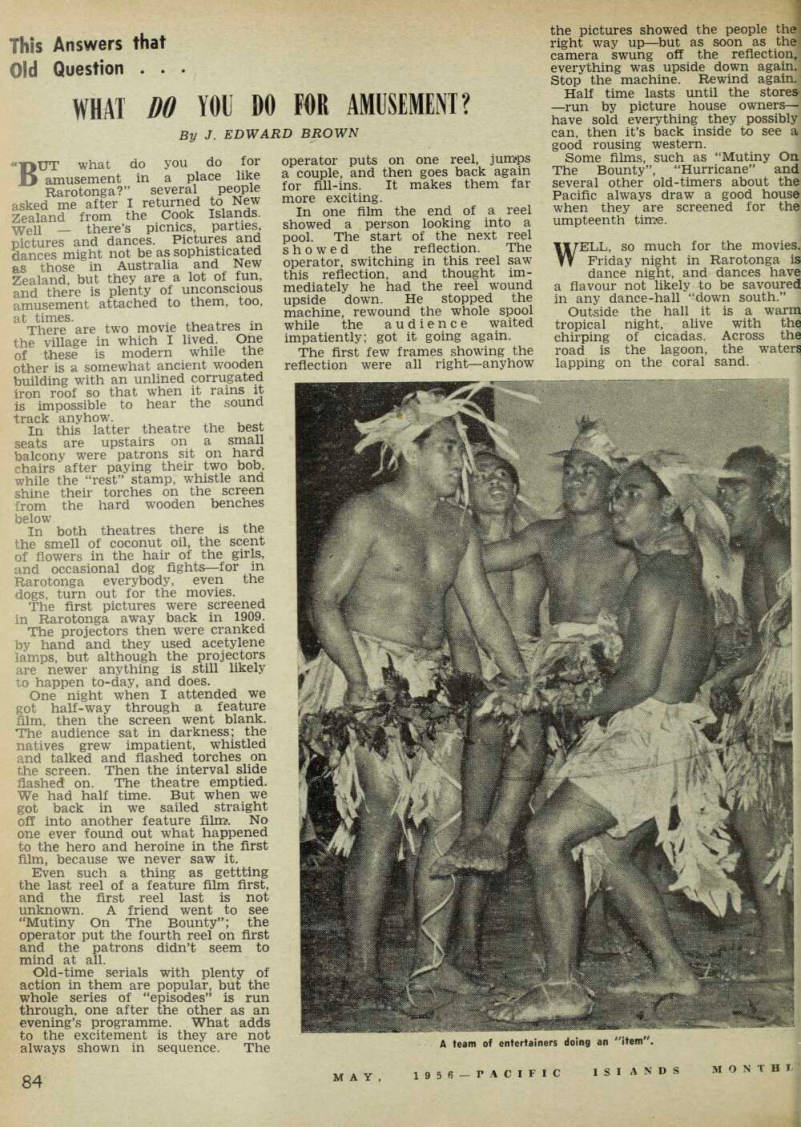
A team of entertainers doing an "item".
There’s a moon hanging in the iky out beyond the reef on which he Pacific rollers are thudding, naking a streak of white on the leaving water. Couples stand under he trees talking.
The sellers of peeled oranges, liced watermelon and fruit-drinks re doing a steady trade in the laring light of their gasoline interns.
Inside the hall it is hot, the air ieavy with the scent of tropical owers woven into eis and worn by oys and girls alike. The girls are
Mr. Brown wrote the article which ppeared in April PIM (“How Radio ■oes to the Rescue of Rafts”) from hich the by-line was inadvertently mitted.
earing their best dresses, shoes, pstick and cheap scent from the ores.
The band is composed of guitars, celeles, a drummer or two, and — le most important instrument—a ittered trumpet, the only one on le island. Vocals are provided by chorus of middle-aged women variably dressed in white.
They play all dance music, all nes more or less the same, to mi-foxtrot tempo, commonly lown as the Rarotonga Hop.
DU can pick out any rhythm you :e from* the mixed-up notes that ey pour out, and the dancers do ecisely that.
Some are doing the foxtrot, me are waltzing. It is, however, st enough to stir the blood and ovide rhythm for the hula, and couple in one corner are jitter gging, an accomplishment no übt learned from a visiting sailor, from the movies.
Rarotongans like to entertain d be entertained. Dances with b “Items” are not popular. ;ems” can consist of displays of ncing, or a play from local ;tory which is acted with great sto. women’s group tried to have a nee every Wednesday night at J . local theatre. But it was a aight dance with no Items, and soon flopped. fhe Friday night dances are lally run by some organisation nting to make money, like the ys’ Brigade, or a committee (resenting a church or village id, and the people concerned ictise for weeks on their Items, "he dance concludes with the id playing “God Save The een”, which sounds just like all i other tunes, except that the icers stand still.
OR sheer entertainment a Tere (travelling) Party is tops.
These are groups of people who vel from one island to another entertain. In the old days they
travelled without restriction to any island they cared to visit; but they are now under Government control.
When a Tere Party descends on an island they have to be fed and housed. A big Tere Party of 50 or more people moving from* village to village can soon clean out all the pigs, chickens, taro and anything else raked up to feed the hungry visitors. After a big Tere Party has visited Rarotonga, there are no eggs or chickens on sale for some time. So now before a Tere Party can visit another island, the Resident Commissioner has to give his permission.
There are also concerts, given by the schools, just as in any other community.
The Catholic Convent held a concert. The church of course is commonly called Roman Catholic.
The Nuns that staff the school are Irish. The Priests of the Catholic Church in the Cooks are Dutch.
The children were Rarotongan, but the songs they sang to entertain the European and Rarotongan audience were predominantly Scottish.
That is the sort of thing that happens in the Cooks.