Territories Talk-Talk
pp. 29-33 · Read in the full issue
By Tolala
ie “Magic
ack Box” [ thought Skipper Brett Hilder’s ormative story about that •dern gadget (Radar) which ■ulcers many an old-time idgator in Pacific waters, most cresting, (PIM March, p. 82).
Decially so as the diagram >wing the Numa Numa anchor i refers to a portion of the again ville coast-line which, if i took notice of the bearings ►wn on many not-so-old charts, aid take you well into the bush definite trap for young inners. n fact, most of the Bougainville st —both east and west—for ny years appeared on charts as :ely dottled lines. Just prior to r I, a German survey ship :ted the Buka passage, but that as far as they got before war ke out; after which very little anything—was ever done to /ey the area in peace-time, he “Casuarina Island” shown Hilder’s chart (if I’m not taken), was previously known Ferguson Island, being the site re a Capt. Ferguson and his v were massacred by the local , who were notoriously tough.
vn Memory Lane
spent a week-end on Numa la plantation back in the early days. My old friend, Arthur th, was then manager, while I engaged opening up Arigua Nation for the CPL—a few s to the south. My wife and 'rived at Numa to be greeted the news that an attack was cted from the bush natives, had objected to certain areas land being planted near the ; boundary of the estate, ord has been sent to the srnment station at Kieta, but autions were necessary. The -y Polly (the company’s small h) lay tied up at the wharf the half-caste skipper alerted an immediate get-away, if ssary. Meanwhile patrols were 3d, rifles issued and we ipeans adjourned to the ;alow for an all-night vigil, pying the time by playing a 3 called “Corner,” popular at time, 3 soon forgot the threatened :k in our efforts to make a ler” in wheat, oats, barely or 1 1 ev e r it was, and our usiastic shoutings for the lines ed became deafening, the midst of the game there 'ed “Masta Grass,” a sedate, e-bearded German overseer by
the name of Heydenreuther, who was armed to the teeth in true German Colonial style: Revolver in holster: knives in belt, leggings and wide-brimmed hat. He had heard our cries, and had feared that we were being massacred.
“Gott im Himmel!” he cried as he entered, “Are you all long-long (mad)?”
Our Australian casualness was not appreciated by the worthy “Masta Grass.”
That is my brightest memory of Numa Numa, one of the few pro perties run by small Sydney com panies, which has survived and proved a success down the years.
The secret has been good, honest (repeat, honest) management.
Guns for . . . What?
There must have been a few raised eyebrows, by older residents of P-NG at least, when they read in the Moresby Post the reported statement by Administrator Cleland that: “New Guinea natives would soon be able to apply for gun licenses.” The statement was made
following some alleged indiscrimin ate shooting by natives along a high way near Port Moresby. This re mark was immediately followed, in the paper, by: “Sir John MacPher son, the Leader of the UNO Mission, told authorities in Rabaul last week that he would not give natives gun licenses.”
Well, well! And where do we go from here? First of all it’s liquor, now it’s arms. How irresponsible can the statements of an Admin istrator become? Is there to be no reference to the Legislative Council of the Territory? Or is it a Min isterial Order to be railroaded, willy nilly, onto the Statute Books? Little wonder, too, after such a statement that there has been trouble on plantations as reported recently in southern papers.
Sir John, from all reports, seems
to have his feet well planted ' the ground, and quite capable taking a realistic view of the coi plexities in P-NG.
This reminds me that in the Ge man days, “Shoot-boys” w e
licenced for pigeon-shooting 1
their employers, but each explod cartridge had to be brought back that all ammunition was accounl for. This edict followed the Paul massacre in the Lainings wb a “shoot-boy” was one of the rir leaders in that said affair. It v subsequently found that he had be accumulating ammunition for own use over a long period. (Our recollection is that legislat: to permit natives to take out sh gun licences was brought before i Legislative Council of P-NG by official member (unofficial memb dissenting), about three years ag licences to be issued at the discret of the Administrator or his nc inees. The argument was that sponsible natives had as much ri; as anyone else to possess a gun hunting game.— Ed. PIM ).
A Plantation
Is Made
After that tragedy at St. Paul back in the very early 1900’s— government worked out a met of punishing the less import
participants.
There were hundreds of Baini connected with the crime and t were put to work terracing the 1 of Old Massawa plantation in 01 to facilitate the planting of cocoe on the steep hills that run d« to the sea.
Present readers of PIM wH journeys take them past this New Guinea Compagnie planta will no doubt notice the tern facing the sea. Long months of h labour by imprisoned Bairn brought this about.
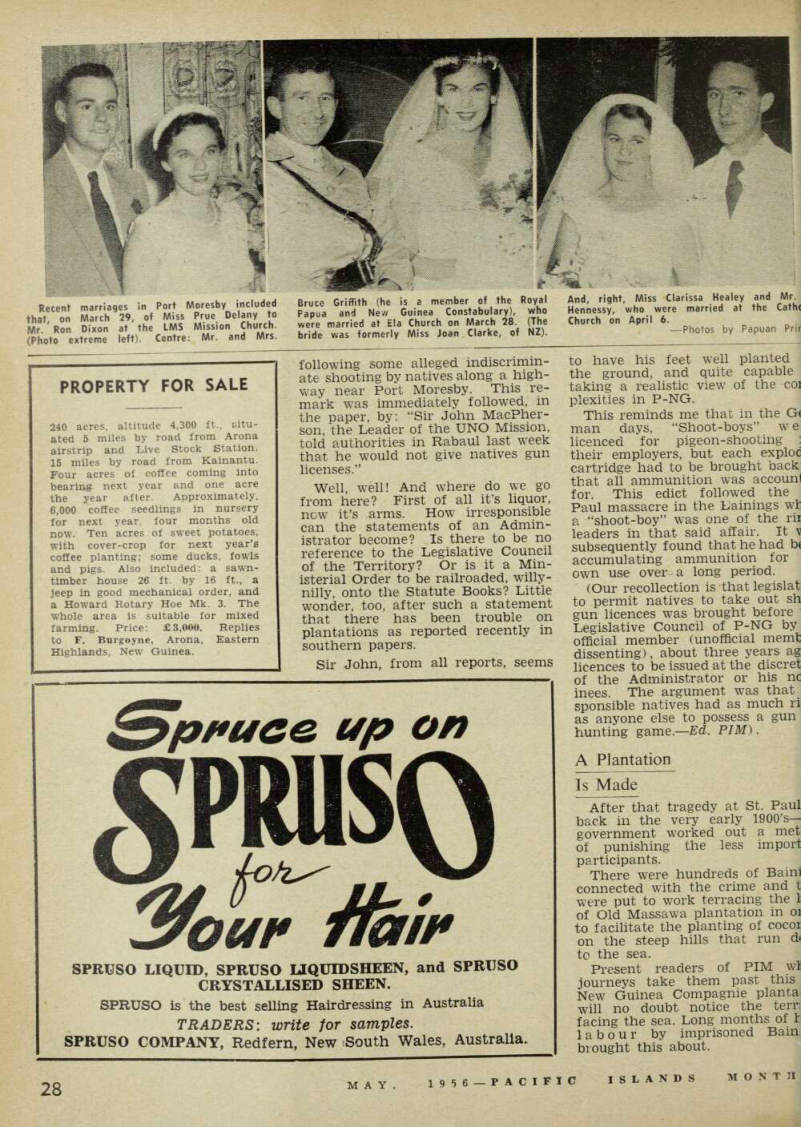
Recent marriages in Port Moresby included that, on March 29, of Miss Prue Delany to Mr. Ron Dixon at the LMS Mission Church. (Photo extreme left). Centre; Mr. and Mrs.
Bruce Griffith (he is a member of the Royal Papua and New Guinea Constabulary), who were married at Ela Church on March 28. (The bride was formerly Miss Joan Clarke, of NZ).
And, right, Miss Clarissa Healey and Mr.
Hennessy, who were married at the Catho Church on April 6. —Photos by Papuan Pri[?]
It taught them a lesson. There as no trouble with them for half century—until a spot of bother a w years ago. r ot! More Brian Maegraith, a professor of >pical research, a famous Rhodes holar, is reported by SMH’s •ranny” to be on his way to NG. ie worthy professor, no doubt, will ike many observations, report and in—what? 5 -NG seems to be a happy hunt ground for researchers, theorists, jerimentalists from all parts of 5 world testing the NG guinea . Research is valuable if it can, i will, be practically applied. But much can lead to confusion, 1 many energetic researchers have ived in the past decade with a re of trumpets as though enter a land hitherto untouched, his is hardly fair to those men » laid the foundations of research hard way, and whose knowledge 1 guidance brought the country he stage of development existing )r to War 11, and all without generous government subsidies University grants and endow its of these later years, espite the 900 entomologists in Pacific area (PIM, April, p. 49), e still appears to be a chronic iache over coconut pests. Is it -use, despite present-day know e, the theories are not practic applied? Forty years ago—and e—the Planters’ Bible was a 11, red-covered brochure written N. W. Froggatt, NSW Govern t Entomologist, who had toured Islands from Papua to the mons, describing the ravages of Dynastid family and the varied ises and how to deal with them, advice was faithfully followed. ; n came War II and the L’y that the government would with everything, is all very well to know what 3, but it is not much use if it done. And that’s what is hap ag too often, in these slap y days.
nee Comes
mans? e query as to the derivation of vord “Didiman” (April PIM, p. in connection with the Rabaul lical Gardens and then, later rnibers of the staff of the Dept, gnculture is—so far as lam rned —v eil e d in a certain nt of mystery. tiave heard that a German d— a surveyor —who laid out anginal gardens, was named lann, which became “Didiman” pronounced by the Tolais, who .verse to two consonants (ex nd,” “mb” or “ng”). (Over)
It was a wonderful area in its hey day, with botanical specimens from almost every tropical clime, would have become a rival of the famed Buitenzorg Gardens laid down by the Dutch in Bavatia had it not been for two wars and a full-scale eruption.
“Didimans,” in the early days, was a favourite venue for beer Pities and one incident, which I recall be ing described, was one staged by the inimitable Steve Whiteman when he, as host, bade his house-boy Go ketchem boxis dice” from his home down Casuarina Avenue, in order that his guests might tarry a while with the goddess of Chance.
After waiting an interminable period, Steve sent a “boy” along to find out the reason for the delay.
The lad returned. “All he come now,” said the courier and in a few minutes Steve and his guests espied from their kiosk on a small hillock in Didimans, a crowd of some ten natives struggling along with a huge ice-chest slung on poles.
“Ah,” said the boss-boy, me think you sing out long boxis ice.
I t’ink ear belong me fast.”
Which is one argument against Pidgin. I should have told that to Dr. Hall for his Hands Off Pidgin- English.
Anyway, check on Herr Land messer Dietmann. Come in Darm stadt, Germany! Calling Capt.
Haug! He should know.
Louis Becke’s Works And the mention of Capt. Haug reminds me of a letter I received from him not so long ago in which
be sent an SOS for some of Lou Becke’s books.
It appears that Carl Haug translating Becke’s works into Ge; man. He has received many copie
e writes, as a result of a previous ppeal in the PIM, but he is still •eking for The First Flett Family, otes From My South Sea Log, and Id Convict Days.
He also wants Beatrice Grim aw’s When the Red Gods Call, and arcus Clark’s For the Term of His atural Life. The Captain has many exchange or will pay any reason )le price. Come on, you book 3rms! His address is Darmstadt 6), Putznerstrasse 6/Apt. 438, ermany.