Third South Pacific Conference
pp. 26-141 · Read in the full issue
Pacific Islanders' Parliament
Meets In Suva
Keynote of the addresses at the official opening of the Third South Pacific Conference at Nasinu, Fiji, (April 23-May 3) was the emphasis placed by the Governor of Fiji, Sir Ronald Garvey, and other speakers, on the value of the Conference in promoting friendship, progress and understanding among the Pacific islanders.
IT was a colourful ceremony from the moment the Governor drove under the decorated archway and inspected a guard of honour of Fiiian troops wearing full ceremonial dress of scarlet jacket and white
Su I U
Inside the Conference Hall were 70 delegates from 18 South Pacific territories members of the South Pacific Commission, and observers from international scientific, University and missionary organisations l4O altogether.
Delegates attended from eighteen South Pacific territories. Tonga, which is outside the sphere of the South Pacific Coffimission, was represented, by special invitation, by Crown Prince Tupouto’-Tungi and Prince Fatafehi Tu’ipelehake.
The Kleig lights of movie and television units made the flagbedecked hall a blaze of colour, Cameras recorded the scene from all angles, and radio units made a direct broadcast of the event.
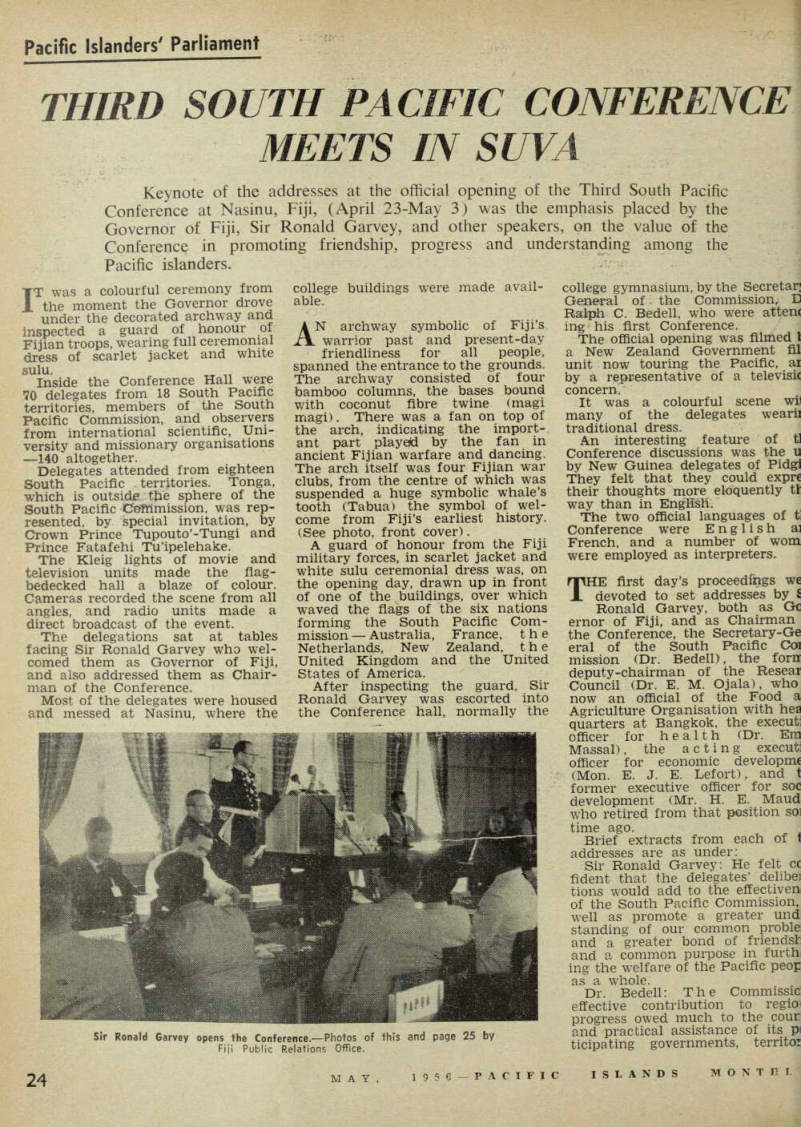
The delegations sat at tables facing Sir Ronald Garvey who welcorned them as Governor of Fiji, and also addressed them as Chairman of the Conference.
Most of the delegates were housed and messed at Nasinu, where the
college buildings were made avail able, AN archway symbolic of Fijis ±\. warrior past and present-day friendliness for all people, spanned the entrance to the grounds.
The archway consisted of four bamboo columns, the bases bound with coconut fibre twine (magi magi). There was a fan on top of the arch, indicating the import ant part played by the fan in ancient Fijian warfare and dancing.
The arch itself was four Fijian war clubs, from the centre of which was suspended a huge symbolic whale s tooth (Tabua) the symbol of wel come from Fiji’s earliest history. (See photo, front cover).
A guard of honour from the Fiji military forces, in scarlet jacket and white sulu ceremonial dress was, on the opening day, drawn up in front of one of the buildings, over which waved the flags of the six nations forming the South Pacific Com mission Australia, France, the Netherlands, New Zealand, the United Kingdom and the United States of America, After inspecting the guard, Sir Ronald Garvey was escorted into the Conference hall, normally the
college gymnasium, by the Secretar: General of the Commission, E Ralph C. Bedell, who were atten< ing his first Conference.
The official opening was filmed I a New Zealand Government fil unit now touring the Pacific, at by a representative of a televisic concern.
It was a colourful scene wil many of the delegates wearii traditional dress.
An interesting feature of tl Conference discussions was the u by New Guinea delegates of Pidgi They felt that they could expre their thoughts more eloquently tl way than in English.
The two official languages of tl Conference were English ai French, and a number of worn were employed as interpreters. rpHE first day’s proceedings we X devoted to set addresses by £ Ronald Garvey, both as Gc ernor of Fiji, and as Chairman the Conference, the Secretary-Ge eral of the South Pacific Coi mission (Dr. Bedell), the fonr deputy-chairman of the Resear Council (Dr. E. M. Ojala), who now an official of the Food a Agriculture Organisation with hea quarters at Bangkok, the executi officer for health (Dr. Em Massal), the acting executi officer for economic developme (Mon. E. J. E. Lefort), and t former executive officer for soc development (Mr. H. E. Maud who retired from that position so] time ago.
Brief extracts from each of I addresses are as under: Sir Ronald Garvey: He felt cc fident that the delegates’ delibei tions would add to the effectiven of the South Pacific Commission, well as promote a greater und standing of our common proble and a greater bond of friendst and a common purpose in furthi ing the welfare of the Pacific peop as a whole.
Dr. Bedell: The Commissic effective contribution to region progress owed much to the cour; and practical assistance of its pi ticipating governments, territoi
Sir Ronald Garvey opens the Conference.—Photos of this and page 25 by Fiji Public Relations Office.
ministrations, interested institu is and its two auxiliary bodies, Research Council and the Con mce. r. Ojala: The value of exports Pacific territories had risen dily since 1953. Increases in e as well as production had con uted to that happy result, but gain in economic welfare was less real on that account, r. Massal; Health education, I and nisption, and mosquito le diseases were the three main ects receiving the attention of Commission’s health experts.
World Health Organisation was peratmg in the health education ramme. ons. Lefort: A review of de mment in the past three years fed a strengthening of the omies of many territories. Ex -3 of cash crops had generally jased, and there was a tendency greater diversification. The oach to all fields of Pacific I vi t y> particularly economics, Id be common programmes for non objectives, as a means of ling the islanders to benefit lly from tangible results.
Maude: There had been re :able extension of governmental ity in the social and welfare :ts of the islands territories, cularly in education. But too h reliance on government nes could do more harm than Community self-help pro mes, whether based on the e, district or island were the hope for progress in the im ate future in all fields.
GENERAL committee of six lembers, one drawn from each t the national territories, con d the procedures for the con of the Conference. The mem
bers of the Committee elected by the Conference were: Australia: Raymund Gadabu, of Nauru.
France: M. Jacgques Drollet, of French Oceania.
The Netherlands: Markus Kasiepo, of Netherlands New Guinea, attend ing his third conference.
New Zealand: Mataio Maka Parua Ariki, ol Cook Islands.
The United Kingdom: R a t u Kamisese Kapaiwai Tuimacilai Mara of Fiji.
The United States of America: Mr. Manuel A. Calvo, of Guam.
Committees Break Down
Formal Atmosphere
nnHE General Committee’s first act A was to arrange reference of the business of the Conference to two standing committees, one to deal with economic matters, the other with social development and health.
This arose from a desire of the delegates at the Second Conference (three years ago) to take a greater part in the conduct of the Confer ence business, it being felt that dis cussions would be more effectively conducted if the agenda subjects were considered by committees be fore being handled in plenary session. p * Uater, Prince Tugi of Tonga was elected chairman of the Social De- SlSP“!Sr nt a T nd Health Committee, v. th Mrs. Lagrimas Untalan, of Guam, deputy chairman Ratu Mara, leader of the Fiji delegation, was J
elected chairman of the economics committee.
This procedure broke down the formal atmosphere Df the full Confer ence.
The smaller numbers of the committee seem t o encourage a more confident approach to the subjects discussed.
Another thing which encouraged easier debate was the use by several of the delegates of their own language, in pre ference to English.
Thus, at the Con ference table and in the committees
the languages
spoken included
Samoan, Indonesian Malay and Pidgin.
Interesting Personalities
Kalsautu, chief of the tribe of Mele, of Efate Island, in the New Hebrides, spoke a dialect which was understood by one other person at the conference: a Frenchman, who spoke only French, which had to be translated into English.
On occasion, the Conference had the experience of hearing Indonesian Ma-|ay being translated into English by a Dutchman, then translated by an Australian into French!
Pacific Islanders are, as a rule, large men. There were many men of mighty girth at the conference, but all were dwarfed by Queen Salote’s two sons—Prince Tugi and Prince Tu’ipelehake.
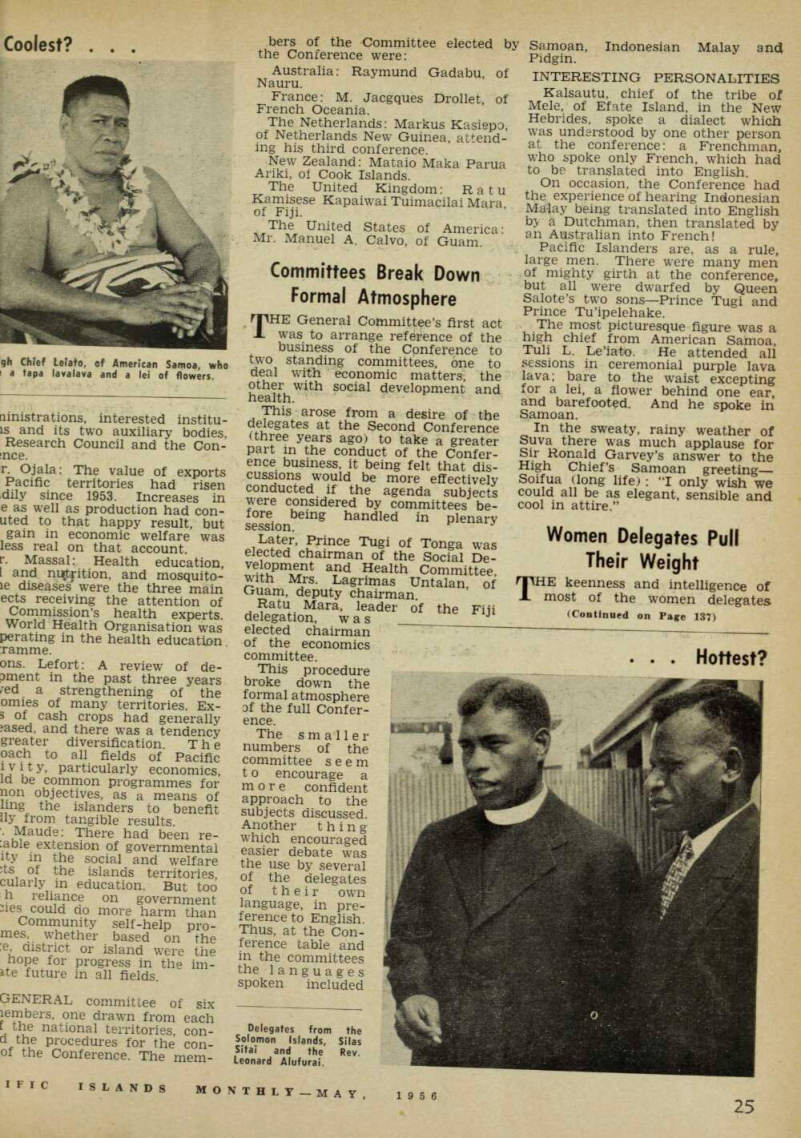
The most picturesque figure was a high chief from American Samoa, Tuli L. Le’iato. He attended all sessions in ceremonial purple lava lava; bare to the waist excepting for a lei, a flower behind one ear, and barefooted. And he spoke in Samoan.
In the sweaty, rainy weather of Suva there was much applause for Sir Ronald Garvey’s answer to the High Chief’s Samoan greeting— Soifua (long life) : “I only wish we could all be as elegant, sensible and cool in attire.”
Women Delegates Pull
Their Weight
r[E keenness and intelligence of most of the women delegates (Continued on Page 137)
the South Pacific Conference, ng at the Teachers’ Training 3ge, near Suva, represent probthe most interesting and enaging feature of the Conference, bpn Prinrp Tuei of Tonga jman of the Socfal and Seafth See, vacated the Chair for : business, the Deputy-Chairman over, and took charge very ’ & e was the Hon. Mrs. Lagnmas j. Untalan, a member of the u Legislature. She was a High ol teacher, and had been suevely a correspondence clerk m Naval Supply Depot, Executive 3tary of American Red Cross, n, and at present she holds itive positions in clubs and astmns dealing with health, ation and youth work. e handled motions and amend- ;s with the calm confidence of who knew what she was doing. she disproved the old belief a woman could not be both Igent and attractive! 10 attractive, as well as keenly ligent, was Madame Jean rt, direct descendant of a y of chieftains, the Wahnyas, of Kedheny, a line of high > of the Loessi District of Lifou, Ity Islands.
She spoke on social and health problems, particularly infant welfare, in a way that showed a keen aware ness of the position. She mentioned the old custom, common in many territories of the mother chewing taro and then placing it In the infant’s mouth, and stressed the P eec t, * or more nutritious food. She kee £ly supported a proposal that workers working outside their place of origin be given a family allow ance.
Then there was Miss Hildegarde Naime, from Papua. Miss Hildegarde was very a i er t. she has a small, p iq Uan t f a ce, full of brightness and intelligence. Her hair was limed, anc j a i moS |; ma tched the canary coloured jumper she wore, Apparently Miss Hildegarde re garded Fiji as a temperate zone, in comparison with New Guinea, She was a nurse and midwife and is at present in charge of a Health Department Clinic at Hanuabada, near Moresby, serving over 2,500 people, and lecturer on child care at the Training Hospital and in Hanuabada schools, The keen interest shown by the women delegates emphasises once again that you cannot raise a race by raising the men alone. If more and more women are educated up to the standard shown by these
women they will make their influ ence felt among their own menfolk, and with the Administrations.
This could be one of the healthiest signs of progress the Commission has shown since its inception.
The primary weakness of the Commission in its inability to im plement decisions was perhaps
stressed by prince Tugi when ’ said that as motions passed by i Conference were not mandat upon Administrations, they sho be made as generally acceptable possible.
Concluding Sessions
Reference of the Conference bi ness to the two standing cc mittees—an innovation—proved success, according to observers.! freer atmosphere in the sma meetings, away from the ov sight by a European chairman, i visers and experts of the cc mission, was quite evident.
In previous conferences ev speech made was a set speech. 4 ' this conference, observers had unique experience of the Island cross-questioning each other, se ing and giving information by ari ment and example.
The Conference passed thir three resolutions on the three m subjects of economic developm< social development and health.
This is considerably less than] number of resolutions at the pre ous two conferences; and the resd tions generally have much m substance to them.
Face to Face!
An interesting item on the ager was a formal meeeting between J Conference and the CommisS (which later held its 15th sess in Fiji).
At previous conferences, the Co mission opened a session after j Conference closed, but received; report in the presence of delegat little more than a courtesy.
This time the item “Discussii between the Conference and I Commission” was a part of ] agenda.
Thus, the representatives of 1 six metropolitan governments tl form the South Pacific Commissi (Australia, France, New Zealand, : Netherlands, the United Kingd and the United States of Amerit came face to face in the Conferei hall with the delegates from the South Pacific territories that thi governments administer.
It was a piquant situation:! cynic could have been pardoned asking who was the master, who j servant.
There were possibilities about I but all passed off quietly.
Levelt, the Senior Commissioner the Netherlands, presided at j opening session of the CommissU then Sir Ronald Garvey, chairmi called the Conference into plem meeting and said, “Let battle begii Battle was brief, and bloodless., few questions were asked. TE were answered by the technic experts of the Commission Sec::
at, but not by the Commissioners nselves. Then both bodies pro led on their separate ways—a te, but not very informative, r or so having been had by ne result that comes from this ference is that from now on the nders themselves will ask for a iter share in the work of con ning the session. bey showed at the Conference Jasinu that they are capable of ig that. The report of the Con nce to the South Pacific Com
mission said, on the question of working procedure: “We are con vinced of the success of this work ing procedure” (that is, reference of the substantial items on the agenda to two committees and the
tkSfsln plenary slslionK have
by the fourth conference.
Suggestions have been made that the fourth conference be held at one three places: Rabaul, in Western Samoa, or in Pago Pago, American Samoa.