[?]lden Pioneered
pp. 59-61 · Read in the full issue
[?]Drrection
[?]lden Pioneered Rabaul Baseball
E enthusiasm of Rabaul sports nen for baseball (PIM, Feb., p. 1) is based on a tradition that back at least 30 years. This has been gently pointed out is by Mr. E. T. Fulton, of irapau Plantation, who also cts Mr. C. H. Meen, who stated Mr. Harry Hugo introduced the to Rabaul. . Fulton sends along two re programmes, several photo is and a great deal of informa to show that the game was luced to the Territory by the Mr. Ray Youlden. suggests that in gratitude to 'act the trustees of the present n Elizabeth Park should call lew baseball pavilion the “Ray ien Memorial Pavilion” in ir of a fine sportsman who ?d unceasingly for the game 1926 until his death in 1941, player, umpire and official of .ssociation. This seems a good :o us.
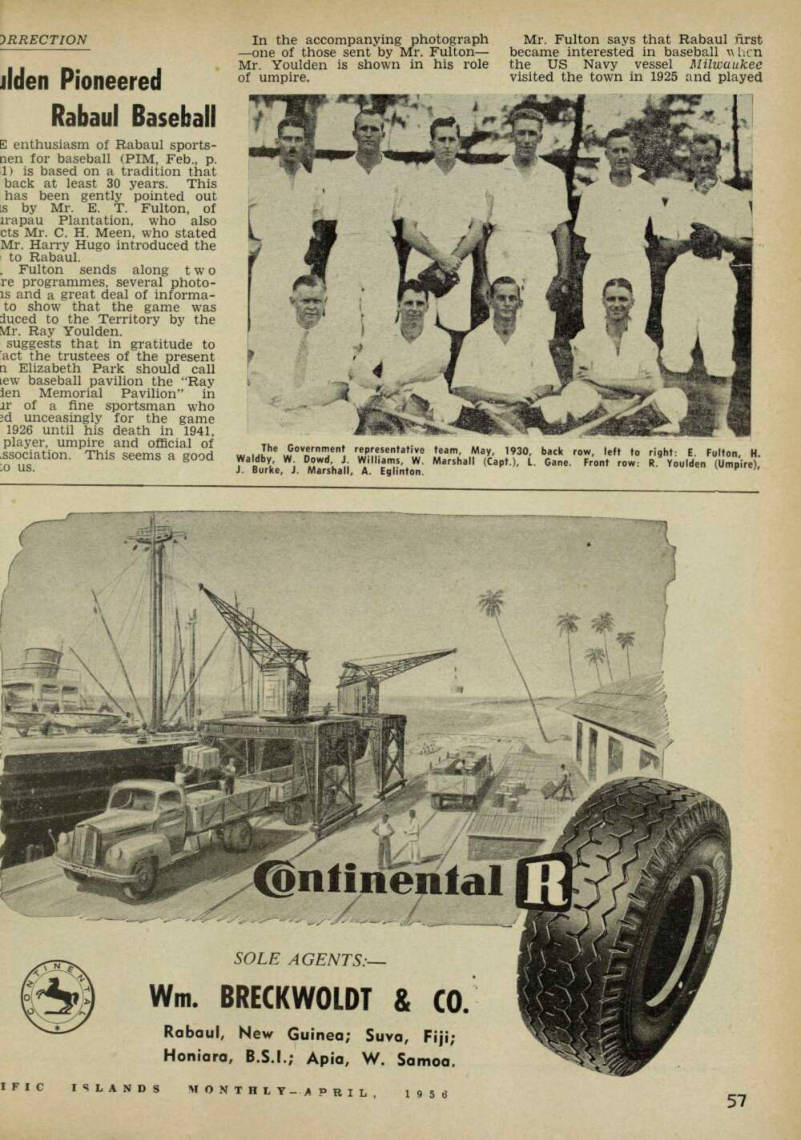
In the accompanying photograph —one of those sent by Mr. Fulton — Mr. Youlden is shown in his role of umpire.
Mr. Fulton says that Rabaul first became interested in baseball v hen the US Navy vessel Milwaukee visited the town in 1925 and played
T he Government Representative team, May, 1930, back row, left to right: E. Fulton, H.
Waldby W. Dowd J. Williams, W. Marshall (Capt.), L. Gane. Front row: R. Youlden (Umpire), J. Burke, J. Marshall, A. Eglinton.
demonstration matches. Youlden (who had played for Caulfield, Melb.) and Fulton (who had played for Waverley, Sydney) arrived in the Territory in 1926 and tried to get local cricketers interested, with varying degrees of success —some were keen but a few die-hards were prejudiced against the Yankee in novation and ‘‘were not very co
operative.”
Ray Youlden did not give up, however, and with several other pioneering spirics soldiered-on and in 1929 finally started the baseball Club and a series of matches.
At first the matches were played on the cricket oval but the same old diehards were not enthusiastic about that either, and in 1930 Youlden organised a separate baseball field.
It is interesting to note that although Rabaul in those days had a much smaller population than it has now, there were then playing in local baseball a far larger number of ex-Australian top-grade players.
In addition to Youlden and Fulton, there were “Doc” Trennery (Uni versity, NSW); Bill Marshall (Peter sham, NSW); Harold Murphie, now a senior member of Burns Philp Head Office, Sydney, and ‘Hammie”
Morton (both of Waverley, NSW).
In addition, the late Jack Bruce had played in Canada; and one of the
greatest sponsors of the game in those days was Mr. Jack Gilmore, also from Canada.
Another interesting point—at that time, over a quarter of a century ago, the Captain of the NSW State baseball side was “Eski” Lambert, better known to present generation Territorians as Mr. C. R. Lambert, Secretary of the Department of Territories.
The theatre programmes wl Mr. Fulton sent along to subs.af ate his claim were interesting : themselves as well as for the snipe of baseball history they contain: One was a programme for Sport of Kings,” staged by I players in May, 1930; the oc "Tons of Money,” played in JI 1932.
Bo h shows were for the Bast
iciation and contain a list of ers, most of whom are quite un vn to present-day Territorians jugh their names bring a pang iosta 1 g i a to B4’s: Dorothy kley, Alan B. McCay, Dorothy ton, James E. Savage, Lancelot lony, Arthur Smith, Kenneth lingham, Dudley Abbott, the Rev.
R. Bishop, Harry Wormald, ;er Dickie Cardew, E. Berkeley 5, Misses Marjorie and Jean nt, E. Slee and A. Eglington. e war did extraordinary things lew Guinea, not the least of h was that it cut history com ly in two. The majority of torians of to-day believe history ;abouts began about 1942—and rents on the other side of the ion, before that fatal January 942, they know little and care ;. This is understandable gh—but galling to old Terri ns.